
Quick answer where to stay
One night near Clark airport, north of Manila, where El Nido flights now leave, three nights in El Nido town or Corong-Corong for the boat tours, then two nights in Coron town on Busuanga.
On this page
- Philippines itinerary 7 days at a glance
- Before you go: eTravel, cash and what to book
- Where to stay in Manila, El Nido and Coron
- Day 1: Arrive in Manila, Intramuros and Binondo
- Day 2: Fly to El Nido and watch the sunset
- Day 3: El Nido Tour A, the lagoons
- Day 4: El Nido Tour C or Nacpan Beach
- Day 5: Ferry to Coron, Mount Tapyas and the hot spring
- Day 6: Coron Island tour, Kayangan Lake and Twin Lagoon
- Day 7: Fly from Busuanga to Manila and depart
- Getting around the Philippines in one week
- Best time to visit the Philippines for this itinerary
- If you only have 5 days in the Philippines
- Another option: Cebu and Bohol
- Adding more days to your Philippines trip itinerary
- The short version
- Frequently asked questions
This Philippines itinerary for 7 days is built around the country’s most famous scenery: a first day in Manila and a night near Clark, north of the city, where the El Nido flights now leave, three nights in El Nido for the lagoons and limestone islands of Bacuit Bay, then a ferry across the sea to Coron for two nights of crater lakes, viewpoints and a hot spring before flying back to Manila. It is a first-timer’s route through northern Palawan, with three bases, two domestic flights and one ferry, and it works best in the dry months from December to May.
Some links below are affiliate links. We may earn a commission if you book through them, at no extra cost to you. We do not rank hotels, and any prices on the map come live from the booking sites.
The Philippines has more than 7,000 islands, and a one-week Philippines travel itinerary cannot cover them all. The trick is to choose one region and spend your time on boats and beaches, not in airports. Palawan is the classic choice for a first trip, and this plan focuses on it. Further down you will find a five-day version, a Cebu and Bohol alternative for travelers who prefer an easier logistics week, and ways to extend your Philippines trip itinerary.
Philippines itinerary 7 days at a glance
| Day | Base | Main stops | Getting around |
|---|---|---|---|
| Day 1 | Manila | Arrive, Intramuros, Binondo, evening transfer to Clark | Grab or airport taxi |
| Day 2 | El Nido | Fly to El Nido, Las Cabanas sunset | Flight of about 1.5 hours |
| Day 3 | El Nido | Island-hopping Tour A: lagoons | Boat tour |
| Day 4 | El Nido | Tour C or Nacpan Beach | Boat tour or tricycle |
| Day 5 | Coron | Ferry to Coron, Mount Tapyas, hot spring | Fast ferry, roughly 4 to 5 hours |
| Day 6 | Coron | Coron Island tour: Kayangan Lake, Twin Lagoon | Boat tour |
| Day 7 | Coron | Fly Busuanga to Manila, connect home | Flight of about 1 hour |
That is one night near Clark, three in El Nido and two in Coron. You can run it in reverse, starting in Coron, if flights line up better that way. The ferry between the two works in both directions.
Where to sleep on this route
Before you go: eTravel, cash and what to book
Entry for US travelers: US citizens can visit the Philippines for tourism without a visa for up to 30 days. You need a passport valid for at least six months beyond your arrival date and a return or onward ticket, which airlines often check at check-in. Rules can change, so confirm on the official Bureau of Immigration or Philippine embassy websites shortly before you travel.
eTravel registration: every arriving passenger must register on the free eTravel system, at etravel.gov.ph, within 72 hours before arrival, and show the QR code if asked. Avoid paid websites that imitate it.
Money: the currency is the Philippine peso. Cards work in Manila malls and many larger hotels, but island tours, tricycles, small restaurants and the environmental fees in Palawan are usually paid in cash. ATMs in El Nido and Coron exist but can run out of money or go offline, especially on weekends and holidays, so bring enough pesos from Manila.
Phone: an eSIM or a local SIM from the airport works well; coverage on the boats and remote beaches is patchy.
Book ahead: the flights to El Nido and from Busuanga (small planes, limited seats), the El Nido to Coron ferry in peak season, and your first island-hopping tour. Some lagoon areas in El Nido limit daily visitor numbers.
Where to stay in Manila, El Nido and Coron

Manila and Clark: flights to El Nido now leave from Clark International Airport, north of Manila, not from NAIA, so for the first night stay near Clark, in the Clark Freeport Zone or neighboring Angeles City. If you need a night in Manila itself, for example before an early flight home, Makati and Bonifacio Global City (BGC) are the safest, most walkable districts, and Pasay is right next to Ninoy Aquino International Airport (NAIA).
El Nido: El Nido town is where the island-hopping boats leave from, and it has the most restaurants and choice of rooms, but it is crowded and noisy in places. Corong-Corong, a short tricycle ride south, faces the sunset and is calmer, with Las Cabanas Beach nearby. Farther north, Nacpan and the area around Lio Beach are quieter and more upscale, but you will spend more time on transfers to the boats.
Coron: stay in Coron town on Busuanga Island. It is not beautiful in itself, but it is where the boat tours start, where the ferry arrives and where the restaurants are. A handful of island resorts sit on their own private islands around Busuanga; they are lovely but far from the main tours.
Day 1: Arrive in Manila, Intramuros and Binondo
Arrival: most flights from the US land at Ninoy Aquino International Airport. Flights to El Nido now leave from Clark International Airport, north of Manila, not from NAIA, so after an afternoon in the old city, transfer to Clark by road this evening; allow two hours or more, depending on traffic, and sleep near the airport. Grab works well from the airport and in the city.

Afternoon: if you land in the morning and have energy, head to Intramuros, the walled city built by the Spanish in the 16th century. Walk along the old walls, visit Fort Santiago, where national hero José Rizal was imprisoned before his execution, and San Agustin Church, the oldest stone church in the country and part of the UNESCO-listed Baroque Churches of the Philippines. Pedicabs and electric carts are an easy way to get around the walled city in the heat.
Evening: cross the Pasig River to Binondo, often described as the oldest Chinatown in the world, founded in the late 16th century. Walk Ongpin Street for dumplings, hopia (flaky pastries) and fried siopao. If you land late at night, simply rest: tomorrow’s flight to El Nido usually leaves in the morning, and you want to be fresh for the islands.
Other quick ideas before you leave Manila: the National Museum complex near Rizal Park, which is free to enter, or a sunset along Manila Bay.
Day 2: Fly to El Nido and watch the sunset
Getting to El Nido: there are two ways in. The fastest is a direct flight from Clark to El Nido’s small Lio Airport, about 1.5 hours, operated by a small airline with limited seats and a strict baggage allowance. Since March 2026 these flights no longer leave from Manila’s NAIA. The cheaper option is to fly to Puerto Princesa, about an hour and twenty minutes, and then take a van north to El Nido, which takes roughly five to six hours on the road. If the direct flight fits your budget, it saves most of a day.
Afternoon: check in and walk El Nido town’s beachfront. The view across the water to the limestone cliffs of Cadlao Island is your first look at Bacuit Bay. All visitors to El Nido pay an environmental fee, the Eco-Tourism Development Fee, which is valid for several days; keep the receipt for your boat tours.
Sunset: take a tricycle to Las Cabanas Beach, south of town, the most popular sunset spot in El Nido. Beach bars line the sand, and the sun drops behind the islands on the horizon. A zipline crosses from the beach to a small island, but simply sitting on the sand with a drink is enough.
Book tomorrow’s tour tonight: agents along the main streets sell the standard island-hopping tours, named A, B, C and D. Prices are regulated and similar everywhere, and your accommodation can arrange it too. Ask about lunch, kayak rental and the pickup time.
Day 3: El Nido Tour A, the lagoons
Tour A is the most famous of El Nido’s island-hopping trips because it includes the Big Lagoon on Miniloc Island. The Small Lagoon is now on Tour D, and joiner boats cannot visit both lagoons on the same day. A traditional outrigger boat, called a bangka, collects groups from the beach in El Nido town in the morning and returns in the late afternoon.
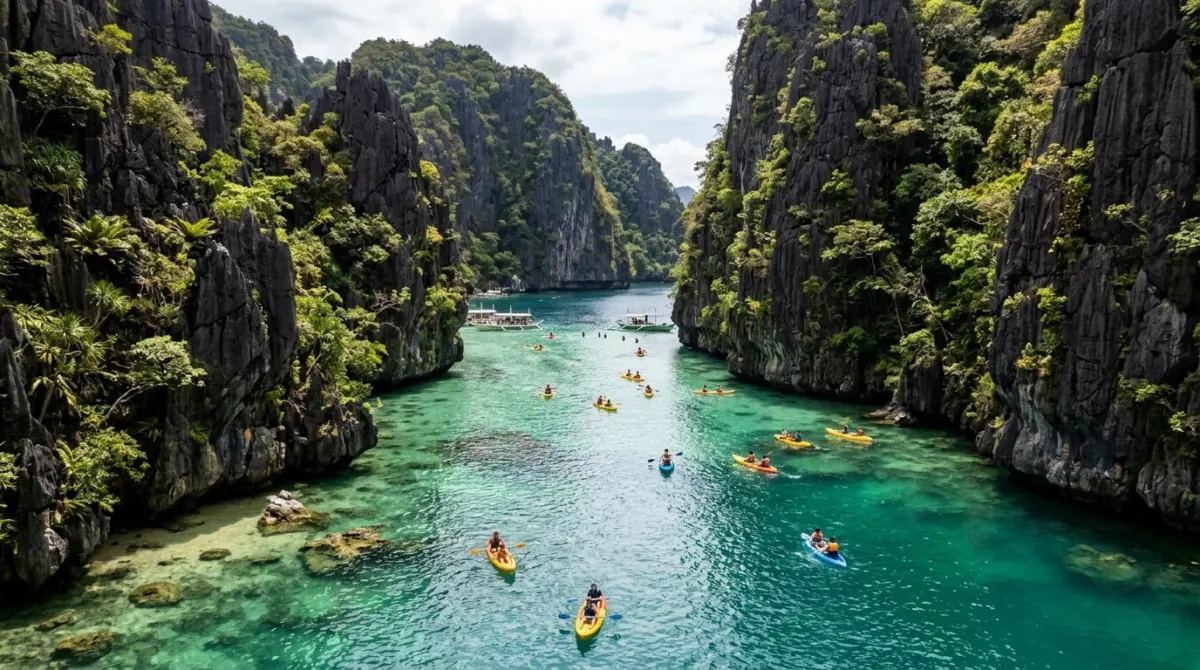
Morning: at the Big Lagoon, you transfer to a kayak and paddle through a narrow gap in the cliffs into a sheltered pool of turquoise water surrounded by sheer black limestone walls. It is calm, shallow in parts and very quiet once you are inside. If you choose Tour D instead, the Small Lagoon is entered through a small opening in the rocks.
Midday: lunch is usually grilled fish, chicken, rice and tropical fruit served on a beach such as Shimizu Island or Secret Lagoon Beach. The crew cooks on board while you explore.
Afternoon: the last stops are often Seven Commandos Beach, a long white-sand beach with palm trees and a small bar, before the boat heads home.
Tips: the Big Lagoon has a daily visitor limit and sometimes a separate kayak fee; tour operators manage the slots, but book early in peak season. Wear sun protection, bring dry bags for phones, and wear water shoes because some landings are on coral rubble. Reef-safe sunscreen is strongly encouraged. Boat trips are canceled by the coast guard in rough weather, which is another reason to keep your El Nido stay at three nights rather than two.
Day 4: El Nido Tour C or Nacpan Beach
Option 1: Tour C. If you loved yesterday, Tour C is the most scenic of the other routes. It usually visits Helicopter Island, named for its shape, the Hidden Beach tucked behind rocks, the Secret Beach reached through a gap in a cliff, and the Matinloc Shrine, an abandoned shrine on Matinloc Island with a viewpoint over the sea. Tour C involves more open water and is sometimes canceled when the waves are high; if so, Tour B, with its caves and the sandbar at Snake Island, is a good substitute.
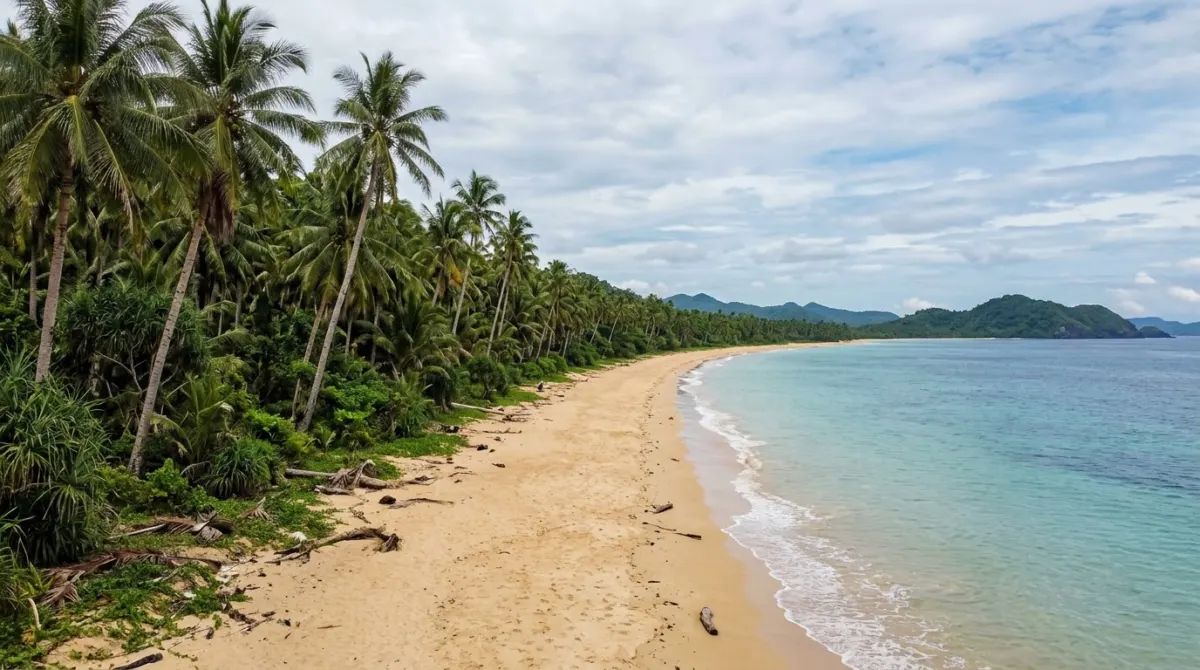
Option 2: Nacpan Beach. For a day on land, ride a tricycle or rent a scooter (if you are experienced) about 45 minutes north to Nacpan Beach, a four-kilometer curve of golden sand facing open sea, with its twin, Calitang, joined by a narrow strip of land. A short climb up the hill at the south end gives the classic view of both beaches. There are a few simple restaurants, hammocks and almost no development.
Evening: back in town, have dinner along the beachfront or in Corong-Corong. Pack tonight: the ferry to Coron leaves early.
Day 5: Ferry to Coron, Mount Tapyas and the hot spring
The ferry: several companies run fast ferries between El Nido and Coron, usually leaving in the morning. Published travel times are around three and a half hours, but many passengers report four to five hours or more when the sea is rough or departures are late, so plan for half a day. Book in advance in peak season, arrive early for the environmental fee and baggage check, and take motion-sickness tablets if you need them. Ferries are suspended in bad weather. A short flight between El Nido and Busuanga, about 40 minutes, is the faster alternative.

Late afternoon: Mount Tapyas. After checking in, climb the concrete staircase of roughly 700 steps to the viewpoint and the large cross at the top of Mount Tapyas, right in Coron town. The view over the town, the harbor and the islands is best around sunset. Go slowly; it is steep and humid.
Evening: Maquinit Hot Spring. A short tricycle ride from town, Maquinit is a rare saltwater hot spring, with stone pools by the mangroves. It is a perfect way to relax tired legs after the ferry and the stairs. It is busiest just after sunset. Have dinner back in town, where seafood restaurants line the main road.
Day 6: Coron Island tour, Kayangan Lake and Twin Lagoon
The classic Coron island tour crosses the channel to Coron Island, a dramatic mass of jagged limestone that is ancestral land of the indigenous Tagbanua people, who manage access to its lakes and beaches. Fees are paid to the community at each site.

Kayangan Lake: after a steep climb of a few hundred steps, a small viewpoint looks back over a cove of limestone islets and turquoise water. It is one of the most photographed views in the Philippines, and lines form for photos at peak times, so go early. Beyond the viewpoint, a boardwalk leads down to the lake itself, with crystal-clear water between limestone walls.
Twin Lagoon: two lagoons separated by a limestone wall. At low tide, you can pass through a small gap in the rocks by kayak; at high tide, a short wooden ladder takes you over the wall. Where fresh water from the island meets the sea, you can see the water shimmer as the layers mix.
Other stops: most tours add a beach such as Atwayan or Banol for lunch, a coral garden and sometimes Barracuda Lake, known for its strange underwater rock formations and a thermocline where the water gets suddenly warmer. Coron is also famous among divers for its Japanese shipwrecks from World War II; diving trips leave from town for certified divers.
Evening: a final sunset drink in Coron town before tomorrow’s flight.
Day 7: Fly from Busuanga to Manila and depart
Morning: Coron’s airport, Francisco B. Reyes Airport on Busuanga, often called simply “Busuanga,” is outside town, so allow up to an hour for the transfer by van and arrive well before your flight. The flight to Manila takes about an hour, and several airlines operate the route. Flights from small island airports are delayed or canceled more often than you might expect, especially in the rainy season.
The connection: leave plenty of time between your domestic arrival and your international departure from Manila. If your two flights use different NAIA terminals, the transfer between them by road can be slow. On separate tickets, a gap of at least four to five hours is sensible. Even better, if your international flight leaves early in the morning, fly to Manila the afternoon before and spend the night near the airport.
If you have spare hours in Manila, the big malls near the airport and in Pasay have food courts, pharmacies and air conditioning, which is often all you want after a week on the islands.
Getting around the Philippines in one week
Domestic flights: the Philippines is an island country, and flying is the way to cover distance. Philippine Airlines and Cebu Pacific connect Manila with Puerto Princesa, Busuanga and many other airports, while a small airline flies to El Nido’s own airport from Clark, not Manila. Domestic schedules change often, so recheck your flights a few days before you go.
Ferries: the El Nido to Coron route uses fast passenger ferries that take three and a half to five hours. In general, ferries in the Philippines are suspended when the coast guard raises weather warnings, which happens most often in the typhoon season.
Vans: shared and private vans connect Puerto Princesa with El Nido. Shared vans are cheap but pack in passengers; a private van is more comfortable for families.
Local transport: tricycles, motorbikes with a sidecar, are the main way to get around El Nido and Coron. Agree on the fare before you set off. In Manila, use Grab; the city is huge, traffic is heavy, and trips that look short on the map can take an hour.
Best time to visit the Philippines for this itinerary
December to February: the cool, dry months, with lower humidity and calm seas in Palawan. This is peak season, especially from Christmas to early January and around Chinese New Year, so book flights and ferries early.
March to May: hot and dry. The water is at its calmest and clearest, ideal for boat tours and the lagoons. Holy Week, the week before Easter, is a major domestic holiday, with flights and rooms booked up.
June to November: the wet season. It is not constant rain, and there are many sunny days, but this is also typhoon season, with the highest risk from about July to October. Boat tours and ferries can be canceled for several days in a row when a storm passes, and domestic flights may be disrupted. If you travel in these months, build a buffer day into your plans, buy flexible tickets and travel insurance, and watch the forecasts.
Palawan’s dry season matches the classic US winter and spring break periods, which makes it a natural choice for American travelers escaping the cold.
If you only have 5 days in the Philippines
Five days is enough for one island base. The best option is to drop Coron and stay longer in El Nido:
- Day 1: arrive in Manila and transfer to Clark for the night.
- Day 2: fly to El Nido, sunset at Las Cabanas.
- Day 3: Tour A, the lagoons.
- Day 4: Tour C or Nacpan Beach.
- Day 5: fly back to Clark and connect home, or transfer to Manila by road.
Alternatively, a five-day Philippines itinerary can focus on Coron alone: fly direct from Manila to Busuanga, spend three nights doing the Coron Island tour, an island-and-beach tour and Mount Tapyas, then fly back. Coron is easier to reach from Manila than El Nido, with more flights and larger planes.
If you only have a long weekend, skip Palawan and stay on Luzon: one day in Manila, then a trip to Taal Volcano and Tagaytay, about two hours south.
Another option: Cebu and Bohol
If you want an easier week with fewer small planes and ferries in open sea, swap Palawan for the Visayas. Cebu has one of the busiest international airports in the country, and some travelers can reach it with a single connection.
Cebu (2 to 3 nights): explore Cebu City’s Spanish-era sights, including Magellan’s Cross and the Basilica del Santo Niño, then head south to the Kawasan Falls area or the relaxed coastal town of Moalboal.
Bohol (3 nights): fast ferries from Cebu City take roughly two hours to Tagbilaran on Bohol. Base yourself on Panglao Island for its beaches, then spend a day inland at the Chocolate Hills, more than a thousand grassy cone-shaped hills, the Loboc River and a tarsier sanctuary to see the tiny primates.
This version has calmer logistics, more flight options and good family appeal, but less of the dramatic limestone scenery of Palawan.
Adding more days to your Philippines trip itinerary
10 days: add Puerto Princesa at the start of the Palawan section to see the Puerto Princesa Subterranean River, a navigable underground river and UNESCO World Heritage Site that requires a permit booked in advance, then travel north to El Nido by road.
Two weeks: combine Palawan with Bohol and Cebu, or add Siargao, the laid-back island known for surfing, palm-forest viewpoints and island-hopping.
One month: a full Philippines itinerary of one month can add the rice terraces of Banaue and Batad in the northern mountains, Siquijor, Dumaguete, Port Barton between Puerto Princesa and El Nido, and Boracay, the most developed beach island in the country.
Whatever you add, follow the same rule as this one-week plan: no more than one island base every two or three nights, and always keep a weather buffer before your international flight home.
Map shows live availability and prices. We may earn a commission on bookings made through it, at no extra cost to you.
For a second country on the same trip, our Bali itinerary and our Malaysia itinerary follow the same one-week format.
The short version
For a first Philippines itinerary of 7 days, focus on northern Palawan. Spend your first day in Manila for Intramuros and the night near Clark, where the El Nido flights now leave, fly to El Nido for three nights of island-hopping, with the Big Lagoon on Tour A and either Tour C or Nacpan Beach, then take the fast ferry to Coron for two nights, with Mount Tapyas, the Maquinit hot spring, Kayangan Lake and Twin Lagoon. Fly from Busuanga back to Manila on Day 7. Register on eTravel within 72 hours of arrival, bring plenty of cash for the islands, travel between December and May for the calmest seas, and keep a buffer day if you go in typhoon season.
Check Philippines availability →
Frequently asked questions
Is 7 days enough for the Philippines?
Seven days is enough for one region, and northern Palawan, with El Nido and Coron, is the best choice for a first trip. Trying to add Cebu, Bohol or Siargao in the same week means more time on planes than on boats.
Do US citizens need a visa for the Philippines?
Not for a tourist stay of up to 30 days, as long as your passport is valid for at least six months and you have an onward or return ticket. Every arriving passenger must also register on the free eTravel system within 72 hours before arrival; check the official sites before you fly, as rules can change.
El Nido or Coron: which is better?
El Nido has the more famous lagoons, more beaches and more restaurants, while Coron has crater lakes, viewpoints, a saltwater hot spring and World War II wrecks for divers. With one week, do both; with five days, pick El Nido for scenery or Coron for easier flights.
When is typhoon season in the Philippines?
The wet season runs from about June to November, and typhoons are most frequent from roughly July to October. Boat tours, ferries and small domestic flights can be canceled during storms, so leave a buffer day before your flight home.
How do you get from El Nido to Coron?
By fast ferry, which is scheduled for about three and a half hours but often takes four to five hours, or by a short flight of about 40 minutes. Ferries are suspended in bad weather, so book flexible tickets in the wet season.
Do I need cash in El Nido and Coron?
Yes. Island tours, environmental fees, tricycles and many small restaurants are cash only, and local ATMs can run out of money or go offline. Bring enough Philippine pesos from Manila for the whole island part of the trip.
Is Manila worth a day on a Philippines itinerary?
One day is enough for a first visit. Intramuros, San Agustin Church and Binondo make a good afternoon, and if your flight home leaves early, a night near NAIA at the end reduces the risk of missing it.
Written and checked by
Triplarks Editorial
An editorial desk, not an invented persona: research, drafting and fact-checking are done by the same small team. Every number here carries the date it was read.