Quick answer where to stay
Split the week evenly: three nights in Kuala Lumpur, in Bukit Bintang or near KL Sentral for the train north, then three nights inside George Town’s heritage zone on Penang, walking distance from the sights and hawker stalls.
On this page
- Malaysia itinerary 7 days at a glance
- Day 1: Arrive in Kuala Lumpur, Petronas Towers and Jalan Alor
- Day 2: Batu Caves, Merdeka Square and Chinatown
- Day 3: Kuala Lumpur itinerary for museums, gardens and Bukit Bintang
- Day 4: ETS train to Penang and the clan jetties of George Town
- Day 5: George Town heritage, street art and Penang food
- Day 6: Kek Lok Si, Penang Hill and Batu Ferringhi
- Day 7: A last morning in George Town and departure
- Where to stay in Kuala Lumpur and Penang
- Getting around Malaysia: trains, Grab and transit cards
- Best time to visit Malaysia and the weather to expect
- Malaysia itinerary 5 days: the shorter version
- If you have more than a week in Malaysia
- The short version
- Frequently asked questions
This Malaysia itinerary for 7 days pairs the country’s two best city stays for a first trip: three nights in Kuala Lumpur, for skyscrapers, Batu Caves and some of the best street food in Asia, then the train north to Penang for three nights in George Town, a UNESCO World Heritage city of shophouses, clan temples and hawker stalls. It suits travelers who love food and city wandering more than beaches, and it works year-round.
Some links below are affiliate links. We may earn a commission if you book through them, at no extra cost to you. We do not rank hotels, and any prices on the map come live from the booking sites.
Malaysia is easy for Americans: English is widely spoken, the trains are modern, and you can enter visa-free. The key to a good Malaysia travel itinerary in one week is to resist adding too many places. Kuala Lumpur and Penang are connected by a fast electric train, so the only long journey is a comfortable one. For a shorter trip, there is a 5-day version below, and suggestions for Melaka, the Cameron Highlands, Langkawi and Borneo if you have more time.
Malaysia itinerary 7 days at a glance
| Day | Base | Main stops | Getting there |
|---|---|---|---|
| Day 1 | Kuala Lumpur | Arrive, Petronas Twin Towers, KLCC Park, Jalan Alor | KLIA Ekspres, about 30 minutes |
| Day 2 | Kuala Lumpur | Batu Caves, Merdeka Square, Chinatown, Central Market | KTM Komuter, LRT, walking |
| Day 3 | Kuala Lumpur | Islamic Arts Museum, National Mosque, gardens, Bukit Bintang | Walking, Grab |
| Day 4 | Penang | ETS train to Butterworth, clan jetties, Armenian Street | ETS, about 3.5 to 4 hours, then ferry |
| Day 5 | Penang | George Town heritage core, street art, hawker dinner | Walking |
| Day 6 | Penang | Kek Lok Si, Penang Hill, Batu Ferringhi | Bus or Grab |
| Day 7 | – | Final breakfast, fly out from Penang or back to KL | About 30 to 45 minutes to the airport |
That gives you one week with six nights, three in each city. If your international flight leaves from Kuala Lumpur, take the train or a short domestic flight back on the last day, or switch the order and start in Penang.
Where to sleep on this route
Day 1: Arrive in Kuala Lumpur, Petronas Towers and Jalan Alor
Flights land at Kuala Lumpur International Airport (KLIA), about 50 kilometers south of the city. The KLIA Ekspres train runs nonstop to KL Sentral, the main transportation hub, in around 30 minutes. From there, take the LRT, the monorail or a Grab car to your hotel.
Before you fly, complete the Malaysia Digital Arrival Card online; it is free and must be done within three days before arrival. Use only the official Immigration Department of Malaysia site, since copycat sites charge unnecessary fees. US passport holders can enter visa-free for tourism.
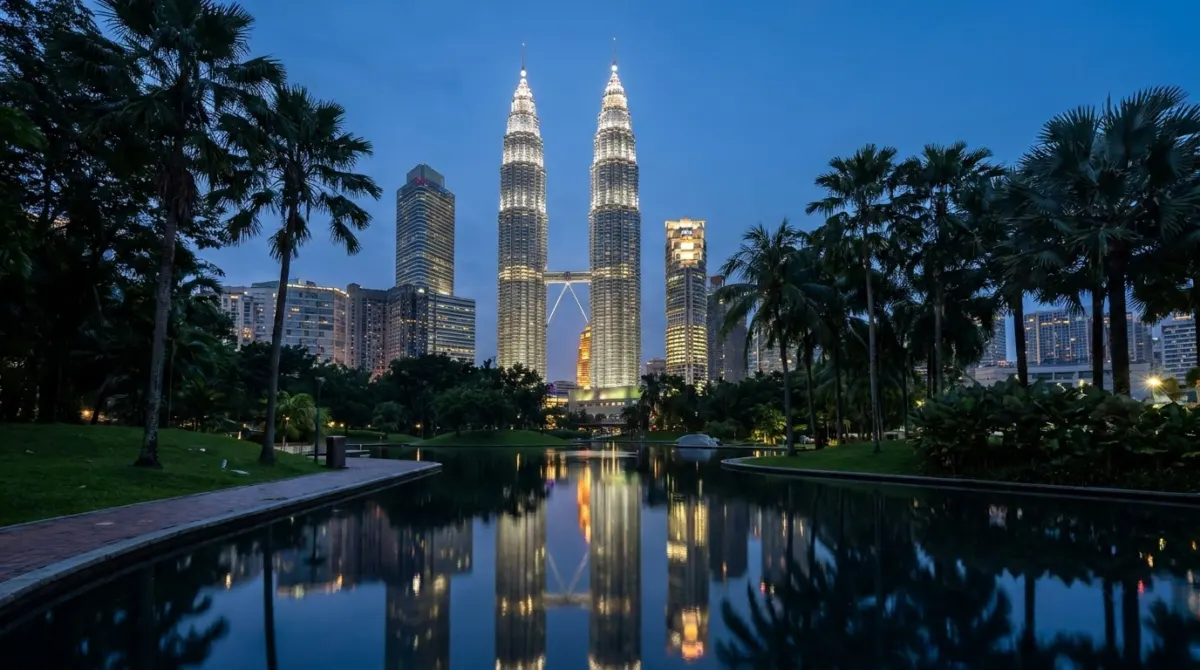
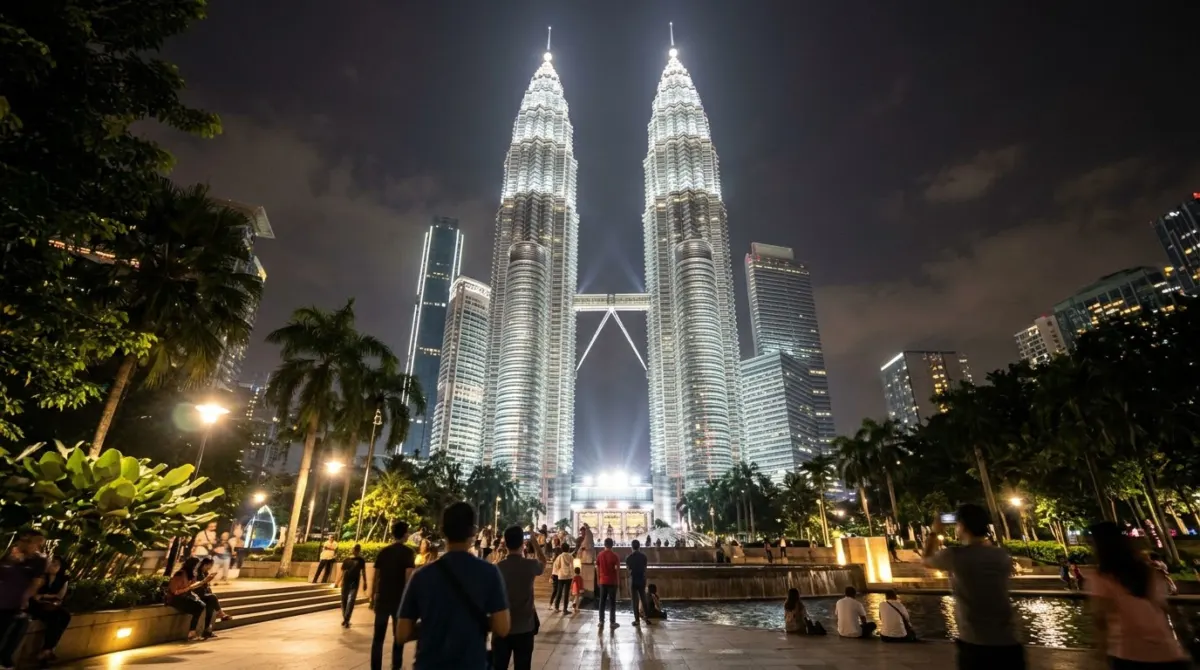
In the late afternoon, head to the Petronas Twin Towers. Walk around KLCC Park at the base of the towers, which has a lake, shaded paths and the best ground-level views of the buildings. Stay for blue hour, when the towers light up. The fountain on the lake usually holds evening light-and-water shows; check the schedule when you arrive. If you want to go up the towers, book a timed ticket for the skybridge and observation deck online in advance.
For dinner, take a Grab or walk about 20 minutes to Jalan Alor in Bukit Bintang, a street of open-air restaurants and food stalls. Try chicken wings, grilled satay, char kway teow noodles and fresh tropical fruit.
Day 2: Batu Caves, Merdeka Square and Chinatown
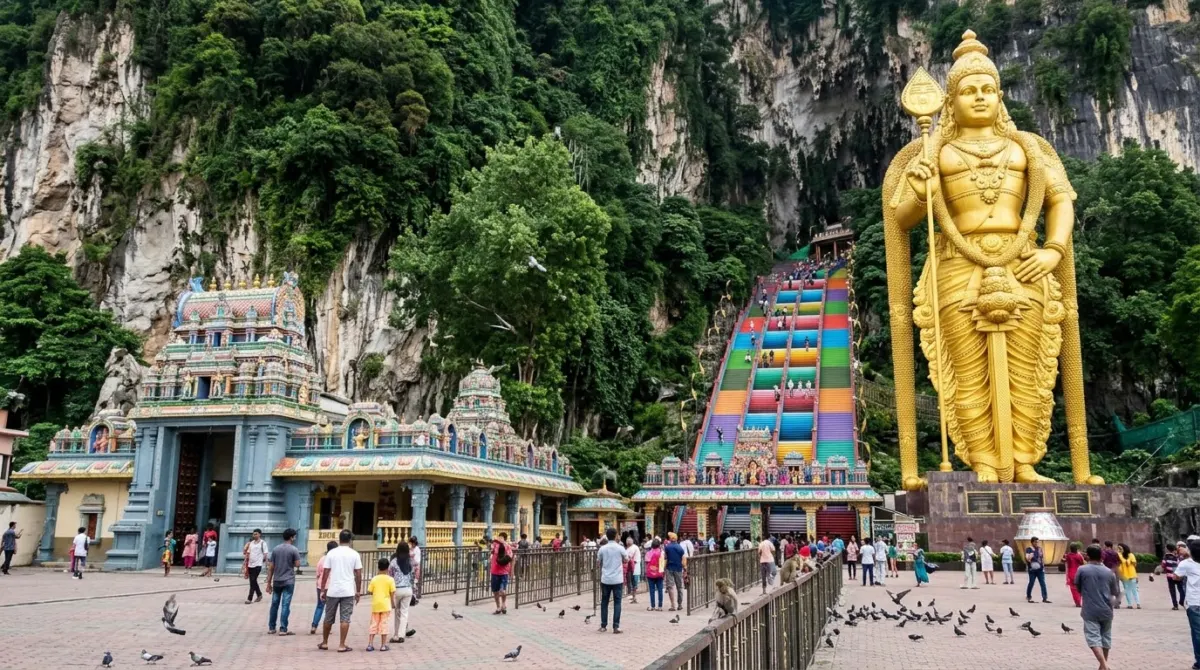
Start early at Batu Caves, a limestone hill on the northern edge of the city with Hindu shrines inside its caverns. The KTM Komuter train from KL Sentral reaches Batu Caves Station in around half an hour. Climb the 272 rainbow-painted steps past the giant golden statue of Lord Murugan to the main Temple Cave. Go early to avoid the heat and the crowds. Cover your shoulders and knees, and keep snacks out of sight from the macaques on the stairs.
Back in the city, go to Merdeka Square, where the British flag was lowered and the flag of independent Malaya was raised for the first time at midnight on August 31, 1957. It is surrounded by colonial buildings, including the Moorish-style Sultan Abdul Samad Building. Nearby, Masjid Jamek is one of the city’s oldest mosques, built where the Klang and Gombak rivers meet; the riverside walkway here, the River of Life, glows blue after dark.
Walk south to Central Market, an Art Deco building full of handicraft shops, and into Chinatown. Browse Petaling Street, see the colorful Sri Mahamariamman Temple and the Chinese Guan Di Temple a few steps apart, and look for the murals of Kwai Chai Hong, a restored back lane. Have dinner in Chinatown or return to your hotel area.
Day 3: Kuala Lumpur itinerary for museums, gardens and Bukit Bintang
Day three is a slower day around the green heart of Kuala Lumpur. Begin at the Islamic Arts Museum Malaysia, one of the finest collections of its kind in the world, with manuscripts, textiles, ceramics and architectural models under beautiful domed ceilings. Allow two hours.
Walk a few minutes to the National Mosque (Masjid Negara), a modernist building with a roof shaped like a folded umbrella. Visitors are welcome outside prayer times, and robes are lent at the entrance. Then walk into the Perdana Botanical Garden, a large park of lakes and shaded lawns that is good for a stroll before the afternoon heat. The old Kuala Lumpur Railway Station, with its Moorish arches and minarets, is close by.
In the afternoon, escape the heat in the malls of Bukit Bintang or visit the KL Tower, a telecommunications tower on a forested hill with an observation deck that has views across to the Petronas Towers. In the evening, try a rooftop bar for skyline views or go back to the hawker stalls for dinner.
Alternative: if you prefer history, swap this day for a day trip to Melaka, about two hours south by bus, a UNESCO-listed port town with Portuguese, Dutch and British history and a strong Peranakan food culture.
Day 4: ETS train to Penang and the clan jetties of George Town
Take a morning ETS electric train from KL Sentral to Butterworth, the mainland station for Penang. The fastest Express services take about three and a half hours, and other services about four hours. Book tickets through KTMB’s official website or app a few days ahead, as trains sell out on weekends and holidays. From Butterworth, cross to George Town on Penang Island by ferry, a short ride across the strait, or by Grab car over the Penang Bridge.
If you prefer to fly, flights from KL to Penang take about an hour, and Penang International Airport is roughly 30 to 45 minutes from George Town by car.
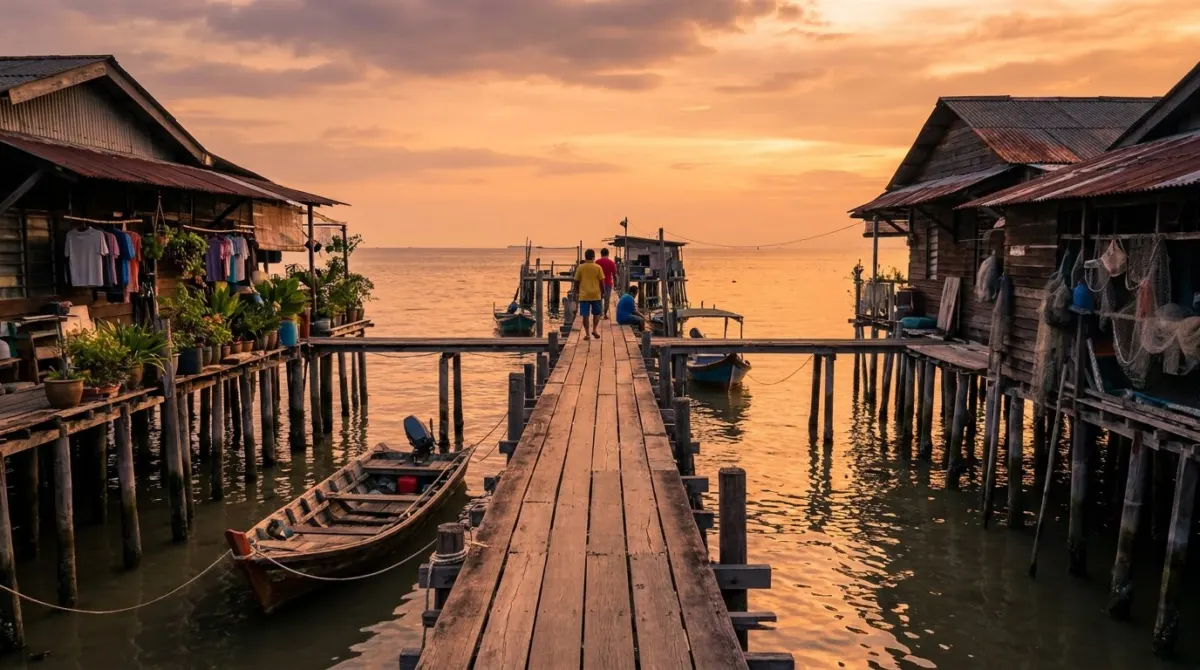
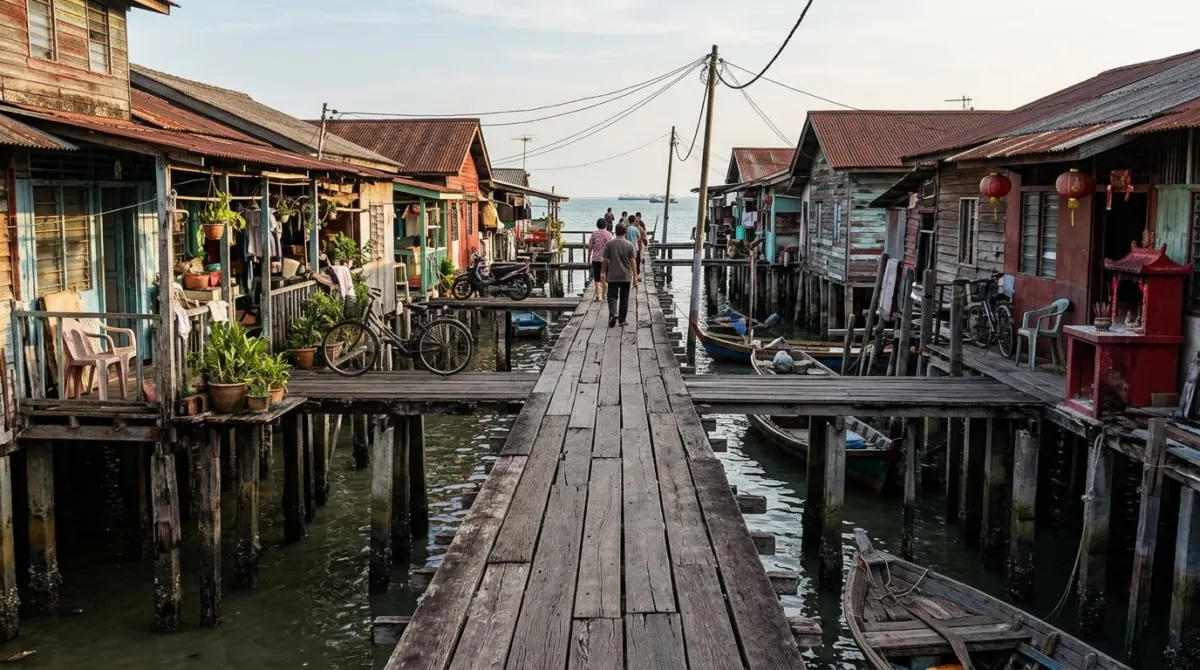
After checking in, start exploring the waterfront. The clan jetties are a row of wooden stilt villages built over the sea by Chinese clans in the 19th century, and some families still live there. Chew Jetty is the largest and is lined with small stalls; walk to the end of the boardwalk for the sunset. Then wander up Armenian Street, one of the best-preserved streets in the heritage zone, and finish with dinner at a hawker center.
Day 5: George Town heritage, street art and Penang food
Spend the whole day on foot in George Town’s historic core, which was listed by UNESCO together with Melaka in 2008. Start at Khoo Kongsi, the grandest of the Chinese clan houses, with an ornately carved and gilded temple hall. Nearby, the Pinang Peranakan Mansion shows how wealthy Straits Chinese families lived in the 19th century.
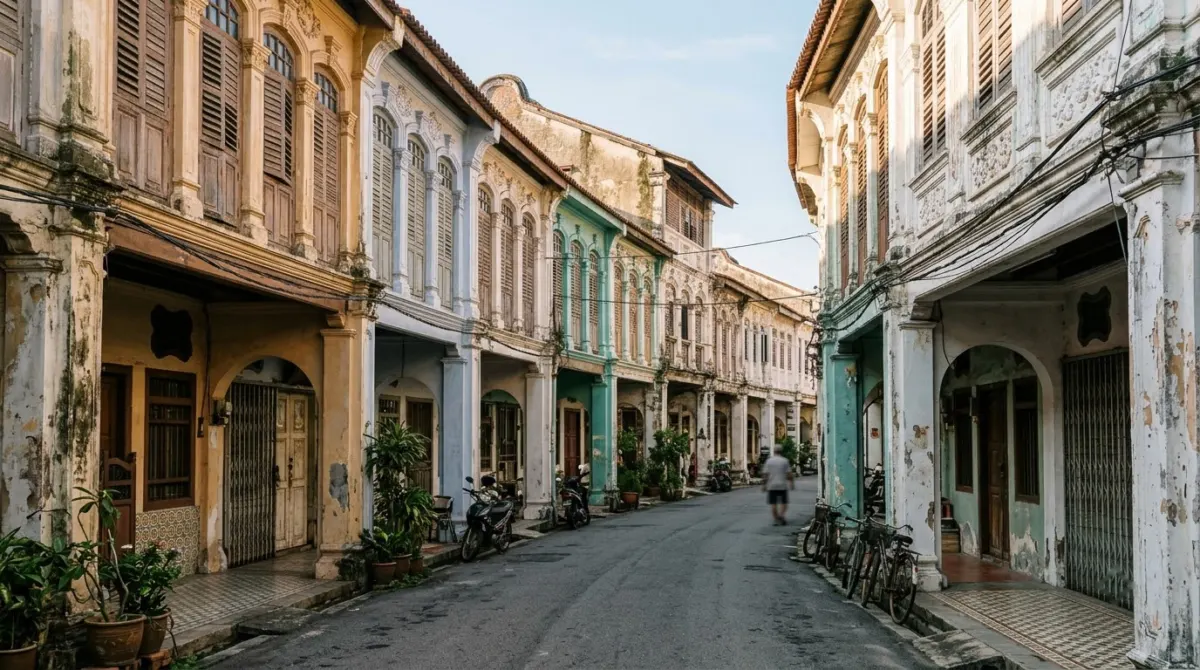
Follow the street art trail through the lanes around Armenian Street and Lebuh Cannon. The murals painted by Lithuanian artist Ernest Zacharevic in 2012, such as the children on a bicycle, made the town famous, and wrought-iron caricatures around the heritage zone tell stories about the streets where they hang. Walk on to Little India, along Lebuh Pasar and Lebuh Queen, for spice shops, music and banana leaf rice.
In the afternoon, take a guided tour of the Cheong Fatt Tze Mansion, the “Blue Mansion,” a restored Chinese courtyard house painted indigo; visits are by guided tour at set times. Then walk to the seafront for Fort Cornwallis and the Esplanade.
Penang is Malaysia’s food capital, so make dinner the main event. Try assam laksa, char kway teow, nasi kandar and cendol at a hawker center such as Gurney Drive or at the stalls around Chulia Street and Lebuh Kimberley.
Day 6: Kek Lok Si, Penang Hill and Batu Ferringhi
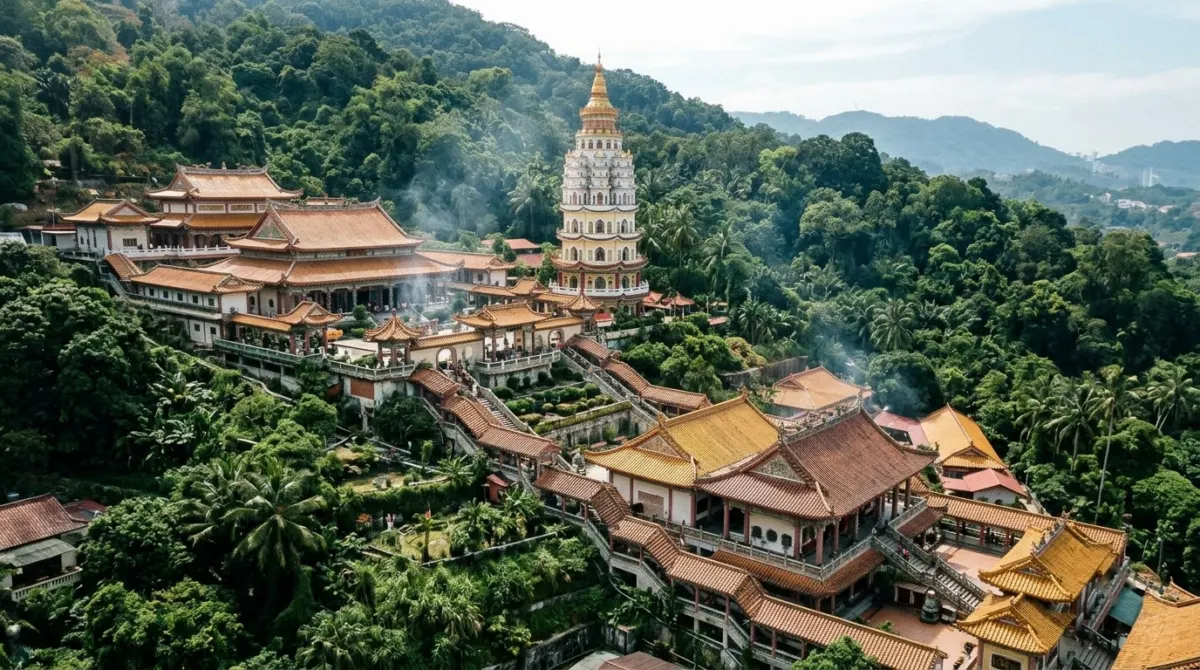
Today you leave the old town for the hills, which are about 30 minutes away by bus or Grab in the Air Itam district. Start at Kek Lok Si, one of the largest Buddhist temple complexes in Southeast Asia. Climb the seven-story pagoda, which combines Chinese, Thai and Burmese architectural styles, and take the short inclined lift up to the giant bronze statue of Kuan Yin.
Next, go to the lower station of Penang Hill, a few minutes away, and ride the funicular railway to the summit, roughly 800 meters above sea level. It is noticeably cooler at the top, with views over George Town, the Penang Bridge and the mainland. Walk the paths, visit The Habitat nature park if you want a canopy walk, and have lunch at the top. Lines for the funicular can be long on weekends and holidays, so go on a weekday morning if you can.
In the late afternoon, head to Batu Ferringhi on the island’s north coast, about 40 minutes from George Town. Watch the sunset over the beach and browse the night market along the main road, which sells clothes and souvenirs, then have seafood for dinner before returning to town.
Day 7: A last morning in George Town and departure
Enjoy a slow morning before you leave. Have a traditional breakfast of roti canai and teh tarik, pulled milk tea, at a coffee shop, or of dim sum at one of the old Chinese teahouses. Visit any sights you missed, buy nutmeg products or local biscuits from a shop in the heritage zone, and take a final walk along the shophouse streets.
Penang International Airport has direct flights to several regional hubs, including Singapore and Kuala Lumpur, where you can connect to flights to the US. If your flight home leaves from Kuala Lumpur, fly to KLIA on a domestic flight, about an hour, or take a morning ETS train back to KL Sentral and the KLIA Ekspres to the airport. Leave plenty of time if connecting on the same day; arriving in Kuala Lumpur the evening before a long-haul flight is the safer option.
Keep a little cash in ringgit for the airport, though cards and e-wallets are widely accepted.
Where to stay in Kuala Lumpur and Penang
Kuala Lumpur (three nights): Bukit Bintang is the most popular base for a first trip, with shopping malls, Jalan Alor and the monorail on your doorstep. KLCC is quieter and more upscale, close to the Petronas Towers and the park, and many rooms have skyline views. Staying near KL Sentral or in Brickfields makes the airport train and the ETS to Penang very easy. Chinatown is better for budget travelers and is within walking distance of the old city center.
Penang (three nights): stay inside the UNESCO heritage zone of George Town. Many restored shophouses and colonial buildings have been turned into boutique lodgings, and you can walk to the main sights and hawker stalls. Gurney Drive, a short ride west, has large modern hotels and a seafront promenade. Batu Ferringhi is the choice for beach resorts, but it is about 40 minutes from the old town, so it suits those who want to relax rather than explore.
Getting around Malaysia: trains, Grab and transit cards
Kuala Lumpur: the city has an extensive network of LRT, MRT and monorail lines, plus the KTM Komuter suburban trains. A Touch ‘n Go card works on all of them, and many lines also accept contactless bank cards. Distances look short on the map, but pedestrian crossings and the heat can make walking slow; use Grab for short hops.
KL to Penang: the ETS trains run several times a day between KL Sentral and Butterworth. Express trains are the fastest, at around three and a half hours, while other services take about four hours with more stops. Tickets can be bought on KTMB’s website and app. Flights take about an hour and are useful if you are connecting to an international flight.
Penang: George Town’s heritage zone is best on foot. Rapid Penang buses connect the town with Kek Lok Si, Penang Hill, Batu Ferringhi and the airport, and Grab is inexpensive for longer trips.
Entry: US citizens can visit visa-free. Fill in the Malaysia Digital Arrival Card within three days before arrival, and check the official Immigration Department of Malaysia site for any changes before you travel.
Best time to visit Malaysia and the weather to expect
Kuala Lumpur and Penang are hot and humid all year, with daytime temperatures usually around the high 80s to low 90s Fahrenheit and short, heavy afternoon or evening thunderstorms. There is no bad month to visit the west coast, but the weather pattern helps you plan.
Relatively drier months: on the west coast, December to February and June to August tend to be a little drier and sunnier, which is good for Penang Hill and the beaches of Batu Ferringhi.
Wetter periods: the transitions between monsoons, around April and May and around October and November, often bring more frequent storms on the west coast. Rain rarely lasts all day, so plan outdoor sights for the morning and keep museums and malls for the afternoon.
Festivals: Chinese New Year, usually in January or February, is spectacular in Penang, though many hawker stalls close for a few days. During Ramadan, Muslim restaurants close during the day but night markets serve food in the evenings, and Hari Raya, the festival at the end of the month, is a busy travel period. Thaipusam, usually in January or February, draws huge crowds to Batu Caves.
Malaysia’s east coast islands have a different season, with a monsoon from about November to February, but they are not on this itinerary.
Malaysia itinerary 5 days: the shorter version
If you only have 5 days in Malaysia, keep both cities and cut one day from each:
- Day 1: arrive in Kuala Lumpur, the Petronas Towers, KLCC Park and Jalan Alor.
- Day 2: Batu Caves in the morning, then Merdeka Square, Masjid Jamek and Chinatown.
- Day 3: ETS train to Butterworth and the ferry to George Town, then the clan jetties and Armenian Street.
- Day 4: the George Town heritage zone and street art in the morning, Kek Lok Si and Penang Hill in the afternoon.
- Day 5: breakfast in George Town and fly out from Penang or back to Kuala Lumpur.
This drops the museums and gardens day in Kuala Lumpur and Batu Ferringhi in Penang. For 5 days and 4 nights, two nights in each city is the right split. If you would rather avoid the travel day, you could also spend all five days in and around Kuala Lumpur, with day trips to Melaka and Batu Caves.
If you have more than a week in Malaysia
With extra time, these are the best additions to a one-week Malaysia trip itinerary:
- Melaka (1 to 2 nights): the historic port city south of Kuala Lumpur, with Dutch-era red buildings, Jonker Street’s weekend night market and Nyonya cuisine. Overnight to see it after the day-trippers leave.
- Ipoh (1 night): a town on the ETS line between Kuala Lumpur and Penang, known for its cave temples, colonial old town and white coffee. It makes an easy stop on the way north.
- Cameron Highlands (2 nights): cool hill country with tea plantations and forest trails, reached by road from Kuala Lumpur or Ipoh.
- Langkawi (2 to 3 nights): an island of beaches and rainforest north of Penang, reached by a short flight or a ferry, for a relaxing finish.
- Malaysian Borneo (3 or more nights): fly to Kota Kinabalu in Sabah or Kuching in Sarawak for wildlife, rainforest and mountain scenery. Sabah and Sarawak run their own immigration checks, so keep your passport handy on domestic flights.
Map shows live availability and prices. We may earn a commission on bookings made through it, at no extra cost to you.
Kuala Lumpur is one of the region’s main flight hubs, so this week pairs well with our Thailand itinerary or our Bali itinerary.
The short version
For a 7-day Malaysia itinerary, split the week evenly between Kuala Lumpur and Penang. In Kuala Lumpur, see the Petronas Towers and KLCC Park on arrival, climb Batu Caves early on day two before Merdeka Square and Chinatown, and spend day three at the Islamic Arts Museum, the National Mosque and the gardens. Then take the ETS train north, about three and a half to four hours, and cross to George Town for three nights: the clan jetties and Armenian Street, the heritage core and street art, then Kek Lok Si, Penang Hill and Batu Ferringhi. Eat at hawker stalls every night, use Grab and a transit card to get around, and fill in the Malaysia Digital Arrival Card in the three days before you fly.
Frequently asked questions
Is 7 days enough for Malaysia?
Seven days is enough for Kuala Lumpur and Penang, the two places most first-time visitors want to see, at a comfortable pace. It is not enough to add Borneo, Langkawi or the east coast islands as well, since each needs a flight and at least two or three days.
Do US citizens need a visa for Malaysia?
No. US passport holders can visit Malaysia visa-free for tourism, for up to 90 days. You do need to complete the free Malaysia Digital Arrival Card online within three days before you arrive; use only the official Immigration Department site, as look-alike sites charge fees.
Should I take the train or fly from Kuala Lumpur to Penang?
Both work. The ETS electric train from KL Sentral to Butterworth takes roughly three and a half to four hours, and you cross to Penang Island by ferry or road. The flight is about an hour, but with airport time the total is similar. The train is more scenic and leaves from the city center.
Is Malaysia expensive for American travelers?
Malaysia is generally good value compared with the US. Hawker food and local transportation are inexpensive, and mid-range rooms in Kuala Lumpur cost less than in most major Asian capitals. Alcohol is relatively expensive because of high taxes.
What is the best time to visit Kuala Lumpur and Penang?
Both are hot and humid all year, with frequent afternoon showers. The west coast tends to be a little drier from around December to February and June to August. Rain rarely lasts all day, so plan outdoor sightseeing for the morning.
What should I wear in Malaysia?
Light, breathable clothes for the heat, plus a layer for chilly air-conditioned malls and trains. Cover your shoulders and knees at mosques and temples; mosques usually lend robes and headscarves to visitors.
Can I use Grab in Malaysia?
Yes. Grab is the main ride-hailing app in Malaysia and works well in both Kuala Lumpur and Penang, with fares shown upfront. It is also a convenient option for airport transfers.
Written and checked by
Triplarks Editorial
An editorial desk, not an invented persona: research, drafting and fact-checking are done by the same small team. Every number here carries the date it was read.