
Quick answer where to stay
Two nights in Hanoi’s Old Quarter or French Quarter, one night on a Ha Long Bay cruise, then three nights in Hoi An, near the Ancient Town or out by An Bang Beach.
On this page
- Vietnam itinerary 7 days at a glance
- Before you go: e-visa, money and what to book
- Where to stay in Hanoi, Ha Long Bay and Hoi An
- Day 1: Hanoi’s Old Quarter and Hoan Kiem Lake
- Day 2: Ninh Binh day trip from Hanoi
- Day 3: Ha Long Bay overnight cruise
- Day 4: Sunrise on the bay and fly to Da Nang
- Day 5: Hoi An Ancient Town
- Day 6: My Son Sanctuary, Marble Mountains or the beach
- Day 7: Tra Que village and departure
- Getting around Vietnam in one week
- Best time to visit Vietnam for this itinerary
- If you only have 5 days in Vietnam
- Adding more days to your Vietnam trip itinerary
- The short version
- Frequently asked questions
This Vietnam itinerary for 7 days covers the north and the center in one week without living out of a suitcase: two nights in Hanoi with a day trip to the limestone landscapes of Ninh Binh, one night on a cruise boat in Ha Long Bay, then three nights in Hoi An, the lantern-lit old trading port near Da Nang. It is designed for first-time visitors, uses one short domestic flight, and works best from February to April, when both regions usually have their most reliable weather.
Some links below are affiliate links. We may earn a commission if you book through them, at no extra cost to you. We do not rank hotels, and any prices on the map come live from the booking sites.
Vietnam is long and thin, more than 1,600 kilometers from north to south, and the most common mistake on a one-week Vietnam travel itinerary is trying to see the whole country. Hanoi to Ho Chi Minh City is a two-hour flight, and every extra base costs half a day. This route sticks to the two regions that pair most naturally, and further down you will find a five-day version, the southern alternative and ideas for a longer Vietnam trip itinerary.
Vietnam itinerary 7 days at a glance
| Day | Base | Main stops | Getting around |
|---|---|---|---|
| Day 1 | Hanoi | Old Quarter, Hoan Kiem Lake, street food | Walk, Grab |
| Day 2 | Hanoi | Ninh Binh day trip: Trang An, Hang Mua | Road, about 2 hours each way |
| Day 3 | Ha Long Bay (boat) | Overnight cruise, kayaking, caves | Expressway, about 2.5 hours |
| Day 4 | Hoi An | Sunrise on the bay, fly Hanoi to Da Nang | Road to Hanoi airport, flight about 1 hour 20 minutes |
| Day 5 | Hoi An | Ancient Town, Japanese Covered Bridge, lanterns | Walk, bicycle |
| Day 6 | Hoi An | My Son Sanctuary or Marble Mountains, beach | Car or tour, about 1 hour |
| Day 7 | Hoi An | Tra Que village, fly out of Da Nang | About 45 minutes to the airport |
In practice that means three bases in one week: Hanoi, a boat and Hoi An. If you would rather avoid the boat night, the version further down replaces the cruise with a second day trip from Hanoi and keeps you to just two hotels.
Where to sleep on this route
Before you go: e-visa, money and what to book
Entry for US travelers: US citizens need a visa for Vietnam, and the easiest way is the electronic visa (e-visa), which allows stays of up to 90 days with single or multiple entry. Apply only on the official government portal, evisa.gov.vn; many lookalike sites charge extra for the same service. Processing usually takes a few working days, but delays happen, so apply at least a week or two before you travel and print the approval. Your passport needs to remain valid well beyond your stay; six months is the safe rule.
Money: the currency is the Vietnamese dong. Cash is still king at street food stalls, markets, small cafés and for tips. Cards are accepted in hotels, larger restaurants and malls. ATMs are easy to find in Hanoi, Da Nang and Hoi An; withdraw at bank-branded machines and keep small notes for everyday spending.
Phone and apps: buy an eSIM before you fly or a local SIM at the airport. Grab is the main ride-hailing app in all three areas, for cars and motorbike taxis, and is also useful for food delivery.
Book ahead: your Ha Long Bay cruise (quality varies widely, so read recent reviews), the Hanoi to Da Nang flight, and Hoi An rooms if your dates fall on a full-moon weekend or around Tet, the Lunar New Year.
Where to stay in Hanoi, Ha Long Bay and Hoi An

Hanoi: the Old Quarter is the classic base for a first visit. Its narrow streets, each traditionally named after the goods once sold there, are packed with cafés, food stalls and small hotels, and Hoan Kiem Lake is a few minutes’ walk away. It is noisy, with motorbikes from early morning, so ask for a room away from the street. The French Quarter, just south of the lake, is calmer, with wider tree-lined avenues and larger hotels. The Tay Ho area around West Lake is quieter again, popular with expats, but farther from the sights.
Ha Long Bay: on this itinerary, your night is on the boat. Cruises include the transfer from Hanoi, meals, kayaking and a cave visit. Many operators now sail in neighboring Lan Ha Bay or Bai Tu Long Bay, which share the same scenery with fewer boats.
Hoi An: stay either near the Ancient Town, so you can walk back after the lanterns light up, or out by the rice fields and beaches. The area just across the river and around Cam Chau is quiet and still close to the center by bicycle. An Bang and Cua Dai beaches, about ten to fifteen minutes away, suit travelers who want the sea in the mornings and the old town in the evenings.
Day 1: Hanoi’s Old Quarter and Hoan Kiem Lake
Arrival: Noi Bai International Airport is around 45 minutes to an hour from the Old Quarter by car, depending on traffic. Use Grab, an airport taxi from the official rank, or a transfer arranged by your hotel.

Afternoon: start at Hoan Kiem Lake, the heart of the city. Cross the red wooden Huc Bridge to Ngoc Son Temple on its small island, then walk the loop around the lake. North of the lake, lose yourself in the Old Quarter’s grid of streets. Stop for an egg coffee, a Hanoi specialty of coffee topped with whipped egg yolk and sugar, in one of the upstairs cafés with a view over the traffic.
Late afternoon: visit the Temple of Literature, Vietnam’s first national university, founded in the 11th century. Its courtyards and stone turtle steles are calm and beautiful, and it is about a 20-minute walk or a short ride west of the Old Quarter. If you have more interest in recent history, Hoa Lo Prison, nicknamed the “Hanoi Hilton” by American prisoners of war, is closer to the lake.
Evening: eat your way around the Old Quarter: bun cha (grilled pork with noodles), pho bo (beef noodle soup) and banh cuon (steamed rice rolls) are local staples. On Friday, Saturday and Sunday evenings, the streets around the lake become a pedestrian zone filled with families, street performers and snack stalls. A traditional water puppet show near the lake is a short, entertaining hour if you are fighting jet lag.
Day 2: Ninh Binh day trip from Hanoi
Ninh Binh province, roughly two hours south of Hanoi by road, is often called “Ha Long Bay on land”: steep limestone towers rising from flat rice fields and rivers. The Trang An Landscape Complex is a UNESCO World Heritage Site, and it is the best day trip from the capital.

Morning: Trang An by rowboat. Local rowers, many of them women who row with their feet as well as their hands, take small groups along the river, through low caves cut through the limestone and past small temples on the riverbanks. The standard routes take around two to three hours. Arrive early to beat the tour buses and the midday heat.
Midday: stop for lunch; goat meat and crispy rice are the regional specialties. Then visit Hoa Lu, the 10th-century capital of Vietnam, where two temples honor early kings.
Afternoon: Hang Mua viewpoint. A stone staircase of around 500 steps climbs to a small pagoda and a stone dragon on the ridge, with the finest view in the province: the Tam Coc river winding between karst peaks and, in late spring, golden rice fields. It is a steep climb, so bring water, and go in the late afternoon for softer light.
Most visitors join a small-group tour or hire a car and driver for the day, which is the easiest way to combine all three stops. Return to Hanoi in the evening. If you prefer slower travel, you can also spend a night in Ninh Binh itself, among the rice fields, and shorten the Hanoi time.
Day 3: Ha Long Bay overnight cruise
Ha Long Bay is the image most people have of Vietnam: about 1,600 limestone islands and islets rising out of emerald water in the Gulf of Tonkin, another UNESCO World Heritage Site. The drive from Hanoi takes around two and a half hours on the expressway, and most cruise companies pick you up from the Old Quarter in the morning.

Midday: you board around lunchtime, and lunch is served as the boat sails out among the islands. The first afternoon usually includes kayaking or a bamboo boat ride through sheltered lagoons and a visit to a cave such as Sung Sot (Surprise Cave), one of the largest in the bay, with wide chambers and a viewpoint at the exit.
Evening: sunset on the deck is the highlight. Many boats offer a cooking demonstration, squid fishing off the stern, or simply a quiet evening anchored in a bay with the lights of other boats in the distance.
Choosing a cruise: boats range from simple to luxurious, and the price usually reflects food, cabin size and the route. Routes in Lan Ha Bay, reached from the Hai Phong side, and Bai Tu Long Bay, northeast of Ha Long, see fewer boats. Check the itinerary for how much time is actually spent on the water. Cruises can be suspended in bad weather, especially during the storm season from summer to early autumn, so keep a flexible day if you travel then.
Day 4: Sunrise on the bay and fly to Da Nang
Early morning: many boats offer a sunrise tai chi session on the top deck, followed by breakfast and a short visit to a beach, a viewpoint or a floating village. Boats typically return to the harbor in the late morning.
Afternoon: instead of heading back into central Hanoi, ask your cruise company to drop you at Noi Bai Airport, which is on the way back from the bay. Allow around three hours from the harbor to the airport, plus check-in time, and book an evening flight to Da Nang. The flight takes about 1 hour 20 minutes and there are many daily departures.
Evening: Da Nang airport is close to the city, and Hoi An is about 30 kilometers south, around 45 minutes by car. Arrange a transfer in advance or use Grab. You will arrive in time for a late dinner and a first look at the lanterns along the river.
If your cruise schedule makes this too tight, spend the night in Hanoi instead and fly to Da Nang early on Day 5. You lose an evening in Hoi An but gain a calmer travel day.
Day 5: Hoi An Ancient Town
Hoi An was a major Southeast Asian trading port from the 15th to the 19th centuries, used by Chinese, Japanese and European merchants. Its old center, with ochre-yellow shophouses, wooden merchant homes and assembly halls, is remarkably well preserved and listed by UNESCO.
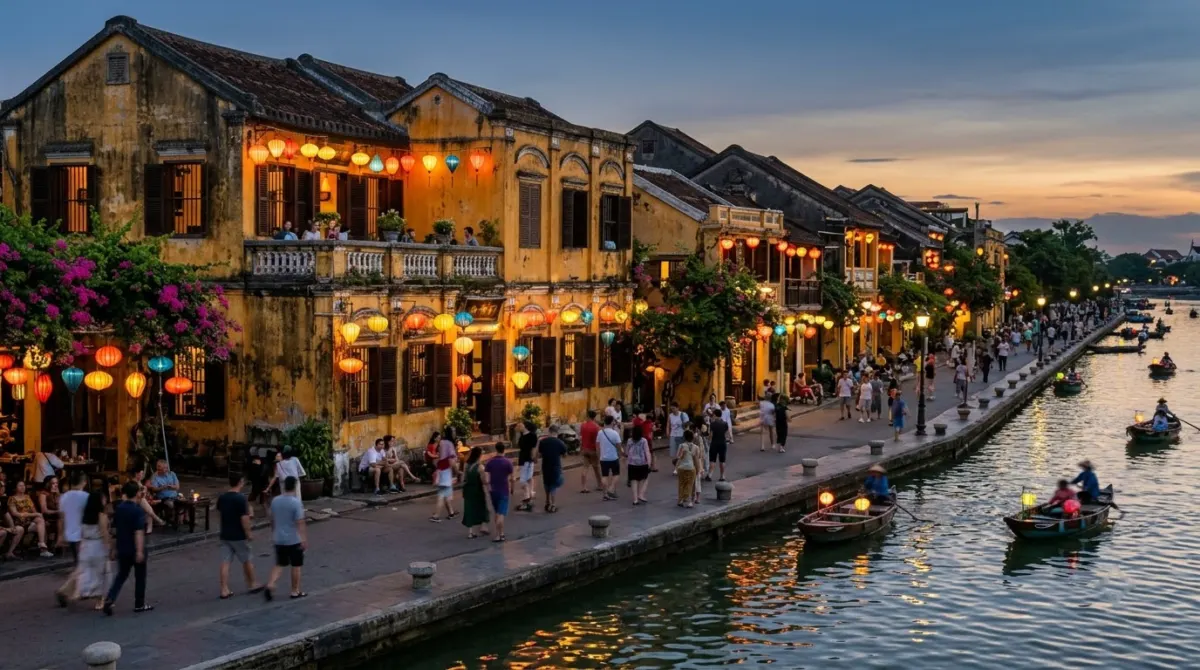
Morning: the old town is at its best early, before day-trippers arrive from Da Nang. Walk to the Japanese Covered Bridge, the symbol of the town, then visit a few of the heritage sites: the old merchant houses, the Chinese assembly halls such as the Fujian Assembly Hall, and small museums. Visitors are asked to buy an Ancient Town ticket before walking in; it covers the old town itself plus a set number of heritage sites, it can be used for up to three days, and the money supports conservation.
Afternoon: Hoi An is known for its tailors, who can make clothes to measure in a day or two. If you want something made, go on your first day to leave time for fittings. Otherwise, rent a bicycle and ride out through the rice fields.
Evening: when the lanterns light up, the riverfront along the Thu Bon River is magical. Small boats sell rides with paper lantern candles to float on the water. Across the bridge on An Hoi islet, the night market sells snacks and souvenirs. Try cao lau, a local noodle dish, and the town’s famous banh mi. On the night of each full moon, the old town traditionally dims electric lights in favor of lanterns.
Day 6: My Son Sanctuary, Marble Mountains or the beach
Use your second full day for a short trip out of town. Three options suit different travelers.

My Son Sanctuary: about an hour by road west of Hoi An, this valley of brick Hindu temples was built by the Champa kingdom between roughly the 4th and 13th centuries. It is a UNESCO World Heritage Site, though many towers were damaged during the war, and restoration is ongoing. Go at opening time; the valley gets hot and crowded by late morning. Many tours return by boat along the river.
Marble Mountains and Da Nang: the Marble Mountains are five limestone hills between Hoi An and Da Nang, with caves, Buddhist shrines and staircases to viewpoints. Combine them with Da Nang’s long My Khe Beach. On weekend evenings, the Dragon Bridge over the Han River in Da Nang usually puts on a short fire and water show at 9 p.m.; local listings differ on whether Fridays are included, so check the schedule that week.
Coconut forest and the beach: for a slower day, take a ride in a round bamboo basket boat through the water coconut palms at Cam Thanh, then spend the afternoon at An Bang Beach with lunch at a beachfront café.
Ba Na Hills, with the Golden Bridge held by giant stone hands, is another popular choice, but it is a full-day theme-park outing about an hour from Da Nang and very busy.
Day 7: Tra Que village and departure
Morning: cycle to Tra Que, a vegetable-growing village a few kilometers from the old town, where farmers have grown herbs and greens in neat raised beds for generations. Several farms offer short cooking classes that start with a walk through the gardens. Alternatively, grab a last coffee by the river and visit the morning market near the waterfront, which is busiest early in the day.
Getting out: Da Nang International Airport is about 45 minutes from Hoi An. It has international flights to several Asian hubs, which is often easier for US travelers than flying back to Hanoi. If your long-haul flight leaves from Hanoi or Ho Chi Minh City, take a domestic flight from Da Nang; both are short hops, and there are many daily departures.
Booking an open-jaw ticket, into Hanoi and out of Da Nang, or the reverse, is the single best way to make a one-week Vietnam itinerary work. It saves a domestic flight and half a day of backtracking.
Getting around Vietnam in one week
Domestic flights: for a one-week trip, flying between Hanoi and Da Nang is the only sensible way to connect the north and center. Several airlines, including Vietnam Airlines and low-cost carriers, operate the route many times a day. Low-cost fares usually charge extra for checked bags.
The train: the North-South railway, often called the Reunification Express, runs the full length of the country. Hanoi to Da Nang by train takes around 16 hours or more, so it suits travelers with extra time rather than a one-week schedule. The short stretch between Da Nang and Hue over the coast is scenic and worth riding if you add Hue.
Cars and drivers: for day trips to Ninh Binh, My Son or the Marble Mountains, a car and driver booked through your hotel or a tour company is easy and good value. Driving yourself is not practical for visitors: traffic is chaotic, and a US license with an International Driving Permit may not be accepted, so check the US State Department’s Vietnam page before you consider driving.
In town: Grab cars and motorbike taxis work well in Hanoi, Da Nang and Hoi An. In Hoi An, a bicycle is the best way around; the old town is closed to motor vehicles at set hours. When crossing the street in Hanoi, walk slowly and steadily so motorbikes can flow around you.
Best time to visit Vietnam for this itinerary
Because this route covers two climate zones, no month is perfect for both. Here is how they compare.
February to April: the best overall window. Hanoi is mild, central Vietnam is dry and warm, and Ha Long Bay is calm, though often misty, which makes photos softer. Tet, the Lunar New Year, falls in late January or February; many businesses close for several days around it, and transport books up fast.
May to August: hot and humid in Hanoi, with heavy summer showers. Hoi An is hot and dry, and the beaches are at their best. This is also storm season in the north, so a Ha Long Bay cruise can be canceled at short notice.
September to December: autumn in Hanoi, from October to early December, is lovely, cool and clear. Central Vietnam, however, has its rainy season, and Hoi An is prone to flooding, typically from October to November, when the river can rise into the old town streets.
December to January: Hanoi can feel chilly and gray, around 60°F, and you will want a jacket. The center is cool and sometimes still rainy.
If you only have 5 days in Vietnam
A 5-day Vietnam itinerary works best if you stay in one region. Two good options:
North only: three nights in Hanoi around a Ninh Binh day trip and an overnight Ha Long Bay cruise. That is Days 1 to 4 of the main plan, with a final morning in Hanoi on Day 5 for the Temple of Literature or the Vietnam Museum of Ethnology before you fly out. No domestic flight needed.
- Day 1: Old Quarter and Hoan Kiem Lake.
- Day 2: Ninh Binh day trip.
- Day 3: Ha Long Bay cruise.
- Day 4: back to Hanoi by mid-afternoon, evening walking street or water puppets.
- Day 5: Temple of Literature, depart.
Center only: fly into Da Nang and spend four or five nights in Hoi An, with day trips to My Son, the Marble Mountains, Ba Na Hills and the beach, or a ride over the Hai Van Pass to the old imperial city of Hue. This is the most relaxed five days in Vietnam, and it suits families.
Trying to fit both Hanoi and Hoi An into five days is possible but rushed; you will spend about a fifth of the trip in transit.
Adding more days to your Vietnam trip itinerary
Hue (1 to 2 nights): the former imperial capital is about three hours north of Hoi An by road, or longer if you take the coastal road over the Hai Van Pass, one of the most scenic drives in the country. See the walled Citadel and the royal tombs along the Perfume River.
Sapa or Ha Giang (2 to 3 nights): the northern mountains, with rice terraces and ethnic minority villages. Sapa is reached by bus from Hanoi in around five to six hours, or by overnight train to Lao Cai. Ha Giang is more remote and best with a local driver.
Ho Chi Minh City and the Mekong Delta (3 nights): the south has a completely different energy. Spend a day on the War Remnants Museum, the Reunification Palace and District 1 food, another at the Cu Chi Tunnels, and a third on a boat in the Mekong Delta. From Ho Chi Minh City, it is a short flight to Siem Reap, which makes it easy to continue to Angkor Wat; see our Cambodia itinerary for 7 days if you want to combine the two countries.
Phu Quoc (3 nights): an island in the far south for a beach finish, reached by flight from Hanoi or Ho Chi Minh City.
Map shows live availability and prices. We may earn a commission on bookings made through it, at no extra cost to you.
Bangkok is a short flight from Hanoi or Da Nang, so this route also pairs well with our Thailand itinerary for 7 days.
The short version
For a first Vietnam itinerary of 7 days, focus on the north and the center. Spend two nights in Hanoi for the Old Quarter, Hoan Kiem Lake, the Temple of Literature and a day trip to Ninh Binh, then one night on a Ha Long Bay or Lan Ha Bay cruise. On Day 4, fly from Hanoi to Da Nang, about 1 hour 20 minutes, and spend three nights in Hoi An for the Ancient Town, the lanterns, My Son or the Marble Mountains, and the beach. Apply for your e-visa on the official portal, carry cash for street food, and aim for February to April for the best weather in both regions.
Frequently asked questions
Is 7 days enough for Vietnam?
Seven days is enough for two regions, not the whole country. The most efficient pairing for a first trip is the north, with Hanoi, Ninh Binh and Ha Long Bay, plus central Vietnam around Hoi An, connected by a short flight. Saigon and the Mekong Delta are better kept for a second week.
Do US citizens need a visa for Vietnam?
Yes. US citizens are not visa-exempt, so apply for an e-visa on the official portal, evisa.gov.vn, which allows stays of up to 90 days. Apply at least one to two weeks before travel and avoid third-party sites that add fees.
Is a Ha Long Bay day trip worth it, or should I stay overnight?
An overnight cruise is much better. The bay is around 2.5 hours each way from Hanoi, so a day trip leaves only a few hours on the water, while an overnight stay adds sunset, sunrise and calmer bays such as Lan Ha.
When is the rainy season in Vietnam?
It depends on the region. The north is hot and wet roughly from May to September, while central Vietnam, including Hoi An, gets its heaviest rain and occasional floods from about September to December. February to April is the best compromise for this route.
Should I fly into Hanoi or Ho Chi Minh City?
For this route, fly into Hanoi and out of Da Nang, or the reverse. Choose Ho Chi Minh City only if you plan to focus on the south and the Mekong Delta, or to combine Vietnam with Cambodia.
Can I use credit cards in Vietnam?
In hotels, malls and many restaurants, yes, but street food, markets and small cafés usually want cash in Vietnamese dong. Bank ATMs are easy to find in the cities on this itinerary.
Is Grab available in Vietnam?
Yes, Grab works in Hanoi, Da Nang and Hoi An for cars and motorbike taxis, with the price shown before you ride. It is the easiest way to avoid haggling with taxis.
Written and checked by
Triplarks Editorial
An editorial desk, not an invented persona: research, drafting and fact-checking are done by the same small team. Every number here carries the date it was read.