Where to stay
Best Hotels in Split: A City Inside a Roman Palace
By Nora Castell Checked
Hotel links open Stay22 (Booking.com and Agoda) and tour links open GetYourGuide. We may earn a commission at no extra cost to you.
Pick by trip
- Atmosphere inside the palace
- Heritage Hotel Antique Split
- Quiet nights close by
- Sperone Hotel
- The beach on the doorstep
- Hotel Park Split
- Leaving early for the islands
- Hotel Villa Diana
- Couples wanting a rooftop
- Jupiter Heritage Hotel
The 7 hotels
- 1Check price
Hotel Park Split
Bačvice · Luxury
- Best for
- Beach and town together
- Standout
- 1921 hotel next to Bačvice beach, with an outdoor pool
- 2Check price
Hotel Ambasador
Riva (west end) · Luxury
- Best for
- A pool with the waterfront outside
- Standout
- Rooftop pool and spa on the waterfront, some rooms with sea views
- 3Check price
Heritage Hotel Antique Split
Diocletian's Palace · Mid-range
- Best for
- Living inside the palace
- Standout
- Inside the palace walls, with views of the cathedral and Peristyle
- Trade-off
- Palace lanes are lively late into the night
- 4Check price
Jupiter Heritage Hotel
Diocletian's Palace · Mid-range
- Best for
- Couples wanting a rooftop
- Standout
- Rooftop lounge bar and hot tub near the Temple of Jupiter
- Trade-off
- Palace lanes are lively late into the night
- 5Check price
Sperone Hotel
Varoš · Mid-range
- Best for
- Old stone, quieter nights
- Standout
- In Varoš, 250 metres from the palace, with a pool and spa
- 6Check price
Central Square Heritage Hotel
Palace edge, near the Riva · Budget
- Best for
- Short stays in the centre
- Standout
- Steps from the Riva, tea and coffee in every room
- Trade-off
- No restaurant or bar listed
- 7Check price
Hotel Villa Diana
Near Bačvice and the ferry port · Budget
- Best for
- Early island ferries
- Standout
- Family-run heritage hotel a few minutes from the ferry port and Bačvice
| Hotel | Area | Tier | Best for | Book |
|---|---|---|---|---|
| Hotel Park Split | Bačvice | Luxury | Beach and town together | Check rates |
| Hotel Ambasador | Riva (west end) | Luxury | A pool with the waterfront outside | Check rates |
| Heritage Hotel Antique Split | Diocletian's Palace | Mid-range | Living inside the palace | Check rates |
| Jupiter Heritage Hotel | Diocletian's Palace | Mid-range | Couples wanting a rooftop | Check rates |
| Sperone Hotel | Varoš | Mid-range | Old stone, quieter nights | Check rates |
| Central Square Heritage Hotel | Palace edge, near the Riva | Budget | Short stays in the centre | Check rates |
| Hotel Villa Diana | Near Bačvice and the ferry port | Budget | Early island ferries | Check rates |
Shortlisted by location and recent guest reviews on Booking.com; we have not stayed in these hotels. Prices show live on Booking.com. Affiliate links.
On this page
- Best hotels in Split: the areas
- Inside the palace
- Varoš
- Bačvice and the east
- The Riva and the harbour
- Split versus Dubrovnik
- Heritage, boutique and beach: the categories in Split
- What to check before booking
- When Split fills up
- What the accommodation is like
- Using Split for the islands
- What there is to do in the city
- Day trips from Split
- When Split is at its best
- Arriving in Split
- How many nights, and what each adds
- Split with children, and with a car
- Where not to stay
- Meje and the Marjan side
- The short version
- Frequently asked questions
Quick answer
Inside Diocletian’s Palace for the atmosphere and the noise that comes with it, Varoš for old stone a few minutes away, Bačvice for the beach, and near the Riva and the ferry port if you are leaving early for the islands.
Split is a city built inside a Roman palace. The emperor Diocletian retired here around 305 AD, and when the palace was later occupied by refugees from a sacked nearby town, they simply moved into its walls and never left. People still live in it.
Some links below are affiliate links. We may earn a commission if you book through them, at no extra cost to you. Where we name hotels, we shortlist them by location and recent guest reviews, and we have not stayed in them. Any prices on the map come live from the booking sites.
That is the context for every accommodation decision here: the old town is a functioning residential quarter inside a Roman monument, with all the charm and all the practical problems that implies. For the area question first, see where to stay in Split, and for the islands, where to stay in Hvar.
Best hotels in Split: the areas
| Area | Character | Suits |
|---|---|---|
| Diocletian’s Palace | Inside the walls, lanes, no cars | Atmosphere, short stays |
| Varoš | Old fishermen’s quarter, west | Quiet, five minutes out |
| Bačvice | Beach area, east | Swimming, nightlife |
| Riva and the harbour | Waterfront | Ferries, convenience |
| Meje and Marjan | Hillside west | Quiet, views, a car |
One answer with no caveats: Varoš or the streets immediately outside the palace walls. You are two minutes from the old town, the lanes are quieter, and the prices are lower.
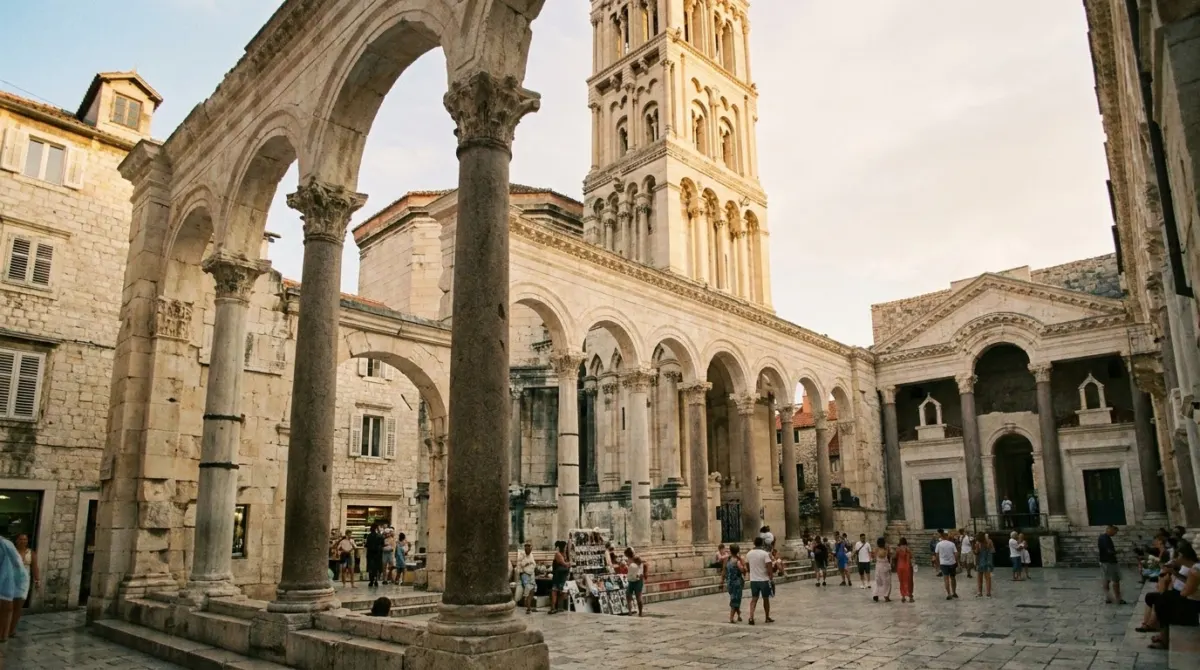
Inside the palace
The palace quarter is a grid of narrow lanes, courtyards and Roman cellars, with apartments and small guesthouses rather than hotels.
Staying here is atmospheric and comes with the usual old-town conditions: stairs, no vehicle access, and noise. Split has a genuinely busy nightlife in summer and the lanes amplify it.
Check before booking how far a car can reach, how many steps follow, and whether the room faces a lane with bars on it.
Varoš
The old fishermen’s quarter on the slope west of the palace: stone houses, steep lanes and small konobas.
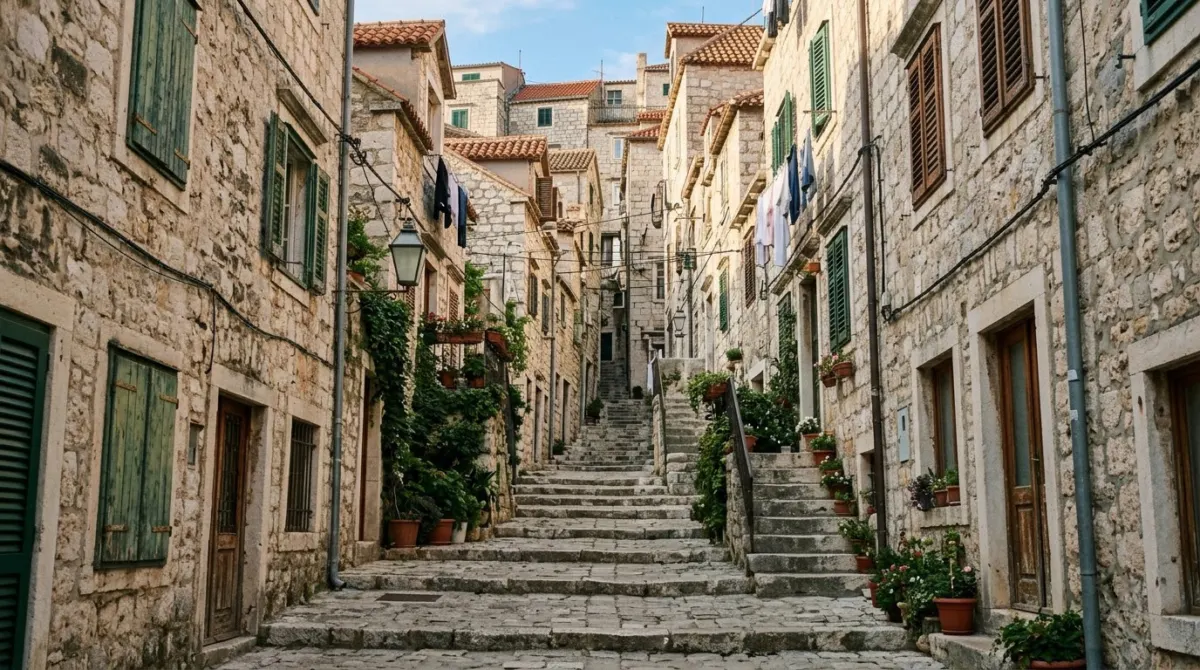
It is a few minutes’ walk from the Riva and the palace, considerably quieter, and the best-value central area.
For most visitors this is the right address in Split.
Bačvice and the east
Bačvice is the city beach, about ten minutes’ walk east of the centre: shallow sandy water, bars and the local game of picigin played in the shallows.
The area around it has modern apartments and hotels, and it is where a lot of Split’s summer nightlife happens.
Good if you want to swim before breakfast. Less good if you want to sleep at two in the morning in August.
The Riva and the harbour
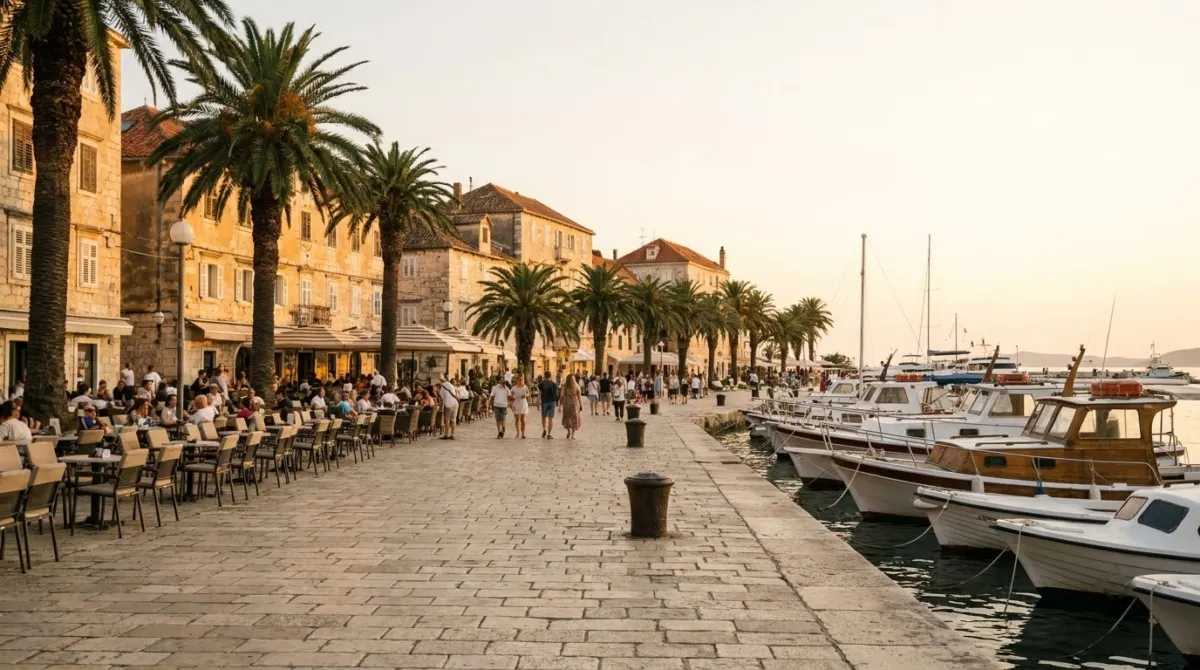
The waterfront promenade runs along the front of the palace, with the ferry port at its eastern end.
Split is the main gateway to the Dalmatian islands — Hvar, Brač, Vis and Korčula — and if you are island-hopping, being within walking distance of the port with luggage is worth more than a view.
Split versus Dubrovnik
Worth settling, because many trips include one or both.
Split is a working city of 160,000 with a Roman palace in the middle. It is cheaper, livelier, less crowded and better connected — ferries to the islands, an airport, and the motorway north.
Dubrovnik is smaller, more spectacular and far more visited, with higher prices and a cruise schedule.
Most itineraries give Dubrovnik two nights and Split two or three, and use Split as the base for the islands. See our guide to hotels in Dubrovnik.
Map shows live availability and prices. We may earn a commission on bookings made through it, at no extra cost to you.
Heritage, boutique and beach: the categories in Split
Croatia’s accommodation vocabulary is specific, and in Split three words cover most of the market.
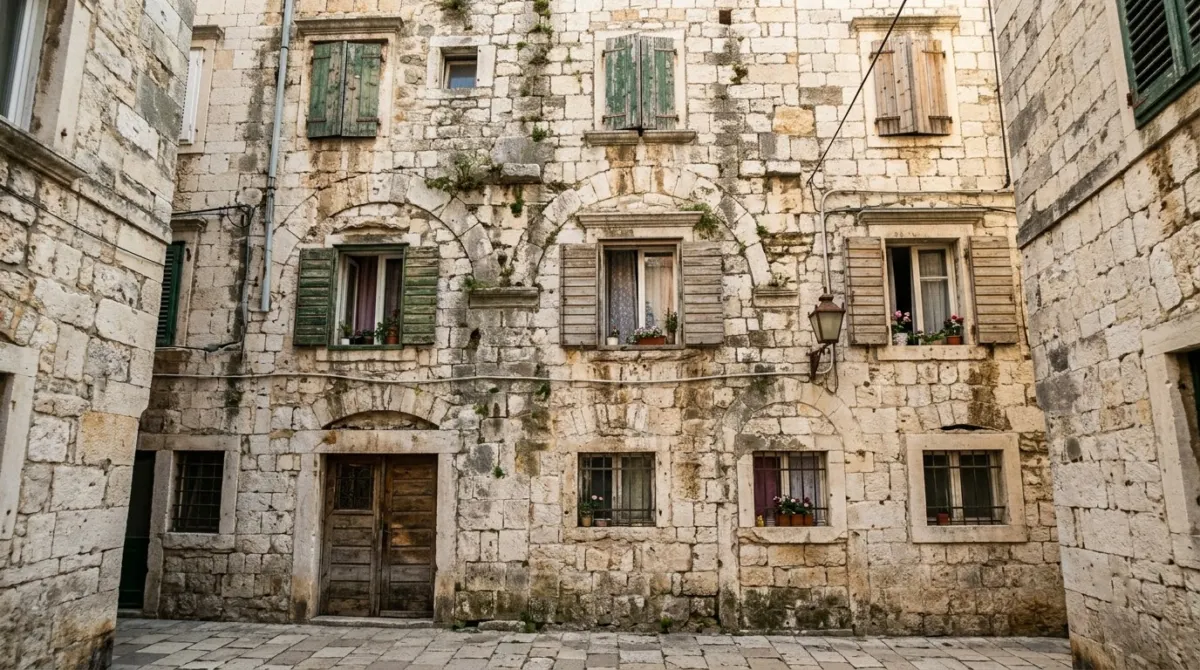
Heritage hotel is a formal Croatian category, not marketing language. It means a protected building converted to rooms, and inside Diocletian’s Palace nearly everything is one. The constraints follow from the designation: no lifts in most, small windows, stone walls, and a licence that limits what the owner can change.
Boutique here usually means eight to twenty rooms in a converted townhouse in Var&ocaron; or just outside the palace walls, with a terrace on the roof. The terrace is the thing worth asking about — in a city this dense it is the only outdoor space the building has, and a rooftop with a view over the palace to the Adriatic is the main reason to pay the difference.
Beach hotels sit east of the centre along Bačvice and out towards Firule, and west under Marjan. They come with a beach club or a sea-water pool and a fifteen-minute walk into town, which is the trade.
Sea view means different things on each side: from the Riva and the east it is the harbour and the ferries, from Marjan it is open water and the islands. Both are genuine; only one is quiet.
What to check before booking
Noise, which in the palace quarter in summer is the main complaint.
Steps and vehicle access, since the palace has neither lifts nor roads.
Air conditioning, essential from June to September.
Distance to the ferry port, if you are going to the islands.
When Split fills up
July and August are hot, busy and the most expensive, with the Ultra music festival filling the city on its dates.
May, June, September and early October are the best months: warm sea, everything open, manageable crowds.
November to April is quiet and mild, the islands’ infrastructure largely closes, and Split carries on as an ordinary city.
What the accommodation is like
Split has very few large hotels in the centre and a great many apartments, which shapes the choice.
Inside the palace, almost everything is an apartment or a small guesthouse in a historic building: stone stairs, no lifts, and occasionally a Roman wall as part of the room.
Varoš is similar in format and quieter.
Bačvice and the east have the modern blocks and the larger hotels.
Meje and the Marjan slopes have villas and apartments with views, and need a car or a walk.
Air conditioning is standard in anything recently renovated and worth confirming in older apartments.
Using Split for the islands
This is the strongest reason to stay here, and it changes where in the city you should be.
Ferries and catamarans leave from the port at the eastern end of the Riva for Hvar, Brač, Vis, Šolta and Korčula. Fast catamarans are passenger-only and sell out in summer; car ferries are slower and more flexible.
If island days are part of the plan, stay within walking distance of the port with luggage, which means the palace quarter, Varoš or the harbour front rather than Bačvice.
What there is to do in the city
Diocletian’s Palace itself: the peristyle, the cellars, the cathedral built inside the emperor’s mausoleum, and the bell tower you can climb.
The Riva in the evening, which is where the city walks.
Marjan hill, a forested peninsula west of the centre with paths, viewpoints and small swimming coves.
Bačvice for shallow swimming and the local game of picigin.
The Meštrović gallery on the Marjan road, which holds the sculptor’s work in his own villa.
Day trips from Split
Trogir, half an hour west, a small Venetian walled town on an island.
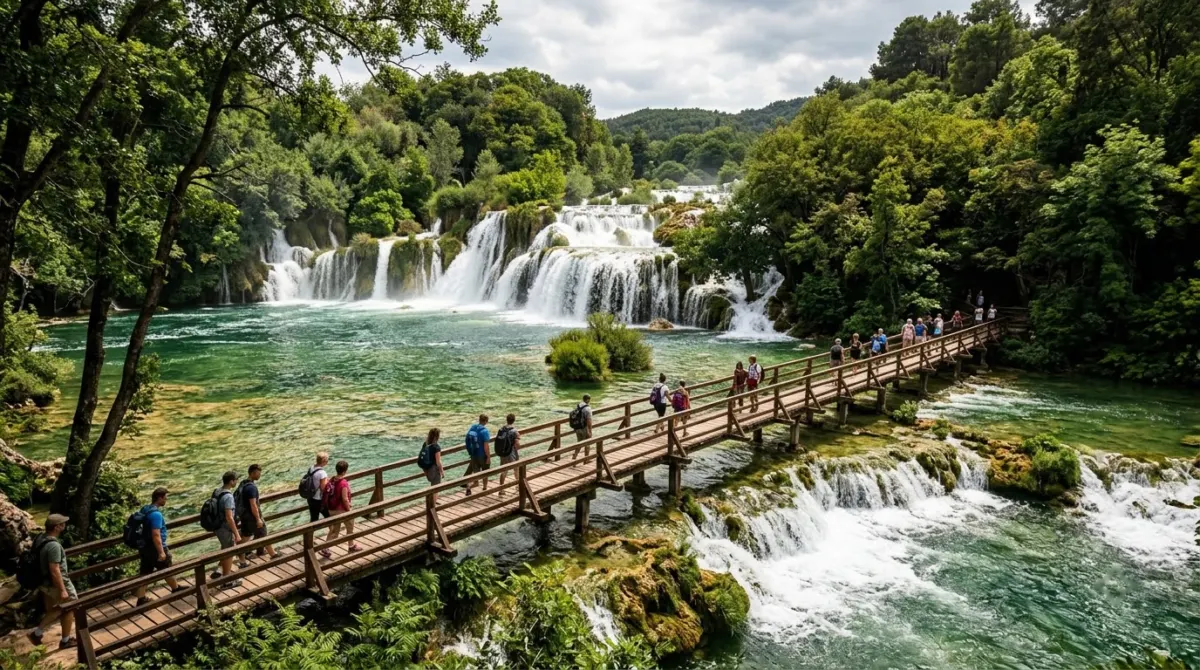
Krka national park, an hour north, with waterfalls and boardwalks.
Brač and Zlatni Rat, the shifting shingle spit, an hour by ferry.
Hvar, an hour by catamaran, which deserves an overnight rather than a day.
When Split is at its best
May, June and September are the strongest months: the sea is warm from June, everything is open, and the city is busy without being overwhelmed.
July and August are hot and crowded, with ferry queues, full restaurants and the highest prices of the year.
October is still warm and much quieter, though island services begin to thin.
November to April is a normal Mediterranean city in winter: mild, inexpensive, with the palace quarter largely to residents and the islands effectively closed.
Arriving in Split
Three ways in, and each suits a different address.
By air: Split airport is about thirty minutes west, near Trogir, with a shuttle bus to the centre and the bus station.
By ferry: the port is at the eastern end of the Riva, two minutes from the palace, which is the best argument for staying in the old town or Varoš if you are island-hopping.
By road: the motorway from Zagreb and the coastal route from Dubrovnik both arrive at the eastern edge, where the public car parks are.
The bus station, railway station and ferry port are all within two hundred metres of each other, which makes Split unusually easy to arrive in with luggage.
How many nights, and what each adds
Two nights covers the palace, the Riva and Marjan hill.
Three adds a day trip: Trogir, Krka or a near island.
Four or five turns Split into an island base, with Hvar, Brač and Vis all reachable by catamaran.
Beyond five nights, most people move on to the islands themselves rather than commuting to them.
Split with children, and with a car
With children, Bačvice is the obvious base: a shallow sandy beach ten minutes from the centre, with the palace walkable for an afternoon.
With a car, the centre is the problem rather than the roads. The palace quarter has no vehicle access, parking in the centre is limited and charged, and the sensible approach is accommodation with its own space or a public car park on the edge.
If you are touring Dalmatia, one practical pattern is to drop the car for the city days and pick it up again on the way out, since Split’s islands and old town both work better without it.
Where not to stay
Directly on a palace lane with bars below, unless you are out until they close.
The outer suburbs, which are a bus ride from everything and save little.
Anywhere without air conditioning in July or August, when the stone holds the heat overnight.
Meje and the Marjan side
West of the centre, the streets climbing towards the Marjan peninsula are the quietest part of Split that is still walkable to the old town.
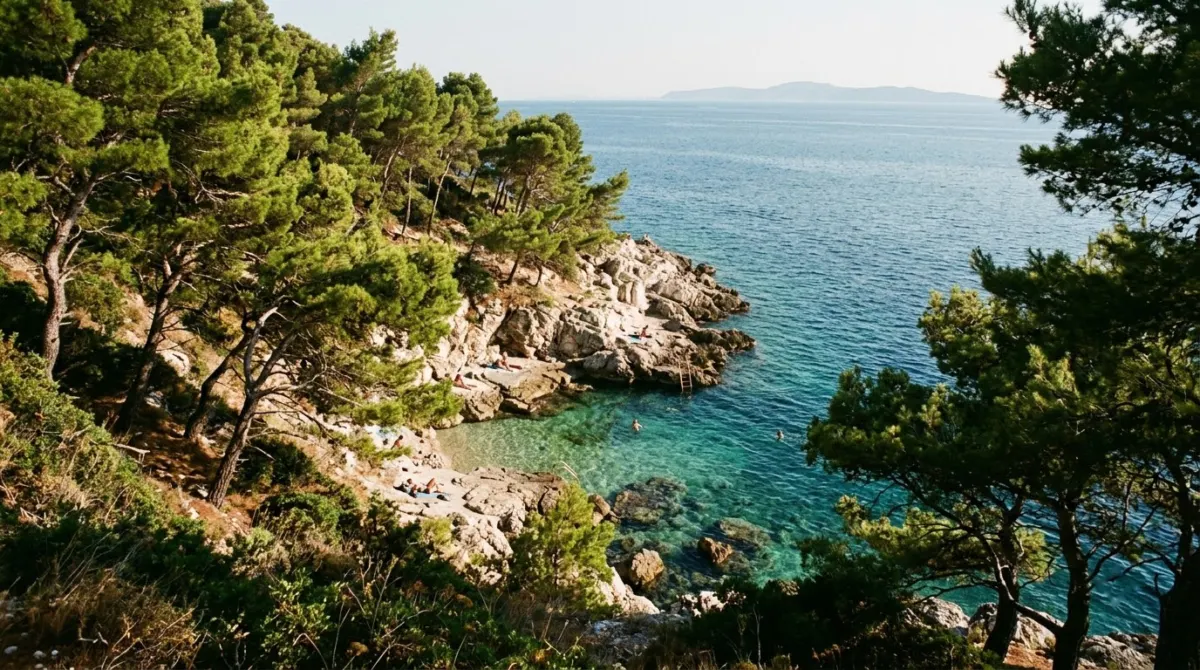
Meje is residential: low buildings, gardens, and a steady climb that keeps the day-trip traffic out. The walk to the Riva takes fifteen to twenty minutes and is downhill in the morning, which matters more than it sounds in August.
Marjan itself is a forested hill with paths, viewpoints and small swimming coves on its southern shore, and it is the reason to choose this side at all.
What you trade is convenience. There are few restaurants, almost no shops after dark, and the climb back at midnight is real. Anyone arriving late by ferry or planning early island departures is better off nearer the harbour.
It suits a longer stay rather than a two-night stop, and it suits anyone who wants to swim before breakfast without taking a boat.
The short version
Varoš or the streets just outside the palace for most visitors, inside the palace for atmosphere and summer noise, Bačvice for swimming, and near the Riva if island ferries are in the plan. Confirm air conditioning, the number of steps and how close a car can get. Two nights for the city, three with a day trip, four or more as an island base — which is what Split is best at.
Frequently asked questions
Where is the best area to stay in Split?
Varoš or the streets just outside the palace walls: two minutes from the old town, quieter lanes and lower prices. Inside the palace for atmosphere if you accept noise and stairs, and near the ferry port if you are island-hopping.
Is it noisy inside Diocletian's Palace?
In summer, yes. The palace quarter has a busy nightlife and the stone lanes amplify it. Ask whether your room faces a lane with bars, or stay in Varoš a few minutes away.
Is Split cheaper than Dubrovnik?
Noticeably. Split is a working city of 160,000 with a Roman palace in the middle, which keeps prices closer to normal Croatian levels, while Dubrovnik's small walled centre and cruise traffic push them up.
Should I stay in Split or Dubrovnik?
Both, if you can: Dubrovnik for two nights and Split for two or three. Split is cheaper, livelier and better connected, and it is the gateway to the Dalmatian islands by ferry.
How many nights do you need in Split?
Two for the palace, the Riva and Marjan hill. Three if you want Trogir, Krka or a near island. Four or more if you are using it as a base for island-hopping, which is what Split does best.
Is Bačvice a good place to stay?
If you want to swim before breakfast, yes — it is the city beach, ten minutes' walk from the centre, with shallow sandy water. It is also where much of the summer nightlife is, so expect noise in August.
Keep planning Croatia
- Best Hotels in Dubrovnik: Inside the Walls, or Looking at Them
- Where to Stay in Hvar: The Port You Land At Is Not the Town
- Where to Stay in Split: You Are Booking a Room Inside a Roman Palace
- Where to Stay in Dubrovnik: The Old Town Is a Trap for Longer Trips
- How Many Days in Dubrovnik? Two, Then Cross a Border
- Croatia Itinerary: Split Is the Hub, Not Dubrovnik

Written and checked by
Nora Castell is the pen name of the Triplarks editorial desk and the editor of its Costa Rica and Central America guides. Each guide is built from national park, transport and tourism sources, operator rate cards and recent traveller reports, then fact-checked, with every figure dated to the day it was read. Triplarks uses AI tools to help draft; nothing goes live until it has been edited and checked. Where we have not been somewhere, we do not write as though we have.