Quick answer where to stay
Two nights in Phnom Penh along the riverside or in BKK1, then four nights in Siem Reap a few streets away from Pub Street, close enough to walk to dinner but quiet at night.
On this page
- Cambodia itinerary 7 days at a glance
- Before you go: e-visa, arrival card and money
- Where to stay in Phnom Penh and Siem Reap
- Day 1: Phnom Penh’s Royal Palace and riverfront
- Day 2: Tuol Sleng, Choeung Ek and Phnom Penh’s markets
- Day 3: Phnom Penh to Siem Reap
- Day 4: Angkor Wat sunrise, Angkor Thom and Ta Prohm
- Day 5: Banteay Srei and the Grand Circuit
- Day 6: Beng Mealea and the Tonle Sap floating villages
- Day 7: A last morning in Siem Reap and departure
- Getting around Cambodia in one week
- Best time to visit Cambodia for this itinerary
- If you only have 5 days in Cambodia
- Adding more days to your Cambodia trip itinerary
- The short version
- Frequently asked questions
This Cambodia itinerary for 7 days gives you the two places every first-time visitor should see: two nights in Phnom Penh, the riverside capital, for the Royal Palace and the sobering history of the Khmer Rouge years, then four nights in Siem Reap for the temples of Angkor, with enough time to see Angkor Wat at sunrise, the faces of the Bayon, the jungle roots of Ta Prohm and the more distant temples without rushing. It works best between November and February, the cool, dry season.
Some links below are affiliate links. We may earn a commission if you book through them, at no extra cost to you. We do not rank hotels, and any prices on the map come live from the booking sites.
Many visitors give Angkor only a day or two as a side trip from Thailand or Vietnam, and leave wishing they had more. A one-week Cambodia travel itinerary lets you slow down: early starts to beat the heat and the crowds, a break at midday, and temples again in the softer afternoon light. Further down you will find a five-day version, the best season for each part of the country, and ideas for a longer Cambodia trip itinerary, including the south coast and a combined trip with Vietnam.
Cambodia itinerary 7 days at a glance
| Day | Base | Main stops | Getting around |
|---|---|---|---|
| Day 1 | Phnom Penh | Royal Palace, Silver Pagoda, National Museum, riverfront | Tuk-tuk, walk |
| Day 2 | Phnom Penh | Tuol Sleng, Choeung Ek, Central Market | Tuk-tuk, about 45 minutes to Choeung Ek |
| Day 3 | Siem Reap | Travel north, Angkor pass, Old Market | Flight of about 45 minutes or bus of about 6 hours |
| Day 4 | Siem Reap | Angkor Wat sunrise, Angkor Thom, Ta Prohm | Tuk-tuk with driver |
| Day 5 | Siem Reap | Banteay Srei, Grand Circuit temples, Pre Rup sunset | Tuk-tuk or car, about 1 hour to Banteay Srei |
| Day 6 | Siem Reap | Beng Mealea, Tonle Sap floating village | Car, about 1.5 hours each way |
| Day 7 | Siem Reap | A last temple or museum, fly out | About 1 hour to the airport |
The same plan works in reverse. If your international flight arrives in Siem Reap, do Angkor first and finish in Phnom Penh. Flying into one city and out of the other saves a long return journey.
Where to sleep on this route
Before you go: e-visa, arrival card and money
Entry for US travelers: US citizens need a visa for Cambodia. You can apply online for a tourist e-visa on the official government site, evisa.gov.kh, which usually takes a few business days, or get a visa on arrival at the international airports. Both give a stay of up to 30 days. Your passport should be valid for at least six months and have blank pages. If you choose the visa on arrival, bring a passport photo and US dollars in cash, just in case.
Cambodia e-Arrival card: Cambodia has introduced a free digital arrival card for air travelers, completed online before your trip at the official site, arrival.gov.kh. It is separate from the visa. Check the current rules and timing on that site, and avoid third-party sites that charge for it.
Money: Cambodia uses two currencies side by side. Prices for tourists are usually quoted in US dollars, and ATMs dispense dollars, while small change comes back in Cambodian riel. Bring clean, untorn US bills; damaged notes are often refused. Cards are accepted in many hotels and larger restaurants, but tuk-tuks, markets and street food are cash.
Phone and apps: an eSIM or a local SIM is cheap and useful. Grab and PassApp work in both Phnom Penh and Siem Reap for tuk-tuks and cars, with the price agreed before you ride.
Where to stay in Phnom Penh and Siem Reap
Phnom Penh: the best area for a short stay is the riverside, along Sisowath Quay and the streets behind it. The Royal Palace, the National Museum and many restaurants are within walking distance, and the evening promenade along the Tonle Sap River is lively. Boeng Keng Kang, often called BKK1, south of Independence Monument, is quieter and leafier, with cafés, boutique hotels and good restaurants, and it is a short tuk-tuk ride to the sights. Note that Phnom Penh’s new Techo International Airport, which opened in 2025, lies roughly 20 to 30 kilometers south of the city, so allow about an hour to get there, more in heavy traffic.
Siem Reap: the town center around the Old Market and Pub Street is walkable and full of restaurants, but Pub Street itself is loud at night. Stay a few streets away, along the Siem Reap River or in the Wat Bo area on the east bank, for a calmer base that is still a short walk to dinner. Many hotels have pools, and you will use one: a midday swim between the morning and afternoon temple sessions is how most people survive the heat. The temples start about 15 to 20 minutes north of town by tuk-tuk.
Day 1: Phnom Penh’s Royal Palace and riverfront
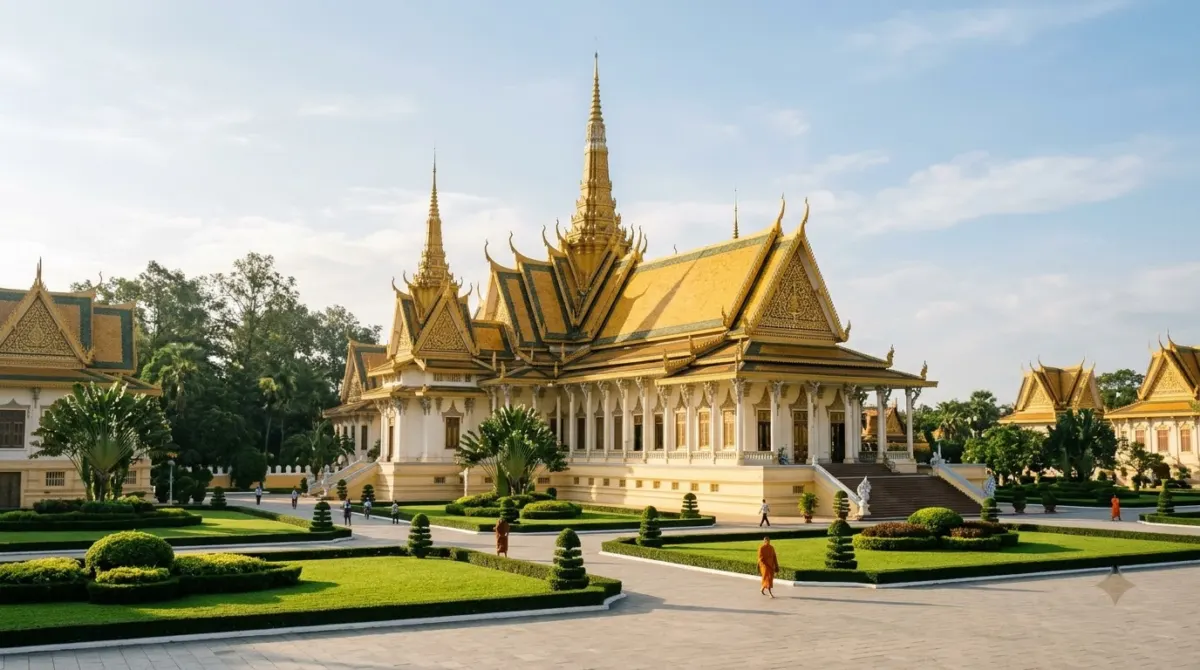
Morning: the Royal Palace and the Silver Pagoda. The palace, with its golden spires and yellow-and-white buildings, is still the official residence of the King of Cambodia, and only part of the complex is open to visitors. The highlight is the Silver Pagoda, named for the more than five thousand silver tiles that cover its floor, which houses a small emerald Buddha and a life-sized gold Buddha. Shoulders and knees must be covered. The palace closes for a long lunch break in the middle of the day, so go when it opens in the morning.
Late morning: the National Museum. Next door, in a beautiful red terracotta building around a garden courtyard, the National Museum holds the world’s finest collection of Khmer sculpture, much of it from Angkor. Seeing it before you visit the temples gives the carvings context.
Afternoon: rest through the heat, then walk along the riverfront. Stop at Wat Phnom, the small hilltop temple that gave the city its name.
Evening: take a sunset boat cruise on the Mekong and Tonle Sap rivers, which meet at the city. Boats leave from the riverside and last around one to two hours. Dinner can be Khmer classics such as fish amok, a curry steamed in banana leaves, or lok lak, stir-fried beef with a lime and pepper dip.
Day 2: Tuol Sleng, Choeung Ek and Phnom Penh’s markets
This day is about Cambodia’s recent history. Between 1975 and 1979, the Khmer Rouge regime killed or caused the deaths of an estimated 1.5 to 2 million people, around a quarter of the population. The two memorials in Phnom Penh are difficult to visit, but essential to understanding the country.
Morning: Tuol Sleng Genocide Museum. A former high school that became the S-21 prison, where thousands of people were held, interrogated and tortured. The rooms, cells and walls of photographs of prisoners have been left largely as they were. The audio guide, with testimony from survivors and guards, is excellent. Allow two hours.
Late morning: Choeung Ek. About 15 kilometers south of the center, around 45 minutes by tuk-tuk, Choeung Ek is the best known of the killing fields, where prisoners from S-21 were executed. Today it is a quiet orchard with a memorial stupa holding thousands of skulls. The audio tour guides you slowly around the site. Many visitors combine the two sites by hiring a tuk-tuk for the morning.
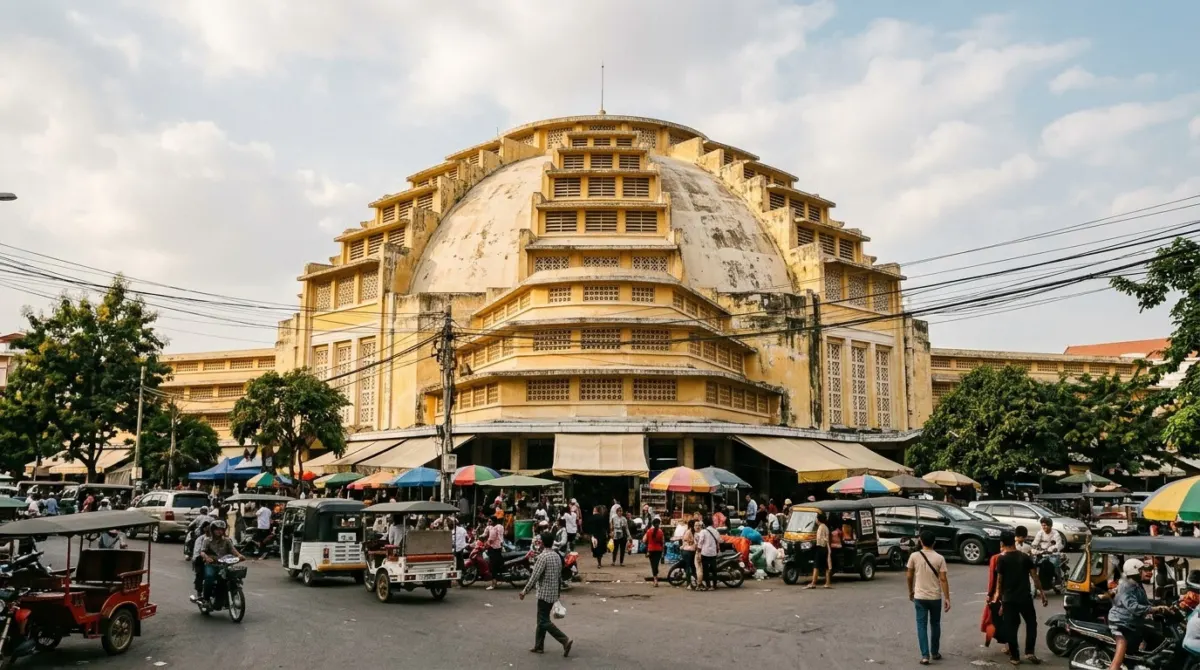
Afternoon: after a long lunch, lighten the mood at the markets. The Central Market, Phsar Thmei, is an Art Deco building with a huge yellow dome, selling jewelry, clothing and food. The Russian Market, Tuol Tom Poung, south of the center, is a warren of stalls with handicrafts, silk, souvenirs and a busy food section.
Evening: dinner in BKK1 or at a training restaurant run by a social enterprise; several in the city help young Cambodians train for hospitality careers.
Day 3: Phnom Penh to Siem Reap
Getting there: there are two realistic options. A domestic flight takes about 45 minutes, but you need to add the long drive to Phnom Penh’s new airport, check-in time and the drive from Siem Reap’s airport into town, so it is less of a time saving than it looks. Buses and minivans take roughly six hours by road, sometimes longer, with a rest stop on the way. Several companies run comfortable express buses, and some have morning and afternoon departures. A private car with driver is a more comfortable option for families or groups.
Siem Reap Angkor International Airport opened in 2023 and is about 45 to 50 kilometers from town, around an hour by road. A shuttle bus runs into the center, and taxis and pre-booked transfers are available.
Late afternoon: buy your Angkor pass. Angkor passes are sold only by the official operator, Angkor Enterprise, at the main ticket center on the way to the temples and through its official online channel. Tickets bought elsewhere are not valid. For this itinerary, a three-day pass covers Days 4 and 5 plus a final temple visit on Day 7, since the Tonle Sap on Day 6 does not need it. The pass can be used on any three days, not necessarily in a row, within a 7-day window. Multi-day passes include your photo, so the pass is tied to you.
Evening: walk around the Old Market area and the night markets. For a memorable evening, Phare, a circus show by a Cambodian social enterprise, combines acrobatics, theater and music, with performers trained at an arts school in Battambang.
Day 4: Angkor Wat sunrise, Angkor Thom and Ta Prohm
This is the classic first temple day, often called the Small Circuit. Hire a tuk-tuk and driver for the day; your accommodation can arrange it, and drivers know the timings.
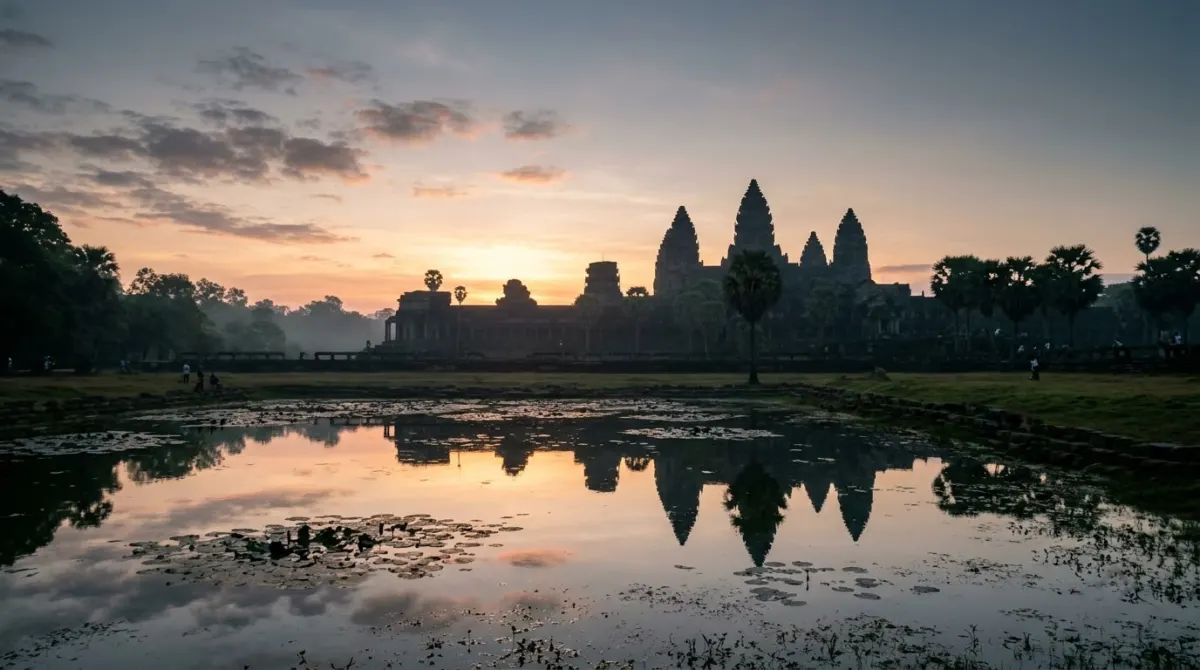
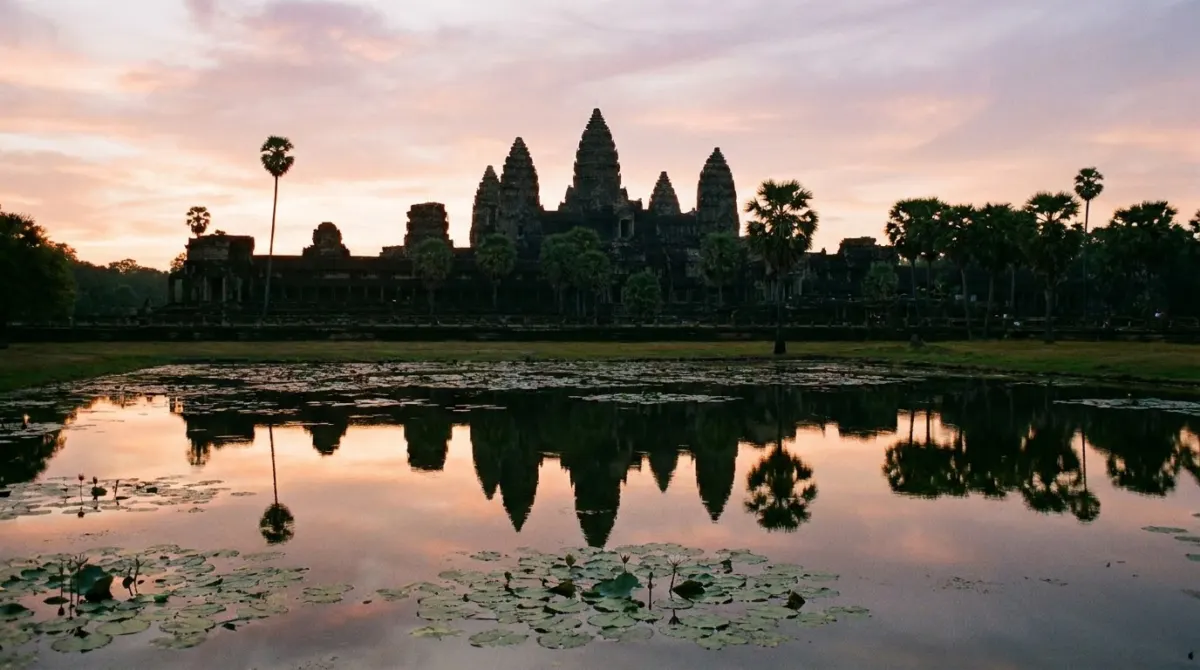
Sunrise at Angkor Wat: leave town around 5 a.m. to reach Angkor Wat before dawn. Crowds gather by the left-hand reflecting pool in front of the main towers, the classic spot. After sunrise, while most people go to breakfast, explore the temple itself: the long galleries of bas-reliefs, including the Churning of the Ocean of Milk, and, if it is open, the steep climb to the upper level, the Bakan. Angkor Wat is the largest religious monument in the world, built in the 12th century as a Hindu temple and later used by Buddhists.
Late morning: Angkor Thom. Enter the walled royal city through the South Gate, lined with stone gods and demons holding a giant serpent. At its center, the Bayon is famous for its more than 200 serene stone faces on dozens of towers. Walk on to the Baphuon temple, the Terrace of the Elephants and the Terrace of the Leper King.
Midday: return to town for lunch and a rest during the hottest hours.
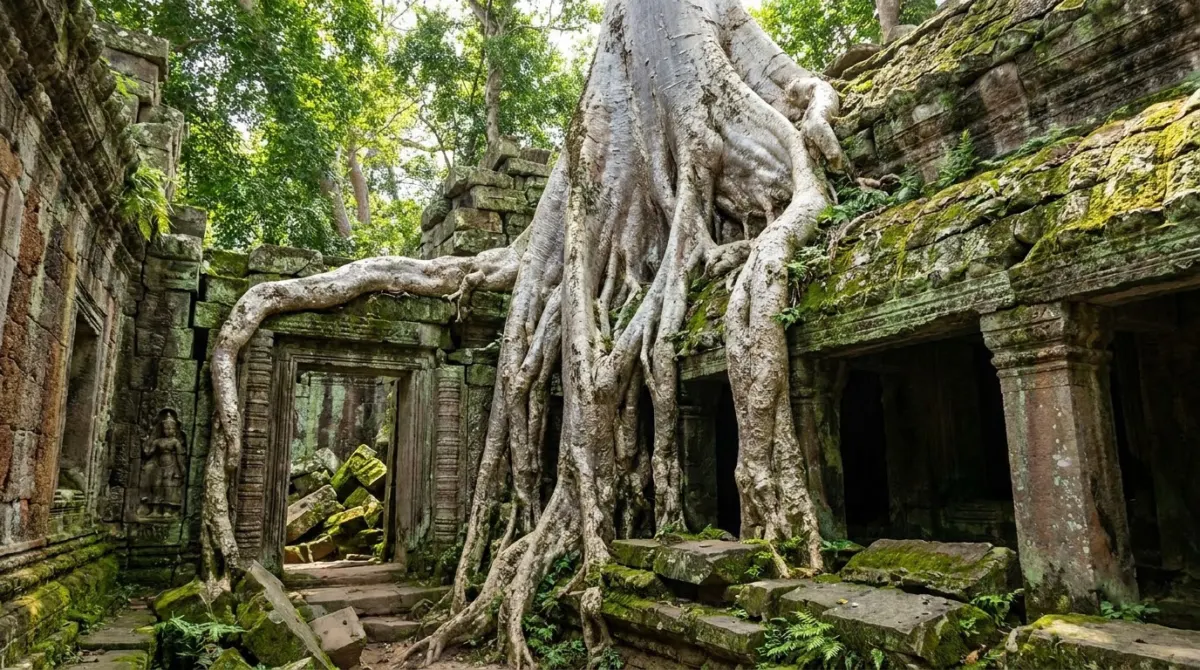
Afternoon: Ta Prohm. This temple has been left partly to the jungle, with giant silk-cotton and strangler fig trees growing out of the ruins. It is among the most atmospheric places at Angkor and is quieter in the late afternoon. If you have energy, end with sunset from the wide grounds of Angkor Wat or from Phnom Bakheng, a hilltop temple that limits the number of visitors at sunset.
Day 5: Banteay Srei and the Grand Circuit
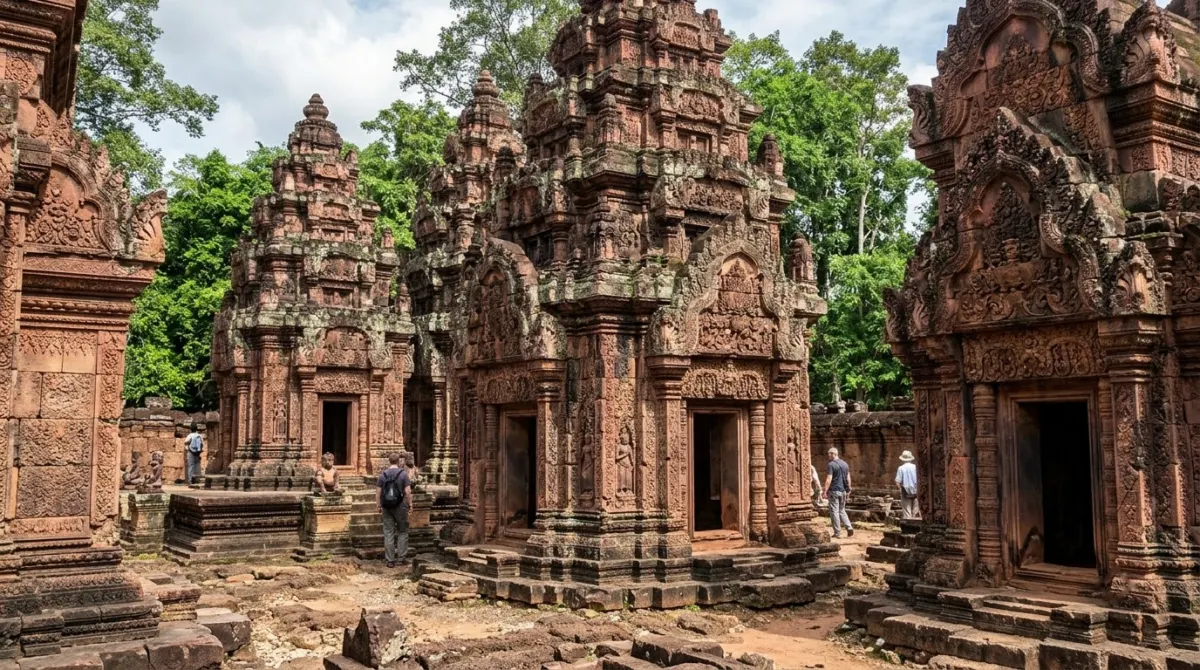
Morning: Banteay Srei. About 35 kilometers northeast of Siem Reap, roughly an hour by tuk-tuk or car, Banteay Srei is a small 10th-century temple built in pinkish sandstone. Its carvings are the finest and most delicate at Angkor, with gods, guardians and floral patterns that still look sharp after a thousand years. Arrive early, before the tour groups.
If you enjoy walking, continue another 30 minutes or so to Kbal Spean, the “River of a Thousand Lingas,” where Hindu symbols are carved into the riverbed. It is reached by an uphill forest trail of around 1.5 kilometers, so allow about two hours there in total. It is best after the rainy season, when there is water in the river.
Afternoon: the Grand Circuit. On the way back, follow the loop of temples east and north of Angkor Thom. Preah Khan is a vast, partly ruined complex of corridors, a quieter version of Ta Prohm. Neak Pean is a small shrine on an island in an artificial pond, reached by a long boardwalk. Ta Som has a gate topped by a large fig tree, and East Mebon has stone elephants at its corners.
Sunset: Pre Rup. This tall temple-mountain of brick and laterite, a short ride south of East Mebon, is a fine place to watch the sun go down over the treetops.
Day 6: Beng Mealea and the Tonle Sap floating villages
With two full days of the main temples done, use your last day for something different, outside the central Angkor area.
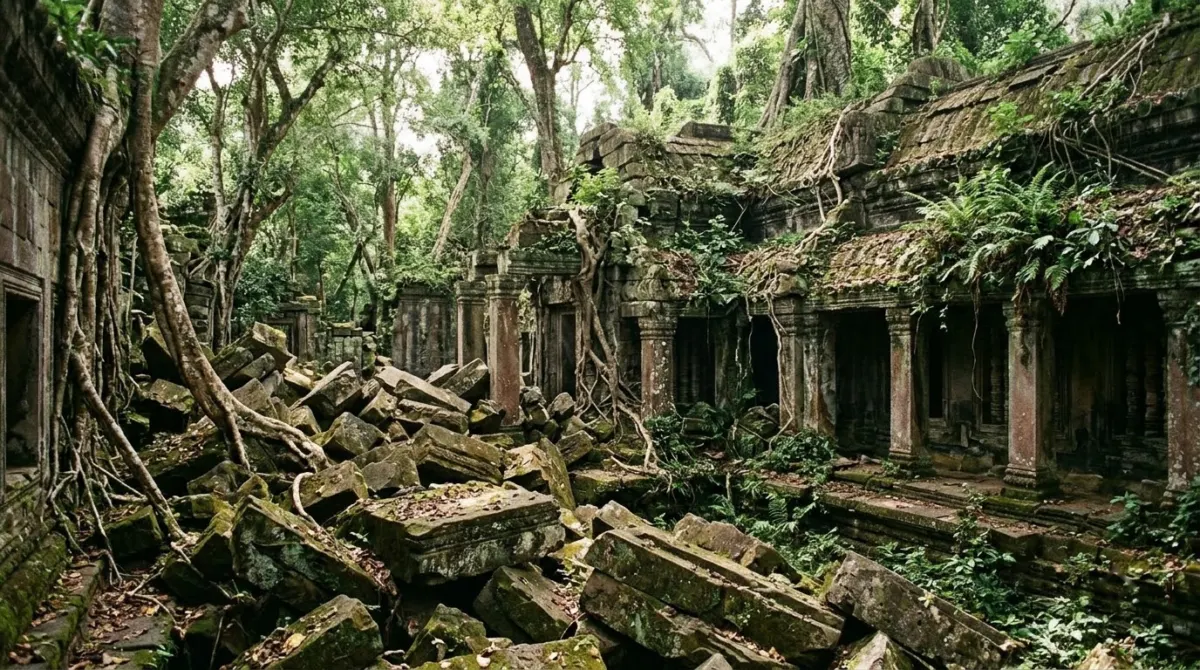
Morning: Beng Mealea. Around 65 kilometers east of Siem Reap, roughly an hour and a half by car, Beng Mealea is a huge 12th-century temple that has largely collapsed and been overtaken by forest. Wooden walkways lead over piles of carved stone, through courtyards and past galleries where trees grow through the walls. It feels like a lost city and sees far fewer visitors than the central temples. Angkor Enterprise sells a separate single-site ticket for Beng Mealea, and some guides say the Angkor pass also covers it, so check at the ticket office when you buy your pass.
Afternoon: Tonle Sap Lake. The Tonle Sap is the largest freshwater lake in Southeast Asia. In the rainy season it swells to several times its dry-season size, and the river feeding it reverses direction. The stilt-house villages around its edges are a remarkable sight. Kampong Phluk, south of Siem Reap, is one of the most visited, with houses on stilts up to around ten meters high and a flooded forest you can explore by small boat. In the dry season, water levels can be low, and boat trips may be shorter. Choose a responsible operator and avoid the most commercial tours.
Alternative: if you would rather stay close to town, take a Khmer cooking class, visit the Angkor National Museum, or return to the temples you liked best.
Day 7: A last morning in Siem Reap and departure
Morning: if your flight leaves in the afternoon, use your morning and the third day of your pass to revisit Angkor Wat or the Bayon in the quiet hours. Otherwise, the Angkor National Museum in town is a good, air-conditioned overview of the Khmer Empire, or you can browse the shops and workshops where local artisans train in stone carving, lacquerware and silk.
Getting out: Siem Reap’s airport is about an hour from town, so leave in good time. There are direct flights to regional hubs such as Bangkok, Singapore, Kuala Lumpur and Ho Chi Minh City, which are the usual connecting points for travelers heading back to the US. If your onward flight leaves from Phnom Penh, fly or take an early bus there the day before.
If you are continuing overland, note that the land border crossings between Cambodia and Thailand, including Poipet, remain suspended, so fly from Siem Reap to Bangkok instead. Buses still run from Phnom Penh to Ho Chi Minh City; the border crossing can be slow, so allow a full day.
Getting around Cambodia in one week
Between cities: the choice between Phnom Penh and Siem Reap is flight or road. Flying is quicker in the air but adds airport transfers at both ends, as both cities now have new airports far from the center. Express buses are cheap, reasonably comfortable and drop you near the center. A private car with driver is the most flexible, and you can stop at sights along the way, such as the pre-Angkorian temples of Sambor Prei Kuk, a UNESCO World Heritage Site near Kampong Thom.
Around the temples: the most popular option is a tuk-tuk, known locally as a remork, with a driver for the day. It is open-air, which is pleasant in the morning, and the driver waits for you at each temple. A car with air conditioning is a good choice in the hot months. Electric bikes and bicycles are available for the closer temples if you are comfortable in the heat. Licensed guides are a big help at Angkor Wat and the Bayon, where the carvings tell long stories.
In town: Grab and PassApp make it easy to call a tuk-tuk at an agreed price. Phnom Penh traffic is chaotic, so walking is best only for short distances along the riverfront.
Best time to visit Cambodia for this itinerary
November to February: cool and dry. This is the best time for temple-hopping, with lower humidity and pleasant mornings. It is also peak season, and Angkor Wat at sunrise is very busy, especially around Christmas, New Year and Chinese New Year.
March to May: hot. Temperatures regularly climb well above 90°F, and April is usually the hottest month. Khmer New Year, in mid-April, is a three-day national holiday when many Cambodians travel home and some businesses close. If you visit in these months, start at sunrise, take a long break at midday, and go back out in the late afternoon.
June to October: the green season. The rainy season brings short, heavy afternoon showers, lush scenery and full moats around the temples, with far fewer visitors. Roads to remote temples can be muddy, and some trails are slippery. September and October are usually the wettest months, but they are also when the Tonle Sap is at its fullest and the floating villages are most impressive.
Whatever the season, dress for the temples: lightweight clothing that covers shoulders and knees, a hat, and comfortable shoes for steep steps.
If you only have 5 days in Cambodia
With five days, focus on Siem Reap and Angkor, and keep Phnom Penh for another trip. Fly into Siem Reap directly, through Bangkok, Singapore or another regional hub, and stay four nights:
- Day 1: arrive, buy your Angkor pass, Old Market and Phare in the evening.
- Day 2: Angkor Wat sunrise, Angkor Thom and the Bayon, Ta Prohm in the afternoon.
- Day 3: Banteay Srei, then the Grand Circuit with Preah Khan and Neak Pean, sunset at Pre Rup.
- Day 4: Beng Mealea in the morning, Tonle Sap floating village in the afternoon.
- Day 5: Angkor National Museum or one last temple, then fly out.
If Phnom Penh’s history is a priority, the alternative is two nights in the capital and three in Siem Reap, dropping Day 6 of the main plan. Fewer than two full days at Angkor is not recommended; the site covers hundreds of square kilometers.
Adding more days to your Cambodia trip itinerary
Kampot and Kep (2 to 3 nights): on the south coast, around three hours by road from Phnom Penh, Kampot is a sleepy riverside town with colonial-era buildings, pepper farms and Bokor Mountain. Nearby Kep is famous for its crab market, where crabs are cooked with fresh Kampot pepper.
Battambang (2 nights): Cambodia’s second city, between Phnom Penh and Siem Reap, has French colonial architecture, a strong arts scene and countryside rides to hilltop temples. It is around three to four hours from Siem Reap by road.
The islands (3 nights): Koh Rong and Koh Rong Samloem, reached by ferry from Sihanoukville, have white-sand beaches and a slow island pace.
Vietnam: Cambodia pairs naturally with southern Vietnam. Buses run from Phnom Penh to Ho Chi Minh City in around seven hours, and there are short flights from Siem Reap and Phnom Penh. For the Vietnamese half of a combined trip, see our Vietnam itinerary for 7 days. Remember that you need a separate e-visa for Vietnam.
Laos: a Cambodia and Laos trip is easiest by flying from Siem Reap or Phnom Penh to Luang Prabang or Vientiane.
Map shows live availability and prices. We may earn a commission on bookings made through it, at no extra cost to you.
Bangkok is a short flight from Siem Reap or Phnom Penh, so you can continue with our Thailand itinerary for 7 days.
The short version
For a first Cambodia itinerary of 7 days, spend two nights in Phnom Penh for the Royal Palace, the National Museum, the riverside, Tuol Sleng and Choeung Ek, then travel to Siem Reap, by a 45-minute flight or a six-hour bus, for four nights at Angkor. Buy a three-day pass from the official Angkor Enterprise ticket office and use it for Angkor Wat at sunrise, Angkor Thom, Ta Prohm, Banteay Srei and the Grand Circuit, and add Beng Mealea and the Tonle Sap floating villages. Apply for your e-visa and fill in the arrival card on the official sites, bring clean US dollars, and go between November and February for the most comfortable weather.
Frequently asked questions
Is 7 days enough for Cambodia?
Yes, for the two main highlights. A week gives you two days in Phnom Penh and four in Siem Reap, which is enough to see Angkor properly without rushing. Add more days for the south coast, Kampot or the islands.
Do US citizens need a visa for Cambodia?
Yes. You can apply for a tourist e-visa on the official site, evisa.gov.kh, or get a visa on arrival at the international airports; both allow up to 30 days. Air travelers also complete a free online arrival card, so check the official sites before you go.
How many days do you need at Angkor?
Three days is ideal for most visitors: one for Angkor Wat, Angkor Thom and Ta Prohm, one for Banteay Srei and the Grand Circuit, and one for Beng Mealea or a slower revisit. Two days covers the essentials; one day feels rushed.
Can you use US dollars in Cambodia?
Yes. US dollars are widely used for hotels, tours, tuk-tuks and restaurants, and ATMs dispense dollars. Small change is given in Cambodian riel, and torn or damaged dollar bills are often refused.
Is it better to fly or take the bus from Phnom Penh to Siem Reap?
The flight takes about 45 minutes, but both cities’ airports are far from the center, so the door-to-door time saving is smaller than it looks. Express buses take around six hours and are cheap and comfortable enough.
What should I wear to Angkor Wat?
Lightweight clothing that covers your shoulders and knees, especially for the upper level of Angkor Wat and the Royal Palace in Phnom Penh. Bring a hat, sunscreen and shoes with good grip for steep stone steps.
When is the rainy season in Cambodia?
Roughly June to October, with short heavy showers, usually in the afternoon. It is a green, quieter time to visit Angkor, while November to February is the coolest and most popular season.
Written and checked by
Triplarks Editorial
An editorial desk, not an invented persona: research, drafting and fact-checking are done by the same small team. Every number here carries the date it was read.