Quick answer
Firostefani or Imerovigli give you the caldera without Fira’s crowds or Oia’s prices; Kamari and Perissa on the beach side cost around half as much and have the swimming. Count the steps and check the opening season before you book anything.
On this page
- Best hotels in Santorini: the two sides of the island
- Fira
- Firostefani and Imerovigli
- Oia
- The beach side
- What the caldera premium buys
- Cave houses, suites and sea views: what the words mean here
- Four things to check before booking
- What the villages are actually like
- Getting around Santorini
- Arriving with luggage
- When to go
- How many nights, and what each adds
- Santorini with other islands
- Santorini with children, and with limited mobility
- What to book before you arrive
- The short version
- Frequently asked questions
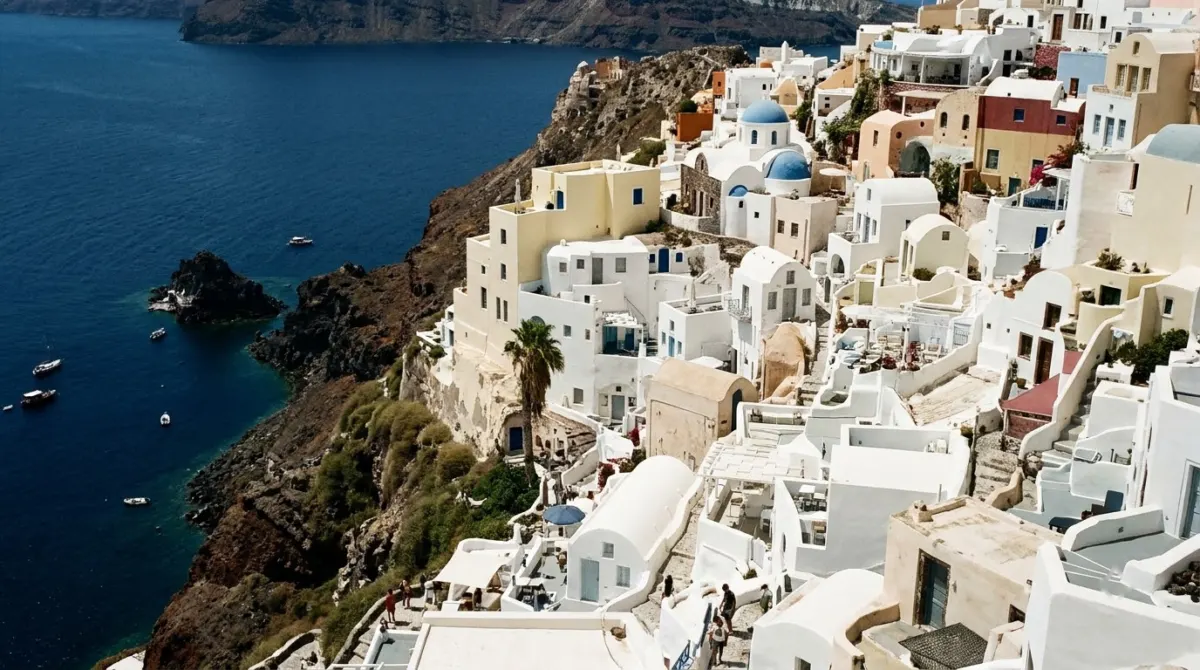
Santorini is a crescent of cliff around a flooded volcanic crater, and that geography decides everything about where to stay. There are two Santorinis: the caldera side, with the famous views and the stepped villages, and the beach side, which is flatter, cheaper and has the actual swimming.
Some links below are affiliate links. We may earn a commission if you book through them, at no extra cost to you. We do not rank hotels, and any prices on the map come live from the booking sites.
This guide is not a ranking of hotels. It is about which side suits your trip, what the caldera premium actually buys, and the four things to check before booking anything here. For how long to stay and how the island fits a wider trip, see how many days in Santorini and our Greece itinerary.
Best hotels in Santorini: the two sides of the island
| Side | Villages | What you get |
|---|---|---|
| Caldera | Fira, Firostefani, Imerovigli, Oia | The view, the sunsets, steps, high prices |
| Beach | Kamari, Perissa, Perivolos | Swimming, flat ground, half the price |
| Inland | Megalochori, Pyrgos, Emporio | Villages, quiet, a car needed |
One answer with no caveats: Firostefani or Imerovigli on the caldera, between Fira and Oia. You get the view and the walk, without Fira’s crowds or Oia’s prices.
Fira
The island’s capital sits in the middle of the caldera rim: the most shops, restaurants and nightlife, the bus station, and the cable car down to the old port.
It is the practical base and the busiest. Cruise passengers arrive here in the morning and the centre is crowded through the day.
Map shows live availability and prices. We may earn a commission on bookings made through it, at no extra cost to you.
Firostefani and Imerovigli
Ten and twenty-five minutes’ walk north along the rim, these are quieter versions of Fira with the same view and better walking.
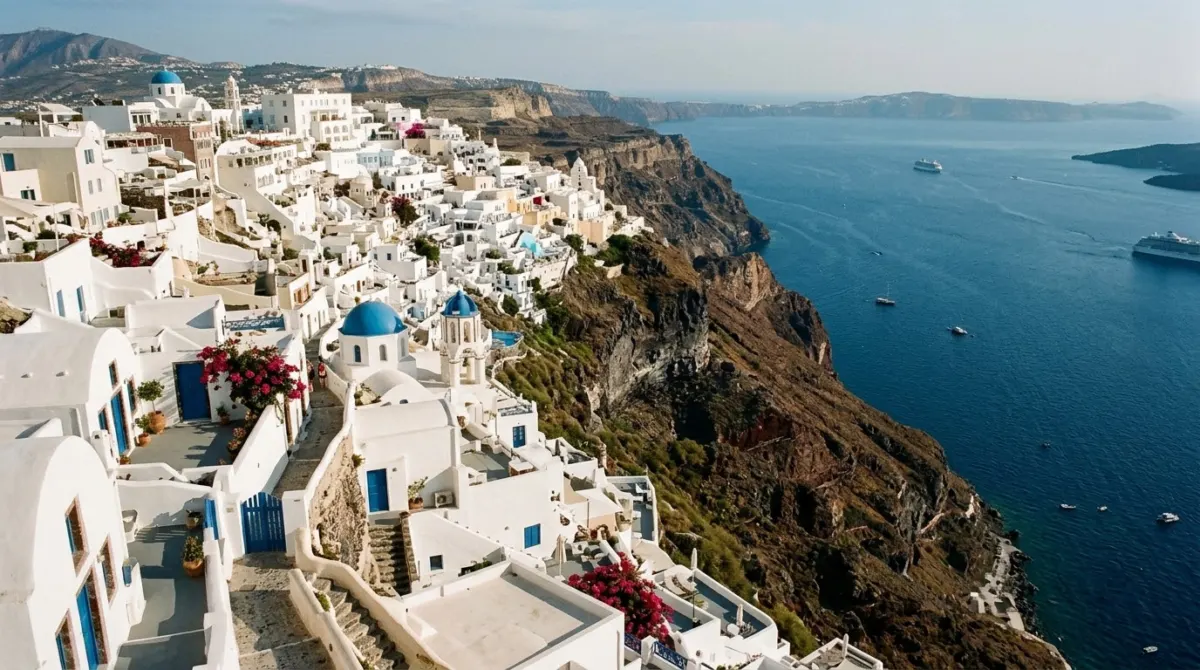
Imerovigli sits at the highest point of the caldera and is generally considered the best view on the island. Both are within walking distance of Fira’s restaurants along the clifftop path.
For most visitors, this is where the balance sits.
Oia
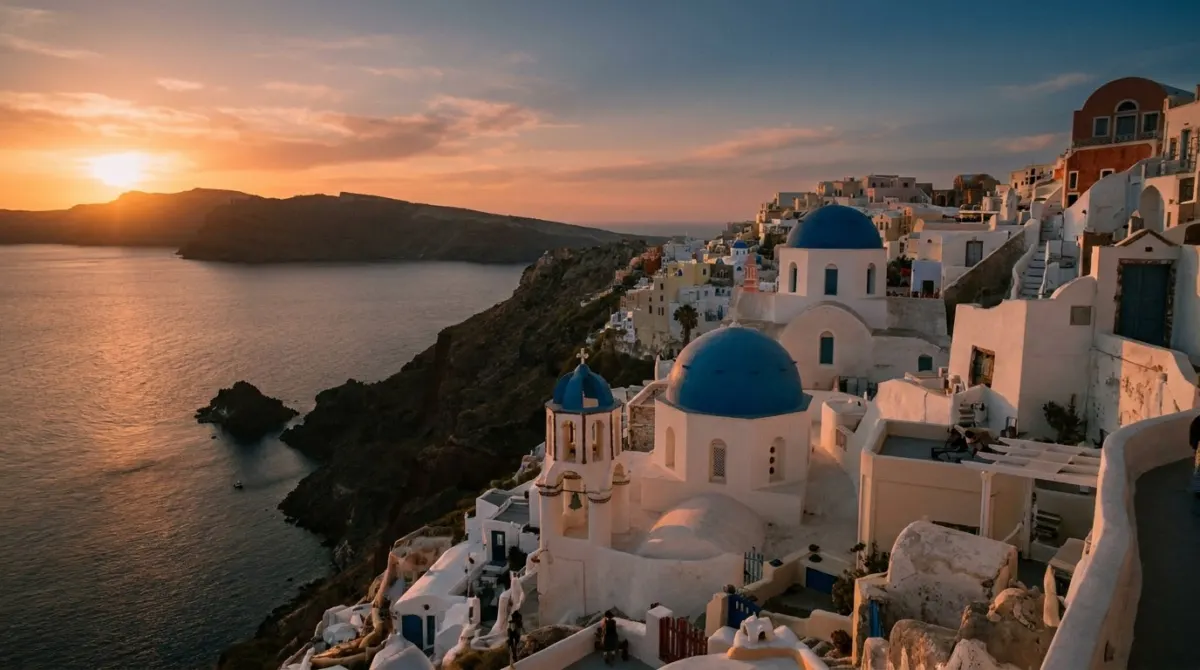
The famous one at the northern tip: white houses and blue domes stacked down the cliff, and the sunset that draws most of the island’s visitors every evening.
It is beautiful, extremely expensive, and crowded from late afternoon. Staying here means you have the village in the early morning when everyone else has gone, which is the strongest argument for it.
It also means a long walk or a bus to anywhere else.
The beach side
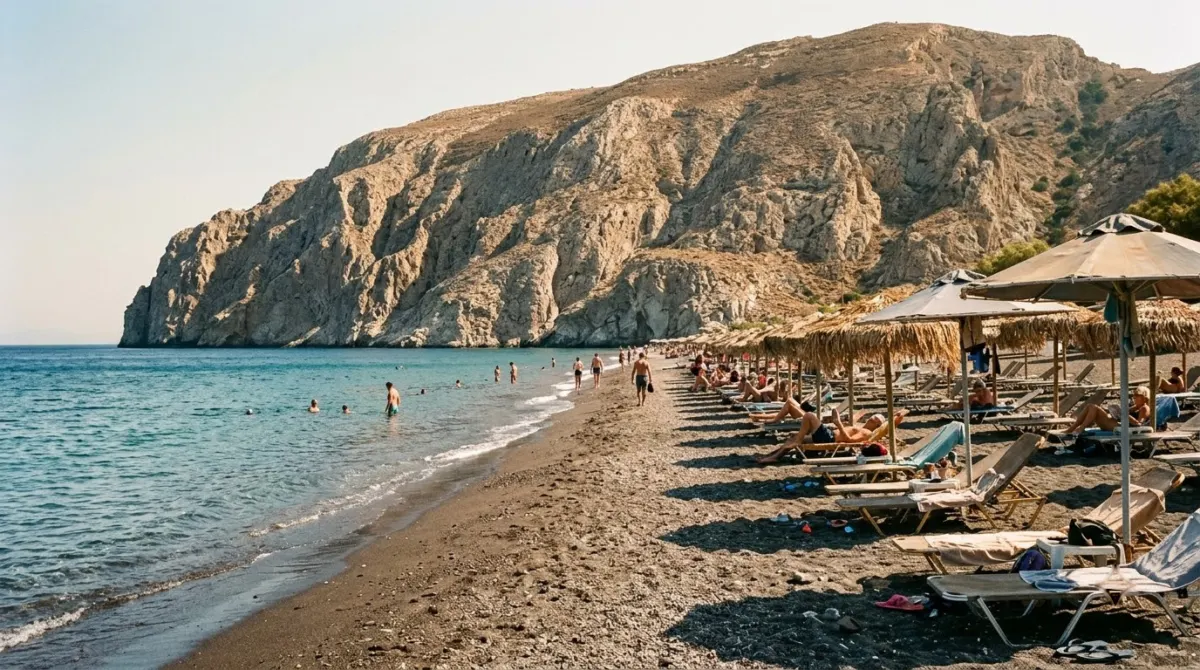
Kamari and Perissa, on the eastern and southern coasts, have black volcanic sand, a seafront strip of tavernas and hotels, flat ground and prices roughly half those on the caldera.
There is no caldera view and no sunset over the water. There is swimming, which the caldera side does not have in any practical sense.
For families, for longer stays, and for anyone who wants a beach holiday rather than a view, this is the sensible side.
What the caldera premium buys
A room with a caldera view costs a large multiple of an identical room facing inland, and it is worth understanding what you are paying for.
You are buying the terrace rather than the bedroom. The best caldera properties are built into the cliff in terraces, each with a private outdoor space and often a small plunge pool, and the view is the entire product.
If you will spend your days out and your evenings elsewhere, the premium is poor value. If you intend to sit on that terrace for three days, it is the whole point of Santorini.
Cave houses, suites and sea views: what the words mean here
Santorini listings use a vocabulary of their own, and three words do most of the work.
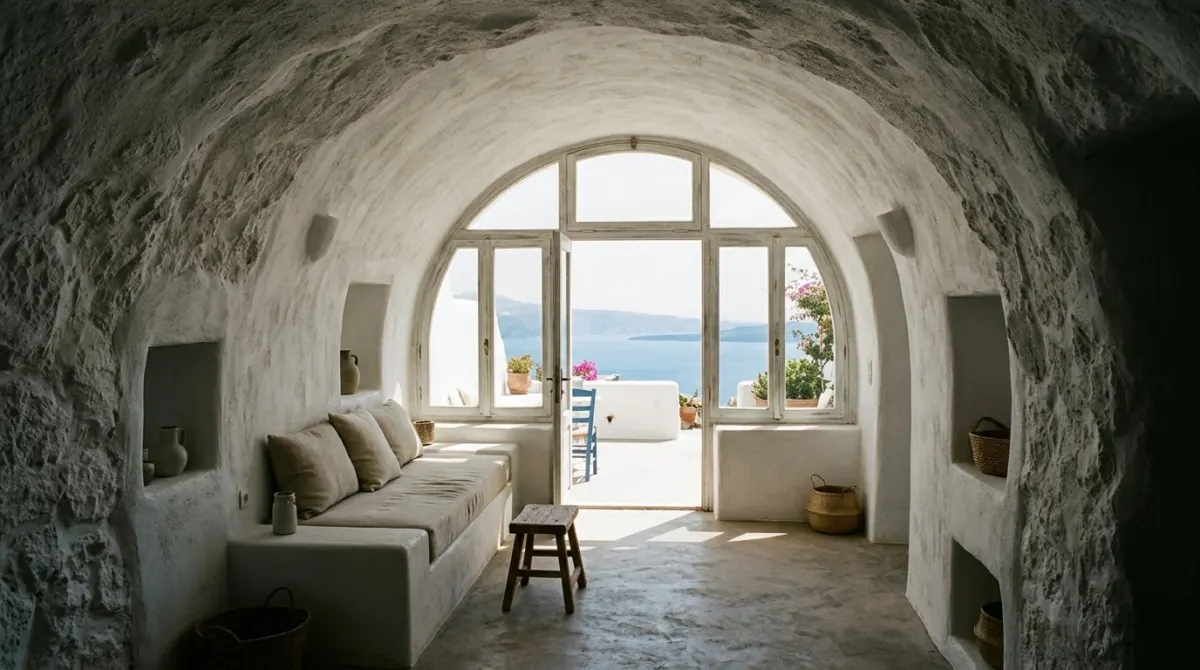
Cave house. The traditional dwelling of the caldera villages, dug back into the volcanic rock so that the room is barrel-vaulted and has one wall of window. Cool in August, dark at the back, and the reason the island looks the way it does. Most of the caldera-side properties are conversions of these.
Suite. On this island the word rarely means a separate sitting room. It usually means a cave room with a private terrace and often a plunge pool, which is what you are actually paying for.
Sea view versus caldera view. These are not the same thing and the difference is large. A caldera view faces west into the flooded volcano and the sunset. A sea view faces the open Aegean, usually from the eastern or southern coast, and is a perfectly good view of water with none of the drama or the premium.
An infinity pool on the caldera side is almost always small and shared between a handful of rooms; the large pools are on the beach side where there is flat ground to build them.
Four things to check before booking
How many steps. Caldera properties are built down a cliff, and some are two hundred steps below the nearest road.
Whether a vehicle can reach it, and whether there is a porter.
Whether the pool and view are private or shared, because photographs rarely make this clear.
Opening season. Much of the island closes from November to March, including hotels, restaurants and some ferry routes.
What the villages are actually like
Four caldera settlements, and they are not interchangeable.
Fira is a town: shops, bars, buses and cruise passengers. The most convenient and the least peaceful.
Firostefani is a ten-minute walk north and immediately quieter, with the same view.
Imerovigli is twenty-five minutes north at the highest point of the rim, residential and expensive, with the best outlook on the island.
Oia is at the far north, the most photographed and the most crowded at sunset, with the highest prices anywhere in the Cyclades.
The clifftop path links all four, which is the best walk on the island and the reason the middle villages work so well.
Getting around Santorini
Buses run from Fira to all the main villages and beaches and are frequent in summer, infrequent otherwise. Everything goes through Fira, so a cross-island journey usually means a change there.
Taxis are scarce and in high demand; pre-booking a transfer from the airport or port is normal.
Hiring a car or an ATV is common and the problem is parking, which in Oia and Imerovigli is genuinely difficult in season.
The cable car from Fira to the old port serves cruise arrivals and the donkey path beside it is best avoided.
Arriving with luggage
Worth planning, because caldera properties are built down cliffs.
Many have a porter service or a small vehicle that can reach part of the way, and most will arrange an airport transfer. Ask when you book rather than on the day, and tell them your arrival time.
If you are arriving by ferry, the new port at Athinios is a steep switchback road below Fira, and a transfer is effectively compulsory.
When to go
May, June, September and early October are the best months: warm, open and less crowded than peak.
July and August are hot, extremely busy and the most expensive weeks of the year.
November to March sees much of the island close, including many caldera hotels and restaurants, and ferry services reduce.
How many nights, and what each adds
Two nights covers your own village and a sunset, and most of it is spent arriving and leaving.
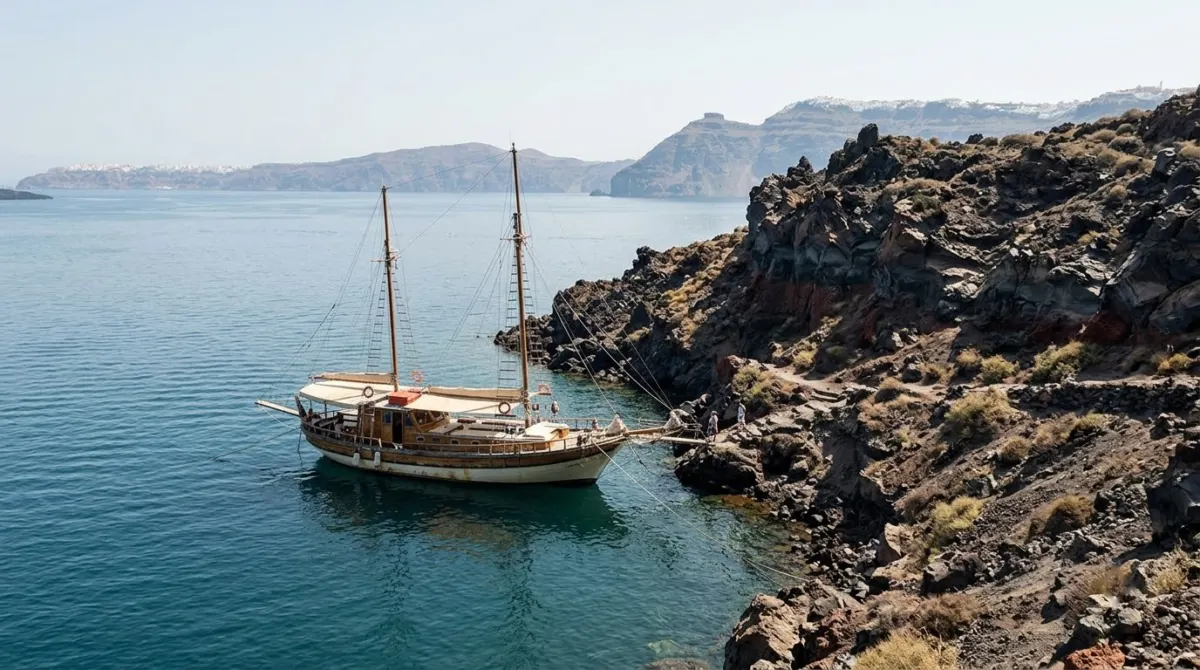
Three nights is the sensible minimum: a boat trip to the volcano and the hot springs, the Fira to Oia clifftop walk, and an evening that is not about the sunset.
Four or five nights adds a beach day on the east coast, the archaeological site at Akrotiri — a Bronze Age town buried by the eruption and far less visited than it should be — and a day doing nothing on the terrace you paid for.
Beyond five nights, most people are ready for a second island.
Santorini with other islands
Santorini is well connected by ferry, which makes it easy to combine.
Naxos and Paros are two to three hours away and are larger, cheaper and better for beaches and villages.
Crete is about two hours by fast ferry to Heraklion.
Mykonos is two to three hours and is the usual pairing, though the two islands are more alike in price than in character.
A common and sensible shape: three nights in Santorini for the caldera, then four or five somewhere larger and quieter.
Santorini with children, and with limited mobility
Both point the same way: the beach side.
The caldera villages are built down cliffs with stepped lanes, no vehicle access in places and long drops beside unfenced paths. They are difficult with a pushchair and genuinely hard with limited mobility.
Kamari and Perissa are flat, have sand, shallow entries and hotels at road level, and cost around half as much. The caldera is then a bus ride away for an afternoon and a sunset, which is the right way round for those trips.
What to book before you arrive
- Accommodation, months ahead for June to September, and earlier for Oia.
- Your airport or port transfer, because taxis are scarce and the port road is steep.
- A sunset dinner in Oia, if that is the plan, since the terraces fill.
- The volcano and hot springs boat, in high season.
What does not need booking is the bus network, the beaches or the clifftop walk, which are the three best cheap things on the island.
Check Santorini availability →
The short version
Firostefani or Imerovigli for the caldera at a sensible price, Oia if the early morning is worth the premium, Kamari or Perissa for swimming at half the cost. Count the steps before you book, confirm the porter, check whether the pool is private and whether the place is open in your month. Three nights minimum, and pay for the view only if you will sit on the terrace.
Frequently asked questions
Where should I stay in Santorini?
Firostefani or Imerovigli on the caldera rim for most visitors: the same view as Oia, the same walk to Fira's restaurants, and neither the crowds of one nor the prices of the other.
Is a caldera view worth the money?
It is a large premium and you are paying for the terrace rather than the room. If you will sit on it for three days, it is the point of Santorini. If you will be out all day, the beach side costs half as much.
Can you swim on the caldera side of Santorini?
Not in any practical sense — the caldera is a cliff with a few small platforms at the bottom. The swimming is on the east and south coasts at Kamari, Perissa and Perivolos, which have black sand beaches.
Is Oia worth staying in?
If the early morning matters to you. Oia is crowded from late afternoon for the sunset, and staying there means having the village before and after. It is the most expensive part of an expensive island.
What should I check before booking in Santorini?
How many steps lie between the road and the door, whether a vehicle can reach it and whether there is a porter, whether the pool and view are private or shared, and whether the property is open in your month.
When does Santorini close?
Much of the island shuts from November to March, including many hotels and restaurants and some ferry routes. April and October are shoulder months with some places just opening or closing.
Keep planning Greece
- Where to Stay in Rhodes: You Are Picking a Side, Not a Town
- Where to Stay in Naxos: The Beds Are All on One Beach
- Where to Stay in Crete: Three Cities on One Road
- Where to Stay in Mykonos: Every Beach Is a Dead End
- Where to Stay in Santorini: The Caldera Side Has No Beaches
- Where to Stay in Athens: Best Areas Near the Acropolis
- How Many Days in Santorini? Three, and You Are Buying Hours Not Sights
- How Many Days in Athens? Two Is the Honest Answer
Written and checked by
Triplarks Editorial
An editorial desk, not an invented persona: research, drafting and fact-checking are done by the same small team. Every number here carries the date it was read.