
Athens is not a city where any central neighborhood will do. Unlike Rome or Barcelona, the center of Athens is genuinely uneven — there are streets ten minutes from the Acropolis that nobody would recommend sleeping on, and there are quiet residential areas that same distance away which are the best value in the city.
Some links below are affiliate links. We may earn a commission if you book through them, at no extra cost to you. We do not rank hotels, and any prices on the map come live from the booking sites.
Quick answer: where to stay in Athens. Plaka for a short first visit, Koukaki for anything longer. Both are within walking distance of the Acropolis, and they differ mainly in whether your neighbours are visitors or residents.
The organizing fact is the Acropolis. It sits on a rock in the middle, everything worth seeing is arranged around its base, and how far you are from it decides how much of your day you spend on the metro.
Areas, transport and safety details checked 7 September 2026.
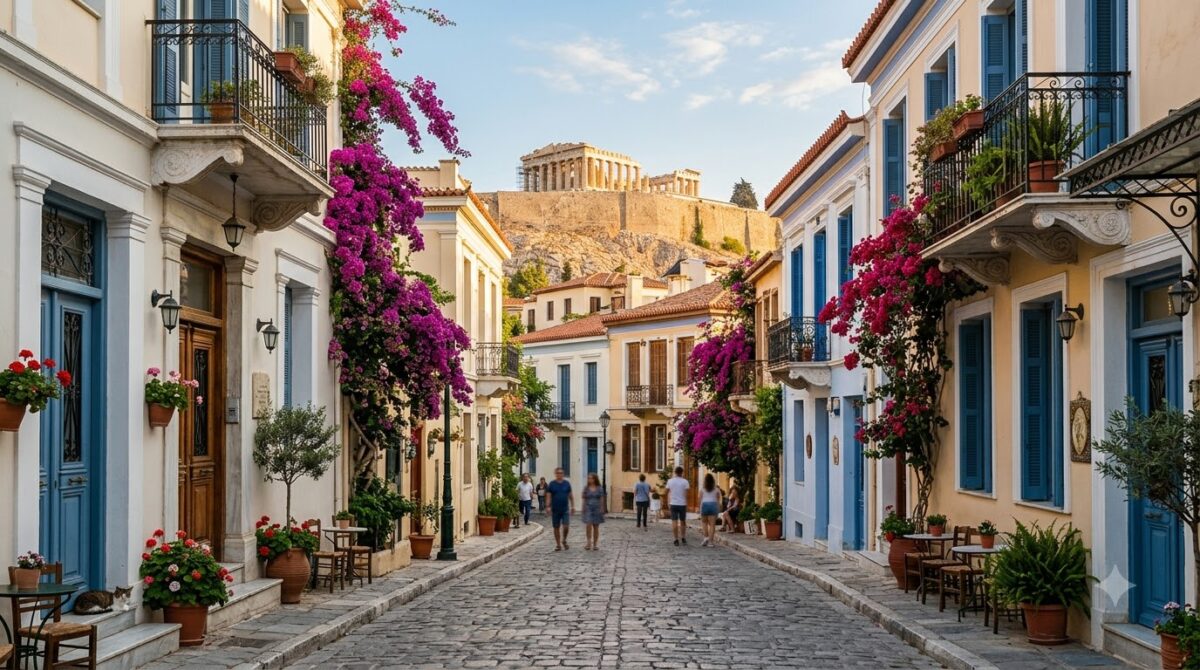
The best areas to stay in Athens, at a glance
| If you are | Best place to stay | Walk to Acropolis |
|---|---|---|
| A first time visitor, two or three nights | Plaka | 5 min |
| Wanting central and convenient | Monastiraki or Syntagma | 10 min |
| Wanting quiet and value | Koukaki | 10 min |
| Here for food and nightlife | Psyrri | 15 min |
| Wanting upmarket and calm | Kolonaki | 20 min |
| Adding beach days | The Athens Riviera | Tram ride |
| On an early flight | Near Athens airport, one night only | — |
If you want one answer: Plaka for a short first visit, Koukaki for anything longer. Both are within walking distance of the Acropolis, and they differ mainly in whether your neighbors are visitors or residents.
Plaka: the postcard, and the obvious choice
Plaka is the old quarter wrapped around the northeast slope of the Acropolis: neoclassical houses, bougainvillea, stepped lanes, and tavernas with terraces.
- The closest you can sleep to the Acropolis without being on it. Five to ten minutes on foot to the entrance.
- Walkable to almost everything — the Acropolis Museum, the Ancient Agora, Monastiraki and Syntagma are all within fifteen minutes.
- The prettiest streets in central Athens, particularly Anafiotika, the tiny whitewashed island-style village on the rock itself.
- Safe and well lit, which is not true of everywhere central here.
The trade-offs: it is the most touristed part of the city, so restaurants on the main lanes are aimed squarely at visitors and priced accordingly. It is also stepped and cobbled, which is hard work with a suitcase. And prices are the highest in central Athens outside Kolonaki.
Book here if you have two or three nights and want to step out of the door into the good part. Walk three streets off the main lanes to eat.
Map shows live availability and prices. We may earn a commission on bookings made through it, at no extra cost to you.
Monastiraki and Syntagma: the most convenient
Monastiraki is the square where the flea market, the metro and the Ancient Agora meet, with the Acropolis directly above it. Syntagma is ten minutes north, where parliament, the National Garden and the airport metro line are.
- The best transport in the city. Monastiraki has two metro lines; Syntagma has two more plus the direct airport line and the airport bus.
- Ten minutes to the Acropolis, and central to everything else.
- Rooftop views are the specialty here. Several hotels around both squares have terrace bars looking straight at the lit Acropolis, and that view is genuinely the best thing you can buy in Athens.
- Plenty of Athens hotels at every level, including large international names around Syntagma and grand older properties like the Electra Palace on the Plaka side.
The catch is noise. Monastiraki square and the streets around Ermou are busy until late, and the flea market area is loud from early. Ask for a room off the square, or high up.
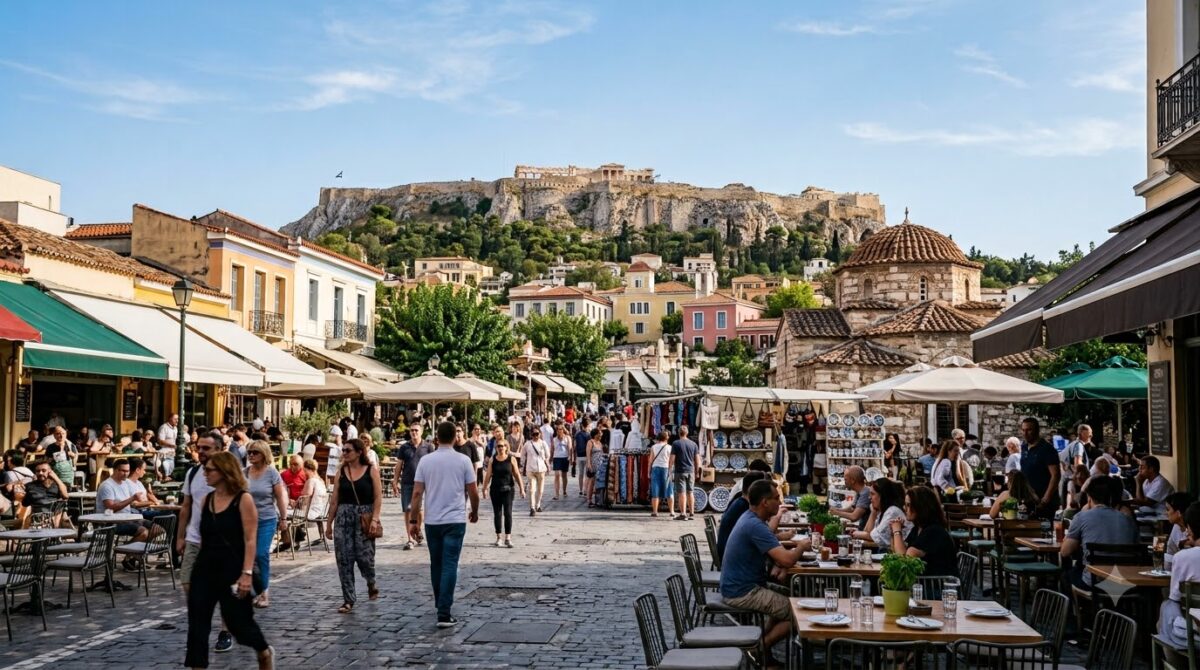
Koukaki: the best value in central Athens
Koukaki sits on the south side of the Acropolis, immediately behind the Acropolis Museum. It is residential, was almost unknown to visitors a decade ago, and is now the recommendation most people who know Athens give.
- Ten minutes on foot to the Acropolis entrance, along the pedestrianized Dionysiou Areopagitou, which is one of the best walks in the city.
- Genuinely residential. Bakeries, greengrocers, families, and cafes full of Athenians rather than tour groups.
- Noticeably cheaper than Plaka for a comparable room, and apartments are larger.
- Quiet at night, and flat, which Plaka is not.
- Syngrou-Fix and Akropoli metro stations at either end.
The trade-off: it is ordinary to look at. Modern apartment blocks, not neoclassical houses. If part of what you want is charm on the doorstep, this is not it.
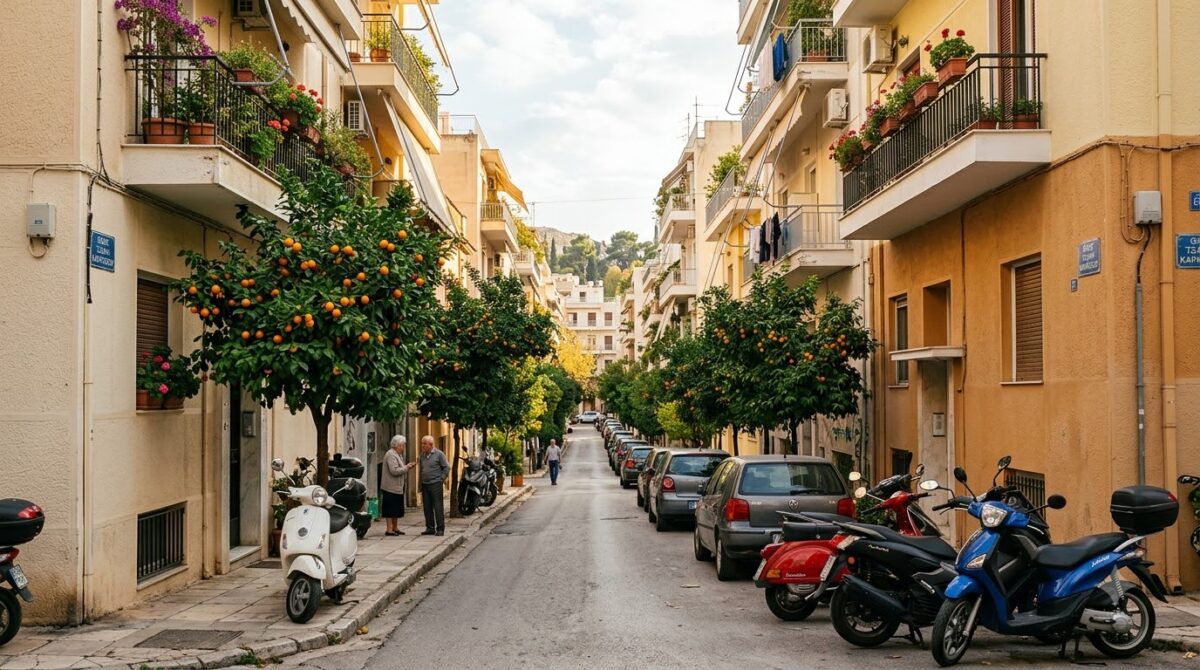
Psyrri: food, bars and street art
Psyrri is northwest of Monastiraki, a formerly industrial quarter now full of small bars, meze restaurants and murals. It has the best night out in central Athens.
- The densest eating and drinking in the city center, and prices below Plaka.
- Fifteen minutes to the Acropolis and five to Monastiraki metro.
- Character in a way the polished areas are not — workshops next to wine bars, and street art everywhere.
Be selective about the street. Psyrri is uneven block to block, loud where the bars are, and it shades into rougher territory as you go north towards Omonia. Read recent reviews and check the exact address rather than the neighborhood name.
Kolonaki: upmarket and quiet
Kolonaki is on the slope of Lycabettus Hill, northeast of Syntagma. It is the smart district: designer shops, embassies, good coffee, and the Benaki and Cycladic Art museums.
It suits travellers who want calm and are happy to walk twenty minutes or take the metro to the ancient sites. Some of the best luxury hotels in Athens sit here or on the edge of it, and the neighborhood empties pleasantly at night.
It does not suit a two-night first visit, because you spend the walk to the Acropolis every morning and evening.
The Athens Riviera: staying by the sea
The coast south of the city — Glyfada, Voula, Vouliagmeni — is the Athens Riviera, with beaches, marinas and resort hotels. The tram runs down to it from the center in about 40 minutes.
This works well if you are combining Athens with beach days, travelling with children, or arriving before an island trip and want to slow down. Several hotels here have an outdoor pool, which almost nothing in central Athens does.
It does not work as a base for sightseeing. Forty minutes each way eats a two or three day city trip.
Where not to stay in Athens
- Omonia. Central on the map, and the least pleasant square in the city, with the worst street problems after dark. Cheap rooms cluster here for that reason.
- Around Larissa station and Metaxourgeio’s northern edge. Improving in parts, still uneven.
- Near Athens airport, except for one night. The airport hotels including the Sofitel Athens Airport are genuinely convenient for a dawn flight and nothing else — the airport is 45 minutes from the city.
- Exarchia, unless you know why you are choosing it. Politically charged, full of good bars and bookshops, and not a first-visit neighborhood.
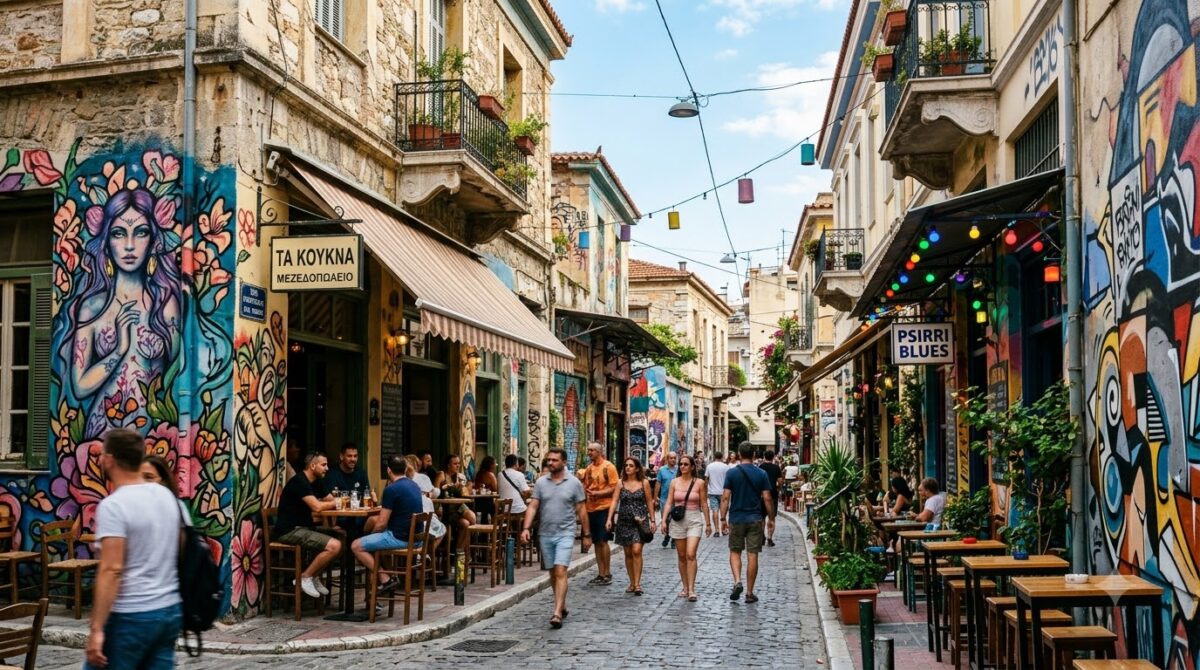
What to look for in Athens hotels
- A rooftop with an Acropolis view. This is the one upgrade in Athens genuinely worth paying for, and dozens of mid-range hotels have one. Check whether the terrace actually faces the rock.
- Air conditioning, non-negotiable from June to September. Athens summers regularly pass 35 degrees.
- Which floor and whether there is a lift, particularly in Plaka where buildings are old and stepped.
- Distance to a metro station, because the airport line matters at both ends of the trip.
- Boutique stay or big hotel. Athens has an unusually good supply of small design hotels in converted neoclassical buildings, mostly in Plaka, Koukaki and Psyrri.
Getting to and from Athens airport
- Metro line 3 runs from the airport to Syntagma and Monastiraki in about 40 minutes. Simple, cheap and the best option if your hotel is central.
- The X95 bus to Syntagma runs 24 hours and takes about an hour depending on traffic.
- Taxis have a fixed fare between the airport and the city center, set by the authorities, with a higher night rate. Agree it is the fixed fare before setting off.
How many nights in Athens?
Two full days covers the essentials; three is comfortable. For a fuller breakdown of what each extra day buys, see how many days in Athens.
If Athens is the start of an island trip, our Greece itinerary sets out how many islands realistically fit after it.
The best places to stay in Athens, compared
The same areas in Athens side by side, because choosing a place to stay is a comparison rather than a list.
| Area | Feel | Price | Noise | Metro |
|---|---|---|---|---|
| Plaka | Neoclassical, touristed | High | Moderate | Akropoli, Monastiraki |
| Monastiraki | Busy, central | Mid to high | High | Two lines |
| Syntagma | Formal, civic | Mid to high | Moderate | Two lines plus airport |
| Koukaki | Residential, plain | Mid | Low | Akropoli, Syngrou-Fix |
| Psyrri | Bars, murals | Mid | High | Monastiraki, Thissio |
| Kolonaki | Smart, calm | High | Low | Evangelismos |
| Athens Riviera | Coastal, resort | Varies | Low | Tram only |
Notice the pattern: in central Athens, the areas that are most walkable to the ancient sites are also the ones where you pay most and sleep least. Koukaki is the exception, and that is why it keeps coming up.
What is within walking distance of what
Central Athens is compact, and once you know the distances the neighborhood choice becomes obvious.
- Acropolis to Acropolis Museum — 5 minutes, both on the south side.
- Acropolis to Plaka — 5 to 10 minutes downhill.
- Plaka to Monastiraki — 10 minutes.
- Monastiraki to Syntagma — 10 minutes along Ermou.
- Syntagma to the National Garden — on its edge.
- Koukaki to the Acropolis entrance — 10 minutes, flat, along a pedestrian street.
- Monastiraki to Psyrri — 5 minutes.
- Syntagma to Kolonaki — 10 minutes uphill.
Everything above is one walk. If your hotel is anywhere in Plaka, Monastiraki, Syntagma, Koukaki or Psyrri, you will barely use the metro except to reach the airport. That is the real argument for staying in the center of Athens rather than further out.
Athens hotels: what each band gets you
Athens is one of the better value capitals in Europe for accommodation, and the bands are unusually distinct.
- Luxury hotels cluster around Syntagma and Kolonaki, with a handful of grand older properties on the Plaka edge. What you buy at the top end here is a rooftop restaurant and a view rather than a large room.
- A boutique stay is the characteristic Athens option: small design hotels in converted neoclassical buildings, mostly in Koukaki, Plaka and Psyrri. Twenty to forty rooms, usually with rooftop views.
- Mid-range hotels around Monastiraki and Syntagma are plentiful and often have terraces facing the Acropolis, which is where the value is.
- Apartments are good value in Koukaki and suit stays over four nights.
- Hostels are concentrated near Monastiraki and Omonia. The Monastiraki ones are fine; check the address carefully on the cheaper listings.
Many favorite hotels in Athens are chosen for one feature: an outdoor terrace or a small rooftop pool with the Acropolis in view. In a city this hot in summer, that matters more than the room.
Athens as a base for the islands
Most people visiting Athens are also heading to the islands, and that changes where to stay near the end of the trip.
- Piraeus is the main port, about 30 minutes from central Athens on metro line 1. Ferries to the Cyclades, including Milos, Naxos and Santorini, leave from there.
- Rafina is the second port, closer to the airport, and serves some Cycladic routes. Check which one your ferry uses.
- Do not stay in Piraeus unless your ferry leaves before about seven in the morning. It is a working port town and there is nothing to do there.
- Staying near Syntagma or Monastiraki gives you the easiest run to both the port and the airport.
For how the islands fit around Athens, see our Greece itinerary.
A short neighborhood guide for a first trip to Athens
If you strip this whole page down to the decision most people are actually making, it is between two things: staying in the heart of Plaka, or staying somewhere plainer and cheaper an easy walk away.
Stay in the center, in Plaka or Monastiraki, if: you have two or three nights, you want cobblestone streets and cafes and restaurants outside the door, and you would rather pay than walk. Being perfectly located in Plaka genuinely does improve a short trip to Athens, because you spend no time in transit and the neighborhood itself is part of the experience.
Stay in Koukaki if: you have four nights or more, you want great value and a bigger room, and a ten minute walk each morning does not bother you. This part of Athens gives you a residential experience and the same access to the major sights.
Plaka and Monastiraki run into each other, so the practical difference between them is small: Plaka is quieter and prettier, Monastiraki is louder and better connected. Either is a good base for the main attractions.
What the buildings are like
One thing that surprises people about accommodation here: much of the good mid-range stock is in restored neoclassical buildings from the nineteenth century, converted room by room.
- They are beautiful and they are old. High ceilings, tiled floors, small bathrooms, and often no lift.
- Ask which floor before you book your hotel, particularly in Plaka where the streets are stepped as well.
- A hotel with a rooftop is the thing to filter for. In this city the terrace is where you will spend your evenings, and the Acropolis view from one is the memory people keep.
- Landmark older hotels such as the Athens Gate Hotel on the south side and the Divani Palace group near the Acropolis Museum are useful reference points when you are working out where a listing sits on the map.
Museums and sights near each base
Where you sleep decides which museums are a five minute walk and which are a metro ride.
- From Plaka or Koukaki — the Acropolis, the Acropolis Museum and the Ancient Agora are all on foot.
- From Syntagma or Kolonaki — the Benaki Museum and the Museum of Cycladic Art are minutes away, and both are excellent and quiet.
- From Monastiraki — the Ancient Agora is at the end of the street, and Thissio and Kerameikos are a short walk west.
- The National Archaeological Museum is the outlier, north of the center near Omonia. Everyone visits it and almost nobody sleeps near it, which is the right way round.
Given the time in Athens most people have — two or three days — being able to walk to the Acropolis group matters more than being near any single museum.
Checking current rates in Athens
Everything above is about position — which area suits which kind of trip. What it deliberately does not do is quote prices, because rates in Athens move a long way by season, by day of the week and by how far ahead you book, and any figure printed in a guide is out of date the week after it is written.
These searches show live availability and current prices, so you can check them against the areas described above:
These are affiliate links. If you book through one we may earn a commission, at no extra cost to you. It does not affect which areas we recommend above — nobody pays to be listed here.
Heading to the islands? Our guide to where to stay in Santorini covers both sides of the island.
Frequently asked questions
What is the best area to stay in Athens for the first time?
Plaka for a short visit, Koukaki for anything longer. Plaka is the prettiest area and five to ten minutes from the Acropolis, though it is heavily touristed and stepped. Koukaki is behind the Acropolis Museum, equally close, flat, quieter and cheaper, but it is residential rather than picturesque.
Is Plaka a good place to stay in Athens?
Yes, for two or three nights. It is the closest neighborhood to the Acropolis, safe, well lit and beautiful. The drawbacks are price, restaurants on the main lanes aimed at visitors, and cobbled steps that are hard work with luggage. Eat three streets off the main routes and it is an excellent base.
Where should I stay in Athens to be near the Acropolis?
Plaka on the northeast slope and Koukaki on the south side are both about ten minutes on foot from the entrance. Monastiraki is a similar distance and adds two metro lines. Anywhere in those three puts the Acropolis, the Acropolis Museum and the Ancient Agora within walking distance.
Is Athens safe at night?
Central Athens is generally safe, with pickpocketing rather than violence the real risk, concentrated on the metro and around Monastiraki. The exceptions are specific: Omonia square and the streets immediately around it are unpleasant after dark, as is the northern edge of Metaxourgeio. Plaka, Koukaki, Kolonaki and Syntagma are all comfortable.
Should I stay on the Athens Riviera?
Only if you want beach time or are travelling with children. The coast at Glyfada and Vouliagmeni has beaches, marinas and hotels with pools, which central Athens lacks, but it is about 40 minutes by tram from the ancient sites. As a sightseeing base it costs you too much of a short trip.
Is it worth paying for a hotel with an Acropolis view?
Yes, and it is the best value upgrade in the city. Plenty of mid-range hotels in Plaka, Monastiraki and Koukaki have rooftop terraces facing the rock, and the Acropolis lit at night from your own terrace is the thing people remember. Check that the terrace actually faces it rather than simply existing.
Where should I stay in Athens before an early flight?
An airport hotel, for that one night only. Athens airport is about 45 minutes from the city center, and the metro does not run all night. Spend the rest of the trip centrally and move out only for the final night if your flight is before about eight in the morning.