Quick answer where to stay in Oaxaca
The centro puts you within walking distance of everything in this guide except the day trips. North of Santo Domingo is quieter and still a ten-minute walk in; Jalatlaco is the atmospheric choice, full of small guesthouses.
On this page
- The 10 best things to do in Oaxaca at a glance
- The historic center: Santo Domingo, the Zócalo and the walkable core
- Jalatlaco and the neighborhoods beyond the city center
- Oaxaca markets: Mercado 20 de Noviembre and the rest
- Mezcal: what to drink and where
- A cooking class, Casa Oaxaca, and why food in Oaxaca is the reason to come
- Museums: Museo de las Culturas de Oaxaca and the Jardín Etnobotánico de Oaxaca
- Monte Albán: the archaeological site above the city
- The Oaxaca day trip: Hierve el Agua, Árbol del Tule and the valley
- Day of the Dead in Oaxaca: Día de los Muertos and the rest of the calendar
- A free walking tour, the history of Oaxaca, and your first day
- Unusual and fun things to do in Oaxaca
- How to get to Oaxaca from Mexico City, and when to travel to Oaxaca
- Where to stay in Oaxaca
- Is Oaxaca safe?
- The best time to visit Oaxaca
- Beyond the city: Oaxaca state and the Pacific coast
- The last thing to do in Oaxaca before you leave
- Frequently asked questions
You can walk the whole historic center of Oaxaca City in a morning. That is not a criticism, and it is the single most useful thing to know before you plan.
Some links below are affiliate links. We may earn a commission if you book through them, at no extra cost to you. We do not rank hotels, and any prices on the map come live from the booking sites.
The sights here cost almost nothing in time. The day trips cost a whole day each. Templo de Santo Domingo, the Zócalo, a museum and a wander through Jalatlaco fit comfortably into one day. Monte Albán is half a day. Hierve el Agua is all of one. Mitla and the Árbol del Tule are another. Stack those and a week disappears without you ever feeling rushed.
And there is a third category that is not sightseeing at all. The markets and the food in Oaxaca are meals, not attractions, so they sit outside the time budget entirely. You have to eat anyway.
Oaxaca is known for three things above all: the food, the mezcal and the craft. None of them is a monument, which is why a visit to Oaxaca is planned differently from a trip to almost any other city in Mexico.
Opening days, locations, transport options and travel times read 10 September 2026. Hours and closures change, so check before you set out.
The 10 best things to do in Oaxaca at a glance
| What | Where | Time it costs |
|---|---|---|
| Templo de Santo Domingo | City center | An hour |
| The Zócalo and the arcades | City center | An evening |
| Mercado 20 de Noviembre | City center | A long lunch |
| Museo de las Culturas de Oaxaca | City center | Two hours |
| Jardín Etnobotánico de Oaxaca | City center | Two hours, tour only |
| Jalatlaco | Edge of the city | A morning |
| A cooking class | In and around the city | Most of a day |
| Monte Albán | 20 min outside | Half a day |
| Hierve el Agua | 2 hours outside | A full day |
| Árbol del Tule and Mitla | East of the city | A full day |
If you only have two days: that is the whole itinerary. The city center and the markets on the first, Monte Albán and a mezcal tasting on the second. Everything else is a reason to stay longer. Among places to visit in Mexico this is one of the best places to spend a slow week rather than a fast weekend.
The historic center: Santo Domingo, the Zócalo and the walkable core
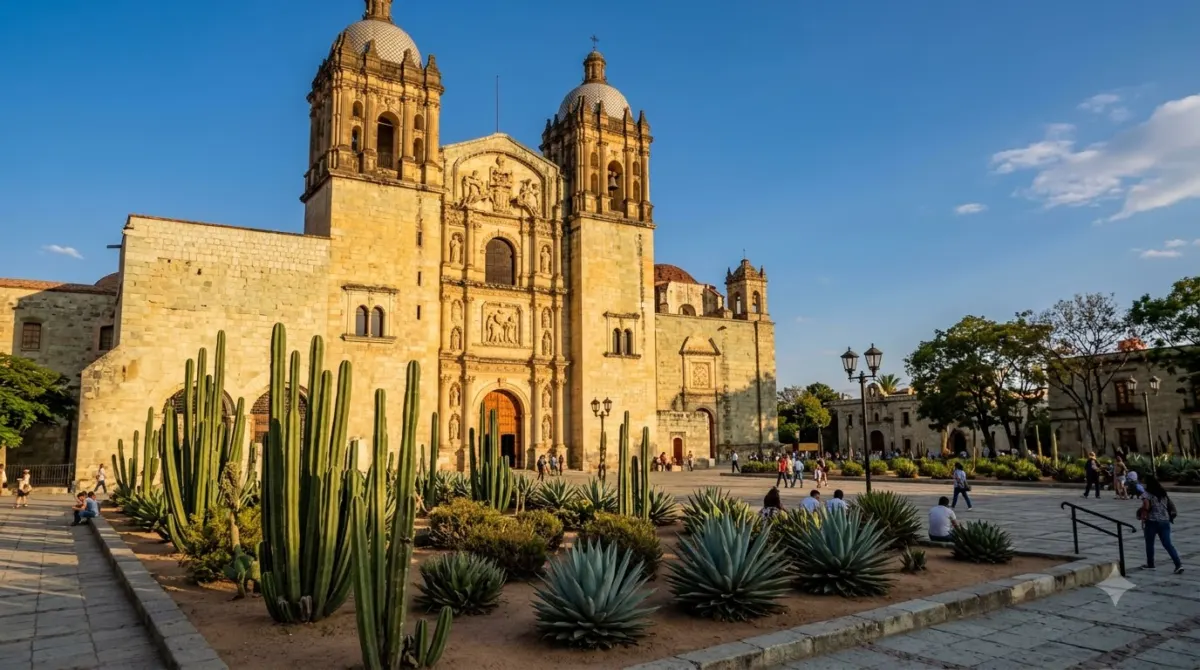
Oaxaca’s city center is a grid of low colonial buildings in colors that would look absurd anywhere else, and it is a UNESCO World Heritage Site in its own right.
- Templo de Santo Domingo is the one building everybody photographs. The interior is covered in gilded plasterwork and it takes about an hour, less if you are not looking up.
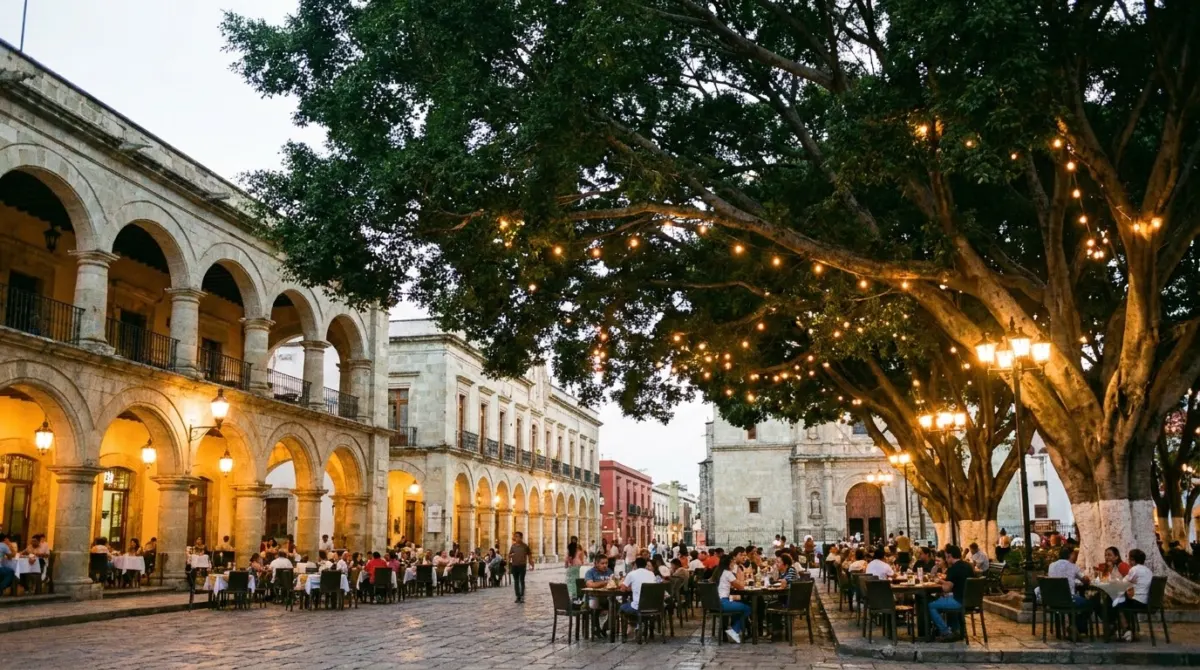
- The Zócalo is the main square, shaded by enormous trees, ringed with arcades and permanently busy. It is where the city sits in the evening and it is free to enter in every sense.
- Andador Macedonio Alcalá is the pedestrian street that connects the two, and walking it end to end takes fifteen minutes.
- The Basílica de la Soledad sits a few blocks west and is quieter, with a small museum attached.
- Do this in Oaxaca on your first day. Explore the city on foot before anything else: it orients you, and everything after makes more sense once you can see the shape of the center.
- The heart of the city is genuinely small. You will not need transport inside it, and taxis are for getting out, not around.
Jalatlaco and the neighborhoods beyond the city center
- Jalatlaco is the old barrio just east of the center: cobbled streets, painted murals and a small church, and it is the prettiest twenty minutes of walking in the city.
- Xochimilco, north of Santo Domingo, is quieter again, with the old aqueduct arches running along one street.
- Both are a short walk from the center, which means you can see them before breakfast and be back for it.
- Go early. The light is better and the streets are empty, and by mid-morning both fill with people doing the same walk.
- This is where a lot of the newer restaurants and cafés have opened, away from the city center and the bustle of the city.
- Both are still a walk, not a taxi ride. Nothing here is really outside of the city; Oaxaca simply stops after about fifteen blocks.
Oaxaca markets: Mercado 20 de Noviembre and the rest
The Oaxaca markets are the reason a lot of people come, and they are not a sight you tick off.
- Mercado 20 de Noviembre is the food market, and its smoke-filled meat aisle, the Pasillo de Humo, is where you point at what you want and it is grilled in front of you.
- Mercado Benito Juárez is next door and sells everything else: chocolate, chapulines, cheese, chilli, hats.
- Pochote Market is smaller and organic, and it is the easier one if the big markets feel overwhelming.
- Mercado de Abastos on the edge of the city is the enormous one where the region actually shops. Saturday is the day and it is not a tourist experience.
- Street food is everywhere and the tlayudas, tamales and tacos in the markets are as good as the restaurants in Oaxaca that cost twenty times more.
- Go hungry and go twice. One visit is not enough to work out what any of it is, and the markets are one of the best things about Oaxaca.
Mezcal: what to drink and where
- Mezcal is to Oaxaca what tequila is to Jalisco, except that tequila is one kind of mezcal and Oaxaca makes dozens from different agaves.
- A mezcalería in the center will pour you a flight with orange and worm salt, and the staff will explain what you are drinking if you ask.
- A palenque tour out in the valley shows you the pit roasting and the horse-drawn mill, and it usually combines with a day trip east.
- Drink it slowly and neat. Nobody here shoots it, and the good stuff is not a strong liquor so much as a smoky one.
- Los Danzantes is both a well-known restaurant in the center and a mezcal label, which tells you how closely the two things run together here.
A cooking class, Casa Oaxaca, and why food in Oaxaca is the reason to come
- Oaxacan cuisine is the most distinctive regional cooking in Mexico, and Oaxaca is widely called the food destination in Mexico for that reason.
- A cooking class usually starts in a market, buying ingredients, and ends with you grinding chillies for a mole. Most run four to six hours.
- Seven moles is the local claim. Mole negro is the famous one and mole coloradito is the one you will probably prefer.
- Casa Oaxaca is the best-known fine dining name in the city and its rooftop is the landmark table. Book ahead if you want it.
- Don’t miss the tlayuda, the enormous crisp tortilla that is the local late-night food. Do not leave Oaxaca without one.
- A cooking class is the single best value day here if you have any interest in food at all.
Museums: Museo de las Culturas de Oaxaca and the Jardín Etnobotánico de Oaxaca
- Museo de las Culturas de Oaxaca occupies the monastery beside Santo Domingo and holds the treasure from Tomb 7 at Monte Albán. It is the one museum to do properly.
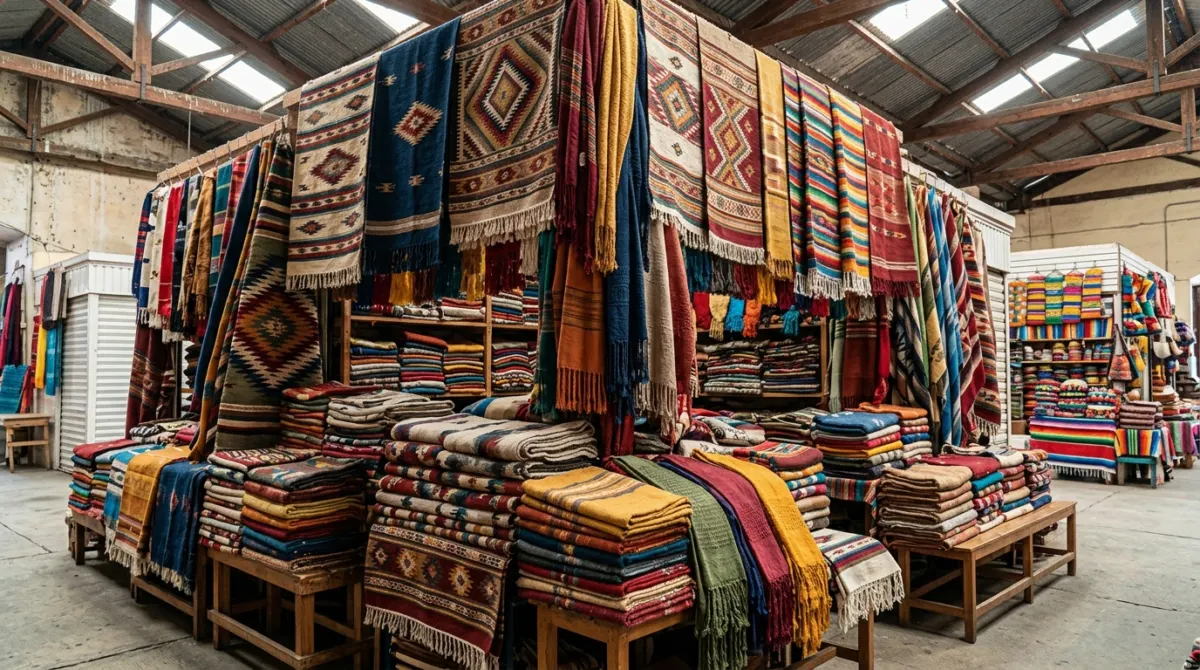
- Museo Textil de Oaxaca is small, free and excellent, and it explains the weaving you will see for sale everywhere.
- The Jardín Etnobotánico de Oaxaca behind Santo Domingo can only be visited on a guided tour at set times. Check the schedule the day before, because English tours are limited.
- Museo de Filatelia de Oaxaca, the stamp museum, is far more interesting than it sounds and has a quiet courtyard.
- Most museums close on Mondays. Plan a day trip for that day rather than discovering it at the door.
Monte Albán: the archaeological site above the city
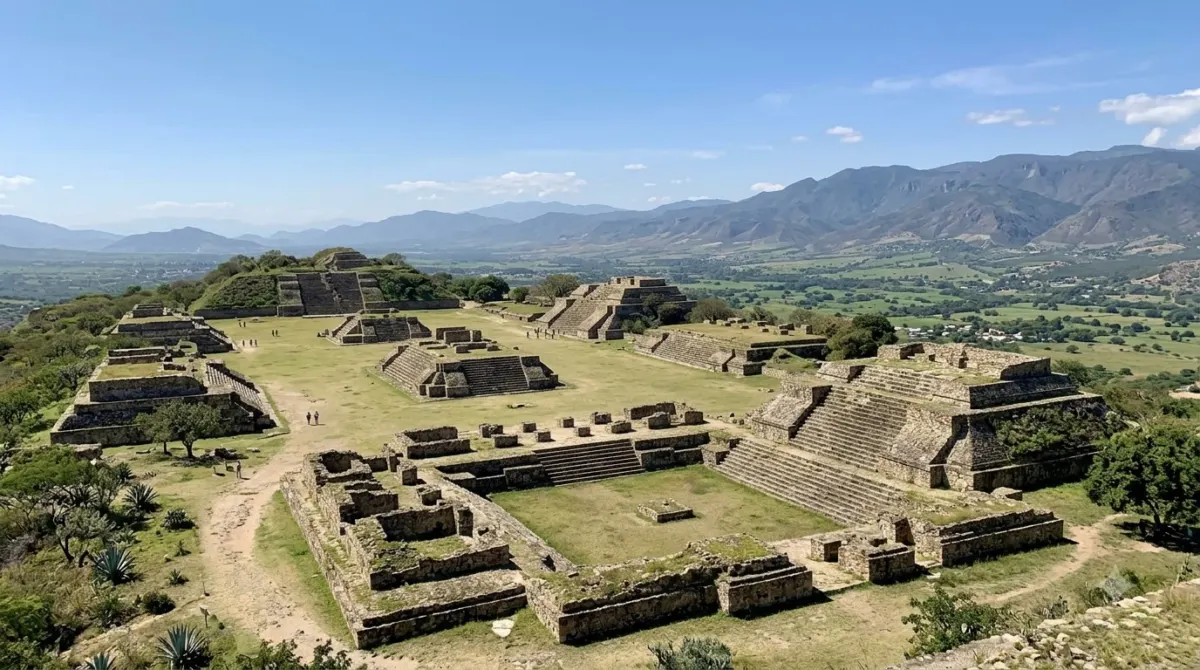
- Monte Albán is a Zapotec city built on a hilltop that was levelled by hand, about twenty minutes from the center, and it is the most important archaeological site in the state of Oaxaca.
- The views from the top run out over three valleys, and the scale of the main plaza is the part photographs never manage.
- Go early or late. There is almost no shade on the site and the middle of the day is punishing.
- Shuttles run from the city through most hotels and agencies, and a taxi there and back with waiting time is the flexible option.
- Two hours on site is enough for most people, three if you take a guide, which is worth doing.
- Mitla is the other Zapotec site and is completely different: no pyramids, but geometric stone mosaics on the walls that nothing else in Mexico matches. It is a shorter stop and easily worth a visit on a valley day.
The Oaxaca day trip: Hierve el Agua, Árbol del Tule and the valley
This is where the time goes, and where the best days are.
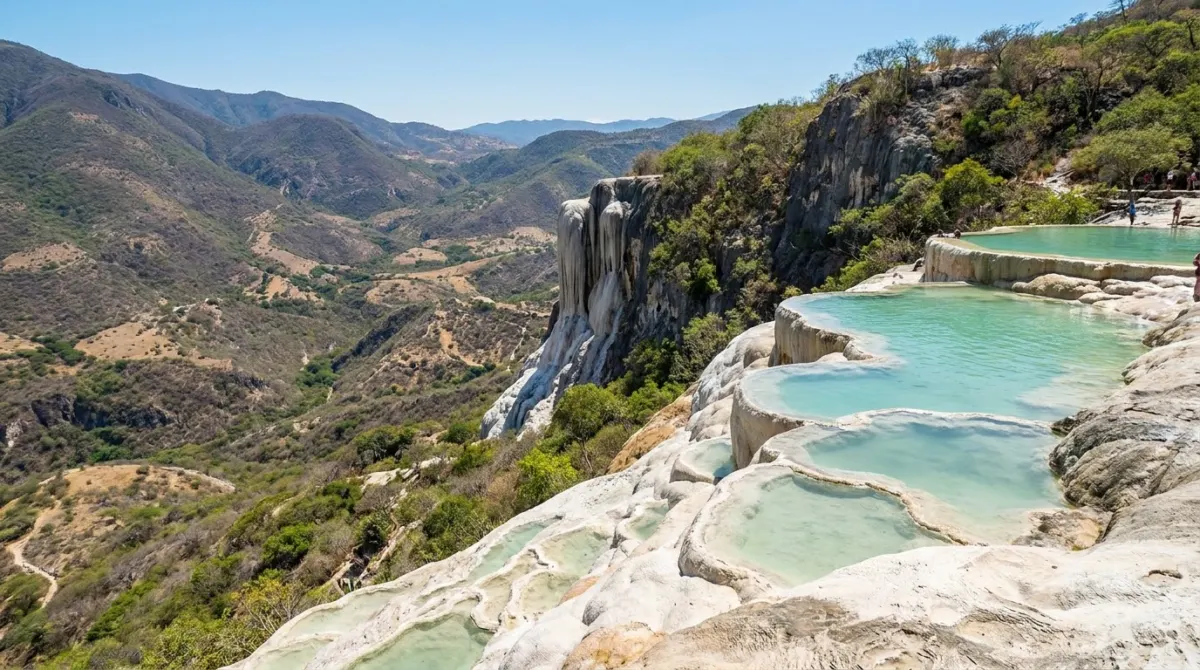
- Hierve el Agua is a petrified waterfall: mineral-laden springs that have built white terraces down a cliff face, with pools at the top you can sit in. It is about two hours each way.
- Access has been closed at times by local disputes over management. Check that it is open on the day before you commit, because it is a long drive to be turned around.
- Árbol del Tule is a single cypress with the widest trunk of any tree in the world, in a churchyard in Santa María del Tule, ten minutes outside the city.
- Teotitlán del Valle is the weaving village where the rugs come from, and the workshops demonstrate natural dyeing.
- The classic Oaxaca day trip chains Tule, Teotitlán, Mitla, a mezcal palenque and Hierve el Agua into one long day. It is a lot, and it works.
- A collectivo or a hire car both work for the near stops. For Hierve el Agua, take the organised trip.
- Everything on this list is outside Oaxaca but inside an hour or two, which is what makes the valley the real reason to give the trip a week.
Day of the Dead in Oaxaca: Día de los Muertos and the rest of the calendar
- Día de los Muertos at the end of October and start of November is when Oaxaca is at its most extraordinary, and also its most expensive and most booked out.
- Book six months ahead for Day of the Dead. Hotels in the center go early and prices roughly double.
- Guelaguetza in July is the other big one, a festival of dance from across the Oaxaca state, and it fills the city in the same way.
- Night of the Radishes in December is exactly what it sounds like and is much loved locally.
- If you want the city quiet, avoid all three and come in the months either side. Those are the cheapest months in Oaxaca as well as the calmest.
A free walking tour, the history of Oaxaca, and your first day
- A free walking tour leaves from the Zócalo most mornings and is the fastest way to get the history of Oaxaca into your head before you start looking at things.
- They are tip-based rather than genuinely free, and the good ones are worth paying for properly.
- Do it on day one. It is much less useful on day three when you have already walked everything.
- A guided walking tour of the markets is the other one worth booking, because a market is where a guide earns their fee.
Unusual and fun things to do in Oaxaca
Past the obvious list, these are the incredible things people come back talking about, and none of them appear on a top ten.
- Oaxaca coffee is seriously good and largely unexported. The state grows it in the Sierra, the cafés in the centro roast it, and a slow brunch in a courtyard is one of the best things you can do with a morning here.
- Museo de Filatelia de Oaxaca, the Oaxaca stamp museum, sounds like a joke and is not. It is free to enter, the courtyard is quiet, and it is worth a visit precisely because nobody expects it to be.
- An alebrije workshop in San Martín Tilcajete, twenty minutes outside of Oaxaca, shows you the carving and the painting of the wooden figures sold all over the city.
- A temazcal, the pre-Hispanic steam bath, is offered by several places around Oaxaca and is a genuinely old piece of Zapotec peoples culture rather than a spa invention.
- The Sunday market at Tlacolula is the big regional one, an hour away, and it is where the valley villages actually trade. Go for the vegetables and the noise, not for souvenirs.
- Dinner on a rooftop facing Santo Domingo at sunset is the cliché and it earns it. The building is lit and the mountains go pink behind it.
- The colonial architecture is Spain filtered through Zapotec stonework, which is why the city of Oaxaca does not look like anywhere in Spain or anywhere else in Mexico.
How to get to Oaxaca from Mexico City, and when to travel to Oaxaca
- Flying takes about an hour from the capital of Mexico and is the obvious choice if your time in Oaxaca is short.
- The ADO bus takes six to seven hours on a good road, runs overnight and by day, and the top-class services are comfortable.
- Driving takes about six hours on the toll road, and the tolls are not trivial.
- Oaxaca airport is small and about twenty minutes south of the center, with shared shuttles and taxis at the door.
- You do not need a car in the city, and parking in the center is more trouble than it is worth.
Where to stay in Oaxaca
- The centro is the obvious base and puts you within walking distance of everything in this article except the day trips.
- North of Santo Domingo is quieter and still a ten-minute walk in, which is the sweet spot for most people.
- Jalatlaco is the atmospheric choice, a little further out, and full of small guesthouses in old houses.
- Colonial courtyard hotels are the local speciality, usually a converted house of fifteen to thirty rooms around a planted patio.
- These are categories, not recommendations. Nobody here has stayed in them and we do not print rates. Check current prices yourself.
Map shows live availability and prices. We may earn a commission on bookings made through it, at no extra cost to you.
Is Oaxaca safe?
- Oaxaca City is generally considered a safe city by Mexican standards, and compared with Mexican cities like Mexico City the center feels small and well lit into the evening.
- Ordinary city precautions apply: watch your bag in crowded markets, use registered taxis or an app at night, and do not walk alone in unlit areas at the edge of the city.
- Many solo female travelers report Oaxaca as one of the easier places in Mexico to travel alone, which matches its reputation among long-stay visitors.
- Teachers’ union protests occasionally block roads and the Zócalo. They are not dangerous but they can disrupt a plan.
- Check your own government’s current advice for the state of Oaxaca before you travel, because it is issued by region and it changes.
The best time to visit Oaxaca
- October to April is the dry season and the most reliable weather, with warm days and cool evenings at 1,550 meters.
- May is the hottest month before the rains, and June to September brings afternoon storms rather than all-day rain.
- The green months are beautiful and much quieter, and the valley is at its best right after the rain.
- Late October is peak for Day of the Dead and July for Guelaguetza. Everything costs more and books out.
- February and March are the easy months: dry, warm, and no festival crowding. That is when this is the best place to visit in the whole region.
Beyond the city: Oaxaca state and the Pacific coast
- Oaxaca is a state as well as a city, and the state is enormous, mountainous and much less visited than the capital.
- The Pacific coast is eight hours by road or an hour by small plane, and it is a completely different trip: Puerto Escondido for surf, Mazunte and Zipolite for quiet.
- The Sierra Norte north of the city has community-run hiking villages, and it is the easiest way to get away from the city for a night or two.
- Give the coast its own week rather than bolting three nights onto a city trip. The journey is the reason, and the coast is one of the best places to visit in Mexico in its own right.
- Oaxaca is home to more indigenous peoples and languages than any other state in Mexico, and that is the thread running through the food, the weaving and the festivals. It is the part of Mexico in general that has changed least.
- Travelers from the United States reach it easily through Mexico City, and the city has a long-stay foreign community because of it.
The last thing to do in Oaxaca before you leave
Go back to the market. Whatever you ate on your first day, you now know enough to order better, and it costs nothing to find out.
Oaxaca is full of things that only make sense on the second look: a mole you dismissed, a mezcal you were not ready for, a street you walked past. That is the argument for a longer trip to Oaxaca rather than a longer list.
Hungry already? Our Oaxaca food guide decodes the whole menu — every masa dish is the same dough in a different shape.
Adding the coast? See the Oaxaca beaches — sorted by which ones you can actually swim in, because most of this coast has a rip.
Adding the coast and want to swim rather than watch? See Huatulco, Oaxaca, the one planned resort on this coast that was never allowed to grow.
Frequently asked questions
What is Oaxaca known for?
Food, mezcal and craft. Oaxacan cuisine with its seven moles is the most distinctive regional cooking in Mexico, mezcal is made across the valley from dozens of agave varieties, and the weaving, pottery and alebrijes come from villages within an hour of the city. The colonial center and Monte Albán are both UNESCO listed.
How many days do you need in Oaxaca?
Four to five nights for the city and two day trips. The historic center itself only needs a day, but Monte Albán is half a day, Hierve el Agua is a full one, and the Tule and Mitla loop is another. A cooking class takes most of a day too. Three nights works but you will leave something out.
What are the best things to do in Oaxaca City?
Templo de Santo Domingo and the Museo de las Culturas beside it, eating your way through Mercado 20 de Noviembre, a mezcal tasting, a walk around Jalatlaco, and a cooking class. Outside the city, Monte Albán and Hierve el Agua are the two unmissable trips.
How do you get to Oaxaca from Mexico City?
A flight takes about an hour. The ADO bus takes six to seven hours on a good road, with overnight and daytime services, and the executive classes are comfortable. Driving on the toll road takes roughly six hours. The airport is about twenty minutes from the city center.
Is Oaxaca safe for tourists?
Oaxaca City is generally regarded as one of the safer cities in Mexico and the center is busy well into the evening. Take normal city precautions in crowded markets and use apps or registered taxis late at night. Protests occasionally block central streets. Check your own government advice for the state before traveling.
Is Monte Albán worth visiting?
Yes, and it is the single best half day outside the city. It is a Zapotec capital built on a hilltop that was flattened by hand, with views over three valleys and a main plaza whose scale does not photograph. Go early because there is no shade, and take a guide if one is available.
Do you need a car in Oaxaca?
Not in the city, which is small enough to walk and where parking is a nuisance. For the valley you have three options: collectivos for the near villages, a hire car for flexibility, or an organised trip. For Hierve el Agua specifically, take the organised trip, because it is two hours each way and access is sometimes closed.
When is the best time to visit Oaxaca?
February and March are the easiest: dry, warm and no festival crowds. October to April is the dry season overall. Late October and early November bring Day of the Dead, which is spectacular but doubles prices and needs booking months ahead. July has the Guelaguetza festival and the same effect.
What should you not miss eating in Oaxaca?
A tlayuda, the huge crisp tortilla eaten late at night. Mole negro or coloradito. Quesillo, the local string cheese. Tamales wrapped in banana leaf. Grilled meat from the Pasillo de Humo inside Mercado 20 de Noviembre, and chapulines if you are curious. Wash any of it down with mezcal, slowly.
Keep planning Mexico
Written and checked by
Triplarks Editorial
An editorial desk, not an invented persona: research, drafting and fact-checking are done by the same small team. Every number here carries the date it was read.