
Start with the thing that surprises almost everyone: Costa Rican food is not spicy, and it is nothing like Mexican food. There are no burritos, the chilli is optional and usually served on the side, and the dominant flavours are cilantro (coriander), sweet peppers, onion and a slightly sweet brown sauce that Ticos put on everything.
Some links below are affiliate links. We may earn a commission if you book through them, at no extra cost to you. We do not rank hotels, and any prices on the map come live from the booking sites.
Quick answer: where to stay if food is the point. The Caribbean coast cooks completely differently from the rest of the country, so spend a few nights in Puerto Viejo. For a first trip, most people start inland in La Fortuna.
Check hotels in Puerto Viejo →Check hotels in La Fortuna →See them on a map ↓
What Costa Rican cuisine actually is: rice, black beans, plantain and whatever protein is going, assembled in a handful of combinations that people here eat happily every day of their lives. It is honest, filling and cheap. It is not, by most measures, the most exciting food in Latin America — and pretending otherwise does nobody any favours.
This guide covers the dishes worth going out of your way for, the ones you will be served whether you seek them out or not, and how the Caribbean coast quietly runs a completely different cuisine. Prices were read on 15 August 2026.
Traditional Costa Rican food and where it came from
Traditional Costa Rican cuisine is the product of three things layered on top of each other: indigenous corn and root vegetables, Spanish rice and cattle, and African cooking that arrived on the Caribbean coast. Compared with the rest of Latin American food it is restrained — fewer chillies than Mexican food, fewer sauces than Peruvian, less pork than Cuban.
That restraint is a fair reflection of Costa Rican culture generally. Traditional foods here are built for eating every day rather than for impressing anyone, and the famous Costa Rican dishes are famous for being reliable rather than dramatic. Understanding that before you arrive prevents a lot of disappointment.
- Corn gives the tortillas, tamales, chorreadas and the drinks made from toasted maize.
- Rice and cattle arrived with the Spanish and became the backbone of every popular dish in the country.
- Black beans are the single most-eaten ingredient, appearing at all three meals.
- Coconut milk and thyme came with Jamaican workers in the 1870s and stayed on the Caribbean coast.
- Coffee shaped the whole economy from the 1830s, which is why the Central Valley looks the way it does.
Costa Rican breakfasts deserve their own mention, because they are the meal that differs most from what visitors expect. Breakfast is savoury, substantial and eaten early — gallo pinto, egg, cheese and fruit, not pastry and coffee.
The two dishes you cannot avoid, plus tamales at Christmas
Gallo pinto — the national breakfast
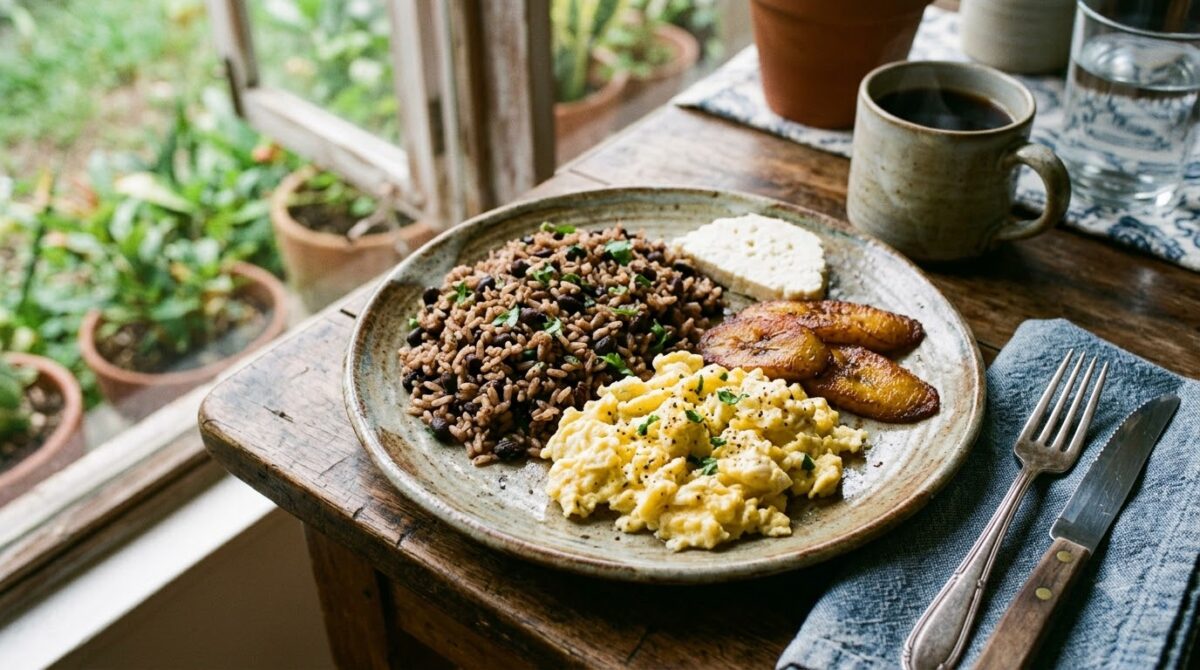
Gallo pinto is rice and black beans fried together with onion, sweet red bell peppers and coriander, usually with a splash of Salsa Lizano. The name means “spotted rooster”, a reference to the speckled appearance the black beans give the white rice.
It is served at breakfast with a fried egg, fried plantain, soft white cheese and corn tortillas, and it is genuinely good — savoury, faintly sweet, better than the description suggests. You will eat it every morning of your trip and you will not get tired of it as fast as you expect.
Nicaragua also claims gallo pinto as its national dish, and the argument is unresolved and mildly serious. The Nicaraguan version uses red beans and no Lizano; the Costa Rican one uses black beans and does. Do not offer an opinion on which came first in either country.
Casado — the national lunch
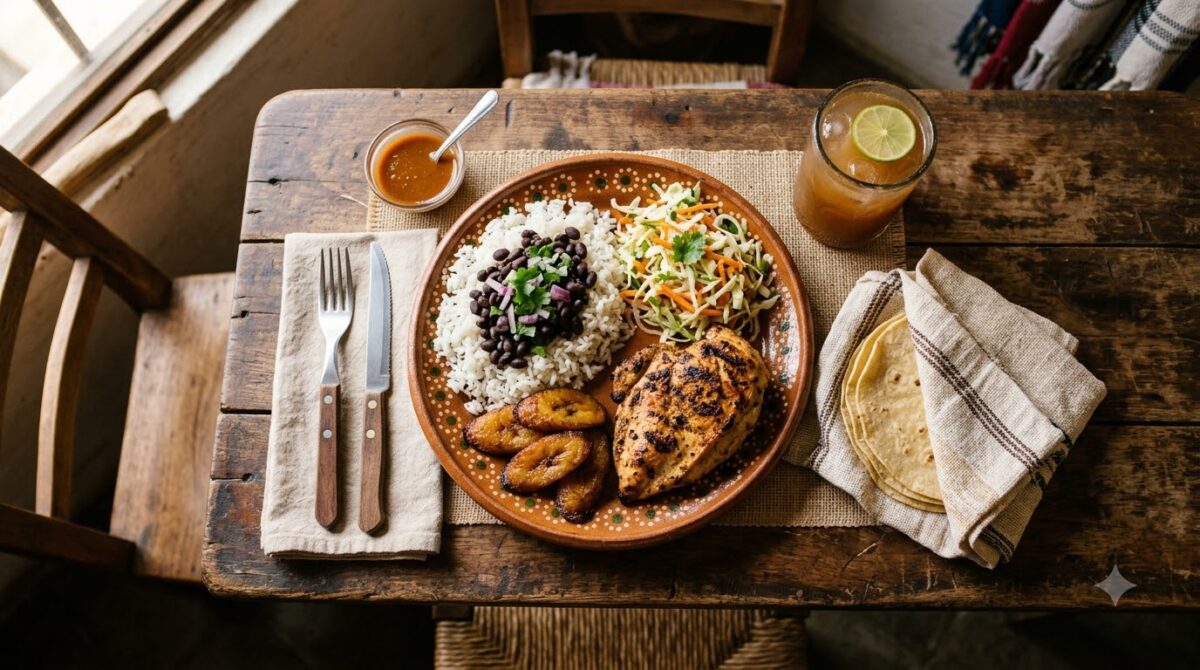
The casado is the single most common Costa Rican meal and the thing you should order at lunch every day. It is a plate with white rice, black beans, fried plantains, a shredded cabbage-and-tomato salad, and a choice of protein: chicken, beef, pork or fish. Often there is a small serving of picadillo or pasta as well.
The name means “married man”, and the usual explanation is that this is the plate a wife would pack for her husband — the elements married together on one dish. A casado in a soda costs roughly 3,500 to 5,000 colones, which is around US$6.50 to US$9.50. In a tourist restaurant expect double that for the same food.
Ceviche, chifrijo, patacones and the rest of the must-try dishes
| Dish | What it is | Where you find it |
|---|---|---|
| Olla de carne | A slow beef and vegetable stew with yuca, plantain, chayote and corn on the cob. The nearest thing to a Costa Rican Sunday roast | Sodas at weekends, family homes |
| Chifrijo | Rice, red beans, crisp fried pork, pico de gallo and avocado in a bowl with tortilla chips. Invented in a San Jose bar in the 1990s and now everywhere | Bars, as a shared starter |
| Costa Rican ceviche | Raw fish cured in lime juice with coriander, onion and sweet peppers. Milder and less citrus-forward than Peruvian ceviche, served cold with soda crackers | Coastal towns, beach bars |
| Patacones | Green plantain sliced, fried, smashed flat and fried again. Salty, crisp, served with black bean dip. Also called tostones elsewhere in Latin America | Everywhere, as a side or snack |
| Sopa negra | Black bean soup with a whole poached egg dropped into it, plus coriander and a squeeze of lime | Sodas, usually lunchtime |
| Tamales | Corn masa with pork, rice, vegetables and olives, wrapped in a banana leaf and steamed, the corn husks of the Mexican version replaced by banana leaves here. Strictly a Christmas food — families make hundreds in December | December only, sold on the street |
| Arroz con pollo | Rice cooked with chicken, bell peppers and vegetables, tinted with achiote. The standard party and birthday dish | Celebrations, sodas |
| Picadillo | Any vegetable diced very small and cooked with onion and minced beef — chayote, green beans, potato or arracache | As a component of the casado |
| Gallos | Corn tortillas folded around a filling of meat or picadillo. The closest thing here to a taco, and the origin of the name gallo pinto | Street food, fairs |
| Chorreadas | Sweet corn pancakes served with sour cream. Simple and very good | Rural sodas, roadside stops |
Salsa Lizano: the thing in every kitchen
Salsa Lizano is a thin brown sauce, slightly sweet and faintly tangy, made from vegetables, spices and a little cumin. It has been made in Costa Rica since 1920 and it goes on gallo pinto, into stews, over meat and onto anything else that needs it. If you want to take one thing home, take a bottle of Lizano.
It is worth understanding what it signals about the cuisine: Costa Rican food is seasoned rather than spiced. If you want heat you ask for chilero, a jar of vegetables pickled with hot chilli that sits on the table. Nothing arrives hot unless you make it so.
The Caribbean coast cooks completely differently
Cross to Limon province and the food changes more than the landscape does. The Afro-Caribbean population brought Jamaican cooking traditions with them in the nineteenth century, and coconut milk replaced water in almost everything.
- Rice and beans — confusingly, not the same as gallo pinto. Here it means red beans cooked in coconut milk with thyme and a whole scotch bonnet chilli, and the result is richer and more fragrant than anything on the Pacific side. Arguably the best single dish in the country.
- Rondon — a slow seafood and root-vegetable stew cooked in coconut milk. The name comes from “run down”, because traditionally you cooked whatever you could run down that day. Order it a day ahead in small places.
- Pan bon — a dark, dense sweet bread with candied fruit, sold on the Caribbean coast and almost unknown in San Jose.
- Patti — a small spiced meat pastry, straight from the Jamaican patty.
- Agua de sapo — ginger, lime and tapa dulce, which is unrefined cane sugar. Non-alcoholic and genuinely refreshing.
If you only eat Pacific-coast food you will leave thinking Costa Rican cuisine is pleasant and unremarkable. Puerto Viejo will change your mind.
Map shows live availability and prices. We may earn a commission on bookings made through it, at no extra cost to you.
Tres leches, arroz con leche and other sweet things
- Tres leches — sponge cake soaked in evaporated milk, sweetened condensed milk and cream. Heavier than it sounds and the standard celebration cake across Latin America.
- Arroz con leche — rice pudding with cinnamon and vanilla, served warm or cold. Every family has a version.
- Cajeta — a dense milk fudge, sometimes flavoured with coconut. Sold in blocks at roadside stalls.
- Melcochas — chewy taffy made from tapa dulce, a fairground sweet treat.
- Queque seco — a plain dry pound cake that Costa Ricans eat with coffee in the afternoon, which is more or less a national ritual.
Fresh fruit grown in Costa Rica you probably have not met
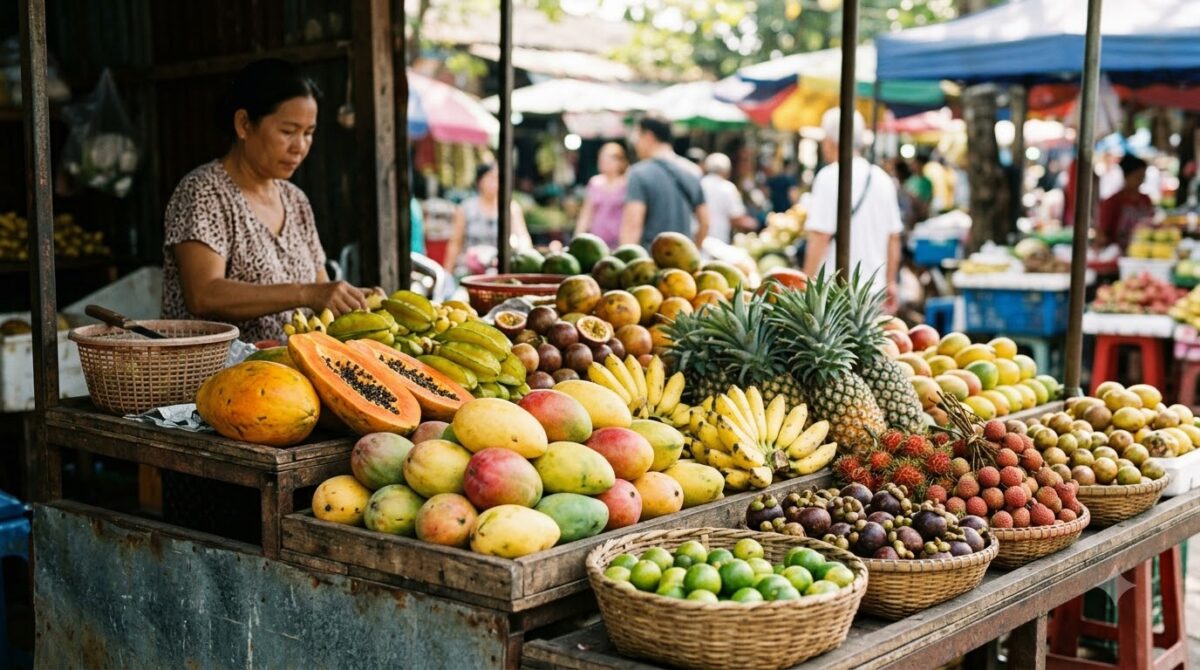
The familiar tropical fruits are all here and they are cheap — mango, papaya, pineapple, banana, passion fruit. The interesting part is everything else. Ask at any market and someone will cut one open for you.
- Guanabana (soursop) — huge, spiky, green outside and creamy white inside. Tastes of pineapple and cream. Best as a batido, a fruit shake blended with milk or water.
- Mamon chino (rambutan) — red and hairy, with translucent lychee-like flesh. Sold in bags at the roadside from July.
- Cas — a sour green guava used almost entirely for juice. Sharp and excellent in the heat.
- Granadilla — a smooth orange passion fruit relative. Crack it open and eat the seeds straight out.
- Pejibaye — a boiled palm fruit eaten with mayonnaise. Starchy, strange, and worth trying once.
- Anona and guayaba — custard apple and guava, both grown in Costa Rica and both usually eaten straight from the tree.
Fresh fruit juice, or refresco natural, comes with almost every casado and can be made with water or milk. Ask for it sin azucar if you do not want it sweetened, because the default is generous.
Coffee, and Costa Rican culinary history in a cup
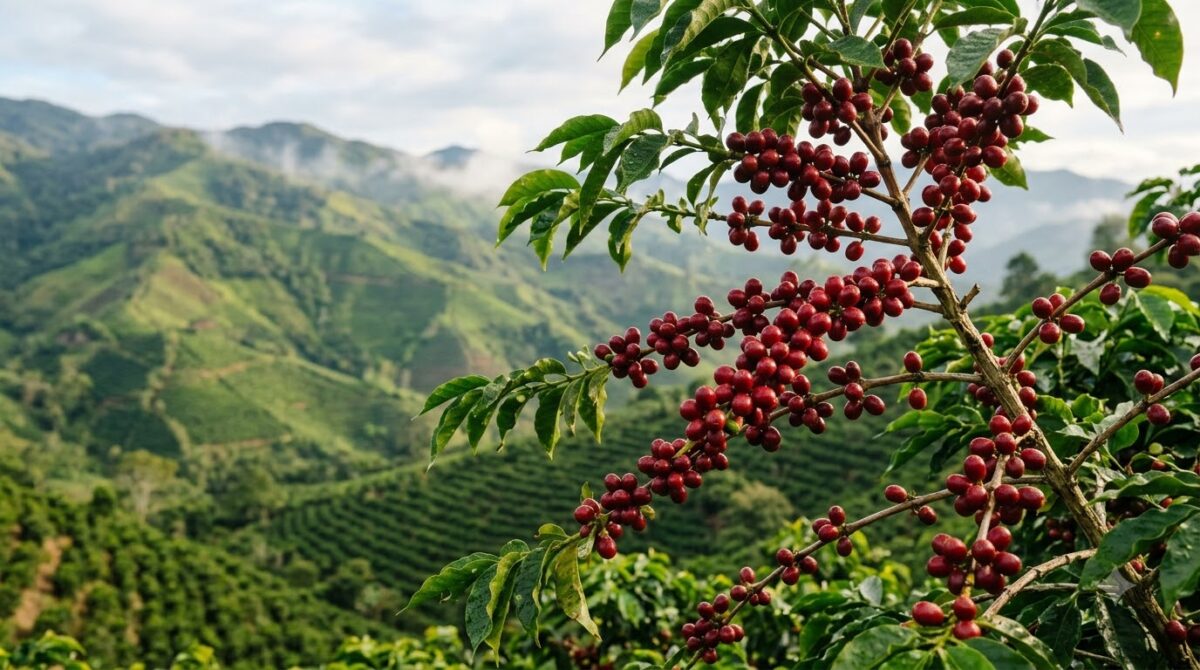
Costa Rica grows some of the best arabica in the world, exports most of it, and historically drank the rest of it in a form that would horrify a specialty roaster. That has changed fast in the last decade, and San Jose and the Central Valley now have serious coffee shops.
The traditional method is worth seeing: a chorreador, a cloth sock suspended in a wooden stand, which produces a clean, unhurried filter coffee. Coffee farm tours in the Central Valley, Monteverde and around Poas run roughly US$25 to US$50 and are among the better-value tours in the country.
Where to eat: the soda system and olla de carne at the weekend
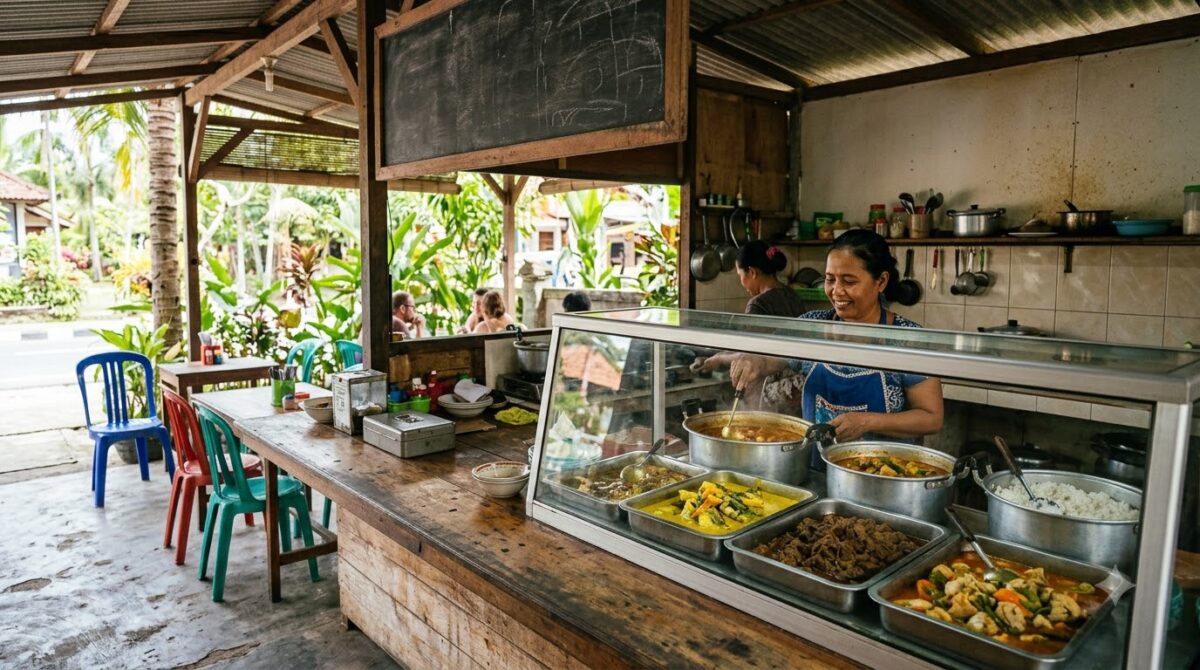
A soda is a small family-run restaurant serving a fixed daily menu of Costa Rican meals. There is usually no printed menu, just a board with two or three options. This is where Ticos eat lunch and it is the best value food in the country by a wide margin.
| Where | Typical cost of a meal | What to expect |
|---|---|---|
| Soda | 3,500–5,000 colones (US$6.50–9.50) | Casado, natural juice, plastic chairs, excellent |
| Central market food stall | 2,500–4,000 colones (US$5–7.50) | The cheapest hot meal anywhere, San Jose especially |
| Mid-range restaurant | 8,000–15,000 colones (US$15–28) | Same dishes, tablecloths, tourist pricing |
| Beach town restaurant | 10,000–20,000 colones (US$19–38) | International menus, seafood, often disappointing |
Two practical notes. A 10 percent service charge and 13 percent tax are added to restaurant bills by law, so the menu price is not the final price — and because service is already included, additional tipping is optional. And the further you get from a soda, the more likely you are to be served an indifferent burger.
Vegetarians and vegans
Costa Rica is one of the easier countries in Central America for this. The base of nearly every meal — rice, black beans, plantain, salad — is already vegan, and any soda will serve you a casado without the meat if you ask for it vegetariano. Beans here are cooked without pork, unlike in much of Latin America.
Watch for two things: gallo pinto is sometimes fried in the same pan as the meat, and Salsa Lizano is vegetarian but not everyone knows what is in it. The beach towns with international crowds — Santa Teresa, Nosara, Puerto Viejo — have proper vegan restaurants.
Must-try food in Costa Rica, in the order to try it
- Gallo pinto for breakfast, on your first morning.
- A casado at a soda for lunch, on the same day.
- Ceviche at a beach bar in the afternoon.
- Chifrijo with a beer, as a shared plate.
- Rice and beans cooked in coconut milk on the Caribbean coast.
- A guanabana batido from a market stall.
- Olla de carne, if you find a soda serving it at the weekend.
- Tres leches, once, and then never again on that trip.
Food is one of the easier parts of travelling in Costa Rica, and eating local cuisine rather than international menus is also the single cheapest change you can make to a trip. Travel to Costa Rica with the expectation of good honest cooking rather than fireworks and it delivers every time, and one of the cheapest if you eat where locals do. For everything else the days are built around, see our guides to things to do in Costa Rica and when to visit.
Check hotels across Costa Rica →
Frequently asked questions
What is the national dish of Costa Rica?
Gallo pinto, a mix of rice and black beans fried with onion, sweet peppers and coriander, eaten at breakfast. The casado, the standard lunch plate of rice, beans, plantain, salad and a protein, has an equally strong claim and is what most Costa Ricans eat most often.
Is Costa Rican food spicy?
No. Costa Rican cuisine is seasoned rather than hot, built on coriander, onion, sweet bell peppers and Salsa Lizano. If you want heat, ask for chilero, a jar of chilli-pickled vegetables kept on the table.
Is Costa Rican food like Mexican food?
No, and this catches a lot of visitors out. There are no burritos, very little chilli and almost no cheese-heavy dishes. The nearest overlap is the gallo, a folded corn tortilla with a filling, which is much simpler than a taco.
What is a casado?
A plate of white rice, black beans, fried plantain, shredded cabbage salad and a choice of chicken, beef, pork or fish. It is the standard Costa Rican lunch and costs 3,500 to 5,000 colones, roughly US$6.50 to US$9.50, at a soda.
What is Salsa Lizano?
A thin, slightly sweet brown sauce made from vegetables and spices, produced in Costa Rica since 1920. It goes on gallo pinto and into most stews, and it is the flavour most Costa Ricans associate with home cooking.
What is the food like on the Caribbean coast of Costa Rica?
Completely different. Afro-Caribbean cooking uses coconut milk, thyme and scotch bonnet chilli. The signature dishes are rice and beans cooked in coconut milk, rondon seafood stew and patti pastries. Many people find it the best food in the country.
Is it easy to be vegetarian in Costa Rica?
Yes. Rice, black beans, plantain and salad are the base of almost every meal and are already vegan, and beans here are cooked without pork. Ask for a casado vegetariano at any soda.
Prices read 15 August 2026 and converted at approximately 525 colones to the US dollar. Exchange rates move — treat the dollar figures as a guide.