
Costa Rica is 51,000 square kilometres, about the size of Denmark, and it holds volcanoes, cloud forest, rainforest, two coastlines and roughly five per cent of the species on Earth. That density is why people come. It is also why the first draft of everybody’s itinerary is wrong.
Some links below are affiliate links. We may earn a commission if you book through them, at no extra cost to you. We do not rank hotels, and any prices on the map come live from the booking sites.
Quick answer: where to stay on this 10-day route. San José for the arrival night, then La Fortuna for three nights, Monteverde for two, and the Pacific coast around Manuel Antonio for the rest.
This is a 10 day Costa Rica itinerary built around four bases and only four travel days. It covers Arenal Volcano, the Monteverde cloud forest, Manuel Antonio and the Pacific coast, with real drive times rather than the ones your phone promises.
There is no single ultimate Costa Rica itinerary, because the country splits neatly into regions that each want a week. What follows is the Costa Rica travel itinerary that gives a first-time visitor the widest range for the least time in the car.
Below the day-by-day plan you will find the same route run in the opposite direction, versions for seven and fourteen days, what the trip costs, and the two reservations that will sink your plans if you leave them until you land.
If you are traveling to Costa Rica for the first time and want to explore Costa Rica broadly rather than deeply, this is the route to take.
Distances, park rules and prices checked 18 August 2026.
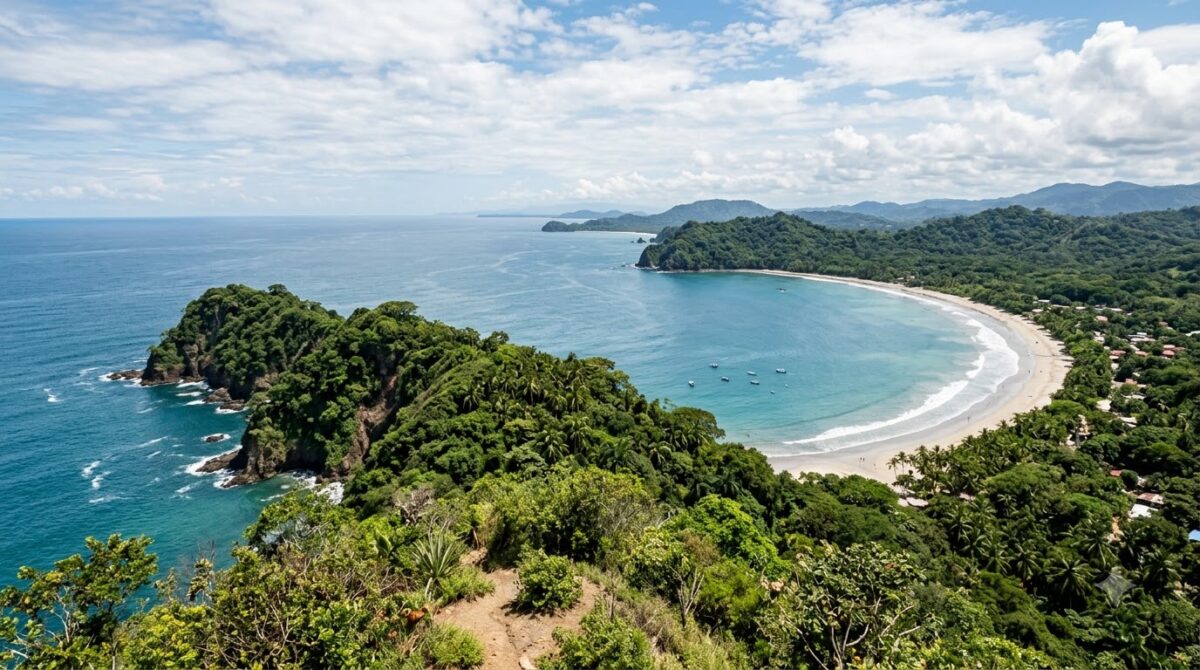
How many days do you need? Why 10 days in Costa Rica is the right length
Ten days is the sweet spot. It is the point where you stop trading one place for another and start actually seeing them.
| Length | What it realistically covers | Verdict |
|---|---|---|
| 5–6 days | One region only — volcano country or one beach | Fine, but pick one thing |
| 7 days | Volcano, cloud forest, one beach | Works, with four driving days |
| 10 days | All of the above, unhurried, plus a second beach | The right answer |
| 14 days | Add the Osa Peninsula or the Caribbean coast | Excellent if you have it |
| 21+ days | Both coasts, properly | Diminishing returns for most people |
If you are short on time, the honest advice is to cut destinations rather than nights. People who spend seven days on four regions enjoy the entire trip less than people who spend the same time in Costa Rica on two.
The reason short trips disappoint here is not distance, it is speed. Costa Rica has almost no motorway. Roads climb, wind and cross ridges, and 150 kilometres routinely takes four hours. A country that looks like a two-hour drive end to end is nothing of the sort.
At a glance: this 10-day itinerary for Costa Rica
| Day | Base | Main thing | Driving |
|---|---|---|---|
| 1 | San José | Arrive, settle in | none |
| 2 | La Fortuna | Drive north, hot springs | 3 hr |
| 3 | La Fortuna | Arenal Volcano and the rainforest | under 1 hr |
| 4 | La Fortuna | Waterfall, hanging bridges, sloths | under 1 hr |
| 5 | Monteverde | Across Lake Arenal by boat | 3 hr transfer |
| 6 | Monteverde | Cloud forest and zip line | none |
| 7 | Manuel Antonio | Drive south to the coast | 4 hr |
| 8 | Manuel Antonio | National park and wildlife | none |
| 9 | Uvita | Playa Uvita and the whale tail | 1 hr |
| 10 | — | Drive back to San José | 4 hr |
Nights: one in San José, three in La Fortuna, two in Monteverde, two near Manuel Antonio, one in Uvita.
Why this 10-day Costa Rica itinerary works for a first trip
Three design decisions, each of which is the opposite of what most itineraries do.
- Four bases, not seven. Every move costs you half a day once you count packing, checking out, driving and checking in. Four moves in ten days is the fewest that still gets you volcano, cloud forest and coast.
- La Fortuna before Monteverde. San José to La Fortuna is three hours on decent road; San José to Monteverde is four and finishes on unpaved switchbacks. Take the easier drive when you are jet-lagged.
- One side of the country only. This route stays on the Pacific side and in the northern highlands. Adding the Caribbean would cost two of your ten days to driving.
What it deliberately leaves out: Tortuguero, Puerto Viejo, Rincón de la Vieja and the Osa Peninsula. All are excellent. None of them fits in ten days alongside everything above without turning the trip into a driving holiday.
Driving in Costa Rica: rent a car for this Costa Rica road trip, or take a shuttle?
Rent a car. Costa Rica is a country built for a road trip, and half of what you will remember happens between the stops — a coati crossing the road, a fruit stand, a viewpoint nobody put on a list.
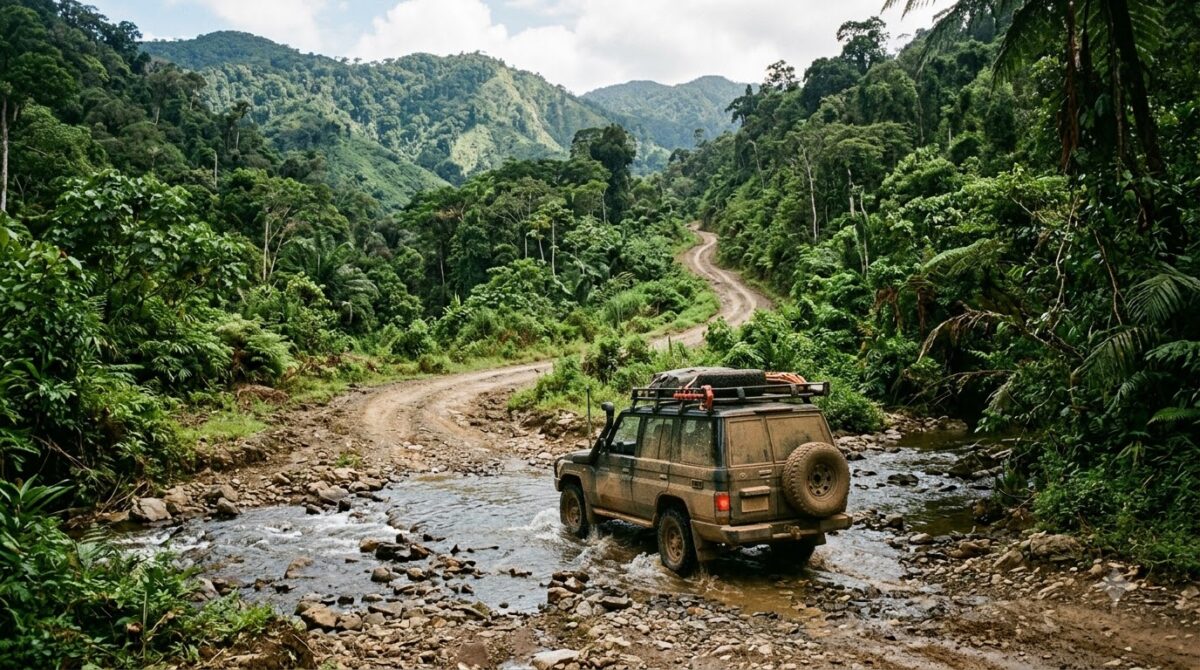
Car rental in Costa Rica has its own rules, and driving in Costa Rica is not like driving at home. Three things that cost people money:
- The headline price is fiction. Costa Rica requires mandatory third-party liability cover on every rental, and comparison sites almost never include it. A car advertised at US$12 a day usually lands between US$45 and US$75 a day once that and the credit-card hold are in. Book direct with an agency that quotes the all-in price and you will not enjoy the number more, but you will not be ambushed at the counter.
- Add 30 to 50 per cent to your phone’s drive times. On Ruta 1 and Ruta 27 the estimates hold. Everywhere else — and that is most of this itinerary — they do not.
- You do not need a 4×4 for this route. A standard car handles all of it, including the unpaved climb to Monteverde, outside the wettest months. You do need a true four-wheel drive — an SUV with high clearance, not a raised hatchback — for the Osa Peninsula, the dirt coast road south of Nosara, and most things during the wet season in September and October.
If you would rather not drive, shared shuttles link every base on this itinerary at roughly US$55 to US$70 per person per leg, on fixed daily departures. You lose spontaneity, not access. A private driver costs about three times that per leg and starts making sense for four people.
One flight worth considering: domestic hops from San José to the coast take 45 minutes on a small aircraft for roughly US$100 to US$160. On this route they save little. On a trip to the Osa Peninsula they save an entire day.
Day 1: Arrive in San José, the Costa Rican capital
Fly into Juan Santamaría International Airport (SJO), which sits in Alajuela, not in the capital itself. Whether San José deserves a night depends entirely on your arrival time.
Land before midday and you can collect the car and drive north the same day. Land in the afternoon or evening — which most flights from North America and all flights from Europe do — and you should sleep here. Driving Costa Rican mountain roads in the dark, on your first day, in a car you have never driven, is how holidays start badly.
San José, Costa Rica is the capital of Costa Rica and home to about a third of all Costa Ricans, which is worth knowing mostly because it explains the traffic. English is widely spoken in tourism, though far less so once you leave it, and a few words of Spanish go a long way outside the hotels.
Stay in Alajuela near the airport if you only want a bed, or in Barrio Amón in the city if you want an evening. Costa Rica’s capital is not a beautiful city, but Barrio Amón is the old coffee-baron quarter, full of restored mansions, and it is a 10-minute walk from the country’s best museums. Our guide to San José covers what is worth an evening and a morning.
Day 2: North to La Fortuna and the Arenal hot springs
The drive to La Fortuna takes about three hours through coffee country, over a ridge with long views back over the Central Valley, and down into the lowlands. It is one of the better drives in the country.
Arrive by early afternoon and spend the rest of the day in hot water. The whole valley sits on geothermally heated groundwater, and the options run in three tiers: resort complexes with landscaped pools and day passes from US$60 to US$130; simpler local spots at US$20 to US$40; and a free stretch of naturally hot river under a road bridge near the resort strip, which has no facilities and nowhere safe to leave anything.
Soaking in the hot springs on the first evening is the traditional opening to a Costa Rica trip, and there is a practical reason for it: it is the one activity that works when you are still jet-lagged. Late afternoon is the right time. It is cooler, it usually rains, and rain while you are already sitting in a hot river is one of the better things about Costa Rica.
Our La Fortuna guide compares the springs and the areas to stay in.
Map shows live availability and prices. We may earn a commission on bookings made through it, at no extra cost to you.
Day 3: Arenal Volcano and the rainforest
Arenal is the volcano from the postcards: a near-symmetrical cone that erupted more or less continuously from 1968 to 2010 and has been dormant since. You will not see lava. You may, with luck, see the summit.
Get up early. Arenal is clearest between sunrise and about eight, and spends most days in cloud. Then walk the 1968 lava-flow trail in Arenal Volcano National Park, which crosses old rubble fields directly beneath the cone. It is the best hiking in the park — about two hours, and more interesting than the forest loops.
Afternoon options. The Balsa river runs gentle class II–III rafting suitable for families, half a day at roughly US$70. A coffee and chocolate tour on a working family farm takes three hours and is better than it sounds. Horseback riding through the lush rainforest on the lower slopes is the other standard half-day, and most rides finish with a traditional Costa Rican lunch at the farm. Or take a guided tour along the Arenal side of the lake for wildlife: caiman, howler monkeys and a great many birds along the shore.
Day 4: La Fortuna Waterfall, hanging bridges and wildlife
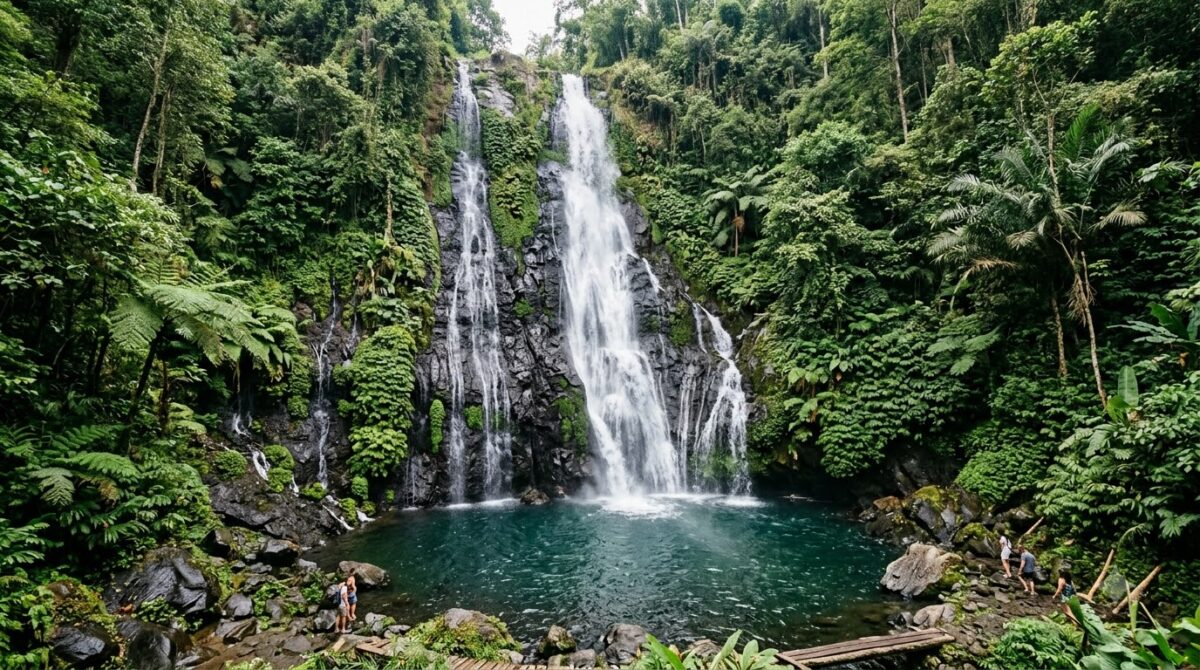
La Fortuna Waterfall. A 70-metre fall into a blue pool at the foot of a steep staircase — about 500 steps down and the same back up in full humidity. Entry around US$18. Arrive at opening, before the tour buses. Swim in the calmer pool downstream rather than directly under the fall.
Mistico hanging bridges. Suspension bridges strung through primary rainforest at canopy height, which is the layer where most of the animals actually are. About US$30 alone, roughly double with a naturalist guide, and the guide is worth it several times over. There is a night version too, when a completely different set of animals is awake.
Sloths. The Bogarín Trail on the edge of town is flat, short, cheap and one of the most reliable places in Costa Rica to see wild sloths — guides find them most days. An hour, about US$30.
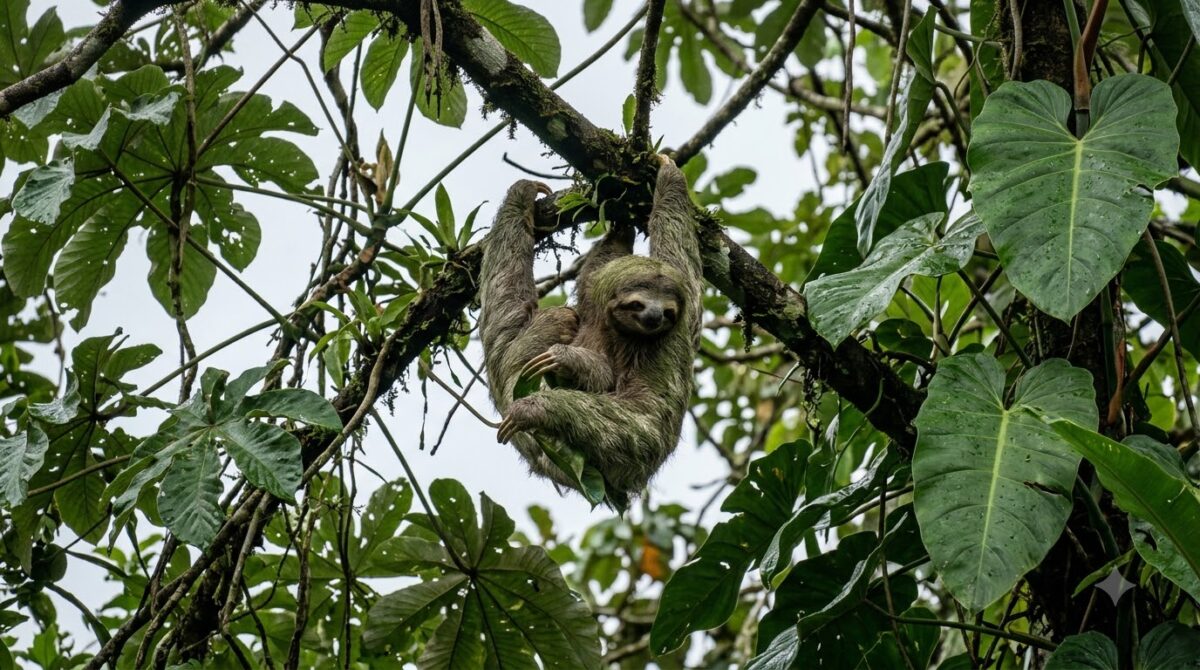
Our Costa Rica wildlife guide covers what else you can expect to see and where.
Day 5: Across Lake Arenal to Monteverde
La Fortuna and Monteverde are 20 kilometres apart across Lake Arenal and four hours apart by road, because the road goes all the way around it.
Take the jeep-boat-jeep. Minibus to the shore, 30 minutes across the lake by boat, minibus up the far side. Three hours door to door, US$30 to US$40 per person, cheaper than the fuel for the drive and considerably more pleasant. The catch is that it does not carry your rental car — either arrange a car swap with your agency, which several will do, or drive the lake road yourself.
Monteverde is a different country climatically. At 1,400 metres it runs 15–20°C, damp all year, and sits inside cloud most afternoons. People arrive from the lowlands in shorts and spend the evening buying a fleece. Bring one, plus a rain layer.
Spend what is left of the afternoon in one of the reserves or on a guided night walk, which is when the cloud forest is at its strangest.
Day 6: The Monteverde cloud forest
The Monteverde Cloud Forest Reserve caps daily entries and sells out in high season, so book online in advance. The Santa Elena Cloud Forest Reserve nearby is quieter, cheaper and holds much the same forest, and a full day to explore either one is not wasted. Either costs about US$25 to US$30.
Go at opening with a guide and a scope. Cloud forest is dense, dim and vertical, and unguided you will see leaves. The resplendent quetzal, which is what most birders come for, is most reliable between February and July.
Afternoon: Monteverde is where commercial zip lining was invented and still has the best courses in the country — long cables across valleys rather than short hops between platforms, two to three hours, US$50 to US$90. If heights are not your thing, the Monteverde hanging bridges cover the same canopy at walking pace, and the orchid garden holds several hundred species including some of the smallest flowers in the world.
Our Monteverde guide compares the reserves and the tours in detail.
Day 7: South to Manuel Antonio and the Pacific coast
About four hours to the Manuel Antonio area, and the first 40 minutes are the unpaved descent out of the mountains. Leave by early afternoon so you arrive in daylight: rural roads here have no lighting, no shoulders and a steady supply of unlit cyclists.
You will feel the change on the way down. Monteverde is fleece weather. The coast is 30°C and humid within two hours of driving.
Where to stay: the road between Quepos and the park entrance holds most of the hotels, many with ocean views over the treetops. Quepos itself is cheaper and has the better restaurants. Both are within 10 minutes of the park gate.
If you have energy left, the beach at Playa Espadilla in front of the park is free, wide and good at sunset. Swim between the flags — the rip currents along this coast are real.
Day 8: Manuel Antonio National Park and its wildlife
Manuel Antonio is the smallest national park in Costa Rica and has the most wildlife per square metre of anywhere you will go. Rainforest runs down to white sand, and capuchins, howler monkeys, sloths, agoutis and iguanas are habituated enough that you find them without trying.
Two rules that ruin days when missed:
- Tickets sell online in advance through the national parks system, in timed entry slots. Do not count on buying at the gate. Book before you fly.
- The park closes one day a week — Tuesday at the time of writing, though it has changed before. Check the official day against your day 8 before you commit to this itinerary.
Enter at opening, around 7am, when it is cool and the animals are moving. Take one of the guides at the gate: roughly US$25 per person with a scope, and comfortably the best value on the whole trip. Playa Manuel Antonio inside the park is the best beach on this stretch. Keep your bag shut; the capuchins are professionals.
Day 9: Playa Uvita, a beach day and where to surf on the Pacific coast
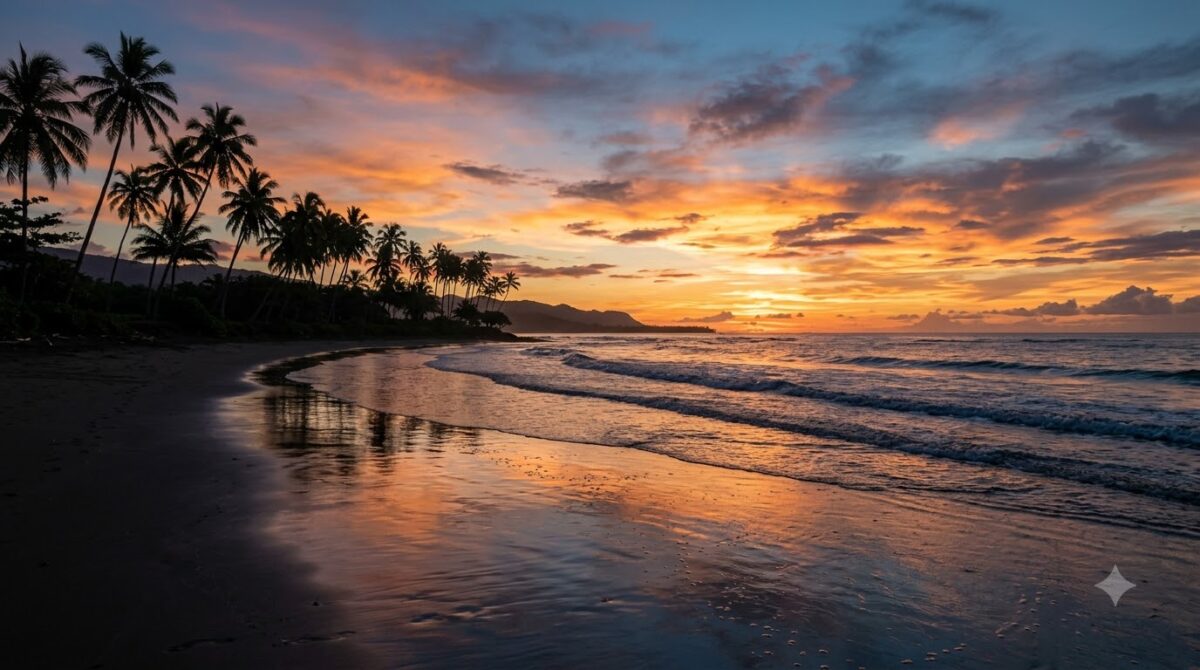
Drive an hour south to Uvita and the stretch of coast known as the Costa Ballena. It is the same ocean with a fraction of the people.
Playa Uvita ends in a sandbar shaped exactly like a whale’s tail, which appears at low tide and is genuinely worth timing your day around — check the tide table, because at high tide it is simply underwater. Entry to Marino Ballena National Park is about US$6.
Humpback whales pass this coast twice a year, roughly July to October and again December to March, which makes Uvita one of the few places with two whale seasons. Boat trips run about US$70.
Nauyaca Waterfalls, inland from Dominical, is the other option for this day: two tiers, a large swimming pool at the base, reached by 4×4 shuttle or a 4km walk in.
Day 10: The drive back to San José, Costa Rica
Uvita to SJO is about four hours: north along the coastal highway, then inland and up through the mountains on Ruta 27. Add an hour for roadworks, which are permanent on that road, and another for returning the car. Working back from a 4pm flight, leave by about 9am.
The drive back to San José is the last of the tropical rainforest you will see, so take it slowly. Worth stopping for on the way: the crocodile bridge over the Tárcoles river, where large American crocodiles lie on the sandbank below and cost nothing to look at, and Jaco if you want a last swim on the way back to San Jose.
If your flight leaves early in the morning, sleep near the airport the night before rather than attempting this drive at dawn.
10 day Costa Rica itinerary map and real driving times
The shape of this route is a loop with a tail: north out of San José into volcano country, west across the lake into the mountains, south-west down to the Pacific coast, then back east.
| Leg | Distance | Real time | Road |
|---|---|---|---|
| SJO → La Fortuna | 125 km | 3 hr | Paved, mountain curves |
| La Fortuna → Monteverde | 20 km direct | 3 hr by boat transfer | Or 4 hr around the lake |
| Monteverde → Manuel Antonio | 170 km | 4 hr | Unpaved first 40 min |
| Manuel Antonio → Uvita | 60 km | 1 hr | Paved coastal |
| Uvita → SJO | 200 km | 4 hr | Paved, constant roadworks |
Note what is not on this list: there is no coast-to-coast leg. Crossing from the Pacific to the Caribbean side would add a full day in each direction, which is the single most common way a ten-day plan turns into a driving holiday.
Doing this Costa Rica itinerary in the opposite direction
The route reverses cleanly: San José → Manuel Antonio → Monteverde → La Fortuna → San José. Whether you should depends on one thing.
- Reverse it if you land early and want the beach first. SJO to Manuel Antonio is three hours on good road, so an early arrival can reach the coast the same day. It also puts the cloud forest in the middle of the trip, which is where cold wet weather is least disappointing.
- Keep the order above if you land late, or if you are travelling with children. The three-hour drive to La Fortuna is the gentlest first leg, and La Fortuna is the easiest base for young children — flat sloth trails, hot springs that work as a swimming pool, short activities.
One thing that does not reverse well: ending in Monteverde. Finishing a holiday at 1,400 metres in cloud, then facing a four-hour drive to the airport, is a poor last day. Whichever direction you run this, finish on the coast or in the valley.
Can you do this Costa Rica itinerary without a rental car?
Yes, entirely. Shared shuttles connect San José, La Fortuna, Monteverde, Manuel Antonio and Uvita on fixed daily departures, at roughly US$55 to US$70 per person per leg. Four legs is around US$250 per person, which for two people is close to what the car would cost anyway.
What you lose is the unplanned half of the trip: the roadside fruit stand, the viewpoint, the decision to stay another hour at the waterfall. What you gain is not driving mountain roads in tropical rain, which some people will consider the better deal.
Public buses cover the same routes for a tenth of the price and roughly double the time, with changes in San José. Uber works in the capital and patchily in larger beach towns; it is not a way to move between regions.
With less time: a 7 day Costa Rica itinerary
Cut Uvita and one night from each base. That gives you three nights in La Fortuna, one in Monteverde and two at Manuel Antonio, skipping the San José night by driving north on arrival.
We have written that version out day by day, with the same drive times and costs — see the 7 day Costa Rica itinerary.
If you have five or six days, do not compress further. Drop Monteverde entirely and split the time between La Fortuna and the coast. Two places done properly beat three done at speed.
With more time: 14 days in Costa Rica
Four extra days is enough to add one whole region rather than three more stops. Three good options:
- The Osa Peninsula. The densest wildlife in the country, and Corcovado National Park. Guided entry is compulsory and the Sirena ranger station books out two to four months ahead. See our Osa Peninsula guide.
- The Caribbean coast. A completely different Costa Rica — Afro-Caribbean food, reggae, calmer water. Puerto Viejo and Tortuguero, which is reachable only by boat or small plane. Note the seasons are inverted: September and October are the best months here and the worst on the Pacific.
- The Nicoya beaches. Fly home from Liberia, Costa Rica (LIR) instead of San José and finish along the peninsula — Santa Teresa, Nosara, Tamarindo. Open-jaw flights into SJO and out of LIR usually cost little more than a return and save a long backtrack.
Adding to this 10 day itinerary: the days worth swapping in
Ten days leaves room for two or three of these without breaking the route. Each one is a half day or a full day from a base you are already sleeping in.
- Rio Celeste is a river that turns opaque turquoise where two streams meet, about two hours from the La Fortuna area. The hike is hard going in the wet and the colour is weather-dependent, so ask before you drive out.
- White water rafting on the Balsa and Sarapiquí runs at grade II to III and leaves from La Fortuna. The Pacuare is the serious one and takes a full day.
- Zip-lining and ATV tours are everywhere. Monteverde has the longest cables with cloud forest under them, and the La Fortuna operators bundle zip lines with views of Arenal Volcano.
- Soaking in hot springs is the other half of La Fortuna. Pools and hot springs fed by the volcano line the road west of town, The Springs Resort and Spa with its Club Rio area is the largest, and most places sell a day pass.
- An animal sanctuary near La Fortuna or Manuel Antonio is the reliable way to see a sloth close up on the day the trails refuse to deliver one.
- Curi Cancha is the quieter reserve at Monteverde, with far fewer people than the main cloud forest and better bird-watching because of it.
- Braulio Carrillo National Park is dense jungle on both sides of the highway out of San José, and the easiest rainforest to reach on a first or last day.
- Guanacaste Province changes the trip entirely if you fly into Liberia instead. Rincón de la Vieja National Park and the north-west beaches replace the first three days.
- A coffee plantation in the Central Valley above San José gives you the taste of Costa Rica most people take home. Finca Rosa Blanca is the best known of the estates that also take guests.
- The Caribbean reef at Cahuita and Puerto Viejo is the only proper snorkelling reef in the country, and that coast is a different Costa Rica from the Pacific side.
Practical notes for exploring Costa Rica on this route
A few things that make exploring Costa Rica easier, and that no amount of reading about beautiful Costa Rica will tell you.
- San José airport sits in Alajuela, about twenty minutes out and already on the right side of the city for the drive north. You never have to enter San José itself.
- Liability insurance is mandatory here and is not in the headline rental price, so every quote you see online rises at the desk. Adobe Rental Car and the other local firms quote it up front, which makes them look expensive and usually means the opposite.
- Book somewhere with a kitchen for at least part of the trip. Eating every meal out is the fastest way to turn a good-value vacation into an expensive one.
- Surfing is available on almost every Pacific beach on this route, and both Manuel Antonio and Dominical have schools that will take a first-timer.
- Give one afternoon to relaxing on the beach and nothing else. A hammock is a legitimate use of a day in a country this green.
- 4 nights in La Fortuna is too many for most people. Three is right, with views of Arenal Volcano from the room if you can get them.
- The stunning beaches of the Nicoya Peninsula are the one part of Costa Rica this route skips. If beautiful beaches are the point of the trip, swap Monteverde for Santa Teresa.
What a 10 day trip to Costa Rica costs
Costa Rica is the most expensive country in Central America, closer to southern Europe than to its neighbours. Per person for ten days, excluding international flights, with two people sharing a room and a car:
| Item | Budget | Mid-range | Comfortable |
|---|---|---|---|
| Accommodation (9 nights) | US$315 | US$810 | US$1,800 |
| Car share, all-in insurance | US$250 | US$300 | US$400 |
| Petrol and tolls | US$90 | US$100 | US$120 |
| Food | US$200 | US$400 | US$700 |
| Parks and tours | US$180 | US$380 | US$650 |
| Total | US$1,035 | US$1,990 | US$3,670 |
Is US$1,000 enough for a week in Costa Rica? For one person sharing a room and a car, yes — a budget week comes to around US$700 and a mid-range week around US$1,360, excluding flights. Alone it is tight, because the room and the car cost the same whether one or two people use them. Solo travel is the expensive case here, not the cheap one.
The reliable budget killer is tours. Each is fair value on its own; four at US$80 is US$320 nobody planned for. Choose three across ten days and spend the rest on staying somewhere with a view.
The best time to go to Costa Rica
The Pacific side, which is where this itinerary spends its time, runs a dry season from December to April and a green season from May to November. September and October are the wettest months and also the cheapest.
- December to April — reliable sun, highest prices, book months ahead over Christmas and Easter.
- May, June and November — the value window. Mornings are usually clear and rain arrives mid-afternoon, which fits this itinerary well since most activities happen early.
- July and August — a short drier spell locals call the veranillo, plus the start of humpback season on the south Pacific coast.
- September and October — wettest on the Pacific, and simultaneously the best weather of the year on the Caribbean.
Our guide to the best time to visit Costa Rica breaks this down by region and month.
Is Costa Rica safe to visit right now?
Costa Rica is one of the safer countries in Latin America for visitors and has no military. The realistic risks on a trip like this are not violent crime.
- Theft from vehicles is the main one. Cars parked at trailheads, waterfalls and beach car parks get broken into. Never leave anything visible, and never leave passports in the car at all.
- Rip currents cause more visitor deaths here than crime does. Most beaches have no lifeguard. Swim where other people are swimming and take local warnings seriously.
- Driving is the genuine hazard: unlit roads, sudden potholes, motorcycles overtaking on blind curves. Avoid driving after dark.
- Petty theft in San José, particularly around the Coca-Cola bus terminal, which is worth avoiding after dark.
Check your own government’s current travel advisory before you book — advisories change, and this page is not one.
Facts about Costa Rica worth knowing before you plan a trip
- Costa Ricans call themselves Ticos. The country abolished its army in 1948 and put the budget into education and health.
- It holds about 5 per cent of the world’s biodiversity on 0.03 per cent of its land surface, and roughly a quarter of the country is protected.
- Most of its electricity comes from renewables — hydro, geothermal, wind — and it runs near 98 to 99 per cent renewable in a good year.
- The currency is the colón. The United States dollar is accepted almost everywhere around Costa Rica, but you will get a poor rate paying in them at small places. Cards work nearly everywhere.
- Pura vida is used as hello, goodbye, thank you and no-problem, and is not a slogan invented for tourists.
- Tap water is safe to drink in most of the country, including everywhere on this route.
- Tipping is not expected on top of the 10 per cent service charge already added to restaurant bills.
For more Costa Rica travel guides covering individual regions, food and wildlife, start with our guide to the best things to do in Costa Rica and our guide to the best beaches.
More Costa Rica travel guides
This page is the spine of our Costa Rica travel guide. Each stop on the itinerary has a full guide of its own, so you can go deeper on the destinations in Costa Rica you actually decide to keep.
- Where to stay in Costa Rica — La Fortuna, San Carlos · Monteverde · Manuel Antonio · Uvita
- Pacific beach towns — Tamarindo, Costa Rica · Santa Teresa · Nosara · Montezuma · Jaco
- Wilder Costa Rica — the Osa Peninsula · Puerto Viejo de Talamanca on the Caribbean coast
- Before you go — when to visit · the best beaches · wildlife you will see · what to eat
Whatever you cut, keep the principle: fewer places, more days in each. Costa Rica rewards it more than almost anywhere.
Doing this by car? Read our guide to driving in Costa Rica for the real rental costs and road conditions.
Before you pack, read what actually matters: our Costa Rica packing list, including what to leave at home.
Only have five days? See our 5 day Costa Rica itinerary, which cuts the route down to two bases.
Still deciding? See is Costa Rica worth visiting — the honest case for and against, including who should go somewhere else.
Planning something bigger next? See our China itinerary, and the hotel licence rule that catches first-time visitors there.
Frequently asked questions
How many days are ideal for Costa Rica?
Ten days is the sweet spot. It covers a volcano, the cloud forest and the Pacific coast without rushing, using four bases and only four travel days. Seven days works with a tighter schedule; fourteen lets you add the Caribbean coast or the Osa Peninsula.
What is the best itinerary for Costa Rica?
For a first trip: San Jose, then three nights in La Fortuna for Arenal Volcano and the hot springs, two nights in Monteverde for the cloud forest, two nights at Manuel Antonio for the national park, and a night at Uvita on the southern Pacific coast.
Is $1000 enough for a week in Costa Rica?
For one person sharing a room and a car, excluding international flights, yes. A budget week runs about US$705 per person and a mid-range week about US$1,360. Travelling solo is the expensive case, because accommodation and the rental car cost the same for one person as for two.
Is it safe for US citizens to go to Costa Rica right now?
Costa Rica is generally considered one of the safer countries in the region for visitors. The main risks are theft from parked cars, rip currents at unpatrolled beaches and driving at night, rather than violent crime. Check your own government current travel advisory before booking, since advisories change.
Do you need a rental car in Costa Rica?
No, but it helps. Shared shuttles link every stop on this itinerary at roughly US$55 to US$70 per person per leg. A car costs about the same for two people and gives you the stops between the stops. You do not need a 4×4 for this route, though you do for the Osa Peninsula and for travel in September and October.
Should you fly into San Jose or Liberia?
San Jose (SJO) suits this itinerary because it sits nearest the middle of the loop. Liberia (LIR) is better if you are heading only to the Guanacaste and Nicoya beaches. An open-jaw booking into San Jose and out of Liberia usually costs little more and saves a long backtrack.
What is the best month to visit Costa Rica?
December to April is the Pacific dry season and the most reliable weather for this route. May, June and November offer clear mornings, afternoon rain, fewer people and lower prices. September and October are the wettest on the Pacific and the best on the Caribbean.
Can you see both coasts of Costa Rica in 10 days?
You can, but it is a poor use of the time. Crossing from the Pacific to the Caribbean costs the better part of a day in each direction, so two of your ten days go to driving. Save the Caribbean for a fourteen-day trip or a second visit.
Park rules, transfer prices and drive times read 18 August 2026. Manuel Antonio ticketing and its weekly closing day change periodically, and Monteverde Cloud Forest Reserve caps daily entries — confirm both on the official sites before booking flights.