
Seven days is the most common length for a first trip to Costa Rica, and it is also the length people most often ruin. The country is small on a map and slow on the ground, and the itineraries that look best on paper are usually the ones that leave you in a car for four days out of seven.
Some links below are affiliate links. We may earn a commission if you book through them, at no extra cost to you. We do not rank hotels, and any prices on the map come live from the booking sites.
Quick answer: where to stay on this 7-day route. Three bases: La Fortuna for the first three nights, Monteverde for one (stay in Santa Elena), and Manuel Antonio for the last two.
This 7 day Costa Rica itinerary uses three bases — La Fortuna, Monteverde and Manuel Antonio — and never asks you to move twice in a day. You get an active volcano, hot springs, a cloud forest, a waterfall, sloths and monkeys, and two days on the Pacific — most of Costa Rica’s most iconic landscapes in one week.
It is a week-long itinerary designed for first-time visitors, and it is deliberately unambitious. Costa Rica’s highlights are spread thin across a country with slow roads, and the perfect 7 day plan is the one that leaves out more than it includes.
Distances, park rules and prices checked 18 August 2026. Costa Rica changes its park booking systems often, so confirm the two reservations flagged below before you fly.
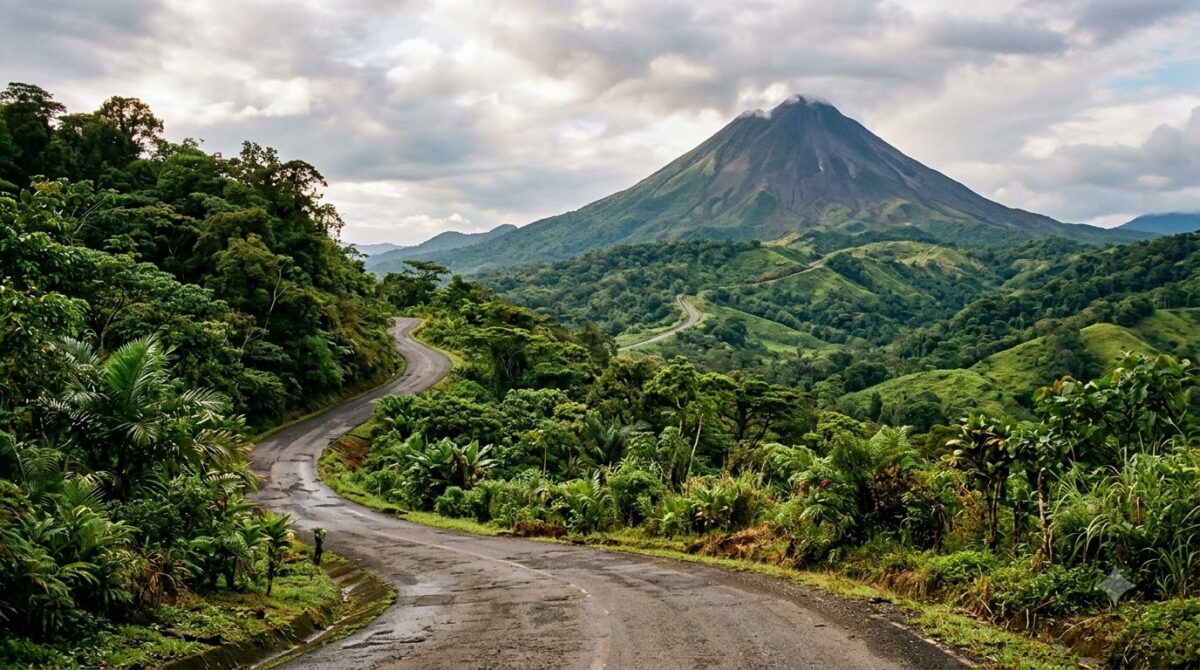
Is 7 days enough time in Costa Rica?
Yes, for one side of the country. It is not enough for both.
Costa Rica is about the size of West Virginia, but the mountain spine running down the middle means almost nothing is a straight line. The drive from the Pacific coast to the Caribbean coast takes the better part of a day. Trying to see Arenal, Monteverde, Manuel Antonio and Tortuguero or Puerto Viejo in a week means roughly 20 hours of driving.
Any itinerary in Costa Rica is really a choice about which one of Costa Rica’s three faces you skip. In seven days you can comfortably do:
- The northern loop plus one beach — La Fortuna, Monteverde and the central Pacific. This is the itinerary below and the one most first-time visitors should take.
- Guanacaste only — fly into Liberia, stay in one beach town, take day trips. Lower effort, less variety.
- The Osa Peninsula — if you care mainly about wildlife and are happy to spend the week in one remote place. See our guide to the Osa Peninsula.
What you cannot do in a week is the Caribbean side as well. Leave Puerto Viejo and Tortuguero for a second trip or a longer one.
Your 7 day Costa Rica itinerary at a glance
| Day | Base | Main thing | Driving |
|---|---|---|---|
| 1 | La Fortuna | Arrive SJO, drive north | 3 hr |
| 2 | La Fortuna | Arenal Volcano, hot springs | under 1 hr |
| 3 | La Fortuna | Waterfall, hanging bridges, sloths | under 1 hr |
| 4 | Monteverde | Cross Lake Arenal, cloud forest | 3 hr transfer |
| 5 | Manuel Antonio | Zip line, then drive south | 4 hr |
| 6 | Manuel Antonio | National park and beach | none |
| 7 | — | Beach morning, drive to SJO | 3 hr |
Nights: three in La Fortuna, one in Monteverde, two near Manuel Antonio.
Why this itinerary loops northern Costa Rica before the beach
Most 7 day itineraries you will find run San José → Monteverde → La Fortuna → coast. This one runs the loop the other way, and the reason is arithmetic.
- Day one is shorter. San José to La Fortuna is about three hours on decent road. San José to Monteverde is four, and the last stretch is unpaved switchbacks. After a long flight, take the easier one.
- The longest drive lands mid-week. Going the other way leaves La Fortuna to Manuel Antonio — four and a half hours — for late in the trip when you are tired of the car.
- You finish at the beach. Ending a trip in a cloud forest at 1,400 metres in the rain is a strange way to close a holiday.
The one argument for the standard direction is that Monteverde is often clearer early in the week in the dry season. It is a weak argument. Take the shorter first drive.
Getting around Costa Rica: rental car, shuttle or private driver
Rent a car. This itinerary works without one, but a car is what turns it from a series of transfers into a trip.
Two warnings about renting, because both catch people out:
- The advertised price is not the price. Costa Rica requires every rental to carry mandatory third-party liability insurance, and comparison sites almost never include it in the headline rate. A car quoted at US$12 a day typically lands between US$45 and US$75 a day once mandatory cover and the deposit hold are added. Budget for the real number.
- Google Maps under-estimates. On the paved highways it is roughly right. On the secondary roads — and the last stretch into Monteverde is one — add 30 to 50 per cent. A route that says two hours can take three.
If you would rather not drive, shared shuttles connect all three bases on this route and cost roughly US$55 to US$70 per person per leg. They run once or twice daily on fixed departures, so you lose flexibility, not access. Private transfers cost about three times that and are worth it for a family of four.
Uber works in San José and, patchily, in some beach towns. Do not plan on it between regions.
Day 1: Arrive in San José and drive to La Fortuna
Fly into Juan Santamaría International Airport (SJO), which is in Alajuela rather than San José proper and is the right airport for this route. Pick up the rental car at the airport and drive straight out — there is no reason to sleep in the capital on the way in.
The drive to La Fortuna takes about three hours via Naranjo and Ciudad Quesada, through coffee country and over a ridge with long views. It is a pleasant drive in daylight and a tedious one after dark, so aim to land before 2pm. If your flight arrives in the evening, sleep near the airport in Alajuela and drive north at first light instead.
Arrive, eat, and go to bed. Do not schedule anything for this afternoon.
Where to stay: La Fortuna town is walkable and cheaper; the hotels strung along the road towards the volcano have the views and the hot springs. For a first trip the volcano-view side is worth the extra. Our La Fortuna guide covers the areas in detail.
Map shows live availability and prices. We may earn a commission on bookings made through it, at no extra cost to you.
Day 2: Arenal Volcano and the hot springs
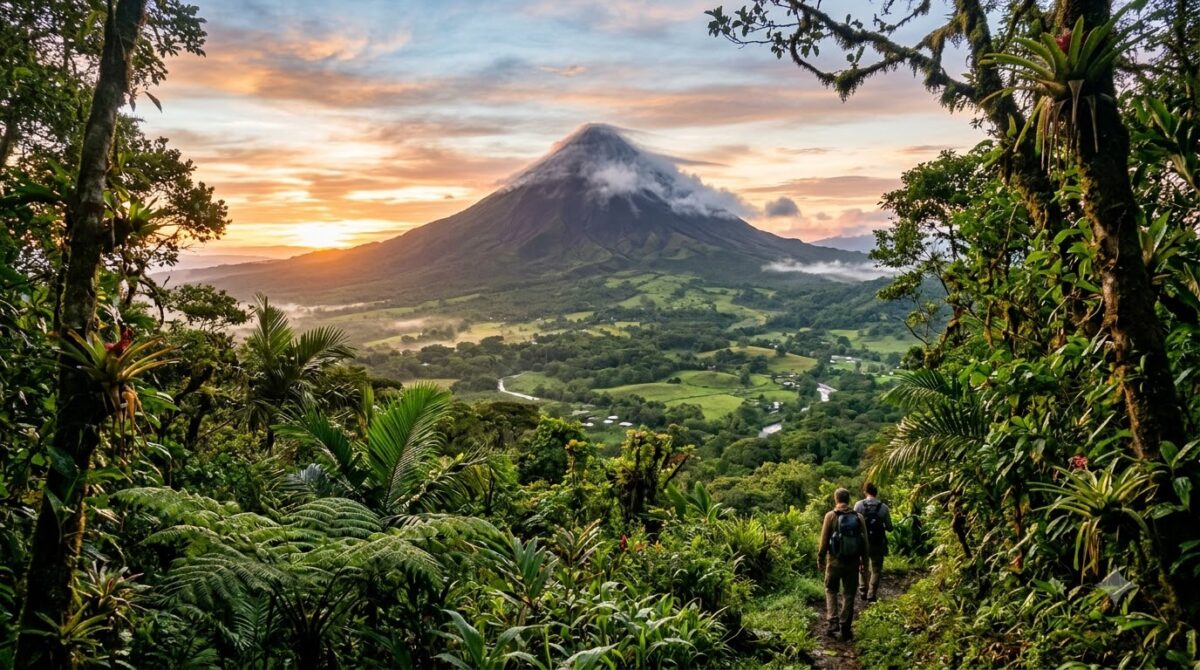
Arenal is the postcard volcano — a near-perfect cone that erupted almost continuously from 1968 until 2010 and has been quiet since. You will not see lava. You will, if you are lucky with cloud, see the cone.
Morning: get up early. The volcano is most often clear between sunrise and about 8am and spends the rest of the day in cloud. Then walk one of the trails in Arenal Volcano National Park. The 1968 lava-flow trail crosses old rubble fields and gives the best views of Arenal Volcano in the park, with the cone directly above; it is more interesting than the forest loops and takes about two hours.
Afternoon: natural hot springs. The whole valley sits on geothermally heated water and there are three tiers of it:
- The big resorts — landscaped pools, swim-up bars, day passes from around US$60 to US$130. Comfortable, busy, and the water is genuinely good.
- Mid-range spots — simpler pools, around US$20 to US$40 for the day.
- The free river — a stretch of naturally hot river under a road bridge near the resort strip, free and popular with locals. No facilities and nowhere to leave valuables.
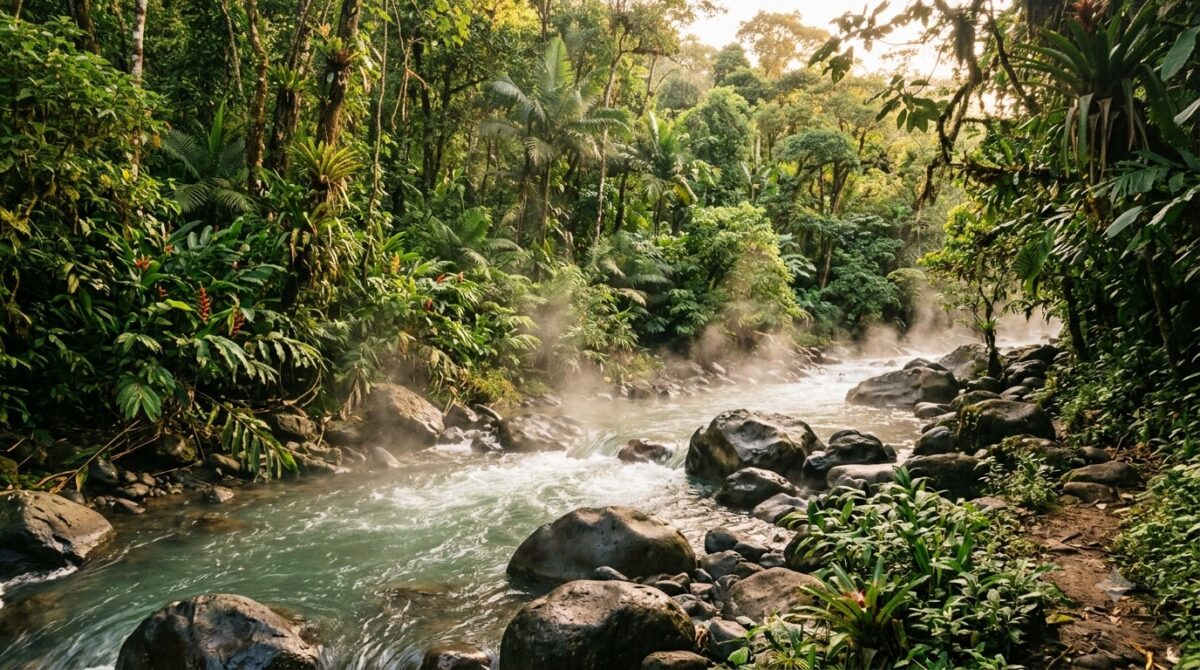
Book the resort passes ahead in high season. Late afternoon into the evening is the best time to be in the water — it is cooler, and it usually rains, which is oddly pleasant when you are already sitting in a hot river.
Day 3: La Fortuna Waterfall, hanging bridges and a sloth walk
Three short outings, none of which needs a full day.
La Fortuna Waterfall. A 70-metre fall into a blue pool at the bottom of a steep concrete staircase — roughly 500 steps down, and the same 500 back up in humidity. Entry is around US$18. Go at opening, before the tour buses. You can swim, though the current at the base is stronger than it looks; the calmer pool downstream is the better one.
Hanging bridges. The Mistico hanging bridges park strings a series of suspension bridges through primary rainforest at canopy height, which is the only way to see the layer of forest where most of the animals actually live. About US$30 to walk it yourself, roughly double with a naturalist guide. Take the guided tour — you will see perhaps five times as much. Mistico also runs a nighttime version, when the forest belongs to a completely different set of animals.
Sloths. La Fortuna is one of the easiest places in the country to see a wild sloth, and the Bogarín Trail on the edge of town is a short, flat, cheap walk where guides find them almost daily. An hour, about US$30 with a guide. Two-toed sloths are more active at dusk; three-toed sloths are the ones asleep in a fork all afternoon.
If you would rather trade one of these for water, the Balsa river runs class II–III rafting suitable for beginners and families, half a day, roughly US$70. Our wildlife guide covers what else you are likely to spot around here.
Day 4: Head to Monteverde by jeep-boat-jeep
La Fortuna and Monteverde sit on opposite sides of Lake Arenal, about 20 kilometres apart in a straight line and four hours apart by road, because the road goes all the way around.
Take the jeep-boat-jeep instead. A minibus to the lake shore, a 30-minute boat across, a second minibus up the other side. About three hours door to door and around US$30 to US$40 per person. It is cheaper than the petrol for the drive, considerably more pleasant, and the boat crossing is the nicest hour of the transfer day.
The catch: it does not take your rental car. Either return the car in La Fortuna and pick up a new one in Monteverde — some agencies will arrange exactly this swap — or drive around the lake yourself, which is a genuinely scenic four hours on a road that deteriorates near the end.
Afternoon in the cloud forest. Monteverde sits at about 1,400 metres and is a different climate entirely: 15–20°C, permanently damp, and wrapped in cloud most afternoons. Bring a fleece and a rain layer — people arrive from the lowlands in shorts and regret it.
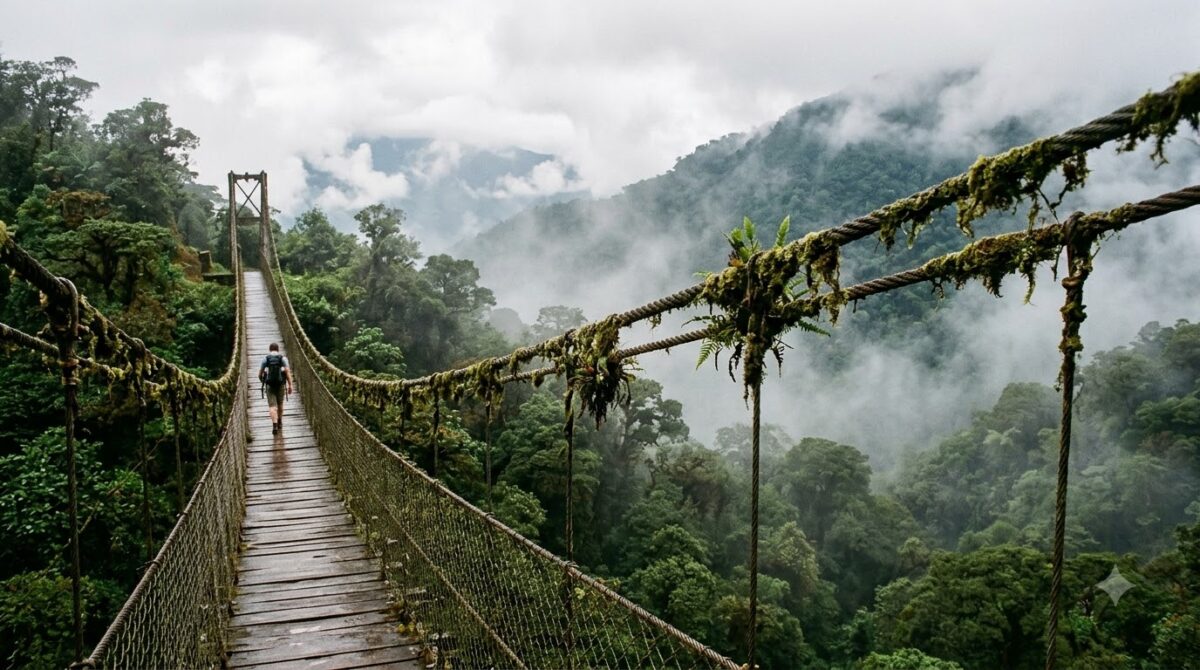
Spend what is left of the day in one of the reserves. The Monteverde Cloud Forest Reserve is the famous one and caps daily entries, so book online in advance in high season. Santa Elena Reserve nearby is quieter and cheaper with much the same forest. Entry to either runs about US$25 to US$30. Our Monteverde guide compares the reserves.
The resplendent quetzal — the bird most people come hoping to see — is most reliably found between February and July, and even then you want a guide with a scope.
Day 5: Monteverde cloud forest, then south to the beach
This is the longest driving day of the week. Do the fun part early.
Morning: Monteverde is where commercial zip lining was invented, and the courses here are still the best in the country — long cables strung across valleys rather than short hops between platforms. Two to three hours, roughly US$50 to US$90. If heights are not your thing, the Monteverde hanging bridges or a guided early-morning birding walk fill the same slot.
Afternoon: drive to the central Pacific coast. Roughly four hours to the Manuel Antonio area, and the first 40 minutes are the rough unpaved descent out of Monteverde. Leave by 1pm so you arrive before dark. Roads here have no lighting, no shoulders and a fair number of unlit cyclists.
You will feel the climate change on the way down. Monteverde is fleece weather; the coast is 30°C and humid. It is the fastest way to experience Costa Rica’s range of climates, and it happens in a single afternoon.
Where to stay: the road between Quepos and the park entrance holds most of the hotels, many with ocean views over the forest. Quepos town is cheaper and has better restaurants. Anywhere on that road is 10 minutes from the park.
Day 6: Manuel Antonio National Park and your last night in Costa Rica
Manuel Antonio is the smallest national park in Costa Rica and the one with the most animals per square metre. Rainforest runs straight down to white sand beaches, and the wildlife — capuchin and howler monkeys, sloths, agoutis, iguanas — is habituated enough that you see it without trying.
Two rules that ruin trips when missed:
- Tickets are sold online in advance through the national parks system, in timed slots. There is no reliable walk-up gate. Buy them before you arrive in the country.
- The park closes one day a week — Tuesday, at time of writing — and the day has changed before. Check the official date against your day 6 before you lock this itinerary in.
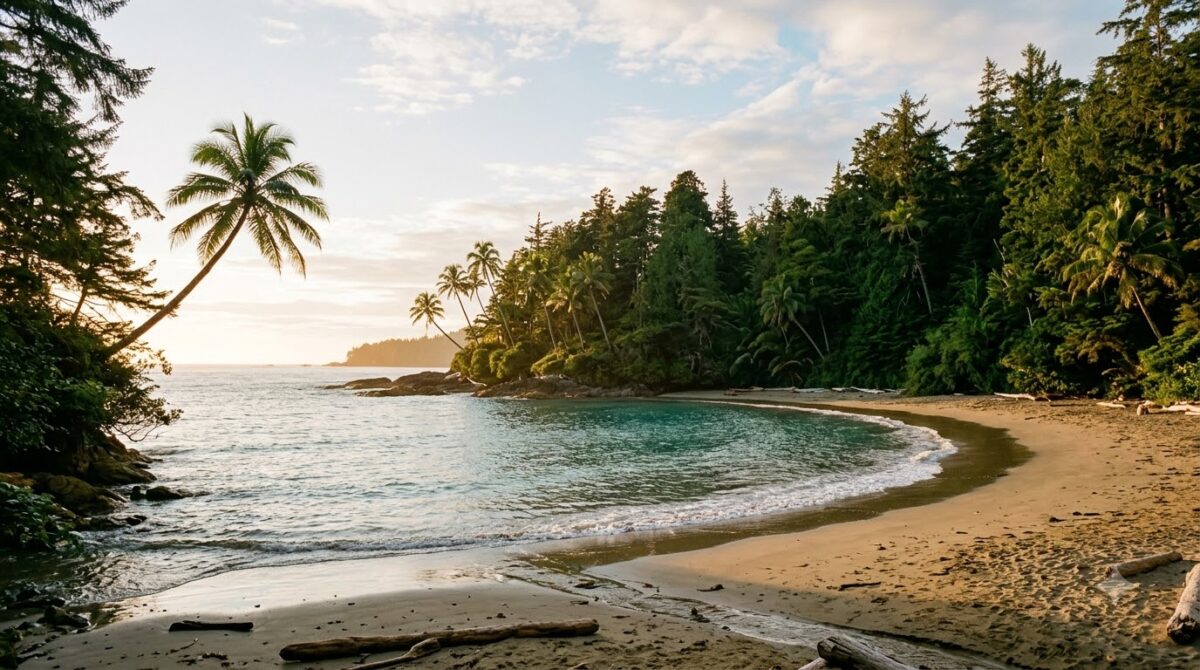
Go in at opening, around 7am. It is cooler, the animals are active, and the crowds arrive from 9. Hiring one of the guides at the gate — roughly US$25 per person, with a scope — is the single best value on this itinerary. They find things you would walk past a hundred times.
Playa Manuel Antonio, inside the park, is the best beach on this stretch of coast. Take water and keep your bag closed: the capuchins are practised thieves.
Afternoon and evening: come out around midday, eat, sleep through the heat, and take the last evening slowly. Sunset over the Pacific, dinner in Quepos, and an early night before the drive. Our Costa Rican food guide covers what to order.
Day 7: Beach morning, then the drive back to San José
Manuel Antonio to SJO is about three hours on the coastal highway and then up through the mountains. Add an hour of margin for roadworks, which are constant on that route, and another hour for the rental return. Working back from a 4pm flight, you want to leave the coast by about 10am.
That leaves a genuine last morning — the one part of a trip in Costa Rica most people wish they had more of: an early swim, breakfast with a view, and a look for the sloths that live in the trees around most of the hotels here.
If your flight is late in the evening, break the drive at Playa Jacó or the crocodile bridge over the Tárcoles river, where large American crocodiles sit on the sandbank below and cost nothing to look at. If you have an early morning flight instead, sleep near the airport the night before and use a few hours in San José, Costa Rica rather than risking the drive at dawn.
Popular activities to add to this Costa Rica trip
The itinerary above leaves an afternoon free most days. These are the additions worth the money, grouped by the part of Costa Rica you will be in when you can do them.
Around La Fortuna, San Carlos. A coffee tour on a working family farm is the standard half-day here, and the better ones fold in a chocolate tour on the same visit — cacao pod to drinking chocolate in an hour, which children like more than adults expect. A cooking class is the other good option if you want to explore Costa Rican culture through something other than a viewpoint: most teach a handful of authentic Costa Rican dishes built on rice, beans and plantain.
Around Monteverde. Beyond the zip line, this is the best part of Costa Rica for small specialist nature reserves. The Monteverde Orchid Garden holds several hundred species in a garden you can walk in half an hour, including some of the smallest orchids in the world. Guided night walks run daily and are where most people finally see a sloth moving. Birders come for the quetzal, but the toucans are easier and, frankly, more entertaining.
Around the coast. Catamaran trips out of Quepos usually find dolphins, and between July and October humpback whales pass through this stretch of water. If you want the adrenaline version instead, the Savegre and Naranjo rivers run whitewater close by, and ATV and motorcycle tours cover the hills behind the coast.
One thing to look for when you book: Costa Rica runs a national sustainability certification for tourism businesses, and operators who hold it display the rating. It is not a guarantee of a good tour, but it is a reasonable filter, and it separates genuine outdoor adventure operators from the ones bussing tourists to a photo stop.
Two additions per week is the realistic number. Any more and the days you set aside to relax quietly disappear.
Map of this 7 day Costa Rica itinerary
The route is a loop that never doubles back. Read it as a triangle: north from the airport into the volcano country, west across the lake and up into the mountains, then south-west down to the coast and back east to San José.
| Leg | Distance | Real time | Road |
|---|---|---|---|
| SJO → La Fortuna | 125 km | 3 hr | Paved, mountain curves |
| La Fortuna → Monteverde | 20 km direct | 3 hr by boat transfer | Or 4 hr by road around the lake |
| Monteverde → Manuel Antonio | 170 km | 4 hr | Unpaved first 40 min |
| Manuel Antonio → SJO | 160 km | 3 hr | Paved, frequent roadworks |
Two of those legs are the ones people underestimate. The drive from La Fortuna over to Monteverde looks trivial on a map and is not, and the La Fortuna to San José return — if you reverse this route — eats a morning. La Fortuna and Manuel Antonio are the two bases worth an extra night if you have one. Note also what is missing: there is no coast to coast leg here, because crossing Costa Rica from the Pacific to the Caribbean would add a full day in each direction.
Thirteen hours of driving in seven days is about the floor for an itinerary that includes a volcano, a cloud forest and a beach. Any route promising all three with less is either skipping something or lying about the roads.
What a 7 day trip to Costa Rica actually costs
Costa Rica is the most expensive country in Central America and roughly comparable to southern Europe. Per person for seven days, excluding international flights:
| Item | Budget | Mid-range | Comfortable |
|---|---|---|---|
| Accommodation (6 nights) | US$210 | US$540 | US$1,200 |
| Rental car share, with insurance | US$175 | US$210 | US$280 |
| Petrol and tolls | US$60 | US$70 | US$80 |
| Food | US$140 | US$280 | US$490 |
| Parks and tours | US$120 | US$260 | US$450 |
| Total | US$705 | US$1,360 | US$2,500 |
Is US$1,000 enough for a week in Costa Rica? For one person sharing a room and a car, excluding flights: yes, with room to spare at the budget end and just about at mid-range. Travelling alone it is tight, because the room and the car are the same price whether one or two people use them. That is the single biggest cost difference for solo travellers here.
Where the money actually goes wrong is tours. Individually they are reasonable; three or four US$80 tours in a week is US$300 nobody budgeted. Pick two you genuinely want.
Do you need a 4×4 for this itinerary?
For this exact route, no. A standard car handles every road on it, including the unpaved stretch into Monteverde, provided you drive it slowly and it is not the height of the wet season.
You want a 4×4 — a real one, not a raised hatchback — if you plan to add any of these:
- Any road into the Osa Peninsula or Drake Bay, where river crossings are normal
- The Nicoya beach towns south of Nosara, where the coast road is dirt and fords streams
- Anywhere at all in September or October, the wettest months
Rental agencies push the 4×4 upgrade hard because the margin is good. On this itinerary it is optional. The insurance is not.
Three ways to change this itinerary
The route above is built for a first trip with a mix of everything. Three sensible variants:
Costa Rica with kids. Cut Monteverde. The drive in is rough, the weather is cold and wet, and small children get less out of a cloud forest than the brochure suggests. Give the two days to La Fortuna instead. La Fortuna with kids is easy: sloths on a flat trail, hot springs that work as a swimming pool, gentle rafting and a chocolate tour, all within 20 minutes of town. Then go straight from there to the coast, where an extra beach day is perfect for families who need time to relax rather than another 6am start.
If you mainly want to surf. Fly into Liberia, Costa Rica (LIR) instead of San José and stay on the Nicoya Peninsula: Tamarindo, Costa Rica for beginner lessons and nightlife, Santa Teresa for consistent waves and a slower scene, or Nosara for yoga and reliable beach break. You lose the volcano; you gain five days of surfing instead of one afternoon.
If you mainly want wildlife. Replace Monteverde and Manuel Antonio with the Osa Peninsula. Corcovado holds the densest concentration of wildlife in the country. Note that guided entry is compulsory and the Sirena ranger station books out two to four months ahead, which is why it does not belong in a standard 7 day plan.
Costa Rica travel tips: seven mistakes to avoid in one week
- Do not try both coasts. The Caribbean side is a full day of driving from the Pacific. In a week it costs you two days to see one place.
- Do not book an evening arrival and a long drive. Unlit roads, no shoulders, heavy rain. Sleep near the airport instead.
- Do not trust the rental car headline price. Mandatory liability insurance is not in it. Assume US$45 to US$75 a day all in.
- Do not trust the drive times on your phone. Add 30 to 50 per cent once you leave the main highways.
- Do not arrive at Manuel Antonio without a ticket. They sell online, in timed slots, and the park closes one day a week.
- Do not skip the guides. A US$25 guide with a scope is the difference between seeing four animals and forty.
- Do not pack for the tropics only. Monteverde is 15°C and wet. A fleece and a rain jacket earn their space.
And if you find you have more than seven days: the first thing to add is not a fourth destination but a night in each of the three you already have. With 9 days the same loop stops feeling like a schedule. With 10 or more, that is when a fourth region starts to make sense.
One more that is not a mistake so much as a mindset: Costa Rica rewards doing less. The people who enjoy their week most are the ones who picked three places and stayed put. For what to see beyond this route, start with our Costa Rica travel guide to the best things to do, and check when to visit before you book flights.
Have longer? The 10 day Costa Rica itinerary adds Uvita and a night in each base.
Doing this by car? Read our guide to driving in Costa Rica for the real rental costs and road conditions.
Two days shorter? The 5 day Costa Rica itinerary drops to two bases and explains which airport to fly into.
Frequently asked questions
Is 7 days enough for Costa Rica?
Yes, for one side of the country. Seven days covers a volcano, a cloud forest and a Pacific beach comfortably. It is not enough to add the Caribbean coast or Tortuguero, which sit a full day of driving away.
Can I do this itinerary without renting a car?
Yes. Shared shuttles connect San Jose, La Fortuna, Monteverde and Manuel Antonio on fixed daily departures, at roughly US$55 to US$70 per person per leg. You lose the ability to stop where you like, not access to any of the stops.
Do I need a 4×4 car for a Costa Rica itinerary?
Not for this route. A standard car handles every road on it, including the unpaved stretch into Monteverde. You want a real 4×4 for the Osa Peninsula, the dirt coast road south of Nosara, or any travel in September and October.
Is $1000 enough for a week in Costa Rica?
For one person sharing a room and a car, excluding international flights, yes. A mid-range week runs about US$1,360 per person and a budget week about US$705. Travelling alone is the expensive case, because the room and car cost the same whether one or two people use them.
What is the best 7 day Costa Rica itinerary for first-timers?
Three nights in La Fortuna for Arenal Volcano and the hot springs, one night in Monteverde for the cloud forest, and two nights near Manuel Antonio for the beach and the national park. It gives you the three landscapes Costa Rica is known for with only four driving days.
Should I fly into San Jose or Liberia?
San Jose (SJO) for this itinerary, because it sits closest to the middle of the loop. Liberia (LIR) is the better airport if you are heading only to the Guanacaste and Nicoya beaches, where it saves three to four hours of driving each way.
When is the best time of year for a week in Costa Rica?
December to April is the dry season on the Pacific side and the most reliable for this route. May, June and November are quieter and cheaper with afternoon rain. September and October are the wettest months on the Pacific, though they are the best time on the Caribbean coast.
Is Costa Rica safe for travelers?
Generally yes, with ordinary precautions. The main risks are petty theft from parked cars and rip currents at unpatrolled beaches, not violent crime. Never leave anything visible in a rental car at a trailhead or beach car park.
Park entry rules, transfer prices and drive times read 18 August 2026. Manuel Antonio ticketing and its weekly closing day change periodically — confirm on the official national parks site before you book flights.