Quick answer which Dublin hotel building to pick
Georgian conversions for period rooms, usually with stairs. Victorian grand hotels for the public rooms more than the bedrooms. Modern Docklands blocks for space, lifts and climate control. Aparthotels once you are staying more than three nights.
On this page
- The five kinds of hotel in Dublin
- The Georgian townhouse conversion
- The Victorian grand hotel
- The modern block
- The aparthotel
- The townhouse guesthouse
- Castles and country houses on the edge
- What actually changes your stay
- Where each kind sits on the map
- The dates when none of this matters
- What changes as you move up the price bands
- Accessibility, honestly
- Airport hotels, and the one case for them
- What sells out first
- Frequently asked questions
Search for the best hotels in Dublin and you get ranked lists. They are not much use, because the thing that varies most between Dublin hotels is not quality or price. It is the building.
Some links below are affiliate links. We may earn a commission if you book through them, at no extra cost to you. We do not rank hotels, and any prices on the map come live from the booking sites.
Central Dublin is Georgian and Victorian. Hotels there are conversions, and conversions come with fixed consequences: small rooms, narrow stairs, sometimes no lift, and windows onto streets that were never designed to be quiet. The modern stock that solves all of that sits at the edges of the centre, in the Docklands. Neither is better. They are different buildings, and knowing which one you are booking removes almost every unpleasant surprise. For the area question first, see where to stay in Dublin; for the days themselves, our 3-day Dublin itinerary and how many days in Dublin.
The five kinds of hotel in Dublin
| Kind of building | What you get | Where they cluster |
|---|---|---|
| Georgian townhouse conversion | Period rooms, high ceilings, odd layouts, often no lift | Merrion Square, Baggot Street, Fitzwilliam |
| Victorian grand hotel | Large public rooms, a doorman, a bar the city uses | St Stephen’s Green, O’Connell Street |
| Modern block | Lifts, standard rooms, climate control, quiet evenings | Docklands, IFSC, Grand Canal Dock |
| Aparthotel | A kitchen, space, better value past three nights | Smithfield, the quays, Docklands |
| Townhouse guesthouse | Ten to twenty rooms, breakfast, owner on site | Ballsbridge, Drumcondra, Portobello |
The Georgian townhouse conversion
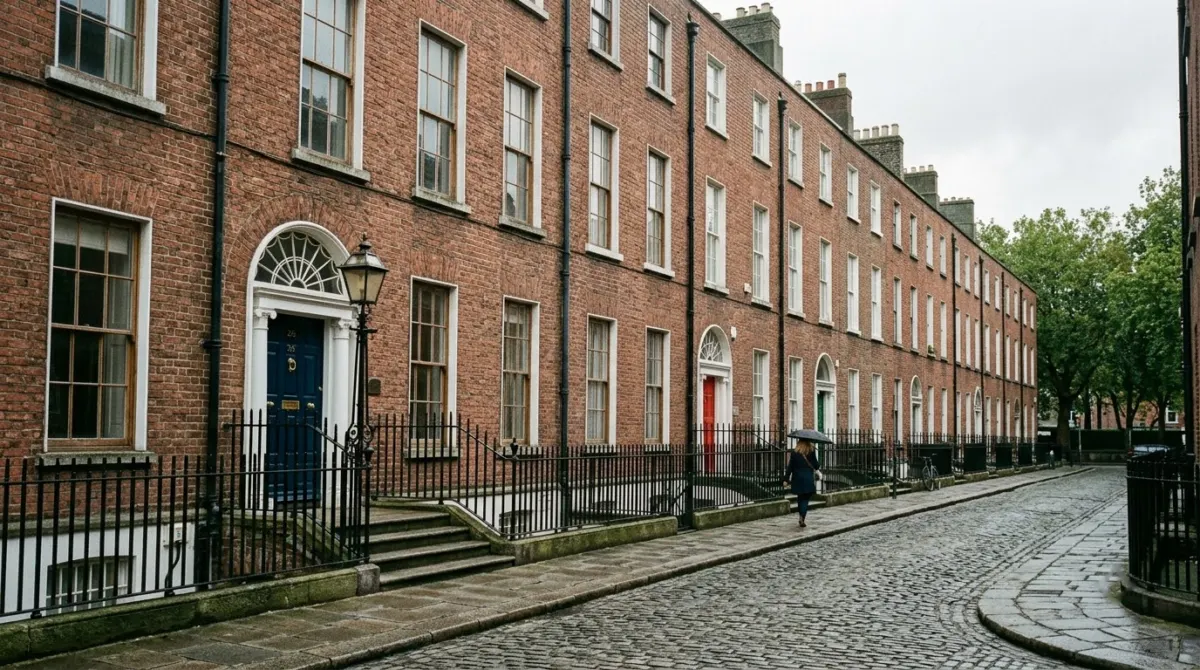
Dublin’s Georgian squares were built as houses for one family each, four or five storeys, one or two rooms deep. Turning one into a hotel means fitting bedrooms into rooms that were drawing rooms, bedrooms and servants’ quarters, and the result is a hotel where no two rooms are alike.
The Merrion, opposite Government Buildings, is the clearest example of the type: four restored Georgian townhouses joined behind a single front, with gardens enclosed by the buildings. That is the shape the category takes at its largest. Most are far smaller — one house, a dozen rooms.
What this buys you is the real thing: tall sash windows, deep plasterwork, a staircase worth walking up. What it costs you is predictability. A room on the top floor of a Georgian house was originally a servant’s room and is still the smallest in the building. Lifts exist in the converted ones and do not exist in many of the smaller ones.
Ask two questions before you book one: is there a lift, and which floor is the room on.
The Victorian grand hotel
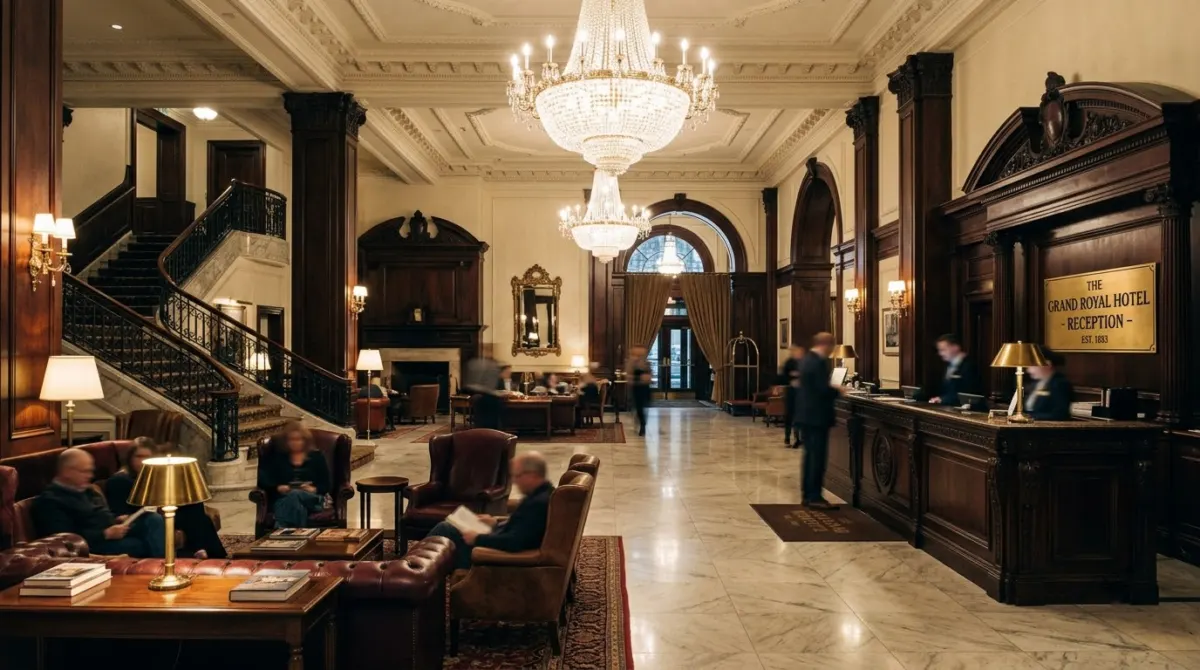
Dublin has a handful of hotels that function as civic buildings as much as accommodation. The Shelbourne, on the north side of St Stephen’s Green, has been open since 1824, when it was made out of three adjoining townhouses; the constitution of the Irish Free State was drafted in one of its rooms in 1922. The Gresham, on O’Connell Street, dates from 1817 and was damaged in both the 1916 Rising and the Civil War that followed.
Buildings like these give you the public rooms — a lobby people meet in, a bar the city actually uses, afternoon tea that locals book. The bedrooms are usually unremarkable by comparison, and that is the honest trade: you are paying for the ground floor more than the fourth.
They also sit on the two busiest addresses in the city, which is convenient at nine in the morning and loud at eleven at night.
Map shows live availability and prices. We may earn a commission on bookings made through it, at no extra cost to you.
The modern block
Everything built in the last twenty years is east of the centre, in the Docklands and around Grand Canal Dock. These are ordinary modern hotels: a lift that works, rooms of a standard size, heating and cooling that respond, double glazing, and a lobby with no history in it at all.
For some trips that is exactly right. If you are arriving late, working during the day, travelling with a wheelchair or a pushchair, or simply tired of charming staircases, the Docklands solves problems the Georgian core cannot. The cost is a fifteen- to twenty-minute walk into town and evenings in a district that empties after work.
The aparthotel
Dublin has an unusually good supply of aparthotels — serviced apartments with a reception desk — clustered along the quays, in Smithfield and in the Docklands.
They are the sensible answer to two situations. One is a family: separate sleeping space and a kitchen change the arithmetic of a trip with children. The other is a stay of four nights or more, where eating breakfast out every day starts to cost more than the room difference.
Check whether the rate includes cleaning and whether reception is staffed around the clock, because in this category both vary.
The townhouse guesthouse
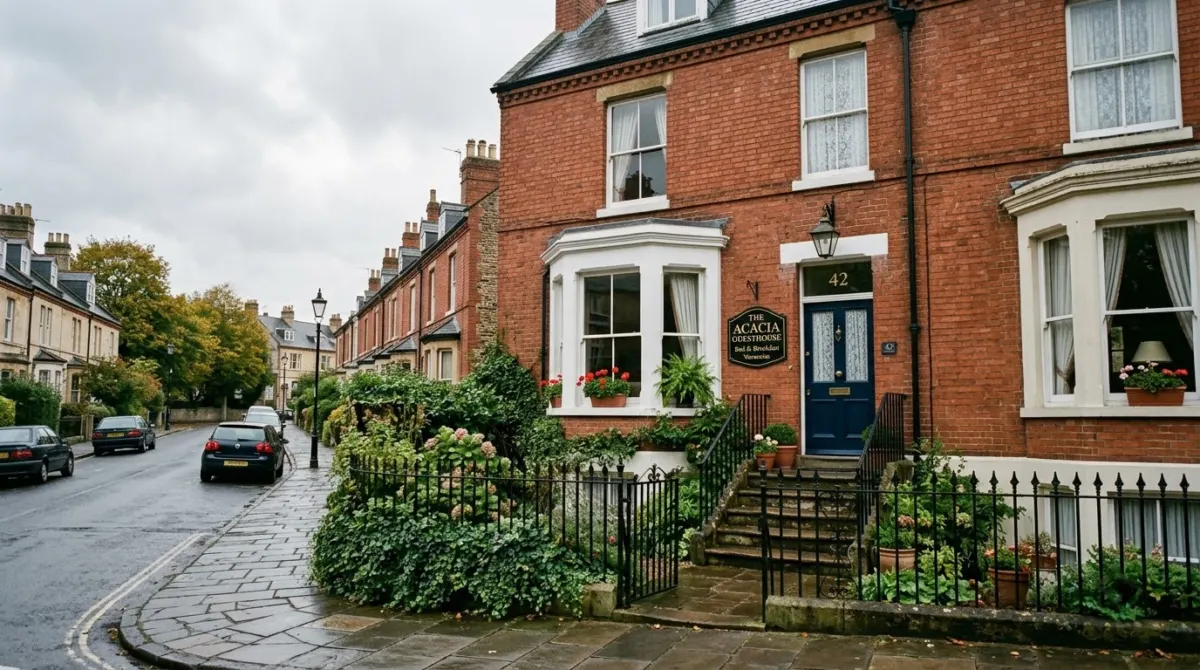
A terraced house with eight to twenty rooms, breakfast cooked to order, and someone at the desk who lives in the city. These sit mostly outside the centre: Ballsbridge, Drumcondra, Portobello, Clontarf.
This is the category that gets forgotten and it is often the best value in Dublin for the money. The trade is distance — fifteen to thirty minutes’ walk, or a bus — and the fact that what you get depends heavily on the individual house rather than on a brand standard.
Castles and country houses on the edge
Within half an hour of the centre, Dublin has several hotels in historic buildings with grounds — converted castles and country houses on the coast and in the suburbs. Clontarf Castle, on the north coastal side, is the best-known of them.
They make sense for a wedding, a quiet weekend, or a first or last night with a car. They do not make sense as a base for seeing Dublin, because every trip into town is a journey rather than a walk.
What actually changes your stay
Five questions, in the order they matter in this city:
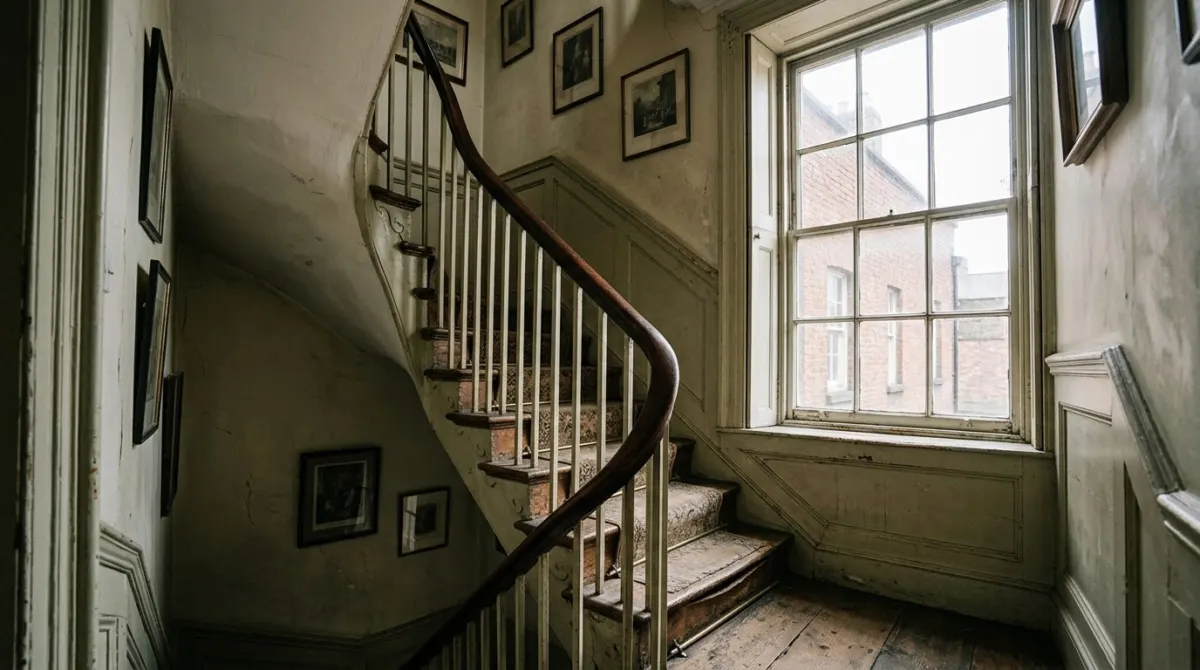
- Is there a lift? In a Georgian or Victorian building, assume not until the listing says otherwise.
- Which floor, and does the window face the street? Dublin’s centre is noisy late. A back-facing room in a busy area beats a street-facing room in a quiet one.
- How big is the room? Listings that say compact mean it. Modern blocks are the reliable answer if space matters.
- Is breakfast included, and is it cooked? In guesthouses it usually is, and it is usually substantial. In city-centre hotels it is often an expensive add-on.
- Which coach stop is nearest? There is no train from the airport, so the walk from your bus stop to your door is part of the booking.
Where each kind sits on the map
Rough geography, because the categories are not spread evenly:
South-east centre — Merrion Square, Baggot Street, Fitzwilliam — is Georgian conversions and the quietest central streets.
Around St Stephen’s Green and Grafton Street is where the grand hotels and the expensive modern refurbishments are, and where you pay the most per square metre in Ireland.
The quays and Smithfield hold most of the aparthotels, with the Luas Red Line running through.
The Docklands and Grand Canal Dock are modern blocks almost exclusively.
Ballsbridge, Drumcondra and Clontarf are guesthouses and the larger suburban hotels, twenty to thirty minutes out.
The dates when none of this matters
Dublin’s hotel supply is small relative to demand, and a handful of dates empty it: St Patrick’s weekend in March, international rugby at the Aviva, championship days at Croke Park, and large concerts. On those weekends the question stops being which building you prefer and becomes what is left.
If your dates are fixed and fall on one of them, book early, and look at the guesthouse and aparthotel categories before you look at raising your budget.
What changes as you move up the price bands
Dublin does not have a cheap end. What it has is a flat middle, and understanding what the extra money buys stops you overpaying for the wrong thing.
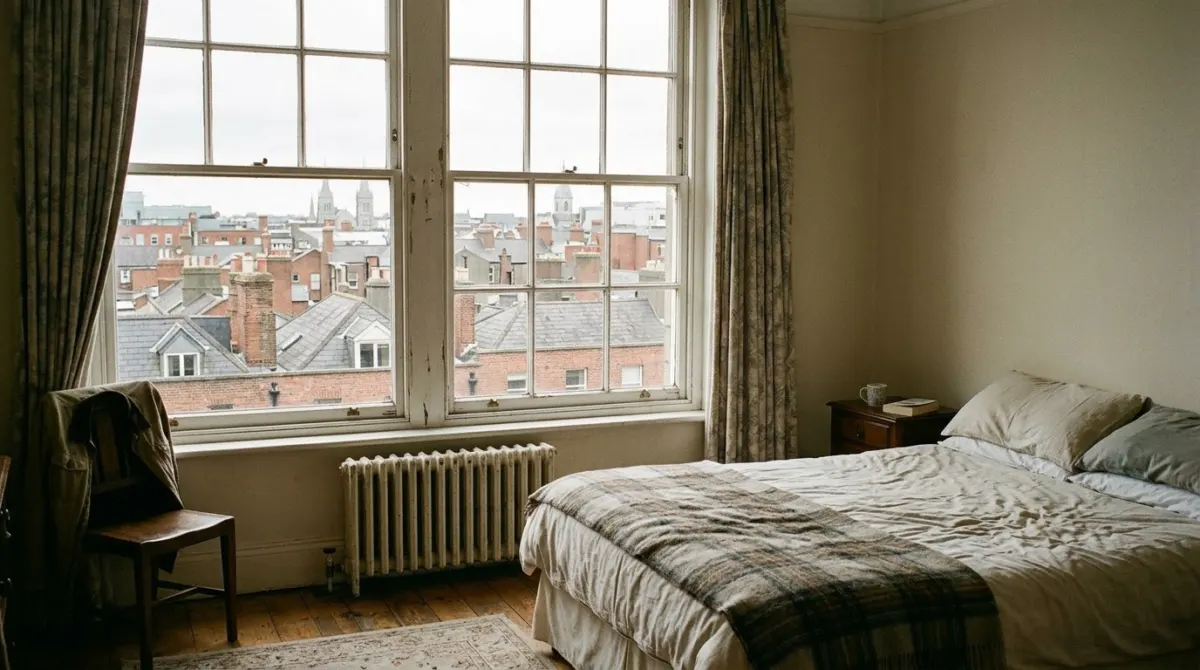
At the lower end you are buying location and nothing else: a small room, a shower over a bath or a pod bathroom, breakfast as an add-on, and a reception that may not be staffed overnight. The rooms are clean and the walls are thin.
In the middle the change is space and breakfast rather than luxury. Rooms get big enough to open a suitcase on the floor, the building usually has a lift, and a cooked breakfast is often included.
At the upper end you are buying the building and the ground floor: a lobby worth sitting in, a bar the city uses, a doorman, room service. The bedrooms improve less than the public rooms do, which is why a mid-range modern room is sometimes more comfortable to sleep in than an expensive period one.
Accessibility, honestly
This is the question Dublin answers worst, and it is worth asking directly.
Period conversions have steps at the entrance, because Georgian houses are raised above the street with a flight up to the front door. Many have a lift that starts on the first floor rather than the ground. Bathrooms fitted into old rooms are frequently small, and “accessible” is used loosely.
If step-free access matters, book a modern building in the Docklands or at Grand Canal Dock, and confirm specifics with the hotel directly rather than relying on a filter. The newer stock is genuinely accessible; the older stock varies house by house.
Airport hotels, and the one case for them
Hotels at Dublin Airport are a twenty-minute drive from the city with nothing around them. They earn their place in exactly one situation: a flight before seven in the morning, when the alternative is a taxi across a sleeping city.
For an evening arrival they are rarely worth it. The coaches into town run late, and a night in the centre buys you a dinner and a walk rather than a view of a car park.
What sells out first
Three patterns repeat, and they are useful for timing a booking:
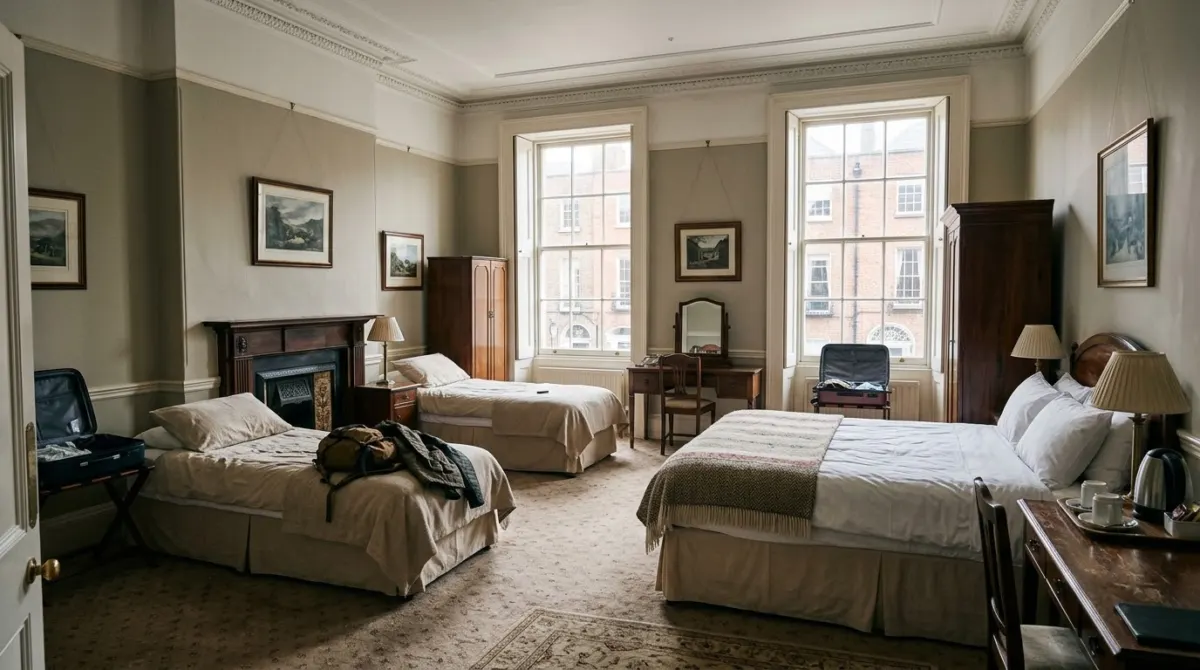
- Family rooms and triples go first, in every category. Dublin’s building stock is old and rooms that fit three people are genuinely scarce.
- Aparthotels fill before hotels on weekends with events, because groups book them.
- The Georgian conversions sell out by character — the handful of rooms with the good windows go months ahead, and what remains is the top floor.
If a specific kind of room matters to you, book it before you book the dates around it.
Frequently asked questions
What kind of hotel building should I book in Dublin?
Decide by what you need rather than by rating. Georgian townhouse conversions give you period rooms and often no lift. Victorian grand hotels give you public rooms more than bedrooms. Modern blocks in the Docklands give you space, lifts and climate control at the cost of a walk into town. Aparthotels suit families and stays over three nights.
Are Dublin hotel rooms small?
In the centre, often yes. Most central hotels are conversions of Georgian and Victorian houses, so rooms are irregular and the top-floor ones are the smallest. If room size matters, the modern stock east of the centre is the reliable answer.
Which Dublin hotels are historic buildings?
The Shelbourne on St Stephen's Green opened in 1824, built out of three adjoining townhouses, and the constitution of the Irish Free State was drafted there in 1922. The Gresham on O'Connell Street dates from 1817 and was damaged in the 1916 Rising and the Civil War. The Merrion occupies four restored Georgian townhouses opposite Government Buildings. We list these as landmarks, not recommendations.
Is it worth staying outside Dublin city centre?
For a stay of four nights or more, often yes. Guesthouses in Ballsbridge, Drumcondra or Clontarf cost less and give you more room, and the centre is a fifteen- to thirty-minute walk or a short bus ride. For two nights, stay central and pay for the walking.
Do Dublin hotels have air conditioning?
Many older ones do not, and in the Irish climate it is rarely needed. If you want it guaranteed, book a modern building in the Docklands rather than a period conversion.
When do Dublin hotels fill up?
St Patrick's weekend, international rugby weekends at the Aviva Stadium, championship days at Croke Park, and large concerts. These fill rooms across the whole city, not just near the venue.
Keep planning Ireland
- Where to Stay in Kilkenny: On the Mile, or Beside the Station
- Where to Stay in Doolin: Book a Room You Can Walk Home To
- Where to Stay in Belfast: Four Quarters, Four Different Trips
- Where to Stay in Killarney: The Town, or the Lakes
- Where to Stay in Dingle: In Town, or Out Where the View Is
- Where to Stay in Ireland: Pick Three Bases, Not Seven
- Where to Stay in Galway: The Noise Decides It, Not the Distance
- Where to Stay in Dublin: The River, the Coach Stop and the Noise
Written and checked by
Triplarks Editorial
An editorial desk, not an invented persona: research, drafting and fact-checking are done by the same small team. Every number here carries the date it was read.