Things to do
Things to Do in Barcelona: The Best of the City, by Area
By Nora Castell Checked
Hotel links open Stay22 (Booking.com and Agoda) and tour links open GetYourGuide. We may earn a commission at no extra cost to you.
Our top choice
Liveliest at night? Stay in Gothic Quarter and El Born.
The old town outside the door and the liveliest streets at night.
Quick answer where to stay
The Gothic Quarter and El Born put the old town outside the door and are the liveliest at night. The Eixample around Passeig de Gràcia is calmer, with larger rooms and lifts. Gràcia is the local alternative, close to Park Güell.
On this page
- Top things to do in Barcelona: the short answer
- The Gothic Quarter: the oldest streets in Barcelona
- El Born: the Picasso Museum and the Palau de la Música
- Las Ramblas, La Boqueria and Plaça de Catalunya
- The Eixample and Gaudí’s apartment buildings
- The Sagrada Família
- Park Güell and the hills above the city
- Montjuïc, the cable car and the museums
- Barceloneta, the beach and the waterfront
- Free things to do in Barcelona
- Where to eat in Barcelona: tapas bars, markets and the vermouth hour
- Day trips from Barcelona: what to see outside of Barcelona
- Walking tours, guided tours and city passes
- Tourist traps: must-see attractions that are not worth it
- Museums in Barcelona beyond the Picasso
- Hidden gems and the quieter side of the city
- Where to stay for sightseeing
- The short version
- Frequently asked questions
2 areas: where to sleep
Liveliest at night
Gothic Quarter and El Born
The old town outside the door and the liveliest streets at night.
- €€
- Miiro BornetaPasseig de Picasso, Gothic Quarter and El Born
- €
- Barcelona HouseEscudellers, Gothic Quarter and El Born
Calmer, larger rooms
Eixample
Around Passeig de Gràcia, calmer, with larger rooms and lifts.
- €
- Acta AntibesDiputació, Eixample
- €
- Leonardo Hotel Barcelona Gran ViaDiputacio, Eixample
Hotels shortlisted by location and recent guest reviews on Booking.com; we have not stayed in them. Affiliate links.
Timed entry · via GetYourGuide
Book these before you go
- Sagrada Família entry with audio guideBook weeks ahead: entry is by timed slot and the popular times sell out well in advance, more than anything else in Barcelona.See times ↗
- Park Güell admissionThe monumental zone with the mosaic bench and gatehouses is ticketed and timed, while the surrounding woodland stays free.See times ↗
- Casa Batlló entry with audio guidePick one Gaudí house rather than two in a day; Casa Batlló is the one for the interior, and its audio guide is unusually good.See times ↗
- Montserrat by train and cable carThe day trip most people take, an hour inland by train plus the rack railway or cable car to the monastery.See times ↗
Barcelona packs more into a small area than almost any city in Europe, and the result is that most visitors spend their time crossing it rather than seeing it. The medieval old town and the nineteenth-century grid sit side by side, the hills are at the edges, and the beach is ten minutes from the cathedral.
Some links below are affiliate links. We may earn a commission if you book through them, at no extra cost to you. Where we name hotels, we shortlist them by location and recent guest reviews, and we have not stayed in them. Any prices on the map come live from the booking sites.
This travel guide groups the best things to see and do in Barcelona by where they are, so you can see a neighbourhood properly instead of zigzagging between famous names.
Top things to do in Barcelona: the short answer
Almost everything below is inside Barcelona city proper and reachable on foot or by metro, and the two things to book before you visit Barcelona are the Sagrada Família and Park Güell.
If you only read one section, read this one.
The Sagrada Família is the one thing that is genuinely unlike anything else, and it is worth booking weeks ahead.
The Gothic Quarter is the other half of the city and costs nothing to walk.
One Gaudí apartment building — Casa Batlló or Casa Milà — is enough for most people.
One hill, either Park Güell or Montjuïc, not both in a day.
One market, and ideally not La Boqueria at midday.
Everything below expands on those, in walking order.
Book your stay
The Gothic Quarter: the oldest streets in Barcelona
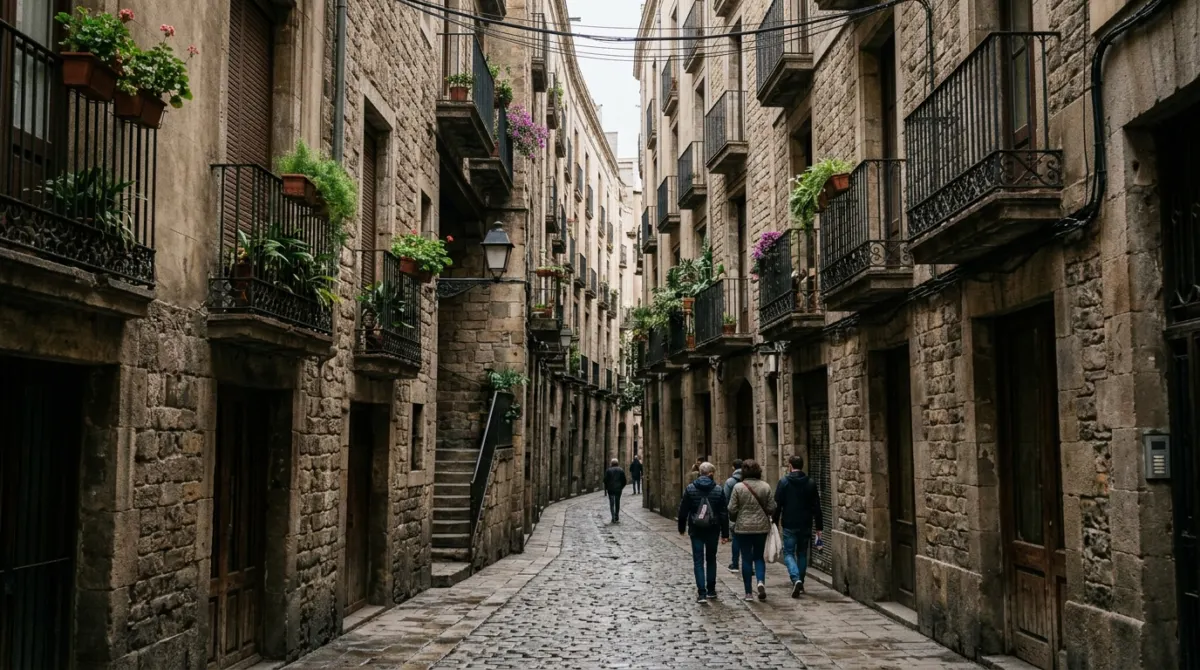
The Barri Gòtic is the medieval core, a dense grid of lanes between La Rambla and Via Laietana. It is free, it is always open, and it is the part of Barcelona people remember.
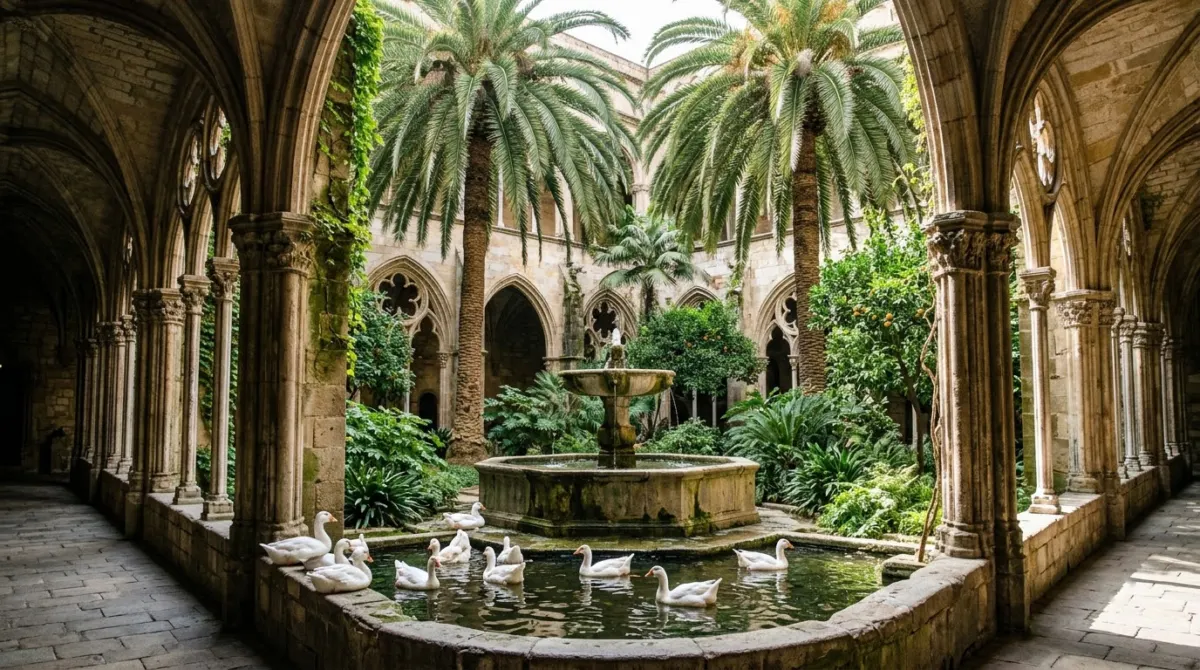
Barcelona Cathedral — properly the Cathedral of the Holy Cross and Saint Eulalia — is the gothic anchor. The cloister holds thirteen white geese, one for each year of Saint Eulalia’s life, and the roof terrace gives a view over the quarter that almost nobody takes. Half an hour inside, and the square in front of it is where the sardana, the Catalan circle dance, is performed on Sunday mornings.
Plaça del Rei is the medieval royal square, enclosed on three sides, and the quietest big space in the old town. Underneath it, the city history museum preserves several streets of Roman Barcelona at their original level, which is the best twenty minutes of gothic and Roman history in the city.
The Pont del Bisbe, the neo-gothic bridge over Carrer del Bisbe, is the most photographed thing in the quarter and was built in 1928, which surprises most people.
Plaça Sant Felip Neri is a small square with a church wall still scarred by shrapnel from the civil war. It takes five minutes and it is the one place in the old town where the twentieth century is visible.
What to know. The Barri Gòtic is where almost all of Barcelona’s pickpocketing happens, along with La Rambla and the metro. Nothing about it is dangerous; it is simply crowded and practised. Keep your bag closed and in front of you and the problem disappears.
El Born: the Picasso Museum and the Palau de la Música
East of Via Laietana, El Born is the same age as the Gothic Quarter and a great deal calmer. Two of Barcelona’s best interiors are here.
The Picasso Museum occupies five adjoining medieval palaces and holds the largest collection of his early work anywhere — the training, the blue period, and the fifty-eight canvases of his Las Meninas series. It is not the museum for his famous later paintings, and it is far better than that makes it sound: you watch a teenager become Picasso across a dozen rooms. Book a timed slot; the queue outside is long and the building is small.
The Palau de la Música Catalana is a modernista concert hall and a UNESCO World Heritage site, and the interior is one of the most extravagant rooms in Europe — an inverted stained-glass dome, sculpted horses breaking out of the proscenium, and a wall of ceramic roses. You can take a guided tour by day, but the hall is better from a seat at a concert, and tickets for the smaller recitals cost little more than the tour.
Santa Maria del Mar is the opposite of both: a bare, enormous, almost unornamented Catalan gothic basilica built by the port workers in the fourteenth century. Entry is ticketed from 10:00 to 18:00 (from 13:00 on Sundays) and free outside those hours. It is the most atmospheric church in Barcelona.
The Mercat del Born at the end of the street is a nineteenth-century iron market hall that was being converted when the excavation uncovered an entire eighteenth-century quarter underneath. The ruins are now the exhibit.
Las Ramblas, La Boqueria and Plaça de Catalunya
La Rambla is the boulevard running from Plaça de Catalunya down to the harbour, and it is the most argued-about street in Barcelona.
Walk it once, early. At eight in the morning it is a plane-tree avenue with flower stalls and people going to work. By midday it is a slow-moving crowd between souvenir stands, and the restaurants on it are the worst value in the city. The parallel streets — Carrer dels Tallers on one side, Carrer d’Avinyó on the other — are where to spend the rest of your time.
La Boqueria, the covered market halfway down, is spectacular and has largely become an attraction rather than a market. Go before nine if you want to see it working. Eat at the counters at the back, where the stallholders eat, rather than the fruit-cup stands at the front.
The Mercat de Santa Caterina, ten minutes away in El Born under a wave-shaped tiled roof, is where people actually shop, and the Mercat de Sant Antoni in the Eixample is the third of the big three.
Plaça de Catalunya is the hinge of the city — old town below, grid above — and mostly a transport interchange with pigeons. It is where the airport bus arrives and where most walking tours meet.
The Gran Teatre del Liceu, the opera house on La Rambla, runs backstage tours by day and is worth it if the auditorium is on your list.
The Eixample and Gaudí’s apartment buildings
North of Plaça de Catalunya the city turns into a grid of octagonal blocks laid out in the 1850s, with chamfered corners that make every junction a small square. This is the Eixample, and the modernista architects filled it with the buildings Barcelona is famous for.
Casa Batlló on Passeig de Gràcia is the most theatrical: a scaled roof like a dragon’s back, balconies shaped like masks, and almost no straight lines inside. The audio guide is unusually good.
Casa Milà, universally called La Pedrera, is three hundred metres further up — a stone facade that ripples like a quarry face and a roof terrace of sculpted chimneys that is the real reason to go up. It also runs evening visits with the roof lit.
Choose one. They are a few minutes apart, they cost similar amounts, and seeing both in a day is the single most common way visitors exhaust themselves in Barcelona. Casa Batlló for the interior, La Pedrera for the roof.
Casa Amatller, directly next door to Casa Batlló, is the quiet third option, and the block they share with Casa Lleó Morera is known as the Illa de la Discòrdia — the block of discord — because three rival architects built on it at once.
Palau Güell, just off La Rambla rather than in the Eixample, is Gaudí’s early townhouse and the one nobody queues for. For a visitor who wants a modernista interior without the crowd, it is the best value in Barcelona.
The Sagrada Família
It deserves its own section because it needs its own planning.
Gaudí’s basilica has been under construction since 1882 and is a UNESCO World Heritage site in its unfinished state. The exterior is free to look at from the park opposite, and the interior is the point: a forest of branching columns under a canopy of coloured light, with the stained glass graded from cool blues on the morning side to reds and oranges on the evening side.
Book weeks ahead. Entry is by timed slot and the popular times sell out well in advance. Nothing else in Barcelona requires this much notice.
The tower lift is a separate ticket and takes you up one of the facades for a view along the city grid to the sea. The descent is a narrow spiral staircase, which is worth knowing before you book it.
Time your visit by the light. Morning for the blue end of the nave, late afternoon for the red. Mid-morning and mid-afternoon are the busiest slots.
Allow ninety minutes inside, plus the park opposite, which is where the photograph everyone takes comes from.
Park Güell and the hills above the city
Park Güell was built as a housing estate that failed and became a public park instead. The monumental zone — the mosaic bench, the undulating terrace, the two gatehouses that look like gingerbread — is ticketed and timed. The surrounding woodland is free and open, with paths up to viewpoints over the whole city.
It sits well up the hill in Gràcia. The metro leaves you a steep fifteen minutes below the entrance; the 116 bus and the outdoor escalators on Baixada de la Glòria do the climb for you.
The Bunkers del Carmel, twenty minutes’ walk further up, are the concrete remains of a civil-war anti-aircraft battery and give the best free panorama in Barcelona. It has become popular enough that the neighbourhood association asks visitors to keep it quiet after dark.
Tibidabo, the mountain behind the city, holds a century-old funfair and a church visible from almost everywhere in Barcelona. It is a half-day with a funicular ride and a view that reaches the Pyrenees on a clear day; the old blue tram up the avenue has been out of service since 2018.
Montjuïc, the cable car and the museums
Montjuïc is the hill at the southern end of the city, and it holds more in one place than anywhere else in Barcelona.
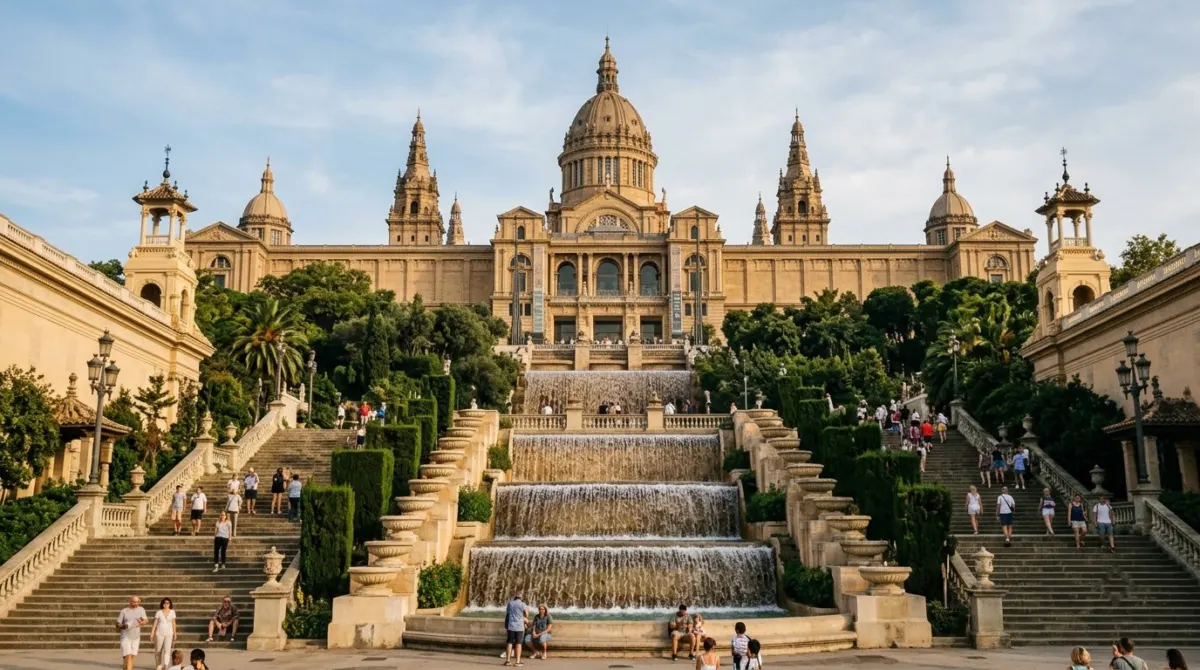
The MNAC, the national art museum, occupies the palace at the top of the steps and holds the best collection of Romanesque frescoes in the world — whole church apses lifted from Pyrenean villages and reassembled. The terrace outside is free and faces straight down over the city.
The Joan Miró Foundation is a short walk along the hill, in a building designed by his friend Josep Lluís Sert, and is the better of the two for most visitors who are not specifically interested in medieval art.
Montjuïc Castle, at the summit, is a seventeenth-century fortress with a bleak history and a complete circle of views over the port and the sea.
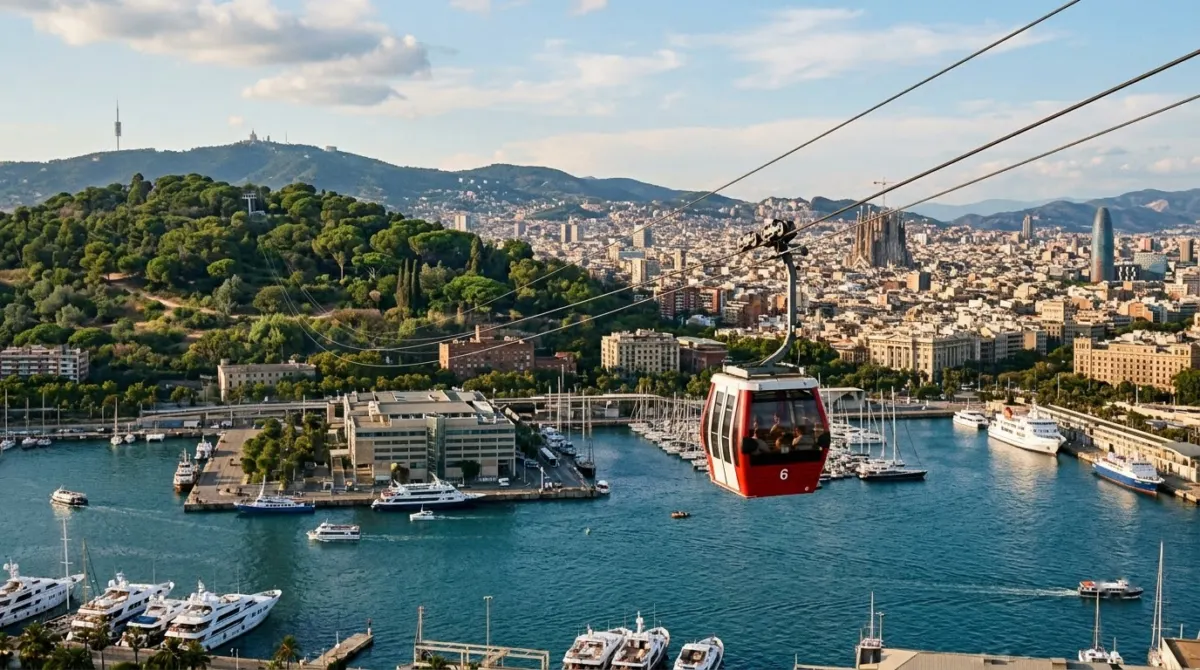
The cable car is the way to arrive. One line, the Transbordador Aeri, crosses the harbour from Barceloneta at a height that makes most people quiet; the other, the Telefèric de Montjuïc, runs from the Parc de Montjuïc up to the castle. They are different cable cars and visitors mix them up constantly.
The Magic Fountain below the museum runs a free light-and-music show on scheduled evenings. Check the schedule before planning around it, because the fountain is switched off for long stretches in winter and during water restrictions.
Barceloneta, the beach and the waterfront
Barcelona is one of the few European cities where you can see a medieval cathedral and swim on the same day.
Barceloneta is the triangular fishermen’s quarter built in the eighteenth century, with its own beach and a grid of very narrow streets behind it. The beach is busy, clean and shelved for swimming; the quieter sand is north at Bogatell and Mar Bella.
The Passeig Marítim runs the length of the beaches and is the best flat walk in the city.
Port Vell at the bottom of La Rambla holds the aquarium and the Rambla de Mar boardwalk, and the Maremàgnum complex, which is a shopping centre and is skippable.
What to know about the beach. It is man-made, created for the 1992 Olympics on what had been industrial land, which is why it is so straight. Bag theft on the sand is common enough that the lifeguard towers announce it; take turns swimming.
Free things to do in Barcelona
An unusual amount of the city costs nothing.
All the street-level architecture. The exteriors of the Sagrada Família, Casa Batlló, La Pedrera and the Illa de la Discòrdia are free to stand in front of, and in the case of the Sagrada Família the exterior is half the experience.
The Gothic Quarter and El Born entire, including Santa Maria del Mar outside its ticketed hours and the cathedral cloister.
The woodland of Park Güell, the Bunkers del Carmel, the MNAC terrace and the Montjuïc gardens.
The Magic Fountain show, on the evenings it runs.
Many museums on the first Sunday of the month, plus the Picasso Museum on Thursday afternoons and the MNAC on Saturday afternoons. Free slots must be booked ahead, and expect queues.
The beaches, which in most Mediterranean cities are not a given.
Where to eat in Barcelona: tapas bars, markets and the vermouth hour
Eating is a thing to do in Barcelona rather than an interruption of it, and two habits change the trip.
Eat late and eat standing. Lunch runs from two, dinner from nine, and the hour before each is the vermouth hour — fer el vermut — when bars serve vermouth on tap with olives and conserves. It is the cheapest and most local thing on this page.
Walk one street back from anything famous. The tapas bars immediately on La Rambla, around the Sagrada Família and on the beachfront are tourist traps in the plain sense: menus in six languages, photographs of the food, and paella by the kilo. The same streets two minutes inland are ordinary good.
What is actually Catalan: pa amb tomàquet, bread rubbed with tomato; escalivada, roasted peppers and aubergine; botifarra amb mongetes, sausage with white beans; and crema catalana. Paella is Valencian and sangria is for visitors — Catalans drink vermouth, cava or beer.
The markets feed you better than most restaurants on La Rambla: Santa Caterina, Sant Antoni and the back counters of La Boqueria all serve plates at the stalls.
Day trips from Barcelona: what to see outside of Barcelona
Once you have done the top attractions in Barcelona, the country around Barcelona is the better use of a fourth or fifth day, and every day trip from Barcelona below is under two hours each way by train.
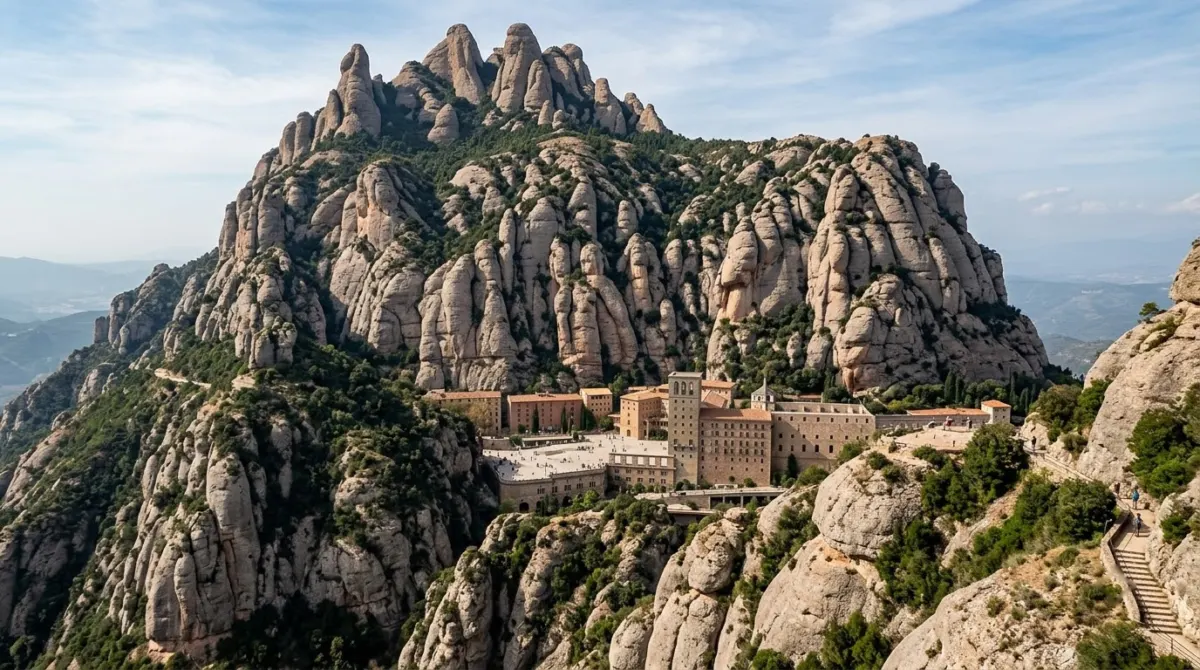
Barcelona is a good base, and three day trips stand out.
Montserrat is the one most people take. A serrated rock massif an hour inland, with a Benedictine monastery built into it, a Black Madonna, a boys’ choir that sings most days, and walking trails along the ridges. Get there by train plus either the rack railway or the cable car. Half a day for the monastery, a full day if you walk.
Girona is thirty-eight minutes north on the fast train: a complete medieval old town, coloured houses along the river, the longest stretch of city walls in Catalonia, and the Jewish quarter that is the best preserved in Spain.
Sitges is thirty-five minutes south, a seaside town of white houses and seventeen beaches, and the easiest half-day out of the city.
Further afield, Tarragona has a Roman amphitheatre above the sea, and the Costa Brava coves need a car to do properly.
Walking tours, guided tours and city passes
Most walking tours in Barcelona cover either the Gothic Quarter or Gaudí, and the two are different enough that a guide for each is justified.
Barcelona is a city where a guide earns their fee in two specific places.
A walking tour of the Gothic Quarter turns an attractive maze into a readable one. Free tip-based tours leave from Plaça de Catalunya and Plaça Reial several times a day; paid small-group versions go deeper and start at fixed times.
A guided tour of the Sagrada Família or a good audio guide is worth it, because almost nothing inside is labelled and the symbolism is the content.
City passes are worth arithmetic rather than faith. They typically bundle transport with entries, and they pay off only if you intend to visit several ticketed sights per day — which, given that this guide recommends one Gaudí building and one hill, you may well not.
Book the big three online regardless of any pass: the Sagrada Família, Park Güell’s monumental zone, and whichever apartment building you choose.
Tourist traps: must-see attractions that are not worth it
Four things take time and give little back.
Eating on La Rambla or the beachfront. Covered above, and the single most common regret.
Doing both Gaudí apartment buildings. They are more alike than the photographs suggest.
Camp Nou, unless FC Barcelona is a reason you came. The stadium has been under redevelopment and the tour varies with the building work; a match is a different matter entirely.
Trying to pair Park Güell with Montjuïc. Two hills at opposite ends of the city with a long metro ride between them.
And one honest note about the city itself: Barcelona has pushed back hard against over-tourism in recent years. Keeping the noise down in residential streets at night, and staying out of the way of people doing their shopping in La Boqueria, is both decent and noticeably better received than it used to be.
Museums in Barcelona beyond the Picasso
The busiest museum in Barcelona is the Picasso, and it is not the best one.
Barcelona has more museums than a three-day visit can absorb, and four are worth knowing about beyond the famous one.
The Fundació Antoni Tàpies sits in the Eixample in a modernista former publishing house topped with a tangle of wire, and holds the work of Catalonia’s major postwar artist. It is small, rarely busy, and the building alone justifies the stop.
The MACBA, the contemporary art museum in El Raval, is a white Richard Meier building whose forecourt has been the city’s main skateboarding plaza for thirty years. The skating outside is as much of an attraction as the collection inside, and both are free to watch.
The CCCB next door runs exhibitions on cities, media and ideas rather than holding a permanent collection, and is the most consistently interesting exhibition space in the city.
Casa Vicens, in Gràcia, is Gaudí’s first house — a tiled, Moorish-influenced villa built when he was thirty, long before the style people recognise. It opened to the public only in 2017 and is still the quietest Gaudí building in Barcelona.
The Hospital de Sant Pau, ten minutes’ walk from the Sagrada Família, is a complete modernista hospital campus of twelve pavilions and a UNESCO World Heritage site in its own right. Most visitors walk past the end of the avenue without realising it is open.
A note on timing: most museums in Barcelona close on Mondays, and several open free on the first Sunday of the month and on Sunday afternoons.
Hidden gems and the quieter side of the city
Everything above appears on every list of attractions in Barcelona. These do not, and they are what a second visit is for.
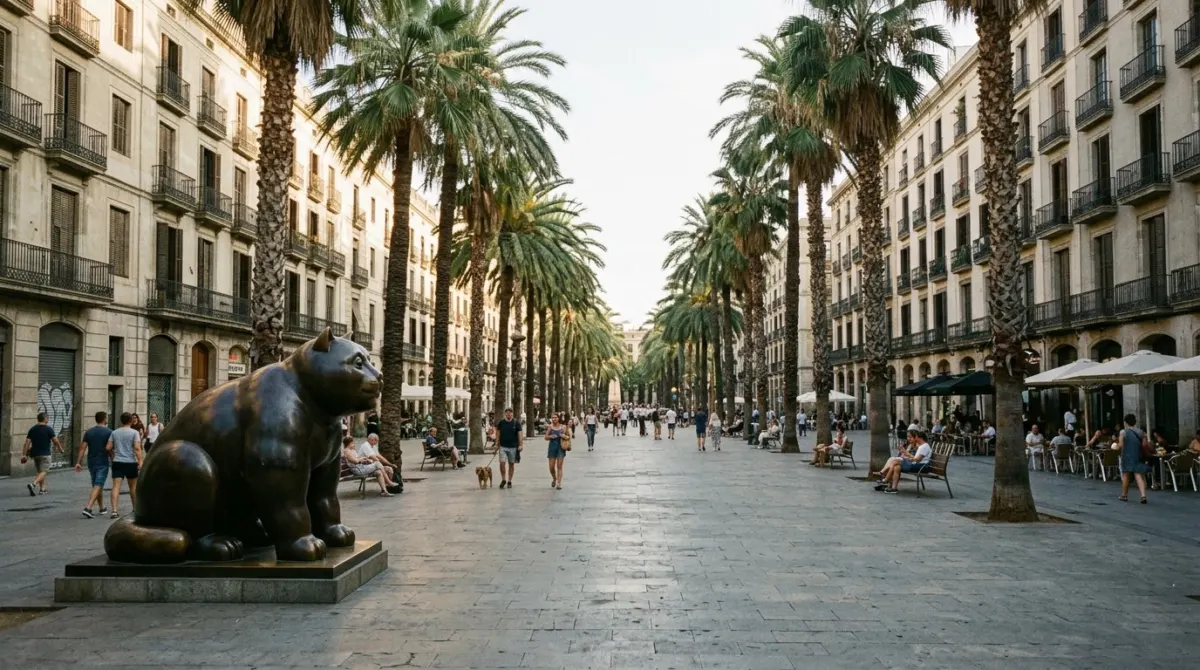
El Raval, west of La Rambla, is the most mixed quarter in the old city — Filipino, Pakistani and Catalan in the same street, with Rambla del Raval running through the middle of it and a Botero cat sculpture at one end. It has an old reputation it has largely outgrown.
The Sant Antoni Sunday book market wraps around the market hall and sells second-hand books, comics and old postcards.
The Horta Labyrinth Park, at the top of the metro line, is an eighteenth-century neoclassical garden with a cypress hedge maze at its centre and a daily visitor cap that keeps it quiet.
The air-raid shelter at Plaça del Diamant in Gràcia, and the larger Refugi 307 on Montjuïc, are civil-war tunnels open for guided visits — the clearest surviving evidence of the bombing of the city.
The Carretera de les Aigües is a flat gravel track along the side of Collserola, above Tibidabo, with the whole city laid out below it. Locals run it at dawn; the funicular drops you at one end.
The Poble Sec terraces on the lower slope of Montjuïc are where people in the city of Barcelona actually drink in the evening, five minutes from the Paral·lel metro.
Where to stay for sightseeing
The things to do above cluster in three places, and your address decides which you see in the evenings.
The Gothic Quarter and El Born put the old town outside the door and are the liveliest at night.
The Eixample around Passeig de Gràcia is calmer, with larger rooms and lifts, and sits between the grid and the old town.
Gràcia is the local alternative, close to Park Güell and further from everything else.
Our guide to where to stay in Barcelona compares each neighbourhood in Barcelona properly, and the Barcelona itinerary sets out how to fit the best of this into three days. For how long to stay, see how many days in Barcelona.
Map shows live availability and prices. We may earn a commission on bookings made through it, at no extra cost to you.
The short version
Book the Sagrada Família weeks ahead and go for the light rather than the hour. Walk the Gothic Quarter and El Born for free, and pay for one Gaudí apartment building rather than two. Take one hill — Park Güell with a booked slot, or Montjuïc with the cable car and the MNAC terrace. See a market before nine. Eat one street back from anything famous, and late. Keep a day for Montserrat or Girona, and keep your bag closed on La Rambla.
Check Barcelona availability →
Frequently asked questions
What should I not miss in Barcelona?
The Sagrada Familia, which is unlike any other building and needs booking weeks ahead; the Gothic Quarter, which is free and is the other half of the city; and one Gaudi apartment building on Passeig de Gracia. After that, one hill – Park Guell or Montjuic – and one market.
Is 3 days enough for Barcelona?
Yes, for the main attractions. Three days covers the old town, the Sagrada Familia and the Eixample, and one hill, with an evening at the beach. A fourth day is for Montserrat or Girona rather than for a third Gaudi building.
What are the top 10 things to do in Barcelona?
The Sagrada Familia, the Gothic Quarter, Park Guell, Casa Batllo or Casa Mila, the Picasso Museum, the Palau de la Musica Catalana, Montjuic and its cable car, La Boqueria market, Barceloneta beach, and a day trip to Montserrat.
What is the best free thing to do in Barcelona?
Walking the Gothic Quarter and El Born, including Santa Maria del Mar and the cathedral cloister. After that the Bunkers del Carmel for the view, the woodland parts of Park Guell, and the MNAC terrace on Montjuic. Several museums are free on the first Sunday of the month.
How do you get to Montserrat from Barcelona?
Take the train from Placa Espanya, about an hour, then either the rack railway or the cable car up the mountain. Half a day covers the monastery and the Black Madonna; a full day lets you walk the ridge trails.
Should I visit Casa Batllo or Casa Mila?
One of the two is enough for most visitors. They sit a few hundred metres apart on Passeig de Gracia and cost similar amounts. Casa Batllo has the more theatrical interior; Casa Mila, known as La Pedrera, has the sculpted roof terrace.
Where should I avoid eating in Barcelona?
Anywhere directly on La Rambla, on the beachfront, or immediately around the Sagrada Familia, particularly places with photographs on the menu. Walking one street inland changes the quality completely, and the markets and vermouth bars are better value than either.
Keep planning Spain
- Best Hotels in Seville: Air Conditioning and Two Weeks in Spring
- Where to Stay in Granada: Book the Alhambra Ticket First
- Where to Stay in Seville: You Are Choosing a Patio, Not a View
- Where to Stay in Madrid: Pick the Evening, Not the Distance
- Where to Stay in Barcelona: Best Neighborhoods Compared
- How Many Days in Granada? Count the Nights Instead
- How Many Days in Madrid? Three for the City, Five for the Day Trips
- How Many Days in Barcelona? Four, and the Tickets Explain Why
Written and checked by
Nora Castell is the pen name of the Triplarks editorial desk and the editor of its Costa Rica and Central America guides. Each guide is built from national park, transport and tourism sources, operator rate cards and recent traveller reports, then fact-checked, with every figure dated to the day it was read. Triplarks uses AI tools to help draft; nothing goes live until it has been edited and checked. Where we have not been somewhere, we do not write as though we have.