
Barcelona is a city where the neighborhood matters more than the hotel. The place to stay in Barcelona that suits a couple on a long weekend is a genuinely bad choice for a family with two children, and both are wrong for someone here to go out until four in the morning.
Some links below are affiliate links. We may earn a commission if you book through them, at no extra cost to you. We do not rank hotels, and any prices on the map come live from the booking sites.
Quick answer: where to stay in Barcelona. The Dreta de l’Eixample, between Passeig de Gracia and the Sagrada Familia: central, safe, well connected, quiet at night and walkable to almost everything. El Born for old streets and atmosphere, Gracia on a budget or with children.
The good news is that the city is compact and flat, with a metro that reaches everything. Almost every area on this list is twenty minutes from the rest of the city. What actually changes between them is noise, price, how many neighbors are tourists, and how far you walk to a beach.
Neighborhoods, transport and safety details checked 7 September 2026. Barcelona hotel prices swing hard by season, so treat any figure you see elsewhere as a starting point.
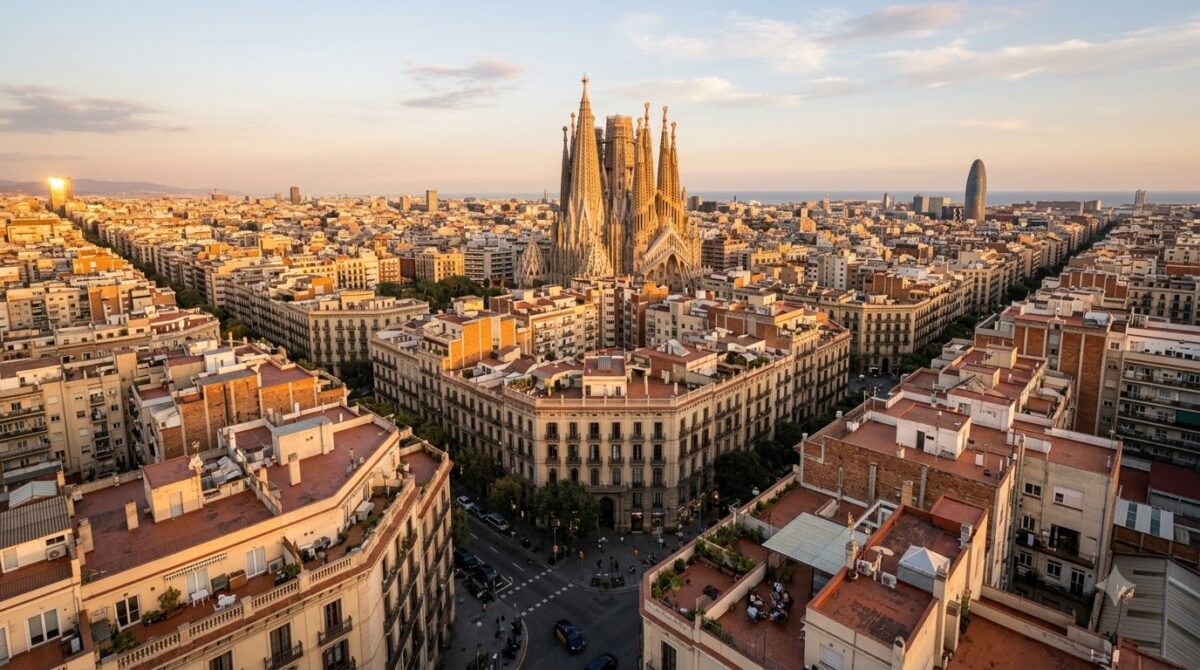
The best areas to stay in Barcelona, at a glance
| If you are | Best area to stay in Barcelona |
|---|---|
| A first time visitor | Eixample (Dreta de l’Eixample) |
| Here for architecture and food | Eixample or El Born |
| Here for atmosphere and old streets | El Born or the Gothic Quarter |
| Travelling with children | Eixample or Gracia |
| Here for nightlife | El Raval or Poble-sec |
| Here for the beach | Barceloneta or Poblenou |
| On a budget | Gracia, Poble-sec or Sant Antoni |
| Wanting a luxury hotel | Passeig de Gracia, in Eixample |
| Staying two weeks or more | Gracia or Poblenou |
If you want one answer with no caveats: the Dreta de l’Eixample, the right-hand half of the Eixample grid, between Passeig de Gracia and the Sagrada Familia. It is central, safe, well connected, quiet at night and walkable to almost everything. It is the best place to stay in Barcelona for most people and it is not close.
Choosing where to stay: understand the map first
Barcelona makes more sense once you know the shape of it, and the shape explains the prices.
- The old city sits nearest the sea: the Gothic Quarter, El Born, El Raval and Barceloneta. Narrow, medieval, dense, loud.
- The Eixample is the nineteenth-century grid above it, laid out in identical octagonal blocks. Wide, orderly, and where most of the modernist architecture is.
- Gracia sits above the Eixample and was a separate village until the city swallowed it. Still feels like one.
- The waterfront runs east from Barceloneta through Poblenou to the newer beaches.
- La Rambla cuts through the old city from Placa Catalunya to the sea, and divides the Gothic Quarter from El Raval.
Placa Catalunya is the hinge. Old city below it, Eixample above it, and the airport bus and most metro lines meet there. If you cannot picture where a hotel is, work out how far it is from that square.
Eixample: the best place to stay in Barcelona for most visitors
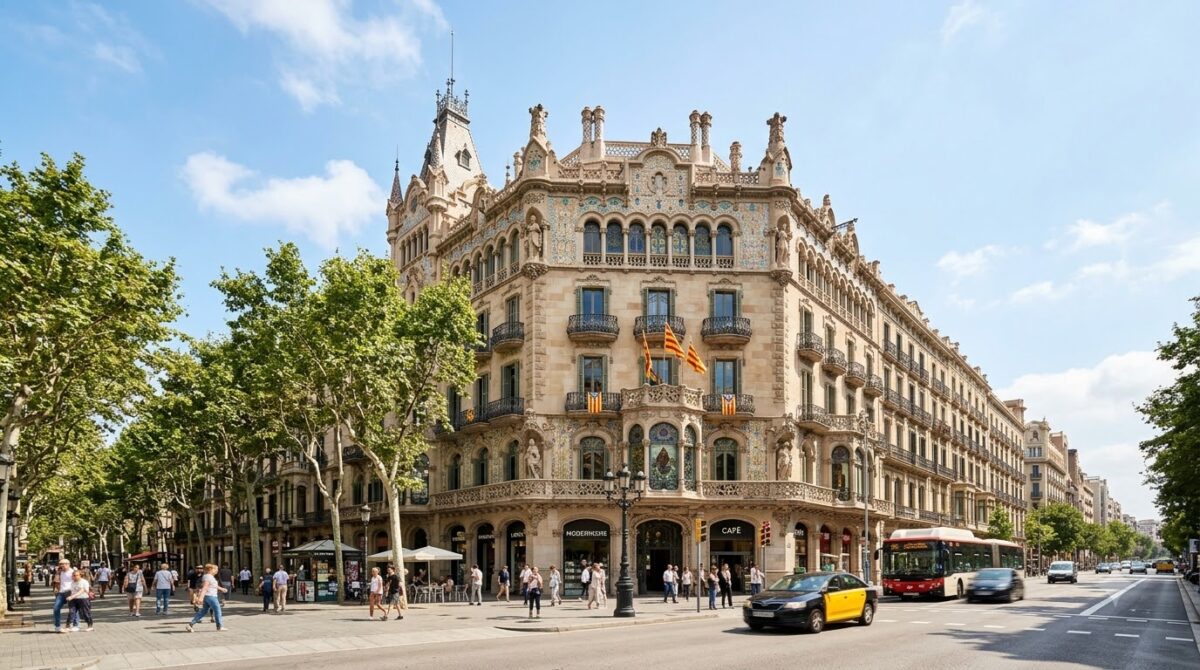
The Eixample is the grid, and it holds Gaudi’s Casa Batllo and La Pedrera on Passeig de Gracia, plus the Sagrada Familia at its eastern edge. It is the answer for anyone who wants central Barcelona without the old city’s noise.
Dreta de l’Eixample: the right half
This is the smart, quieter side, and the part of Barcelona this guide recommends most often.
- Wide pavements, quiet streets, real residents. Blocks are large and the interiors are protected from street noise.
- Walk to almost everything. The Gothic Quarter is fifteen minutes downhill, the Sagrada Familia twenty minutes across.
- Best hotels in Barcelona cluster here, particularly along and around Passeig de Gracia, from grand old properties to small boutique hotels in converted modernist apartments.
- Rooms are bigger than in the old city, because the buildings are newer and were built as apartments.
- Excellent metro coverage and the airport bus terminates at Placa Catalunya.
The trade-off: it is not picturesque in the way the old city is. You step out of the door onto a wide, handsome, slightly formal street, not a medieval alley.
Esquerra de l’Eixample: the left half
The left side of the grid is more residential, less polished and noticeably cheaper for the same standard of room. It is a great place to stay if you want the Eixample’s calm without Passeig de Gracia’s prices, and it puts you closer to Sants station.
Sant Antoni: the Eixample’s southwest corner
Sant Antoni has become one of the city’s best eating neighborhoods without becoming expensive. It sits between the Eixample and Poble-sec, has a superb covered market, and it is where a lot of people who live in Barcelona go out. Ten minutes on foot to La Rambla.
Map shows live availability and prices. We may earn a commission on bookings made through it, at no extra cost to you.
El Born: the best of the old city
El Born, sometimes written La Ribera, is the medieval quarter east of the Gothic Quarter. Narrow lanes, but with better restaurants, more independent shops and considerably less chaos than its neighbor.
- The best food radius in the old city. Tapas bars, wine bars and small restaurants aimed at people who live there.
- Santa Maria del Mar, one of the finest Gothic churches in Spain, and the Picasso Museum are both here.
- Walkable to everything old and ten minutes to Barceloneta beach.
- Quieter than the Gothic Quarter, though not quiet.
The catch: buildings are old, so rooms are small, lifts are rare and street noise carries up the narrow lanes. Ask which floor and which aspect before booking.
The Gothic Quarter: atmosphere with a warning
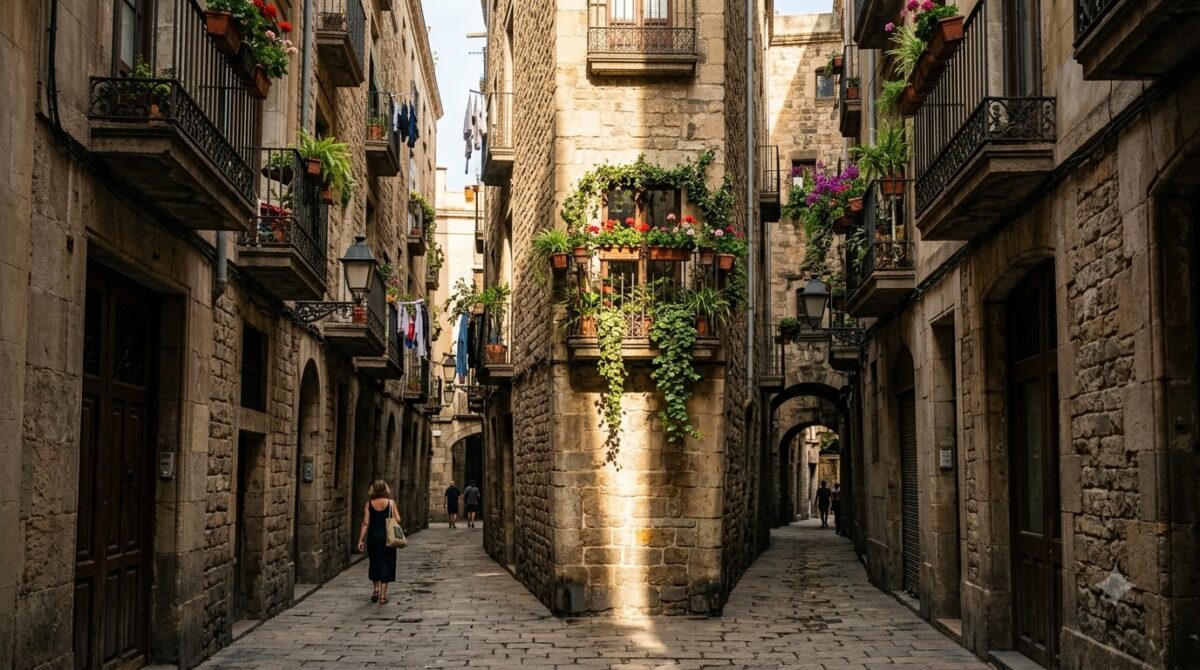
The Barri Gotic is the oldest part of Barcelona, a maze of stone alleys between La Rambla and Via Laietana, with the cathedral in the middle. It is the most atmospheric place to stay in the city.
- You are inside the postcard. Every walk to breakfast goes through somewhere worth photographing.
- Central to the point of absurdity — La Rambla, the port, El Born and the Eixample are all a short walk away.
- Restaurants immediately on the main routes are the weakest in Barcelona. Walk three streets off any square.
The honest problems. It is loud until very late, particularly near Placa Reial. The alleys are dark and disorienting at night. And this is where pickpocketing is at its worst in Spain — not dangerous, but persistent, and the streets around La Rambla are the single most worked area in the city.
Stay here if you are a light packer, a heavy sleeper and want atmosphere above all. Otherwise visit it every day and sleep in the Eixample.
El Raval: cheap, lively, and mixed
El Raval is on the other side of La Rambla from the Gothic Quarter, and it divides opinion more than anywhere else in the city.
- The most diverse part of Barcelona, with the best cheap food and a genuine nightlife scene.
- The MACBA contemporary art museum anchors the northern half, which is the more comfortable end.
- Rooms are cheaper than anywhere else this central.
- The southern half, towards the port, is scruffy and has the city’s worst street problems. It is not dangerous in a violent sense, but it is not restful and it is not where you want to be walking at three in the morning.
Rule of thumb: north of Carrer de l’Hospital is fine and interesting. South of it, be more selective, and read recent reviews rather than old ones.
Gracia: the local favorite neighborhood
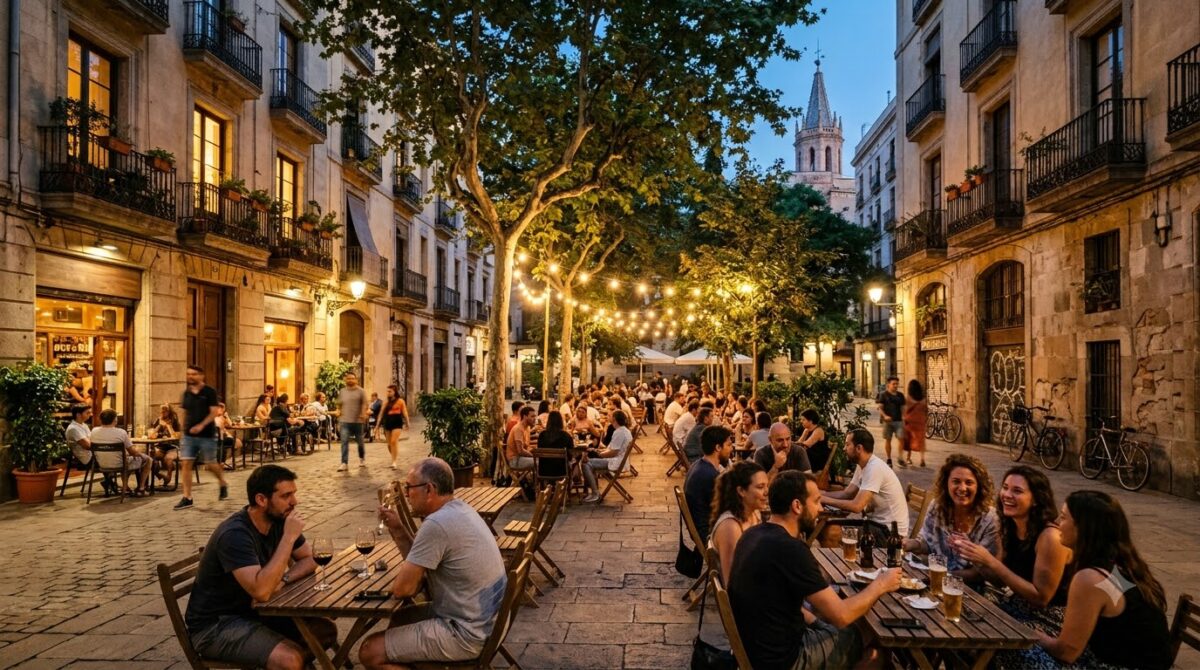
Gracia was an independent town until 1897 and it still behaves like one. Small squares with cafe tables, low buildings, independent shops, and a street plan that ignores the Eixample grid entirely.
- The most pleasant residential area to actually live in for a week or more.
- Cheaper than the Eixample for a comparable apartment or room.
- Excellent, unpretentious eating aimed at residents rather than visitors.
- Park Guell is at the top of it, walkable if you do not mind a climb.
- Genuinely quiet at night, except during the Festa Major in August, when it is the loudest place in the city for a week.
The trade-off is distance. You are twenty to twenty-five minutes by metro from the old city and the beach. On a three-day trip that adds up; on a two-week stay it is nothing.
Barceloneta and the beach neighborhoods
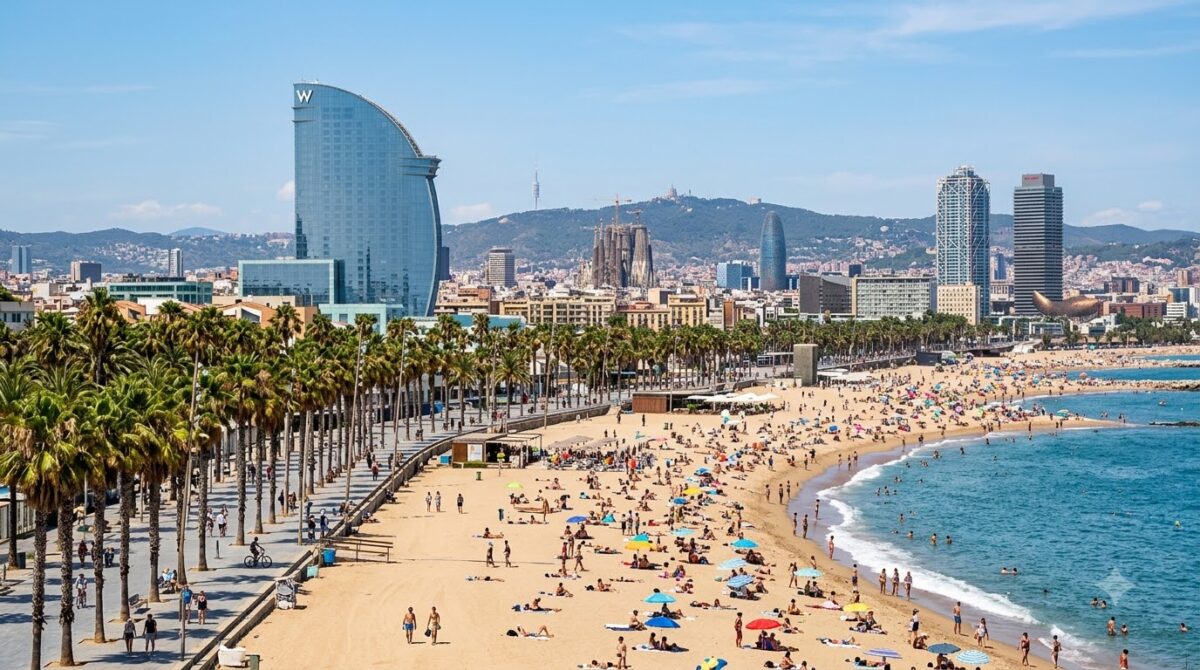
Barceloneta is the old fishermen’s quarter on the beach, a tight grid of narrow streets between the port and the sand. The W Barcelona, the sail-shaped tower at the end of the seafront, is the landmark you will use to orient yourself along the whole waterfront.
- The beach is genuinely on your doorstep, which no other central area offers.
- Seafood restaurants, and a covered market that is still mostly for residents.
- Ten minutes on foot to El Born and the old city.
The problems are real. Barceloneta apartments are small and old, summer nights are noisy, and the beachfront restaurants immediately on the sand are tourist traps with prices to match. Residents have protested about holiday rentals here for years, and it can feel it.
Poblenou: the better beach option
Poblenou, further east along the coast, is the old industrial district turned tech quarter. Wide streets, converted factories, a beautiful tree-lined Rambla of its own, and beaches that are quieter and cleaner than Barceloneta.
It is fifteen to twenty minutes by metro to the center, and it is the answer for anyone who wants a beach holiday with a city attached rather than the reverse.
Poble-sec: underrated and well placed
Poble-sec sits between Sant Antoni and Montjuic hill, and it is where a lot of people who know the city stay when they want value.
- Carrer de Blai is a pedestrian street of pintxos bars, and it is one of the best cheap eating streets in Barcelona.
- Montjuic is directly above, with the castle, the gardens, the Joan Miro Foundation and the best views over the city.
- Ten minutes on foot to La Rambla, and Sants station is close for onward trains.
- Prices are well below the Eixample, and the area is residential and calm.
Where not to stay in Barcelona
- Directly on La Rambla. Noise all night, the weakest restaurants in the city, and the heaviest pickpocketing. One street back is a different experience for less money.
- The far southern Raval, near the port. Read recent reviews carefully.
- Near the airport or out by the Fira conference centre. Cheap, and a long commute to anything you came for.
- Anywhere chosen only on price without checking the metro. Barcelona is well connected but the outer districts are genuinely far.
Best hotels in Barcelona: hotels, apartments or aparthotels?
Barcelona has an unusual accommodation market because the city has restricted new tourist apartment licences for years.
- Hotels in the city are plentiful and well run. The Eixample has the deepest supply at every level, from hostels to the best luxury hotels in the city.
- Boutique hotels in converted modernist buildings are the characteristic Barcelona stay. Twenty to forty rooms, a roof terrace with a plunge pool, and a location on the grid.
- Legal tourist apartments must display a licence number (HUT). If a listing has no licence number, it is operating illegally and you have no recourse if it is cancelled. Check for it.
- Aparthotels are the practical middle — a kitchen with a front desk, legal, and good for families or stays over a week.
- Roof terraces matter here more than in most cities. Barcelona is hot from June to September and a pool on the roof changes an afternoon.
How many nights do you need in Barcelona?
- Three nights is the working minimum: one day for Gaudi (Sagrada Familia and Park Guell), one for the old city, one for the beach or Montjuic.
- Four or five adds Montserrat or the Dali museum at Figueres as a day trip, and time to slow down.
- A week or more and you should be in Gracia or Poblenou with a kitchen, living rather than visiting.
Book the Sagrada Familia and Park Guell before you fly. Both use timed entry and both sell out, and the Sagrada Familia in particular sells out days ahead in summer.
Practical things that change which hotel you pick
- Pickpocketing is the one real risk, and it is concentrated on La Rambla, in the metro, and around the Sagrada Familia. Violent crime against visitors is rare. A zipped cross-body bag solves most of it.
- Air conditioning is essential from June to September. Older buildings in the old city sometimes lack it.
- There is a city tourist tax, charged per person per night and usually collected at the property.
- Lifts are common in the Eixample and rare in the old city. Ask.
- The airport is well connected — the Aerobus to Placa Catalunya takes about 35 minutes, and metro line L9 Sud serves both terminals.
- Sants is the main train station, in the west. If you are arriving or leaving by train, a room in the Esquerra de l’Eixample or Sant Antoni saves a cross-city trip.
Where to stay in Barcelona for a first trip, in one line
Dreta de l’Eixample if you want one safe answer, El Born if you want old streets and good food, Gracia if you are staying a while, Poblenou if the beach is the point. All four are within twenty-five minutes of each other, and none of them is a mistake.
Combining Barcelona with other European cities? Our guides to where to stay in Rome and where to stay in Lisbon take the same neighborhood-first approach.
A guide to the best neighborhoods, side by side
The same information as a table, because choosing where to stay is a comparison and not a list.
| Neighborhood | Feel | Best for | Noise | To Placa Catalunya |
|---|---|---|---|---|
| Dreta de l’Eixample | Wide, formal, calm | First visits, families, hotels | Low | 5–15 min walk |
| Esquerra de l’Eixample | Residential, plainer | Value, longer stays | Low | 15 min walk |
| Sant Antoni | Local, food-led | Eating, value | Low to medium | 15 min walk |
| El Born | Medieval, stylish | Food, atmosphere | Medium | 10 min walk |
| Gothic Quarter | Medieval, dense | Atmosphere, walking | High | 5 min walk |
| El Raval | Diverse, gritty | Budget, nightlife | High | 5 to 10 min walk |
| Gracia | Village-like | Long stays, locals | Low | 15 min metro |
| El Poble-sec | Quiet, hilly edge | Value, Montjuic | Low | 10 min walk |
| Barceloneta | Old fishing grid | Beach | High in summer | 15 min metro |
| El Poblenou | Converted industrial | Beach, families, space | Low | 20 min metro |
Read the column on the right carefully. Every one of these neighborhoods to stay in is within twenty-five minutes of the heart of Barcelona. That is why the noise column matters more than the distance column when you choose to stay somewhere here.
Where to stay for a Barcelona itinerary of 3 days
Three days is the most common length for a trip to Barcelona, and it is enough if you stay central. Here is how the days fall, and what that means for your best location.
- Day 1, Gaudi and Modernisme. Sagrada Familia in the morning, then Casa Batllo and La Pedrera on Passeig de Gracia, then Park Guell in the late afternoon. Every one of those works of Antoni Gaudi sits in or near the Eixample, which is the strongest argument for sleeping on the grid.
- Day 2, the historic center of Barcelona. The Gothic Quarter and its Gothic architecture, the cathedral, La Rambla, La Boqueria market, then El Born, Santa Maria del Mar and the Picasso Museum. All on foot, all in the old city.
- Day 3, Montjuic or the beach. The cable car up Montjuic, the Miro Foundation and the views, or a slow day at Barceloneta and Parc de la Ciutadella.
Is 3 days in Barcelona enough? For the city itself, yes. It covers the Gaudi sites, the old city and one of Montjuic or the beach at a reasonable pace. What it does not allow is a day trip to Montserrat or Figueres, or any real time doing nothing, which is a large part of what makes the city pleasant. Four or five nights is the version most people wish they had booked.
Because day 1 and day 3 both start away from the old city, the Eixample is the best location for a three-day trip even though the Gothic Quarter looks more central on a map. If it is your first time visiting, that single fact decides the booking.
Barcelona best hotels, by what you are actually buying
Rather than a ranked list, it is more useful to know what each price band gets you in this city, and which neighborhood that band clusters in.
Luxury hotels in Barcelona
The grand properties sit on and around Passeig de Gracia in the Eixample, and along the waterfront. What you pay for in the Eixample is a modernist building, a roof terrace and a location you can walk from. On the seafront it is a view and a pool.
The landmark is the sail-shaped W Barcelona at the end of Barceloneta, the building you use to orient yourself along the whole beach. It trades a central location for a beachfront one, which is right for some trips and wrong for a first visit. The Sofitel Barcelona Skipper and the Grand Hyatt Barcelona sit in the same waterfront band.
Best boutique hotels
This is what the city does best: twenty to forty rooms in a converted Modernisme apartment building, a courtyard or a terrace on the roof, and an address on the Eixample grid or in El Born. Hotel Mirlo, Primero Primera in the upper city and the Innside by Melia Barcelona all sit in this band, and there are dozens more.
Ask for the interior aspect. Eixample blocks are built around protected courtyards, and a bedroom facing inward is dramatically quieter than one on the street. This single question improves more stays than any star rating.
Mid-range and aparthotels
The deepest supply in the city, mostly in the Eixample and Sant Antoni. Aparthotels are the practical choice for families or a stay over a week, because you get a kitchen with a front desk and a legal licence, which private apartments do not always have.
Budget rooms and hostels
El Raval, El Poble-sec and Gracia hold most of the budget options, and Barcelona hostels are generally excellent with private rooms available. In the old city, check the floor and whether there is a lift before booking anything cheap, because five flights with luggage is common.
Barcelona for tourists: what the neighborhoods do not tell you
A few things about the city shape a stay more than the neighborhood does.
- Catalonia is not simply Spain. Catalan is the first language on signs and menus across the city and the culture is distinct. Nobody expects you to speak it, but knowing it exists changes how you read the place.
- Tourism here is politically contested. The city has restricted tourist apartment licences and residents have protested about overtourism for years, particularly in Barceloneta and the Gothic Quarter. Staying in a licensed property rather than an illegal one is not a formality.
- The city eats late. Lunch at two, dinner from nine. A restaurant serving dinner at seven is serving tourists.
- La Rambla is a pedestrian zone and a trap. Walk it once, eat nowhere on it.
- August is difficult. Hot, crowded, and many small local restaurants close for the month.
Planning your trip to Barcelona: the booking order
Get these in sequence and the rest of the trip arranges itself around them.
- Sagrada Familia tickets first. Timed entry, sells out days ahead in summer, and it anchors one morning.
- Park Guell next. Also timed entry, also sells out, and the paid Monumental Zone is the part worth booking.
- Then the neighborhood, using the table above.
- Then the hotel, filtering on lift, floor and aspect rather than on stars.
- Leave restaurants loose. Book only the two or three you genuinely care about.
Do not book a room before you know where the Sagrada Familia and Park Guell sit on your map. Both are in the upper part of the city, which is another reason the Eixample beats the old city for a short first trip.
Where to stay in Barcelona if it is your first time visiting
Most people reading a guide to where to stay are asking a narrower question than the neighborhood pages answer: where do I not regret booking? Here is that answer directly.
Stay in the Dreta de l’Eixample, within about ten minutes of Passeig de Gracia. It is one of the best places in the city on every axis that matters for a first trip. You are close enough to walk into the historic center, close enough to walk to the Gaudi houses, on top of two metro lines for the Sagrada Familia and Park Guell, and far enough from the old city that you can sleep.
Do not stay right on La Rambla, and do not stay out by the airport or the conference centre. Those two mistakes account for most of the unhappy reviews people write about Barcelona accommodation, and neither has anything to do with the hotel itself.
If you want somewhere with more character and you are a reasonable sleeper, El Born is the alternative. If you want space and quiet and do not mind a metro ride, Gracia is. Everything else on this page is a specialist choice for a specific kind of trip.
How the neighborhoods feel at different times of day
A neighborhood that is perfect at two in the afternoon can be unbearable at two in the morning, and the reverse. This is the part that photographs never show, and it is what people mean when they say they wish they had stayed somewhere else.
| Neighborhood | Morning | Afternoon | Late night |
|---|---|---|---|
| Dreta de l’Eixample | Commuters, calm | Shoppers on Passeig de Gracia | Quiet |
| El Born | Very quiet | Busy, pleasant | Lively until about 1am |
| Gothic Quarter | Empty and beautiful | Extremely crowded | Loud, and loudest near Placa Reial |
| El Raval | Local, working | Mixed | Nightlife, and the least comfortable streets |
| Gracia | Residential | Cafe tables in the squares | Quiet except in August |
| Barceloneta | Runners and market | Packed beach | Loud in summer, dead in winter |
| El Poblenou | Office workers | Calm beach | Quiet |
The Gothic Quarter row is the important one. Walking it at eight in the morning is one of the best experiences in the city. Sleeping above it on a Friday is one of the worst. Both are true, and which one you get depends entirely on the street.
Getting around from each area
Barcelona has one of the better metros in Europe, and it changes what counts as a good location. Trains run roughly every three to five minutes, and all night on Saturdays.
- From the Eixample — lines L2, L3, L4 and L5 all cross the grid. You are never more than five minutes from a station.
- From the old city — walking beats the metro for most trips, which is the real advantage of staying there.
- From Gracia — L3 to Passeig de Gracia and the center, about fifteen minutes door to door.
- From Poblenou — L4 to the old city, about twenty minutes.
- To the airport — the Aerobus from Placa Catalunya takes about 35 minutes; metro L9 Sud serves both terminals and needs a special ticket.
- To Montserrat — trains from Placa Espanya, about ninety minutes each way.
Buy a T-casual ticket rather than singles. It gives ten journeys on any combination of metro, bus and tram, and it is dramatically cheaper. There is no need to buy a tourist travel card unless you plan more than three trips a day.
Staying longer: a month in Barcelona
Barcelona is one of the most popular cities in Europe for a long stay, and the calculation changes completely past about two weeks.
- Gracia is the classic choice: a real neighborhood, good markets, quiet nights, and prices below the center.
- El Poblenou suits anyone working remotely, with wide streets, converted industrial spaces, cafes with power sockets and a beach ten minutes away.
- Sant Antoni and Esquerra de l’Eixample give you central without central prices.
- Avoid the Gothic Quarter and Barceloneta for anything over a week. The noise and the small, dark apartments wear thin fast.
For a stay of a month or more you want a monthly rental rather than a nightly booking, and those are a different market with different rules. The HUT licence requirement applies to short stays; longer contracts sit outside it.
Common mistakes when choosing where to stay in Barcelona
- Booking on La Rambla because it looks central. It is central and it is the worst street in the city to sleep on.
- Assuming the Gothic Quarter and El Born are the same. They are neighbors and they are not alike. El Born is calmer, better fed and better value.
- Choosing Barceloneta for a city trip. It is a beach neighborhood, and everything else is a metro ride.
- Ignoring the floor and the lift. In the old city this matters more than the star rating.
- Booking an unlicensed apartment. No HUT number means no recourse.
- Not checking the aspect. Interior courtyard rooms in the Eixample are much quieter, and hotels rarely volunteer which you are getting.
- Staying somewhere far to save money, then buying three taxis a day. The saving disappears.
Barcelona travel: a last word on the trade-off
Every neighborhood in this guide to Barcelona trades one thing for another, and there is no area that wins on all of them.
- Atmosphere costs you sleep. The Gothic Quarter and El Born are the most charming and the loudest.
- Space costs you distance. Gracia and Poblenou give you a bigger apartment and take twenty minutes off your day.
- Central costs you money. Passeig de Gracia is the most convenient address in the city and it is priced accordingly.
- Beach costs you the city. Barceloneta puts you on the sand and away from everything else.
The Eixample is the recommendation throughout this page because it is the area that gives up the least on any of those four. It is not the most exciting place to stay in the city, and for three or four nights that is exactly the point.
Which areas are best for what you came to do
One last cut through the same question, because people rarely want a neighborhood in the abstract. They want the perfect place to stay for a specific trip.
- Medieval Barcelona. If the reason you booked is stone alleys and Gothic churches, stay in El Born and walk into the Gothic Quarter every morning before the crowds. You get medieval Barcelona without sleeping in the middle of its nightlife.
- Cosmopolitan Barcelona. If you came for design, shopping and modern architecture, the Eixample is the only sensible answer. This is where Modernisme lives and where the city looks like the twenty-first century.
- Barcelona with children. Space, lifts and quiet nights matter more than being central. Eixample, Gracia or Poblenou, with Parc de la Ciutadella and the beach as the daily release valve.
- A romantic long weekend. A small boutique hotel with a roof terrace in El Born or the Dreta de l’Eixample. The terrace is the thing you will remember.
- A working stay. Poblenou, without much competition. Converted warehouses, cafes that tolerate laptops, and a beach at lunchtime.
- A first look at the city with limited time. Stay in the heart of the Eixample near Passeig de Gracia and accept that you will not see everything.
What people say after they have visited Barcelona
The most common reflection from people who have already been is not about which sights they missed. It is that they underestimated how much of the experience is simply being in the city rather than visiting places in it.
Barcelona rewards the hours you do not schedule: a long lunch, an afternoon in a square in Gracia, the walk home along a street of Modernisme facades. That is an argument for a central neighborhood, because the unscheduled hours only happen if stepping outside is easy.
It is also an argument against optimizing purely on price. Saving on a room forty minutes out costs you exactly the thing that makes the city worth the trip, and you will not notice the loss until you are home.
Exploring Barcelona on foot is genuinely the best way to see it. The city is flat, the grid is legible, and the distances are shorter than the map suggests. Almost every good decision about where to sleep here follows from that one fact.
Heading east on the same trip? Where to stay in Athens uses the same neighborhood-first approach for a city where distance to one hill decides everything.
Building the wider trip? Our Spain itinerary sets out 10 days by train through Madrid, Seville and Barcelona.
Doing both cities? Our guide to where to stay in Madrid covers the same ground for the capital.
Still working out the trip length? See how many days in Barcelona you actually need, and why the tickets decide it.
Checking current rates in Barcelona
Everything above is about position — which area suits which kind of trip. What it deliberately does not do is quote prices, because rates in Barcelona move a long way by season, by day of the week and by how far ahead you book, and any figure printed in a guide is out of date the week after it is written.
These searches show live availability and current prices, so you can check them against the areas described above:
These are affiliate links. If you book through one we may earn a commission, at no extra cost to you. It does not affect which areas we recommend above — nobody pays to be listed here.
Frequently asked questions
What is the best area to stay in Barcelona for the first time?
The Dreta de l’Eixample, the right-hand half of the Eixample grid between Passeig de Gracia and the Sagrada Familia. It is central, quiet at night, well served by metro, has the widest choice of hotels and bigger rooms than the old city, and everything is walkable or one short metro ride away.
Is the Gothic Quarter a good place to stay in Barcelona?
It is the most atmospheric and the least practical. The alleys are beautiful and central, but rooms are small, lifts are rare, the streets near Placa Reial are loud until very late, and this is where pickpocketing is worst in the city. Choose it if atmosphere matters most and you sleep heavily.
Where should families stay in Barcelona?
The Eixample or Gracia. Both have wide pavements, larger apartments and aparthotels, lifts in most buildings, and quiet streets at night. Poblenou is the third option if beach time matters, with cleaner and calmer sand than Barceloneta and easy metro access to the center.
Is Barceloneta a good place to stay?
Only if the beach is the main reason you came. It puts sand on your doorstep and good seafood nearby, but the apartments are small and old, summer nights are noisy, and the restaurants directly on the beachfront are poor value. Poblenou gives you a better beach and a calmer neighborhood for a short metro ride.
Is El Raval safe to stay in?
The northern half around MACBA is fine and interesting, with the best cheap food in the city. The southern half towards the port is scruffier and has persistent street problems, and it is not somewhere to walk late at night. Read recent reviews rather than old ones, and check exactly which street a property is on.
How many nights should I spend in Barcelona?
Three at a minimum: one day for the Gaudi sites, one for the old city, one for Montjuic or the beach. Four or five allows a day trip to Montserrat or Figueres. A week or more works well from Gracia or Poblenou with a kitchen, treating the city as somewhere to live rather than tick off.
Should I book an apartment or a hotel in Barcelona?
Either works, but check the licence. Legal tourist apartments in Barcelona must display an HUT licence number, and listings without one are operating illegally, which means no recourse if the booking is cancelled. Aparthotels are the safest middle ground for families and longer stays.
Where are the best luxury hotels in Barcelona?
Along and around Passeig de Gracia in the Eixample, where the grand properties and the best boutique hotels in converted modernist buildings cluster together. The waterfront has the landmark towers including the sail-shaped W Barcelona at the end of Barceloneta, which trades central location for a beachfront one.