Quick answer
The old city on day one, the Sagrada Família and the Eixample on day two, one hill on day three. Stay in El Born, the Gothic Quarter or the lower Eixample and most of it is walkable.
On this page
- Barcelona itinerary at a glance
- Day 1 — the old city
- Day 2 — Gaudí and the grid
- Day 3 — the hill
- What to book, and when
- The four day version
- Beaches, and what they are worth
- Eating, and when
- When to go
- Where to stay for this itinerary
- Three days with children
- What to skip
- The Gaudí question
- Beyond Gaudí: the Palau de la Música, Sant Pau and the Ciutadella
- The markets, the cathedral and Las Ramblas
- Practical tips for a first trip to Barcelona
- From the airport to the old city
- Getting around on three days
- Barcelona in two days
- Where this fits in a Spanish trip
- The short version
- Frequently asked questions
Barcelona has two sets of sights that are nothing like each other: a medieval old town of narrow lanes, and a nineteenth-century grid full of modernista architecture. Most visitors try to do both at once and spend the trip crossing between them.
Some links below are affiliate links. We may earn a commission if you book through them, at no extra cost to you. We do not rank hotels, and any prices on the map come live from the booking sites.
This itinerary separates them, which is the single most useful structural decision you can make here. Three days, by area. For the rest of the country, see our Spain itinerary.
For where to sleep, see our guide to where to stay in Barcelona; for the length, how many days in Barcelona.
Barcelona itinerary at a glance
| Day | Area | Doing |
|---|---|---|
| 1 | Ciutat Vella | Gothic Quarter, El Born, the cathedral, the beach |
| 2 | Eixample | Sagrada Família, Casa Batlló, La Pedrera |
| 3 | Montjuïc or Park Güell | Views, Miró, the Olympic hill |
Day 1 — the old city
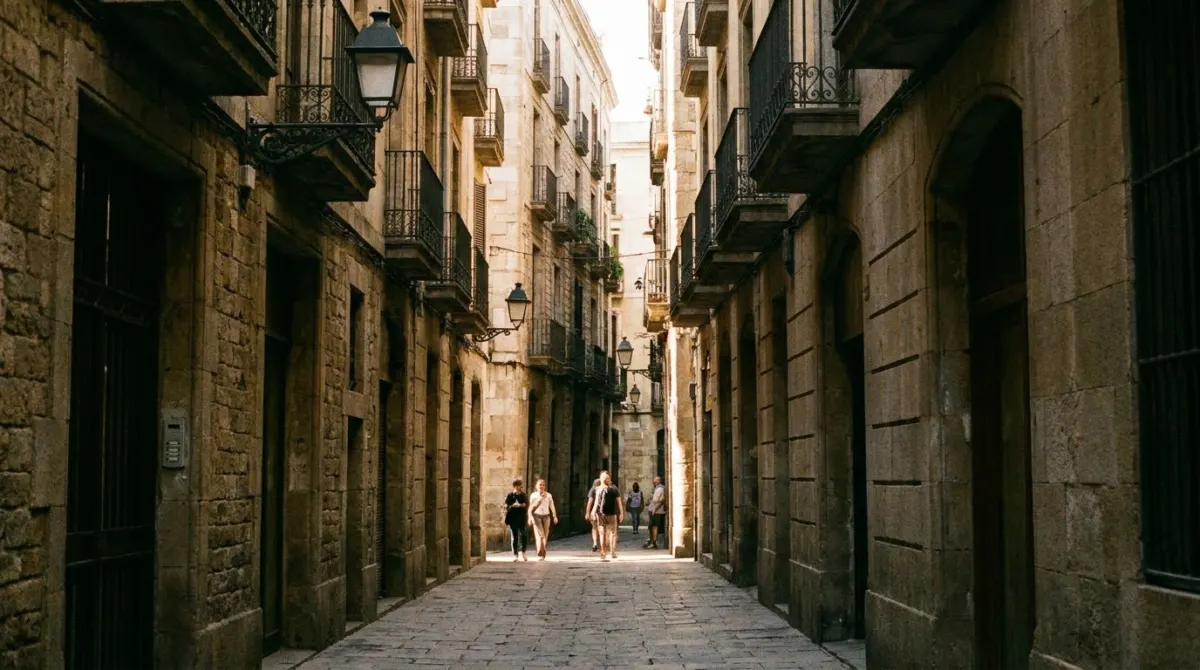
Morning. Start in the Barri Gòtic, the Gothic Quarter: the cathedral, the Roman walls built into later buildings, and the Plaça del Rei. The lanes are narrow and the best approach is to get lost deliberately for an hour.
Midday. La Rambla, which you should walk once and then avoid, and the Boqueria market beside it, which is genuinely good early and a crush by noon.
Afternoon. El Born, east of the Via Laietana: the Santa Maria del Mar basilica, the Picasso Museum and the best small shops in the city.
Evening. Walk down to Barceloneta and the waterfront, and eat in El Born afterwards.
Day 2 — Gaudí and the grid
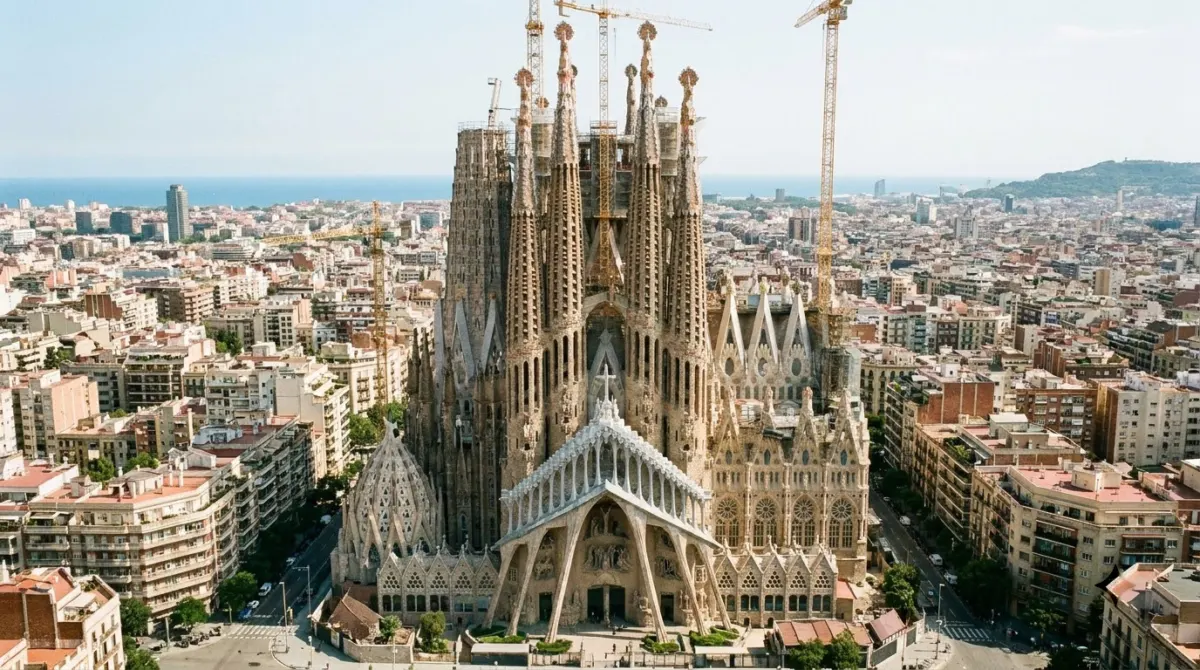
Morning. The Sagrada Família on a booked timed ticket. It has been under construction since 1882, the interior is a forest of branching columns, and it is the one thing in Barcelona that justifies every superlative. Allow ninety minutes, and add the tower lift if you have booked it.
Afternoon. Walk or take the metro to Passeig de Gràcia, the grand avenue of the Eixample, for Casa Batlló and La Pedrera, two Gaudí apartment buildings a few hundred metres apart. One is enough for most people.
The Eixample grid itself is worth noticing: chamfered corners at every intersection, designed in the 1850s to let carriages turn and now full of terraces.
Evening. Tapas in the Eixample or in Gràcia, the old village further north which still has its own squares.
Day 3 — the hill
Two options, and the choice depends on what you booked.
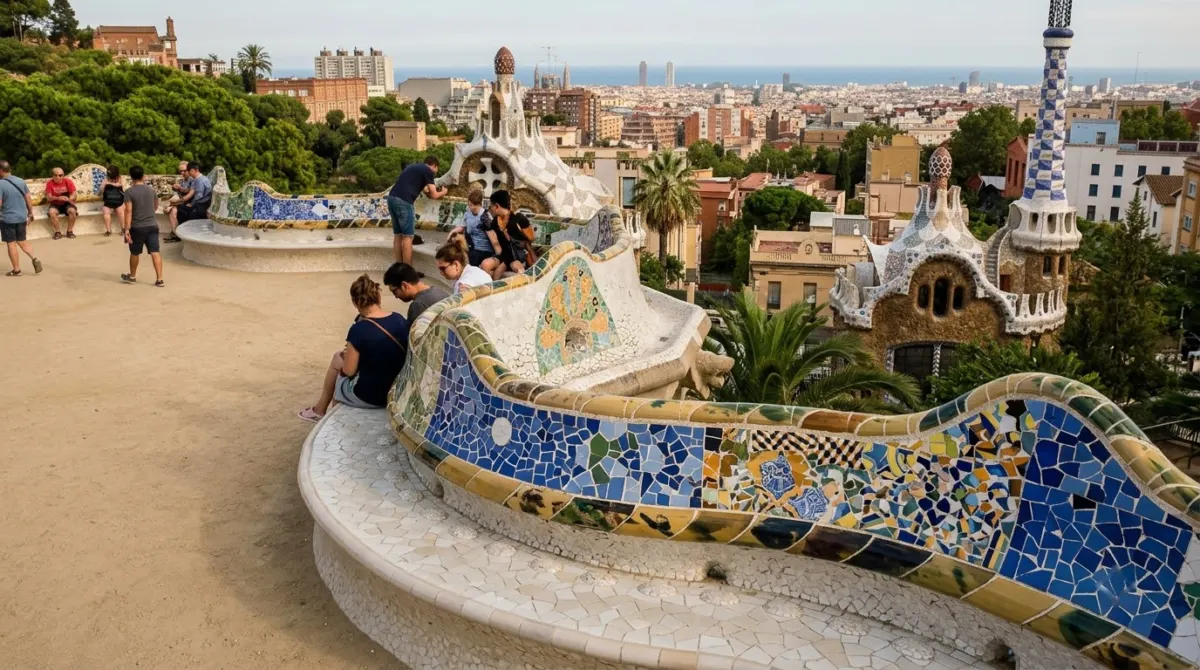
Park Güell, Gaudí’s hillside park with the mosaic terrace and the view down over the city, needs a timed ticket for the monumental zone and sells out. Half a day including the climb.
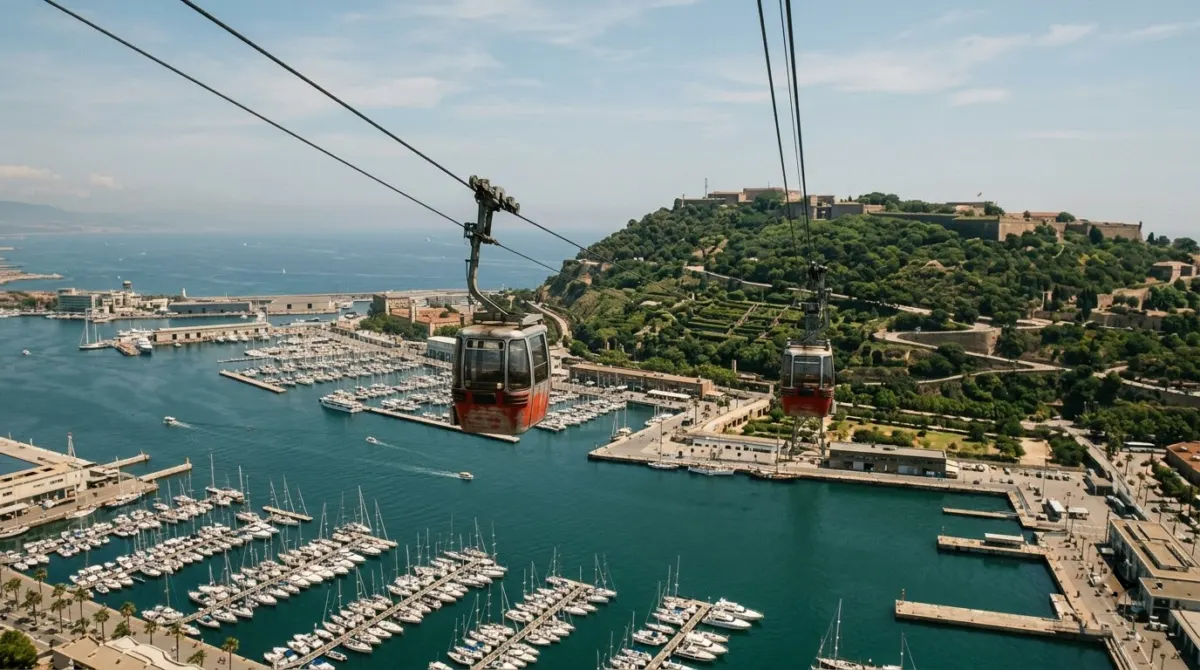
Montjuïc, the hill above the port, holds the Joan Miró Foundation, the National Art Museum of Catalonia with its Romanesque frescoes, the Olympic stadium and a castle at the top. A cable car runs from the harbour and a funicular from the metro.
Either fills a day. Montjuïc has more in it; Park Güell has the photograph.
What to book, and when
- The Sagrada Família, weeks ahead in season. It is the busiest paid attraction in Spain.
- Park Güell, which limits numbers in the monumental zone.
- Casa Batlló or La Pedrera, both of which use timed entry.
- The Picasso Museum, which is free on certain evenings and busy accordingly.
Nothing else in this itinerary needs booking, and the Gothic Quarter costs nothing at all.
The four day version
A fourth day is best spent out of the city, and there are three good options.
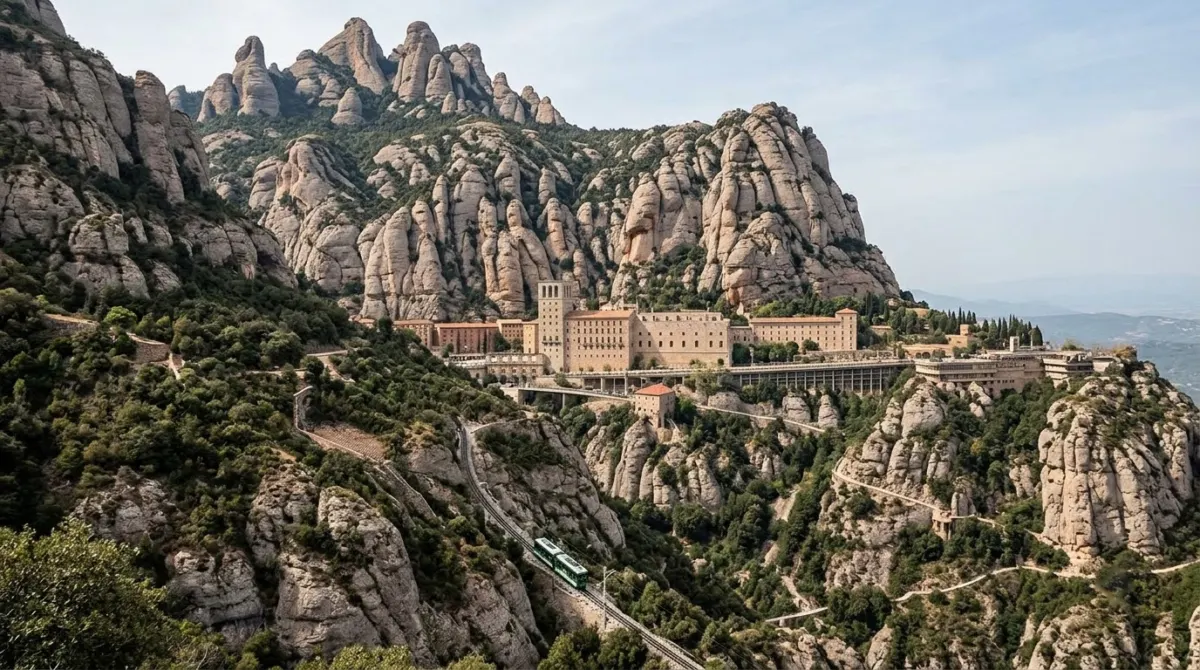
Montserrat, an hour away, is a monastery on a serrated rock mountain reached by rack railway or cable car, with walking at the top.
Girona, thirty-eight minutes by fast train, has a complete medieval old town, colourful houses along the river and the best-preserved Jewish quarter in Spain.
Sitges, forty minutes south, is a beach town with a long seafront and a whitewashed old quarter.
Beaches, and what they are worth
Barcelona’s beaches are artificial, created for the 1992 Olympics, and they are busy, central and perfectly good for an afternoon.
Barceloneta is the closest and the most crowded. The beaches north-east of it — Bogatell and Mar Bella — are quieter and cleaner.
For a serious beach day, the trains along the coast reach Sitges in forty minutes and the Costa Brava in an hour and a half.
Eating, and when
Catalan mealtimes are late: lunch from half past one, dinner from nine. Many kitchens do not open before eight thirty.
Two practical notes. The restaurants on La Rambla and around the Sagrada Família are the worst value in the city; five minutes in any direction is better. And a menú del día at lunch is the cheapest good meal in Spain, served on weekdays almost everywhere.
When to go
May, June, September and October are the best months: warm, open and less crowded than peak.
July and August are hot and extremely busy, with the city at its most crowded.
November to March is mild, much quieter and the cheapest, and nothing in this itinerary closes.
Map shows live availability and prices. We may earn a commission on bookings made through it, at no extra cost to you.
Where to stay for this itinerary
All three days work from the old city or the lower Eixample.
El Born and the Gothic Quarter put day one outside the door and are the liveliest at night.
The Eixample around Passeig de Gràcia is calmer, with larger rooms and better lifts, and it is ten minutes by metro from the old town.
Gràcia is the local alternative, cheaper and further out.
Our guide to where to stay in Barcelona covers the districts properly.
Three days with children
Swap one Gaudí building for something active.
The Aquarium at Port Vell, the cable car across the harbour to Montjuïc, and the beach all work. Park Güell is better with children than the apartment buildings, because it is outdoors and strange.
The Sagrada Família holds most children for half an hour, which is about as long as the queue-free booked entry takes anyway.
What to skip
La Rambla as a destination. Walk it once, early, and then use the parallel streets.
Eating anywhere with a photo menu, particularly on La Rambla and around the Sagrada Família.
Camp Nou, unless football is the reason you came; it has been under redevelopment and the tour varies.
Trying to see both Park Güell and Montjuïc in one day, which is two hills and a long metro ride between them.
The Gaudí question
Barcelona has seven Gaudí sites and most visitors try to see too many of them.
The Sagrada Família is the one that is genuinely unlike anything else, and it is non-negotiable.
Park Güell is the outdoor one, with the mosaic terrace and the view.
Casa Batlló and La Pedrera — the latter formally Casa Milà — are apartment buildings a few hundred metres apart on Passeig de Gràcia. They are similar enough that one is usually enough, and both are expensive for what they are.
Palau Güell, off La Rambla, is the quiet one that nobody queues for and is better value than either.
On three days: the Sagrada Família, one apartment building, and Park Güell if you booked it.
Beyond Gaudí: the Palau de la Música, Sant Pau and the Ciutadella
Gaudí was one of several modernista architects, and the other great buildings of the movement are less visited and, for many people, more enjoyable.
The Palau de la Música Catalana, on the edge of El Born, is a concert hall by Lluís Domènech i Montaner, built in 1905–08 and paid for largely by the city’s businessmen. The interior, with its stained-glass skylight hanging over the auditorium, is the most extravagant room in Barcelona. See it on a guided tour or, better, at a concert; either fits naturally into day one.
The Hospital de Sant Pau, also by Domènech i Montaner, is a complete hospital town of tiled pavilions and gardens at the far end of Avinguda de Gaudí, a straight walk of about ten minutes from the Sagrada Família. It is the natural thing to do on day two straight after your timed entry, and it is rarely crowded. The Palau and Sant Pau were listed together as a UNESCO World Heritage Site in 1997.
The Parc de la Ciutadella, beside El Born, is the city’s central park, with a monumental fountain, the Catalan Parliament and the brick Arc de Triomf on the avenue leading to it. It is the easiest place on day one to sit down for an hour between the old city and the beach.
The markets, the cathedral and Las Ramblas
Three things in the old city that every first visit runs into, and that are worth getting right.
La Boqueria, the covered market off Las Ramblas, is spectacular and is now largely a tourist attraction: go before nine if you want to see it working, and eat at the counters at the back rather than the fruit-cup stalls at the front. The Santa Caterina market in El Born, ten minutes away, is the one locals actually shop in.
Barcelona Cathedral — the Gothic one in the Barri Gòtic, not the Sagrada Família — has a cloister with thirteen geese in it and a roof you can go up. It takes half an hour and most itineraries skip it.
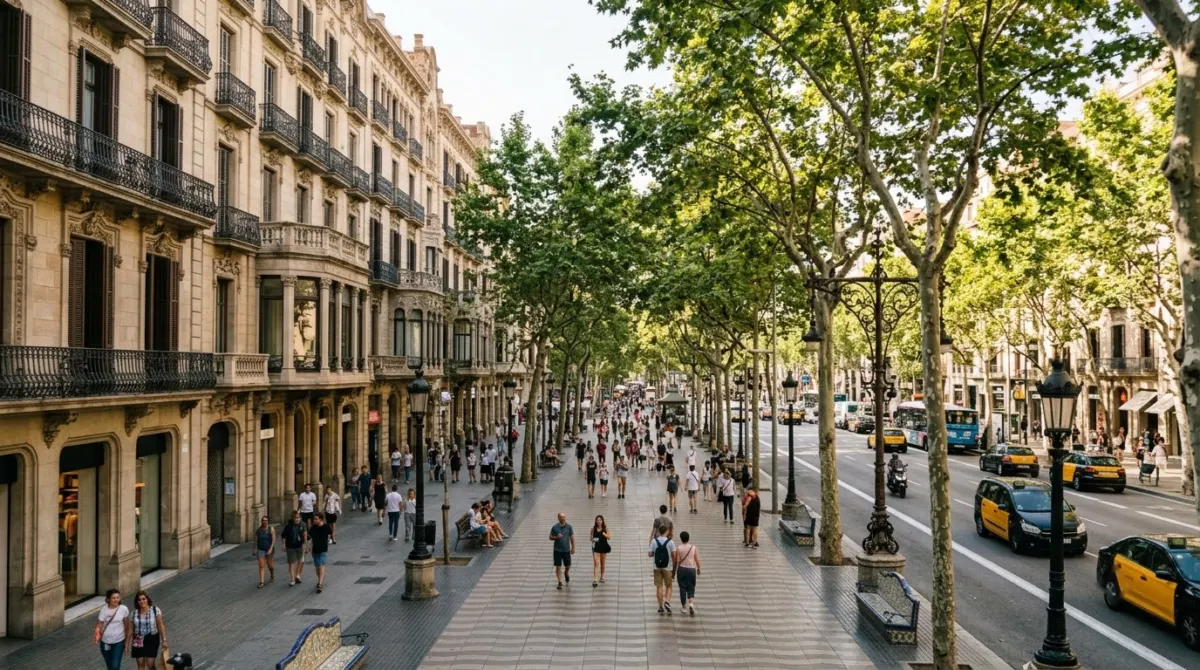
Las Ramblas and Plaça de Catalunya. The boulevard runs from the square down to the harbour and is the orientation line of the city. Walk it once, early, then use the parallel streets: Carrer dels Tallers on one side, Carrer d’Avinyó on the other.
Practical tips for a first trip to Barcelona
Four things that change a Barcelona trip and are easy to arrange before you go.
Book the Sagrada Família weeks ahead, and Park Güell’s monumental zone too. Both run on timed entry and both sell out.
Do not rent a car. Parking is difficult, the old city is pedestrianised and everything in this itinerary is on the metro.
Watch your bag on Las Ramblas and on the metro, which is where almost all of Barcelona’s pickpocketing happens, particularly line 3.
A flamenco show is a Seville and Jerez tradition rather than a Catalan one, and Barcelona’s are aimed squarely at visitors. If you want one, treat it as an evening’s entertainment rather than a cultural obligation — and know that the Catalan equivalent, the sardana, is danced outside the cathedral on Sunday mornings and costs nothing to watch.
From the airport to the old city
Josep Tarradellas Barcelona-El Prat airport has two terminals, T1 and T2, and three public routes into the centre. Which one to take depends on where you are staying.
- The Aerobús runs from both terminals to Plaça d’Espanya, Gran Via and Plaça de Catalunya around the clock, every day of the year, in about thirty-five minutes. It is the simplest choice for the Gothic Quarter, El Born and the lower Eixample, because Plaça de Catalunya is the top of La Rambla.
- Metro line L9 Sud serves both terminals, but it needs its own airport ticket, because the standard multi-journey tickets are not valid to or from the airport stations, and it needs a change of line to reach the centre.
- The R2 Nord train leaves from Terminal 2 only, about every half-hour, for Barcelona-Sants and Passeig de Gràcia. Passengers arriving at T1 take the shuttle bus between terminals first.
Which to take: the Aerobús for the old city, the train if you are staying near Passeig de Gràcia, and a taxi from the official rank if you land late with heavy luggage and your apartment is in the lanes of the Gothic Quarter, where no stop is close.
Getting around on three days
The metro reaches everything in this itinerary and a ten-journey ticket is far better value than singles.
The old city is walkable end to end in half an hour. The Eixample is larger than it looks, with long blocks and chamfered corners that make every junction wider than expected.
For Montjuïc, the cable car from the harbour and the funicular from Paral·lel both save a long climb, and the funicular is included on a normal metro ticket.
Barcelona in two days
If you only have two, cut the hill rather than thinning the other days.
Day 1: the Gothic Quarter, El Born and the waterfront.
Day 2: the Sagrada Família in the morning and the Eixample in the afternoon, with Park Güell only if you booked an afternoon slot and are prepared to move quickly.
Two days covers the city’s two faces, which is the minimum that makes sense here.
Where this fits in a Spanish trip
Barcelona is well connected for a longer route.
Madrid is about three hours by fast train while speed restrictions remain on the high-speed line, which still makes a two-city trip straightforward and removes any need to fly internally.
Valencia is three hours south, Girona thirty-eight minutes north, and the French border is close enough that Barcelona pairs naturally with Toulouse or Perpignan.
On a week in Spain, three nights here and four in Madrid with the train between them is the standard shape, and it is a good one.
The short version
Old city on day one, the Sagrada Família and the Eixample on day two, one hill on day three. Book the Sagrada Família weeks ahead and Park Güell if you want the monumental zone. Eat five minutes away from any sight, take the menú del día at lunch, and give the fourth day to Montserrat or Girona rather than to a third Gaudí building.
Check Barcelona availability →
Frequently asked questions
What is the best 3 day Barcelona itinerary?
Separate the two cities: the Gothic Quarter and El Born on day one, the Sagrada Família and the Eixample on day two, and Montjuïc or Park Güell on day three. Crossing between them repeatedly is what wastes time here.
Do I need to book the Sagrada Família?
Yes, weeks ahead in season. It is the busiest paid attraction in Spain and uses timed entry, with a separate ticket for the tower lift. Park Güell's monumental zone also limits numbers.
Is 3 days enough for Barcelona?
Yes for the city itself. A fourth day is best spent out of it — Montserrat in an hour, Girona in thirty-eight minutes by fast train, or Sitges in forty for the beach.
Should I visit Park Güell or Montjuïc?
Montjuïc has more in it — the Miró Foundation, the Catalan national art museum, the Olympic stadium and a castle. Park Güell has the mosaic terrace and the photograph. With three days, pick one.
Are Barcelona's beaches any good?
They are artificial, created for the 1992 Olympics, and perfectly good for an afternoon. Barceloneta is the busiest; Bogatell and Mar Bella north-east of it are quieter. For a proper beach day, take the train to Sitges.
When is the best time to visit Barcelona?
May, June, September and October — warm, open and less crowded. July and August are hot and at peak capacity, and November to March is mild, quiet and cheap with nothing closed.
Keep planning Spain
- Best Hotels in Seville: Air Conditioning and Two Weeks in Spring
- Where to Stay in Granada: Book the Alhambra Ticket First
- Where to Stay in Seville: You Are Choosing a Patio, Not a View
- Where to Stay in Madrid: Pick the Evening, Not the Distance
- Where to Stay in Barcelona: Best Neighborhoods Compared
- How Many Days in Granada? Count the Nights Instead
- How Many Days in Madrid? Three for the City, Five for the Day Trips
- How Many Days in Barcelona? Four, and the Tickets Explain Why
Written and checked by
Triplarks Editorial
An editorial desk, not an invented persona: research, drafting and fact-checking are done by the same small team. Every number here carries the date it was read.