Quick answer where to stay in Puglia
Two bases. In the north, the Valle d’Itria: Ostuni, Locorotondo, Cisternino or Martina Franca. In the south, Lecce, or a masseria in the countryside around it if you want a pool. Book well ahead for July and August.
On this page
- The 7 day Puglia road trip and travel itinerary at a glance
- Renting a car in Puglia, and why driving in Puglia is the whole trip
- Days 1 to 3: the Valle d’Itria and the Adriatic coast
- Day 4: Matera, and the drive south
- Days 5 to 7: Lecce and Salento
- How long is the perfect Puglia trip, and what to cut
- Where to stay in Puglia: the best place to stay is two places
- Puglia travel guide: travelling to Puglia and getting around
- Visiting Puglia without a car: the travel by train version
- Food, wine and caves: the other reason to explore Puglia
- Frequently asked questions
Most people plan a trip to Puglia the way they plan Tuscany. Pick one beautiful place to stay, settle in, drive out and back each day. It is the obvious approach and it does not work here.
Some links below are affiliate links. We may earn a commission if you book through them, at no extra cost to you. We do not rank hotels, and any prices on the map come live from the booking sites.
Puglia is about 400 kilometres long. Apulia, to give the region of Italy its formal name, is the heel of Italy’s boot, and it has two halves that are effectively two different holidays. The Valle d’Itria in the north has the trulli, the white hill towns and the Adriatic coves. Salento in the south has Lecce, Otranto, Gallipoli and two separate seas. Two hours of driving separates them.
So a Puglia travel itinerary that works has two bases, not one. Everything below is built on that, and on the second thing nobody says clearly enough: you need a car in Puglia. Car rental is the difference between seeing the region and driving past it.
Distances, road connections, airport positions and train services checked 9 September 2026. Opening hours and prices change, so verify anything time-critical before you go.
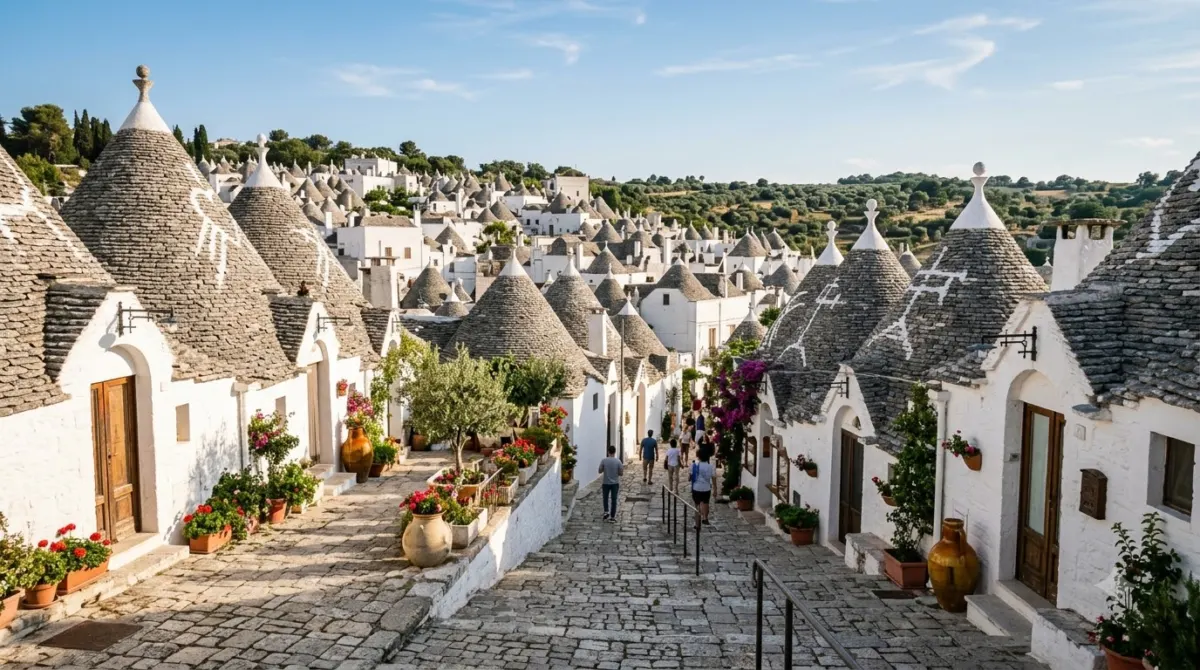
The 7 day Puglia road trip and travel itinerary at a glance
| Days | Base | Covers |
|---|---|---|
| Day 1 | Valle d’Itria | Fly into Bari, pick up your rental car, Polignano a Mare |
| Day 2 | Valle d’Itria | Alberobello, Locorotondo and Martina Franca |
| Day 3 | Valle d’Itria | Ostuni, Cisternino, the coast at Monopoli |
| Day 4 | Move south | Matera as a detour, then drive to Salento |
| Day 5 | Salento | Lecce, all day |
| Day 6 | Salento | Otranto on the Adriatic, Gallipoli on the Ionian |
| Day 7 | Salento | Santa Maria di Leuca at the tip, or a beach day |
The one week Puglia travel itinerary in short
A week in Puglia is the right length for that route, and this week Puglia travel itinerary assumes you drive. Five days works if you drop southern Puglia or drop the Valle d’Itria, and cutting one side of Puglia is far better than rushing both.
Where to sleep on this route
Renting a car in Puglia, and why driving in Puglia is the whole trip
Do you have to rent a car for a Puglia road trip itinerary?
This is the part that changes the whole trip, so it goes before the day-by-day. Short answer: for this route, yes.
- The towns you came for are inland. Alberobello, Locorotondo, Martina Franca, Cisternino and Ostuni sit on a plateau, spread out among olive groves, with nothing joining them but small roads.
- The regional railway is not a substitute. The Ferrovie del Sud Est line that serves the Valle d’Itria is slow, infrequent, and runs a reduced service at weekends.
- Puglia is flat and easy to drive, unlike the Amalfi Coast. Roads are wide, traffic is light outside the cities and parking outside the old towns is usually straightforward.
- Watch the ZTL zones. Historic centres are closed to traffic and the cameras are automatic. Park outside the walls and walk in.
- Doing Puglia without a car is possible but it becomes a different trip in Puglia: Bari, Lecce and a couple of coastal towns reached by train, and none of the countryside.
Fly into Bari, pick up your rental car at the airport, and drive out. Brindisi works just as well if you are starting in the south.
Days 1 to 3: the Valle d’Itria and the Adriatic coast
The northern half is the postcard: dry stone walls, ancient olive trees, whitewashed towns on low hills, and a coast of limestone and clear water.
Day 1: Bari, Polignano a Mare and Monopoli
- Bari Airport to the Valle d’Itria is about an hour. Collect the car and go; Bari itself can wait for the end.
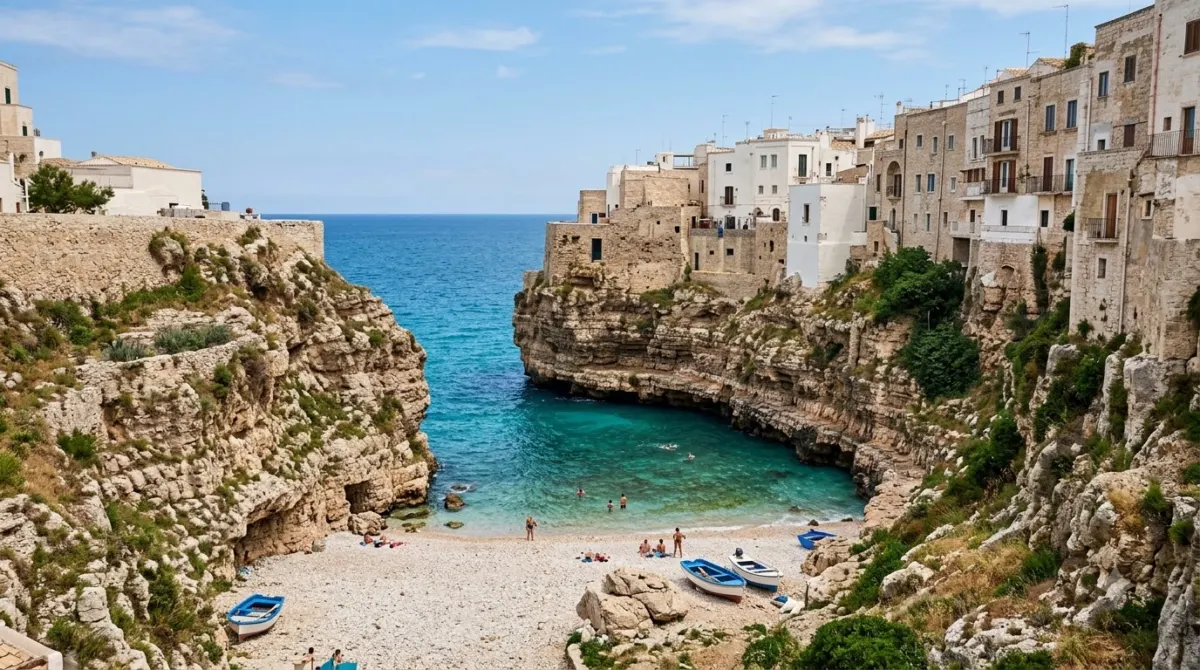
- Polignano a Mare is built on a cliff above a small pebble cove, Cala Porta Vecchia, wedged between rock walls. It is the most photographed spot in the region and it is genuinely small, so go early or late.
- Monopoli, ten minutes further along the coast, is the better place to eat. It is a working port town with a proper old town and far fewer visitors, and the oldest part of town is small enough to walk in an hour.
- Settle into your first base in or near Locorotondo, Cisternino or Ostuni.
Day 2: the trulli of Alberobello, Locorotondo and Martina Franca
- Alberobello is the trulli town, a UNESCO World Heritage site of over a thousand conical stone roofs. It is the single most visited town in Puglia and the most obvious day trip target, so give it a morning, not a day. Two zones make up the site and the quieter one, Aia Piccola, is where it still feels like somewhere people live.
- A trullo is a dry stone house built without mortar, and the countryside is full of them. Plenty are now rented out.
- Locorotondo is a circular white town on a hill with a view over the whole valley, and it is the prettiest of them.
- Martina Franca is bigger and baroque, with a grand piazza and less of a crowd.
- Locorotondo and Martina Franca are ten minutes apart, which is the whole point of basing yourself here rather than moving around Puglia every night.
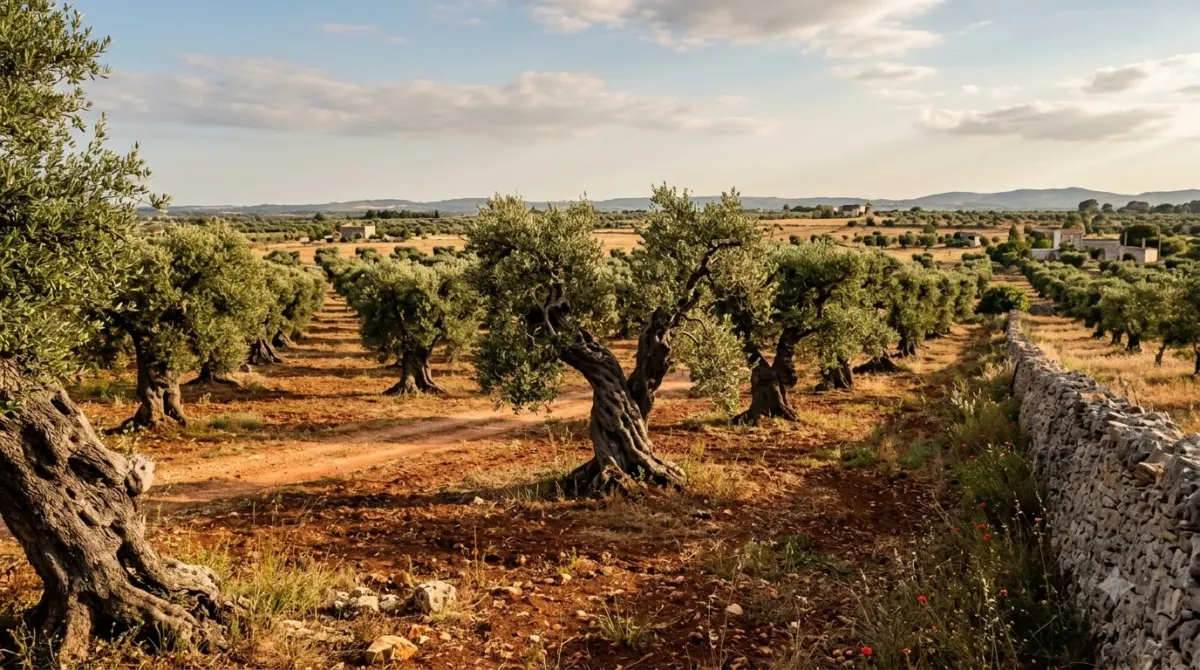
Day 3: Ostuni, Cisternino and the coast
- Ostuni, the white town, is a mass of whitewashed houses stacked on a hill above the olive plain, visible from a long way off. The old town is a maze and the cathedral sits at the top of it.
- Cisternino is small, quiet and known for its butchers who grill what you choose in the evening.
- The coast north of Ostuni has low limestone rocks, clear water and beach clubs rather than long sand.
- Torre Guaceto is the protected stretch, and the reason the water here looks the way it does.
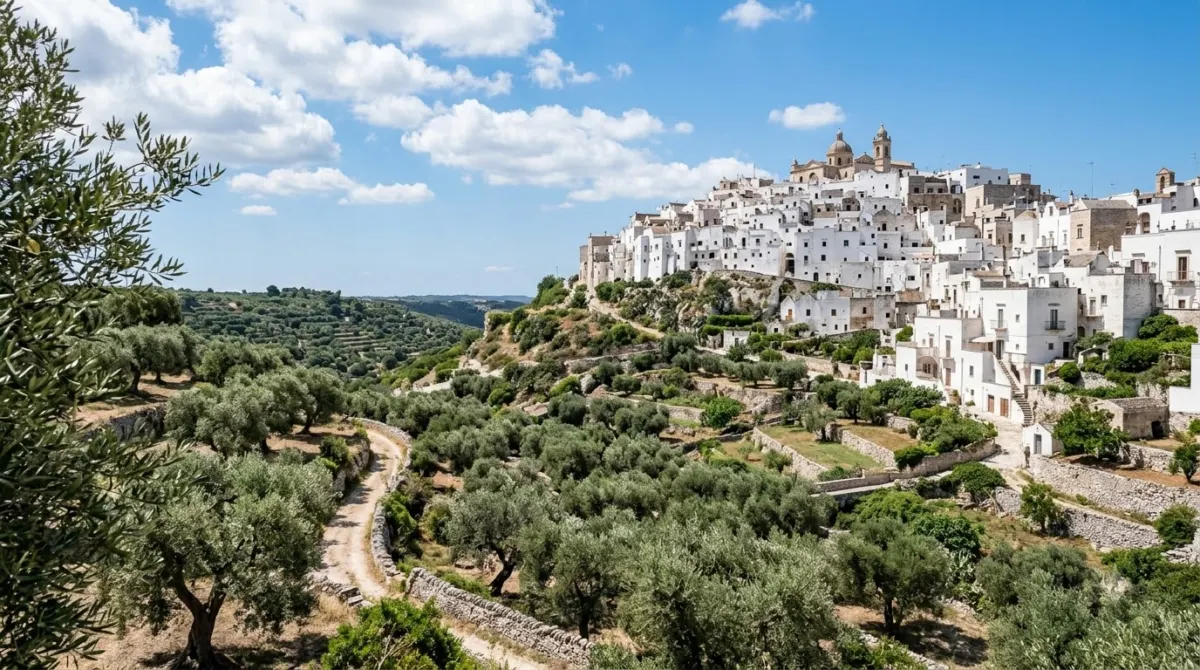
Map shows live availability and prices. We may earn a commission on bookings made through it, at no extra cost to you.
Day 4: Matera, and the drive south
Matera is not in Puglia. It is in Basilicata, the region next door, and it is worth the detour anyway.
- The Sassi are cave dwellings carved into a ravine, inhabited for thousands of years, emptied in the 1950s and now restored. It is one of the strangest places in Italy to look at.
- It is a UNESCO World Heritage site and about an hour and a quarter from the Valle d’Itria.
- Give it a full day or a long half day. The town is vertical and walking it takes longer than the map suggests.
- Then drive to Salento, about two hours from Matera to Lecce. This is the day the trip changes character.
Days 5 to 7: Lecce and Salento
Salento is southern Puglia, the tip of the heel, and it is a different landscape: flatter, drier, hotter, with the Adriatic Sea on one side and the Ionian Sea on the other. This is the part of the trip where most people fall in love with Puglia.
Day 5: Lecce
- Lecce is the reason to come south. The local limestone is soft enough to carve like wood, and the seventeenth-century builders carved everything.
- The Basilica di Santa Croce is the extreme example, a facade covered in figures, fruit and animals.
- The Piazza del Duomo is a closed square with one entrance, which is unusual and works beautifully at night when it is lit.
- A Roman amphitheatre sits half-excavated in the middle of the main piazza, below street level.
- Give Lecce a full day. It is a real city, not a set piece, and the evening passeggiata is the best part.
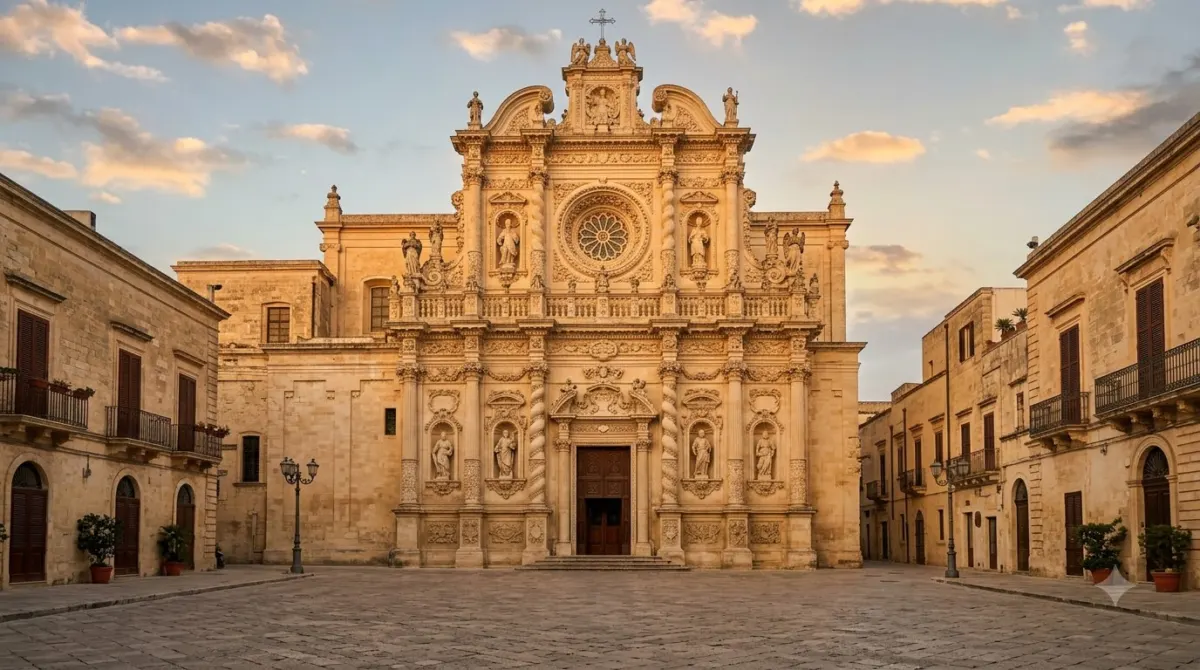
Day 6 and day 7: Otranto, Gallipoli and the tip of the heel
- Otranto sits on the Adriatic side, a walled town with a castle and a cathedral floor covered in a twelfth-century mosaic of a tree of life.
- Gallipoli, Apulia is on the Ionian side, an old town on an island joined by a bridge, with the better sunsets and the livelier evenings. It is the best thing to visit in Puglia at the end of a hot day.
- The two coasts are forty minutes apart, which is the pleasure of Salento: you can swim in two seas in a day.
- Santa Maria di Leuca is the tip of the heel, where the two seas meet, and the drive down the eastern coast to it is the best road in the region.
- The Ionian beaches south of Gallipoli are the long sandy ones. The Adriatic side is rockier and clearer.
How long is the perfect Puglia trip, and what to cut
- 2 nights — one base in the Valle d’Itria, the trulli and two white towns. A weekend, not a trip.
- 3 nights — the Valle d’Itria properly. Trulli, white towns, one stretch of coast, and one full day in Puglia with nothing planned.
- 5 days — either the north plus Matera, or Salento plus Lecce. Not both halves.
- 7 days in Puglia — the full route above, two bases, no rushing. This is the right length.
- 10 days — adds the Gargano peninsula in the far north, which almost nobody includes and which is the wildest part of the region. At that length you can build a loop right around Puglia rather than a line down it.
- Extra days go to the beach. Puglia rewards doing nothing more than most of Italy does, and a week in this region is not long if you swim.
If you only have a long weekend, stay in the Valle d’Itria and skip the south entirely. Driving four hours to see Lecce for an afternoon is the most common way to spoil this trip.
Where to stay in Puglia: the best place to stay is two places
- North base — Ostuni, Locorotondo, Cisternino or Martina Franca. All within twenty minutes of each other and of Alberobello.
- South base — Lecce itself, or a masseria in the countryside around it if you want a pool.
- A masseria is a fortified farmhouse converted into a hotel, and it is the characteristic place to stay in Puglia. A trullo apartment or a bed and breakfast in one of the white towns is the cheaper version.
- Coastal towns like Monopoli and Polignano a Mare work as a base too, if you would rather be on the water than in the hills.
- Book well ahead in summer. July and August fill up and the region is genuinely hot.
The full breakdown is in our guide to where to stay in Puglia.
Puglia travel guide: travelling to Puglia and getting around
- Best time to go is May, June, September or early October. July and August are very hot and the coast is busy.
- Bari and Brindisi are the two airports. Bari suits the north, Brindisi suits Salento.
- Trains run down the main line from Bari to Brindisi and Lecce, so travel by train between the cities is easy. Between the hill towns it is not, and the best way to explore Puglia is still the car.
- Food is the regional specialism: orecchiette pasta, burrata from Andria, and olive oil from trees that are centuries old.
- Lunch closes things. Shops and many sights shut for a few hours in the afternoon, more strictly than in northern Italy.
- Beaches are mostly rock in the north and sand in the south, which is worth knowing before you book anything along the coast.
Fitting this into a longer route? See our 10 day Italy itinerary and our Amalfi Coast itinerary for the other southern option.
Visiting Puglia without a car: the travel by train version
If car rental is off the table, the trip is still worth taking. It is just a narrower one, built along the main railway line rather than across the countryside.
- The main line runs Bari to Monopoli to Ostuni to Brindisi to Lecce, so five good stops are reachable and a day trip between any two of them is easy.
- Polignano a Mare has its own station, about ten minutes on foot from the old town, which makes it the simplest day itinerary in Puglia to do by train.
- Alberobello is reachable on the regional Ferrovie del Sud Est line from Bari, slowly, and it is the one inland town you can manage this way.
- What you lose is Locorotondo, Cisternino, Martina Franca and the coastal roads — which is to say most of the region of Puglia that people fall in love with.
- Buses fill some gaps in summer, and organised day tours from Bari or Lecce cover the trulli if you only want to see them once.
Two nights in Bari or Lecce and a set of day trips is a perfectly good short trip in Puglia. Just do not plan the countryside route and then arrive without a car.
Food, wine and caves: the other reason to explore Puglia
The region of Italy that produces the most olive oil and some of its best value wine is not a place to eat quickly.
- Orecchiette, the little ear-shaped pasta, is the local shape, and in the old part of town in Bari you can still watch it being made in doorways.
- Burrata comes from Andria, half an hour inland from the coast, and a meal here starts with better cheese than most restaurants in Italy serve at all.
- Negroamaro and Primitivo are the Salento red grapes, and estates throughout Puglia open for tastings without much ceremony.
- The Grotte di Castellana are a cave system near Alberobello, and Grotta della Poesia is a sea grotto on the Adriatic side of Salento where swimming and diving are now banned and entry is limited.
- Lecce has a small archaeological museum and a Roman theatre, and the ruins are scattered around the streets rather than fenced off.
- Book dinner in the towns in July and August. Restaurants in Ostuni and Polignano a Mare fill early along the coast.
Puglia inside a longer Italy itinerary
A week in this region works as a standalone trip, and it also works as the southern leg of something bigger.
- From Rome — about four hours by train to Bari, which is the easiest way in without flying.
- From Florence — further, and better done as a flight than a drive.
- With Sicily — the natural pairing for a longer southern route, though they are a flight apart rather than a drive.
- With Matera and Basilicata — already built into the route above, and the shortest detour of the lot.
Still deciding how long to give it? See how many days you need in Cinque Terre.
Frequently asked questions
How many days do you need in Puglia?
Seven days for the whole region. Puglia is about 400 kilometres long and splits into two halves that need separate bases: the Valle d’Itria in the north with the trulli and white hill towns, and Salento in the south with Lecce and the two coasts. With five days or fewer, pick one half rather than driving between them.
Do you need a car in Puglia?
Yes, for the countryside. The towns most people come for — Alberobello, Locorotondo, Martina Franca, Ostuni, Cisternino — are spread across an inland plateau, and the regional railway that serves them is slow and infrequent. Puglia is flat and easy to drive. Without a car you are limited to Bari, Lecce and a few coastal towns by train.
What is the best base for a Puglia itinerary?
Two bases. In the north choose Ostuni, Locorotondo, Cisternino or Martina Franca, all within twenty minutes of each other and of Alberobello. In the south choose Lecce or a masseria in the countryside nearby. A masseria is a converted fortified farmhouse and is the characteristic place to stay in the region.
Is Matera part of Puglia?
No. Matera is in Basilicata, the neighbouring region, but it sits about an hour and a quarter from the Valle d’Itria and almost every Puglia road trip includes it. Its cave dwellings, the Sassi, are a UNESCO World Heritage site and it makes a natural stop on the drive south towards Lecce.
When is the best time to visit Puglia?
May, June, September and early October. The weather suits both driving and swimming, and the towns are not overwhelmed. July and August are very hot, the beaches are busy and prices peak. Winter is quiet, and many coastal places close.
Can you visit Puglia without a car?
You can, but it becomes a different trip. The main railway line links Bari, Monopoli, Ostuni, Brindisi and Lecce, so a city and coast trip works. What you lose is the Valle d’Itria, which is the reason most people come, because the hill towns are connected only by small roads and a limited regional service.
Is 5 days enough for Puglia?
Five days is enough for one half of the region. Either the Valle d’Itria plus Matera, or Lecce and Salento. It is not enough for both, and the most common mistake is trying, which turns two good trips into one trip spent in the car.
Keep planning Italy
- Best Hotels in Taormina: The Town Is Up, the Sea Is Down
- Best Hotels on the Amalfi Coast: Pick the Town First
- Best Hotels in Positano: Count the Steps Before the Stars
- Best Hotels in Florence: The ZTL Matters More Than the Stars
- Where to Stay in Verona: Inside the River Loop, or Outside It
- Where to Stay in Tuscany: You Are Choosing a Driving Radius
- Where to Stay in Puglia: Pick the Building, Not the Town
- Where to Stay in Cinque Terre: Ask About the Stairs First
Written and checked by
Triplarks Editorial
An editorial desk, not an invented persona: research, drafting and fact-checking are done by the same small team. Every number here carries the date it was read.