
The Amalfi Coast is about 50 kilometers of cliff with one road along it. That single fact shapes every Amalfi Coast itinerary, and it is the thing most guides mention in passing and then ignore.
Some links below are affiliate links. We may earn a commission if you book through them, at no extra cost to you. We do not rank hotels, and any prices on the map come live from the booking sites.
Quick answer: where to base yourself. Use one base, because moving along the coast is slow. Amalfi town is flat, central and the ferry hub. Positano is the most beautiful and the most expensive. Sorrento, just off the coast, often has the best transport and prices.
The road is two lanes, carved into rock, with blind bends and buses coming the other way. A journey that looks like twenty minutes on a map takes an hour in July. Plan the itinerary around the transport and it is one of the best weeks in Italy. Plan it around the towns and you spend the trip in traffic.
Ferry seasons, bus routes and drive times checked 7 September 2026. Ferry timetables change by month, so confirm on the operators’ own sites before you build a day around one.
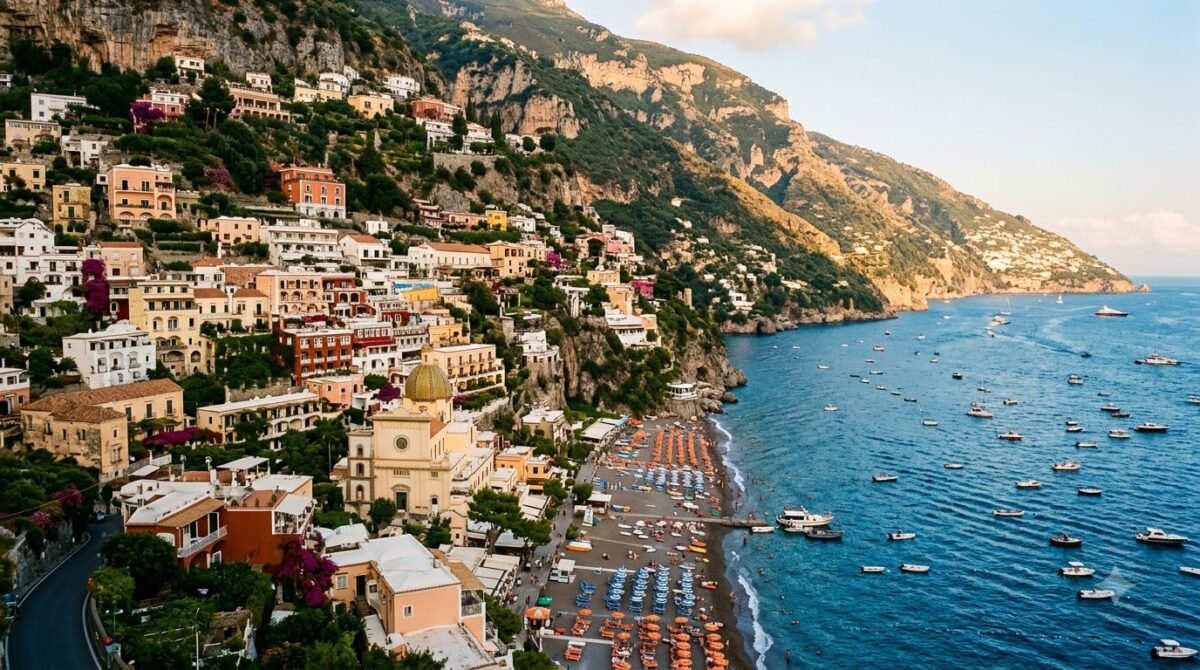
The coast, town by town
Running west to east from Sorrento, these are the places an Amalfi Coast trip is built from.
| Town | What it is | Best for |
|---|---|---|
| Sorrento | Larger town on the far side of the peninsula, not technically on the coast | Transport, value, families |
| Positano | The famous vertical town | The view, the photographs |
| Praiano | Quiet village between Positano and Amalfi | Sunsets, calm, value |
| Amalfi | The historic centre of the coast, and the ferry hub | Getting around, budget |
| Atrani | Tiny village next to Amalfi | A five minute walk and no crowds |
| Ravello | 350 metres above Amalfi, gardens and views | Quiet, romance, music festival |
| Minori and Maiori | Working towns with real beaches | Budget, staying put |
| Vietri sul Mare | The eastern end, famous for ceramics | A stop rather than a base |
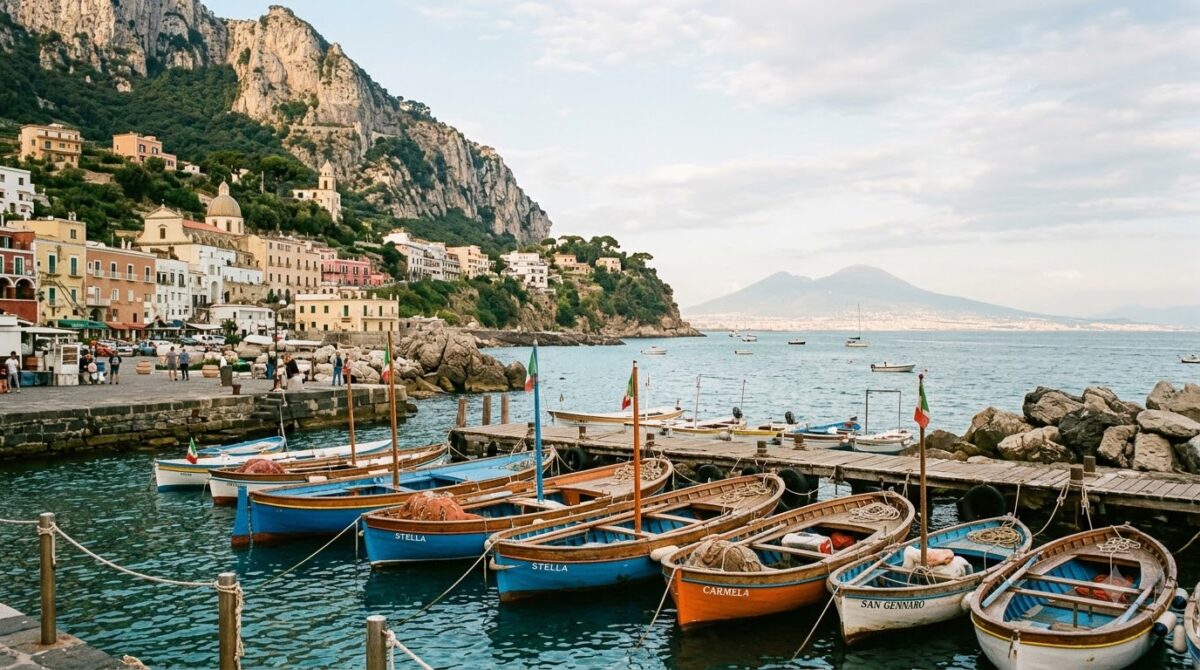
Capri sits offshore and is reached by ferry from Sorrento, Positano or Amalfi. It belongs in the itinerary as a day, not as a base, unless you are staying overnight deliberately.
First: how you will get around
This decides everything else, so it comes before the day plan.
Ferry: the best option in season
Ferries run roughly April to October between Sorrento, Positano, Amalfi and Capri, and they are faster, cooler and far more pleasant than the road. They also give you the coast from the water, which is how it looks best.
The catch: they stop for the winter, and they cancel in rough sea. Never make a ferry the only way you can reach a flight.
The SITA bus: cheap, and an experience
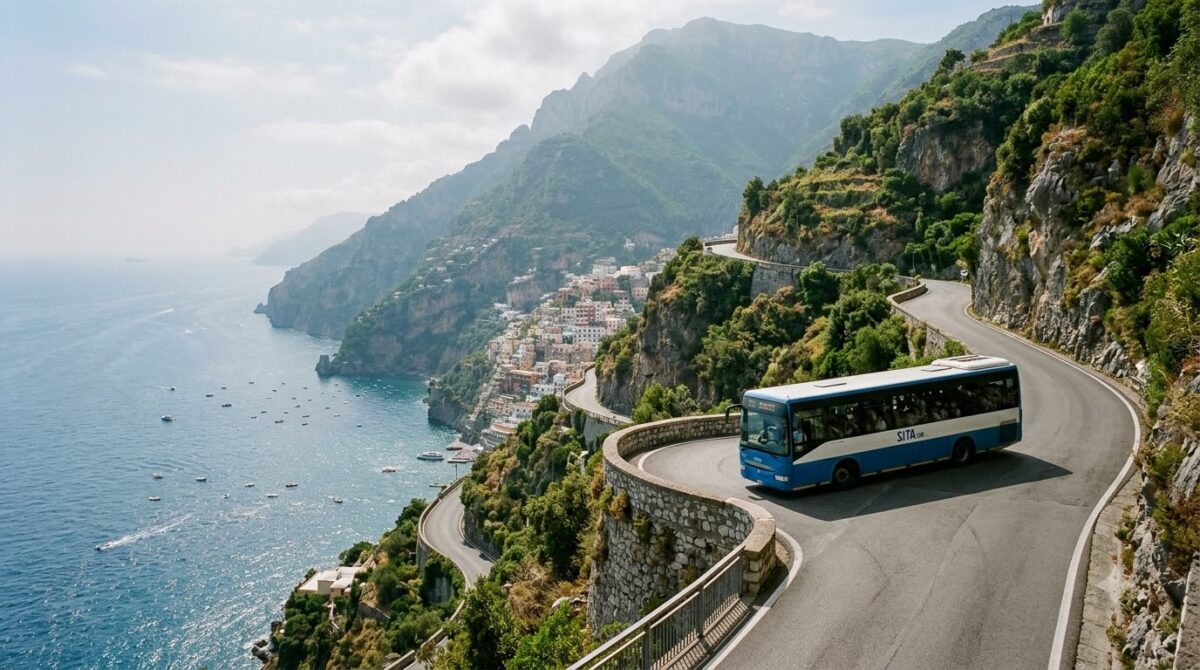
The blue SITA buses run the coast road all year and cost very little. They are also crowded in summer to the point where you may not get on the first one, and the road makes them slow.
Sit on the right heading east from Sorrento for the sea side, and buy tickets before boarding from a tabaccheria.
Renting a car: usually a mistake
Do not rent a car for the Amalfi Coast unless you have somewhere to put it. Parking in Positano and Amalfi is scarce and expensive, the road is narrow enough that meeting a bus means reversing, and several towns are effectively pedestrian.
A car makes sense only if you are staying inland or in Praiano or Ravello with hotel parking, and even then you will leave it there most days.
3 days on the Amalfi Coast
Three days is a taste and it works if you base yourself once and do not move.
Day 1: arrive and Positano
Arrive from Naples or Sorrento. Settle in, then walk down through Positano to the beach in the late afternoon when the light is best and the day trippers have gone. Dinner with a terrace overlooking the sea.
Day 2: Amalfi town and Ravello
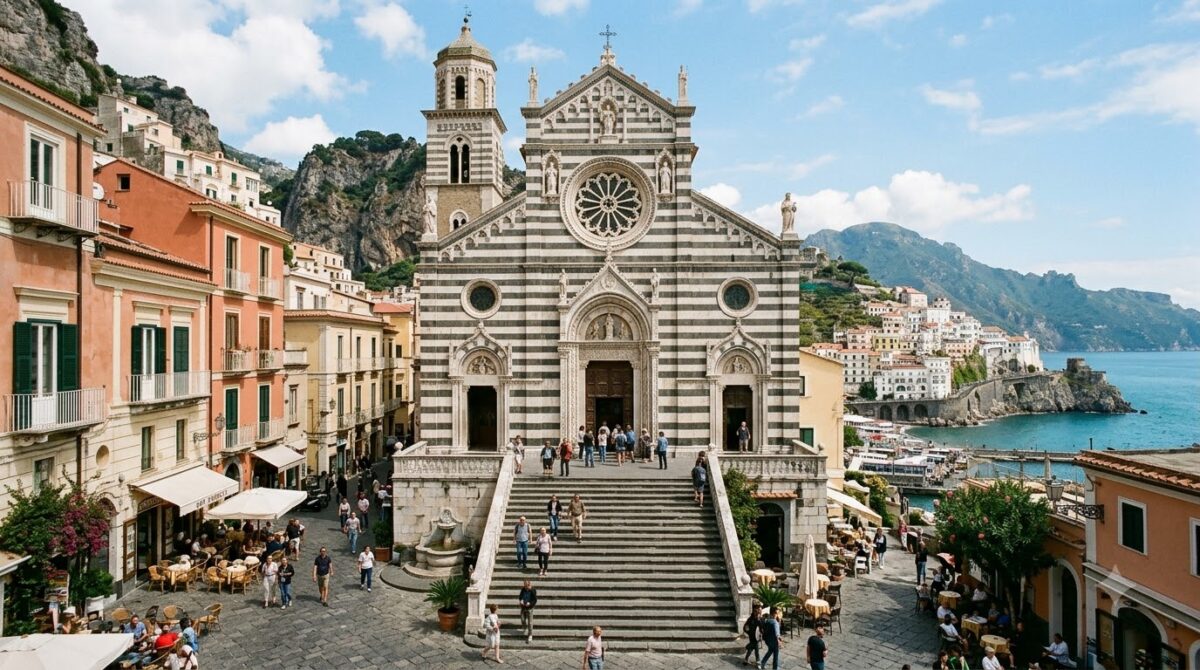
Ferry or bus east to the town of Amalfi. The cathedral with its striped facade and long staircase is the centrepiece, and the paper museum in the valley behind is a good hour.
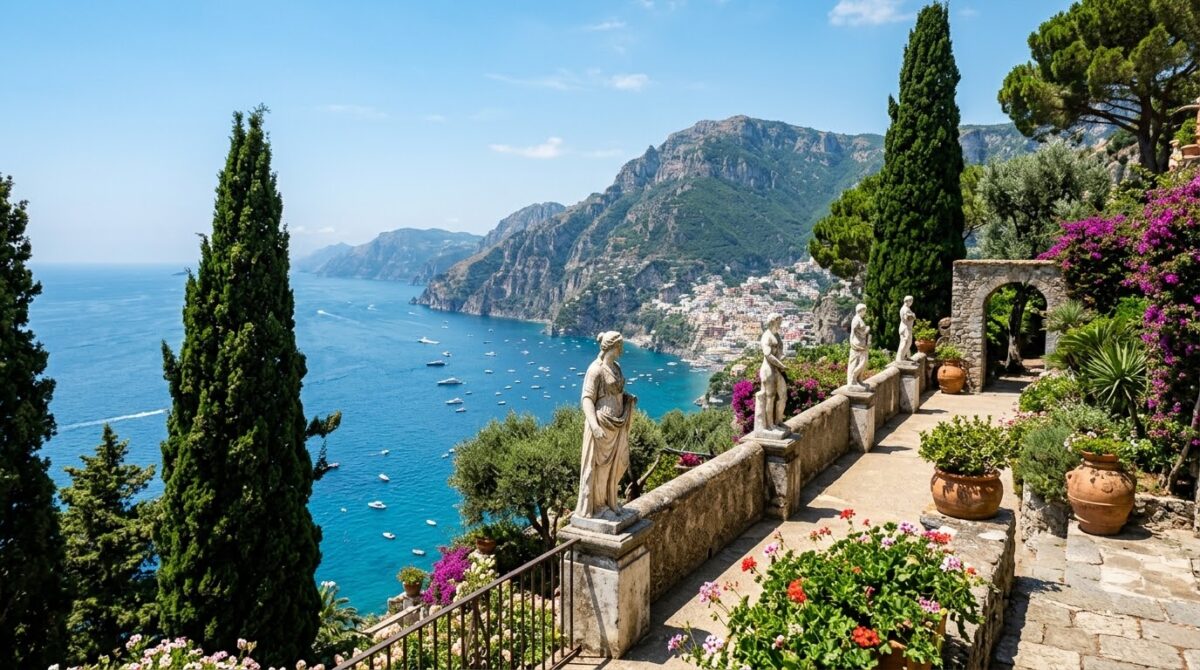
Then the bus up to Ravello, twenty-five minutes of switchbacks, for Villa Rufolo and Villa Cimbrone. The terrace at Cimbrone is the best view on the whole coast.
Day 3: Capri or the Path of the Gods
Either the ferry to Capri for the day, or the Path of the Gods, the cliff-top walk from Bomerano to Nocelle above Positano. About three hours, mostly downhill if you walk it that direction, and the best free thing on the coast.
5 days on the Amalfi Coast
Five days is the sweet spot, and it lets you add Pompeii without cutting anything.
- Day 1 — arrive, settle, Positano in the evening.
- Day 2 — Positano properly: the beach, the boat trip along the coast, and the walk up through the town.
- Day 3 — Amalfi town, Atrani next door, and Ravello above.
- Day 4 — Capri by ferry. Go early, take the chairlift up Monte Solaro, and leave before the last boat rush.
- Day 5 — the Path of the Gods, or Pompeii on the way out.
The 5 day version is the one to book if you have the choice. It fits the coast, the island and one walk without a single rushed morning.
7 days on the Amalfi Coast
A week lets you slow down and add the things a shorter Amalfi Coast trip cuts.
- Days 1–5 as above.
- Day 6 — Pompeii or Herculaneum, both about an hour by train from Sorrento on the Circumvesuviana. Herculaneum is smaller and better preserved; Pompeii is larger and more famous.
- Day 7 — the quiet end: Minori, Maiori and Vietri sul Mare, or a second boat day.
With ten days, add Naples itself for two nights at one end. It is under an hour away and it is the reason the region exists.
Where to base yourself
Because moving along the coast is slow, most itineraries work best from a single base rather than two.
- Positano — the most beautiful and the most expensive, and it is built on a near-vertical slope. Everything is stairs.
- Amalfi town — flat, central, the ferry hub, and much cheaper. The practical choice.
- Praiano — between the two, quiet, good value, and the best sunsets.
- Ravello — above it all, calm and cool, and a bus ride from the water.
- Sorrento — not on the Amalfi Coast at all, and often the smartest base: better transport, more choice, lower prices, and the ferries and trains both start there.
Our guide to where to stay on the Amalfi Coast compares the towns properly, and where to stay in Positano covers the upper and lower parts of that town, which matter more than people expect.
Map shows live availability and prices. We may earn a commission on bookings made through it, at no extra cost to you.
The best time to visit the Amalfi Coast
- May, June and September are the best months: warm sea, full ferry timetables, and the road is passable.
- July and August are hot, extremely crowded and expensive, and the bus queues are genuinely long.
- April and October are pleasant and cheaper, with a reduced ferry service.
- November to March is largely closed. Many hotels and restaurants shut and the ferries stop.
September is the single best month. The sea is at its warmest after the summer, the crowds thin after the first week, and everything is still running.
Getting there
- From Naples — train to Sorrento on the Circumvesuviana, then bus or ferry. Or a direct ferry to Positano and Amalfi in season.
- From Rome — fast train to Naples (about 70 minutes), then as above.
- From Naples airport — the Curreri bus runs direct to Sorrento.
If you are combining this with the rest of the country, our 10 day Italy itinerary explains why the Amalfi Coast usually belongs on a second trip rather than a first, and whether Naples is worth visiting covers the city at the gateway.
A 7-day itinerary along the Amalfi Coast, day by day
The five day version above compressed and the seven day version expanded both work, but the perfect Amalfi Coast trip for most people is the full week. Here it is as a day itinerary rather than a list.
Day 1: arrive and settle
Naples to Amalfi takes about two hours by train and bus, or roughly ninety minutes by direct ferry in season. Arrive, drop bags, and spend the first evening walking whichever town on the Amalfi Coast you have chosen as a base. Do not plan anything ticketed.
Day 2: one full day in Positano
The town is built down a cliff, so the walk is one long descent to the beach and one long climb back. Take the boat trip along the coast in the morning for the views of the coast from the water, then the beach in the afternoon.
Day 3: explore Amalfi town and Atrani
The Amalfi cathedral, with its striped facade and long staircase, is the centrepiece of the town of Amalfi. The paper museum in the valley behind is a genuinely good hour. Atrani is a five minute walk east around the headland and has none of the crowds.
Amalfi lemons are the local obsession, and the limoncello and lemon granita here are worth the cliche.
Day 4: Ravello in one day
Twenty-five minutes of switchbacks above Amalfi. Villa Rufolo and Villa Cimbrone are the two gardens, and the belvedere terrace at Cimbrone is the single best view on the coast. In summer the Ravello Festival puts concerts in the Rufolo gardens with the sea behind the stage.
Day 5: a day trip to Capri
Take the first ferry. Capri from Sorrento is about twenty-five minutes; from Positano or Amalfi it is longer. Chairlift up Monte Solaro, walk down, and be back at the harbour before the late afternoon crush.
The Blue Grotto is weather dependent and often closed. Treat it as a bonus rather than the reason for the trip to Capri.
Day 6: the Path of the Gods
Bus up to Bomerano, walk the cliff path to Nocelle, then the steps down into Positano. Around three hours plus the descent, and it is the best free thing on the coast.
Day 7: Pompeii on the way out, or the quiet end
Either Pompeii or Herculaneum on the Circumvesuviana line, or the eastern towns: Minori, Maiori and Vietri sul Mare, which are working towns with real beaches and almost no visitors.
Getting from Naples to Amalfi, and around the coast
Distances are short and journey times are not, so it helps to see them written down.
| Leg | How | Time |
|---|---|---|
| Naples to Sorrento | Circumvesuviana train | 1 hr 10 |
| Naples to Amalfi | Direct ferry, in season | 1 hr 30 |
| Sorrento to Positano | Ferry | 40 min |
| Sorrento to Positano | SITA bus | 50 min to 1 hr 30 |
| Positano to Amalfi | Ferry | 25 min |
| Positano to Amalfi | SITA bus | 40 min to 1 hr 15 |
| Amalfi to Ravello | Local bus | 25 min |
| Sorrento to Capri | Fast ferry | 25 min |
The bus times have a range for a reason. In July and August the same journey can take twice as long, and you may not fit on the first bus. That is the single strongest argument for taking the ferry wherever one runs.
How many days to spend, and how many nights
A short guide to the Amalfi Coast that ignores the arithmetic of nights is not much use, so here it is plainly.
- 3 nights — two full days of exploring the Amalfi Coast. Positano and Amalfi town, and one of Ravello or Capri.
- 5 nights — four full days. Adds both Ravello and Capri, plus the Path of the Gods.
- 7 nights — six full days, and room for Pompeii and a slow day.
Arrival and departure days are travel days here more than anywhere else in Italy, because reaching the coast from Naples or Rome takes most of a morning either way.
Should you stay in Sorrento or on the coast?
People who stayed in Sorrento and people who stayed in Amalfi generally report the same trip with different logistics, so it is worth setting out the trade.
- Sorrento — more hotels, lower prices, the train to Naples and Pompeii, and every ferry starts here including Capri from Sorrento. It is a town rather than a village, and it is not actually on the Amalfi Coast.
- Amalfi or Positano — you wake up on the coast, which is the point of coming. Everything else is harder and costs more.
The honest split: a first Amalfi Coast vacation should be on the coast itself, because waking up there is what you are paying for. A second visit, or a trip with children and heavy bags, is easier from Sorrento.
Going further south? Our Sicily itinerary covers the east and west halves of the island and why you should pick one.
Sicily’s answer to a cliffside coast town: where to stay in Taormina.
Across the Adriatic: the Croatia itinerary covers Split, Hvar and Dubrovnik.
Comparing the two coasts? The Cinque Terre itinerary covers the northern alternative, which needs no car at all.
For the other southern coast, see our Puglia itinerary — flatter, cheaper and far easier to drive.
Frequently asked questions
How many days do you need on the Amalfi Coast?
Five is the sweet spot. Three days covers Positano, Amalfi town and Ravello from a single base. Five adds Capri and the Path of the Gods without rushing. Seven lets you include Pompeii or Herculaneum and the quieter eastern towns.
Should I rent a car on the Amalfi Coast?
Usually not. The coast road is two narrow lanes with blind bends, meeting a bus often means reversing, and parking in Positano and Amalfi is scarce and expensive. Use the ferries between April and October and the SITA buses otherwise. A car only makes sense if your hotel has parking and you are staying in Praiano or Ravello.
Where should I base myself on the Amalfi Coast?
Amalfi town for practicality: it is flat, central and the ferry hub, and it costs far less than Positano. Positano is the most beautiful and the most vertical, so everything is stairs. Sorrento is not on the Amalfi Coast at all and is often the smartest base because the ferries and the train both start there.
Is the Amalfi Coast worth it in one day?
As a day trip from Naples or Sorrento it works, but only just. You will see one town properly, most likely Positano or Amalfi, and spend a large part of the day on a bus or a boat. If a single day is all you have, take the ferry rather than the road and pick one town.
What is the best time to visit the Amalfi Coast?
September, followed by May and June. The sea is warmest in September after the summer, crowds thin after the first week, and ferries still run full timetables. July and August are hot, crowded and expensive. From November to March much of the coast closes and the ferries stop.
Can you visit Capri from the Amalfi Coast?
Yes, by ferry from Positano, Amalfi or Sorrento, and it is worth a full day. Go on the first boat, take the chairlift to Monte Solaro for the view, and head back before the late afternoon crush at the Marina Grande. Ferries run roughly April to October.
What is the Path of the Gods?
A cliff-top walking trail from Bomerano to Nocelle, high above Positano, with views along the whole coast. It takes about three hours and is mostly downhill in that direction. It is the best free thing to do on the Amalfi Coast and it needs proper shoes rather than sandals.