
Planning a trip to Sicily starts with a number most people get wrong. Sicily is bigger than they plan for. It is around 25,700 square kilometers, the largest island in the Mediterranean, and Palermo to Syracuse is a three and a half hour drive on a good day.
Some links below are affiliate links. We may earn a commission if you book through them, at no extra cost to you. We do not rank hotels, and any prices on the map come live from the booking sites.
Quick answer: where to stay in Sicily. Choose bases, not hotels. Ortigia in Syracuse is the most pleasant base in the east; Taormina has the best views and the highest prices. In the west, give Palermo three nights.
That is the whole planning problem. 7 days in Sicily does not cover the island. It covers one half of it properly, or all of it badly, and the single decision that makes a Sicily itinerary work is choosing which half.
Drive times, opening patterns and transport checked 7 September 2026.
East or west: the decision that shapes the trip
Sicily divides naturally into two halves with different characters, and most good itineraries pick one.
| East | West | |
|---|---|---|
| Airport | Catania | Palermo |
| Main draws | Etna, Taormina, Syracuse, the baroque towns | Palermo, Cefalu, Trapani, Agrigento |
| Character | Greek ruins, volcano, baroque | Arab-Norman, markets, salt flats, beaches |
| Best for | A first trip to Sicily | Food, cities, fewer visitors |
| Driving | Shorter hops | Longer legs |
For a first trip, go east. The concentration of things people come to Sicily for is higher, the distances are shorter, and Catania airport puts you in the middle of it.
1 week in Sicily: the perfect Sicily itinerary for the east
7 nights, one airport, and no leg over two hours. Most guides sell this as the ultimate Sicily route; it is more honestly the best of Sicily east of Enna, and that is exactly why it works. 7 days in Sicily done this way beats ten days spread across the whole island.
Days 1 and 2: Catania and Mount Etna
Catania is a working city built from black lava stone, with the best fish market in Sicily and a baroque center that is a UNESCO heritage site. It is also the base for Etna.
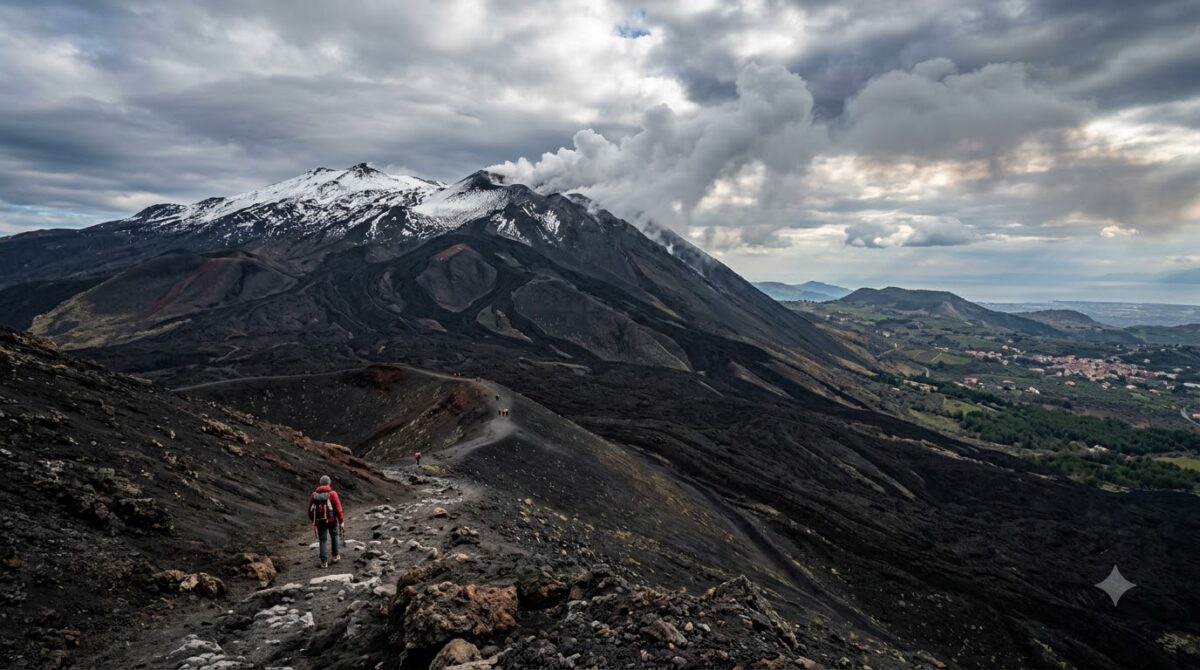
Etna is 3,300 meters and active. A half-day trip takes you to the Rifugio Sapienza at around 1,900 meters, then a cable car and a 4×4 higher. Book a guide if you want the summit craters; the upper section is not open to unaccompanied walkers.
Day 3: Taormina
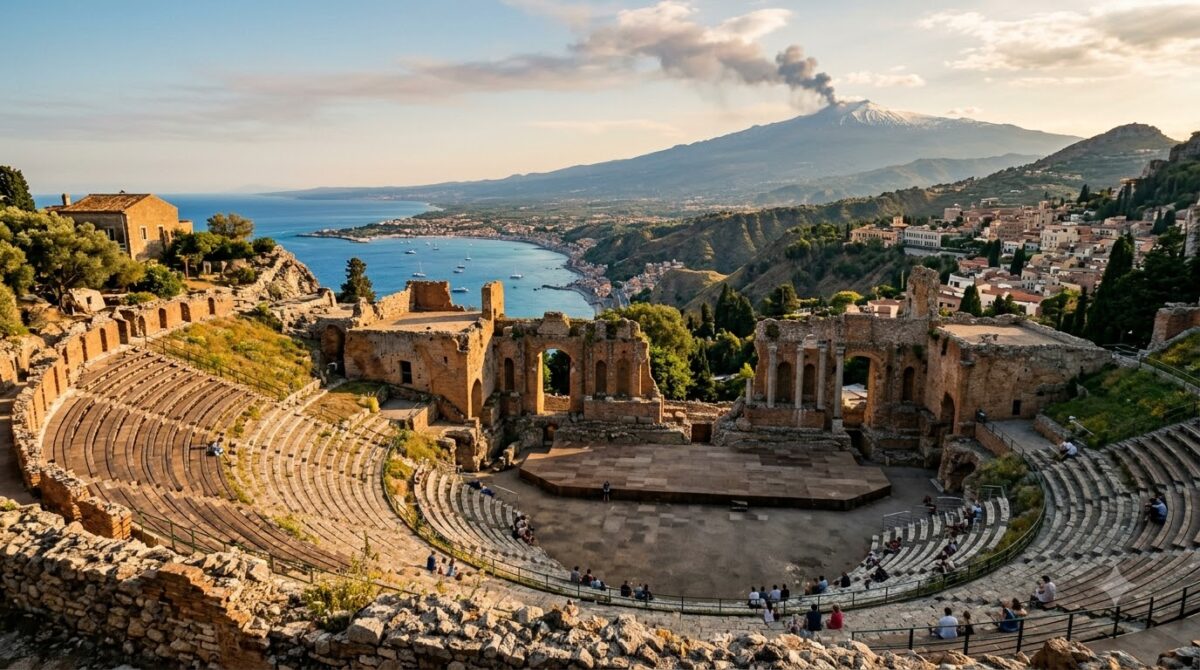
Taormina sits on a terrace 200 meters above the sea, and the ancient theater of Taormina looks straight at Etna. Built by the Greeks and rebuilt by the Romans, it is the second largest surviving theater of ancient Greece in Sicily, and the best place on the island to see Mount Etna framed by anything. Taormina has been the most touristed town in Sicily since The White Lotus filmed at the Grand Hotel Timeo, and it is still worth a day.
Go early or stay overnight, because the day trippers arrive by eleven. Isola Bella, the tiny island below, is reached by cable car.
Days 4 and 5: Syracuse and Ortigia
Syracuse, Sicily was once the most powerful city in the Greek world — Athens sent a fleet against it and lost it. Its old town of Ortigia, Siracusa in Italian, sits on an island joined to the mainland by two bridges, and it is the single most pleasant place to stay in eastern Sicily.
- The Neapolis archaeological park with the Greek theater and the Ear of Dionysius.
- Ortigia’s duomo, a Greek temple converted into a cathedral with the columns still visible in the walls.
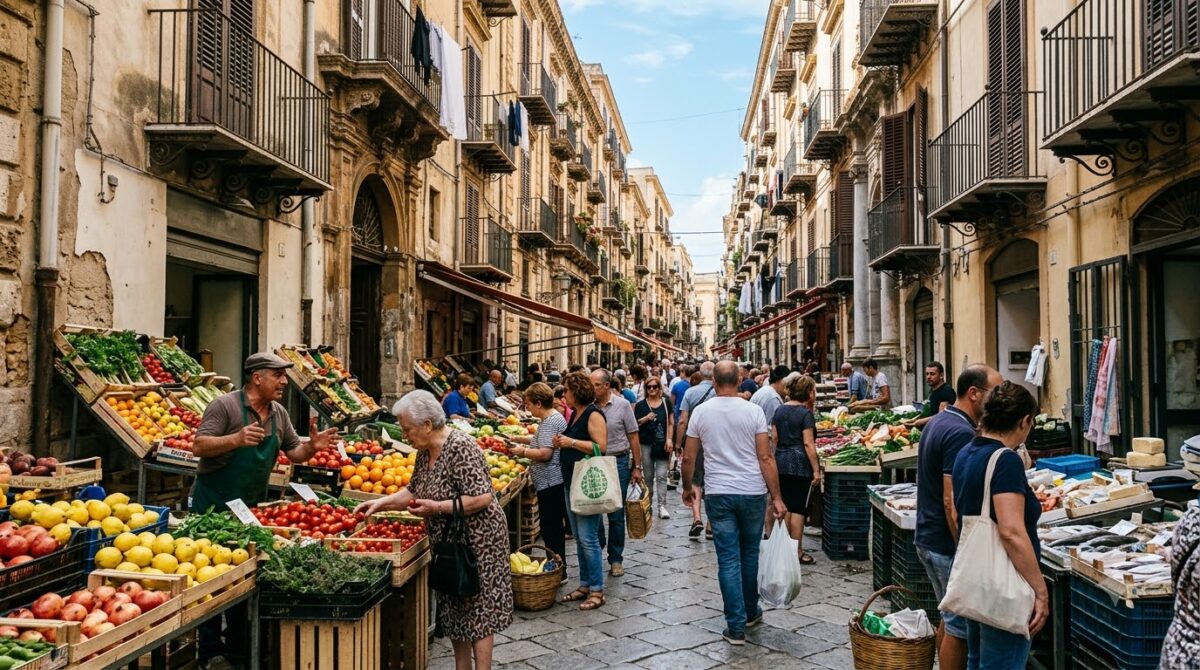
- The Ortigia market in the morning, which is small and excellent.
Day 6: the Val di Noto baroque towns
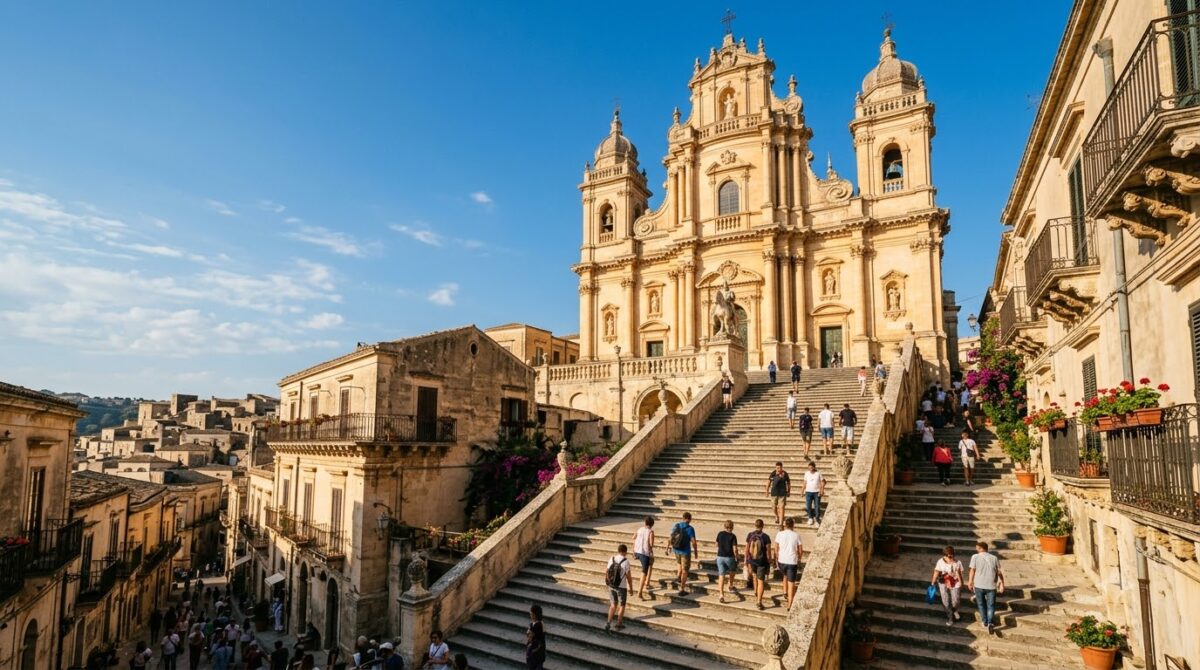
An earthquake flattened southeast Sicily in 1693 and eight towns were rebuilt at once in a single baroque style. The result is a UNESCO heritage site spread across the countryside.
- Noto — the showpiece, a honey-colored main street of churches and palaces.
- Modica — built down a gorge, and famous for its cold-worked chocolate.
- Ragusa, Sicily — specifically Ragusa Ibla, the older lower town, and the prettiest of the three.
All three fit into one long day with a rental car. Without one, pick two.
Day 7: beach or Agrigento
Either a slow last day on the coast, or the drive west to Agrigento and the Valley of the Temples, which holds the best preserved Greek ruins outside Greece. Agrigento is around two and a half hours from Syracuse, so it is a long day rather than a detour.
Around Sicily the other way: a Palermo and west Sicily trip
The alternative week, flying into Palermo. Fewer visitors, better food, longer drives.
- Days 1–3 — Palermo. The street markets at Ballaro and Capo, the Arab-Norman cathedral at Monreale just outside the city, the Capuchin catacombs, and the best street food in Italy. Palermo’s markets are the reason a lot of people rate the west over the east.
- Day 4 — Cefalu. A small coastal town with a Norman cathedral and a proper beach, an hour east of Palermo by train.
- Day 5 — Trapani and Erice. Salt flats, a cable car up to a medieval town on a mountain, and the ferry point for the Egadi islands.
- Day 6 — San Vito Lo Capo or the Zingaro nature reserve, for the best beaches on the island.
- Day 7 — Agrigento and the Valley of the Temples on the way back, or Segesta’s Greek temple standing alone in a valley.
10 day itinerary: around the island, both halves
Ten days is the minimum to see Sicily properly rather than choosing a side, and the sensible shape is a one-way loop.
- Fly into Catania, out of Palermo, or the reverse. An open-jaw ticket saves a four hour drive back.
- Days 1–5 — the eastern itinerary above, compressed slightly.
- Day 6 — Agrigento and the Valley of the Temples, roughly the midpoint.
- Days 7–10 — Palermo, Cefalu and the west.
Two weeks adds the Aeolian islands off the north coast, including Stromboli, whose volcano erupts every twenty minutes or so and is watched from boats after dark. They need their own ferries and their own time, and they are the best thing in Sicily that most itineraries skip.
Sicily travel tips: rent a car, or take the train?
This is the one piece of advice that changes a Sicily road trip most.
- Trains connect the coastal cities — Palermo, Cefalu, Messina, Catania and Syracuse — and are slow but perfectly usable.
- Everything inland needs a car. The Val di Noto, Segesta, the Zingaro reserve and most beaches are not reachable otherwise.
- Historic centers are ZTLs with camera enforcement, like the rest of Italy. Park outside the walls.
- Driving is assertive rather than dangerous. Lane markings are treated as advisory in cities and everything calms down on the open road.
- Take the extra car rental insurance. Scrapes are common in narrow towns and basic cover usually has a large excess.
When to go
- April to June and September to October are the best months. Warm, and the archaeological sites are bearable.
- July and August regularly pass 38 degrees inland, and the Valley of the Temples has no shade at all. Coastal towns are full.
- November to March is mild, green and very quiet. Sites stay open, ferries to the islands reduce, and it is the cheapest time by a wide margin.
Sicily has a longer season than most of Italy. May and October here are warmer than June and September further north.
Best places to visit in Sicily
If you are building your own route rather than following one, these are the places that earn their spot. Sicily is one of the few regions in Europe where Greek, Roman, Byzantine and Arab-Norman layers all survive within a few hours of each other.
Palermo and Monreale
Palermo Cathedral is a single building with Norman, Gothic, Baroque and neoclassical sections stacked on top of one another, and the Cappella Palatina inside the Norman palace has Byzantine Empire mosaic work that is the best in Italy outside Ravenna. Monreale, twenty minutes uphill, has more mosaic still. Both sit inside the UNESCO World Heritage Site listing for Arab-Norman Palermo.
Agrigento and the Greek temples
The Valle dei Templi at Agrigento holds the best preserved ancient Greek temple row anywhere outside Greece, spread along a ridge above the Mediterranean Sea. Go early or late; there is no shade and no relief in summer. If you see the temples at one site in Sicily, see them here.
Villa Romana del Casale at Piazza Armerina
An Ancient Rome hunting villa in the middle of the island, buried by a landslide and dug out with 3,500 square meters of Roman Empire floor mosaic intact. It is a World Heritage Site and the single most surprising thing on the island, which is why it turns up on so many road trip itinerary plans as the inland stop between the two coasts.
Cefalu
A small seaside resort an hour east of Palermo with a Norman cathedral, a good beach, and a rock, La Rocca, that you can climb in about forty minutes for the view. It is the easiest day trip from Palermo and the one place on the north coast worth a visit in its own right.
Ragusa, Modica and Noto
The three baroque towns of the Val di Noto, all World Heritage listed. Ragusa Ibla is built across a ravine, Modica is famous for cold-worked chocolate, and Noto has the finest main street of the three. A rental car makes the difference here; without one, pick two and take the bus.
Trapani, Erice and San Vito Lo Capo
The far west. Trapani has salt flats and windmills, Erice sits on a mountain above it reached by cable car, and San Vito Lo Capo has the best sand beach in Sicily. This corner is the reason a Sicily trip that only covers the east feels incomplete on a second visit.
Scala dei Turchi and the south coast
A white limestone cliff stepped down into the sea near Agrigento, and the closest thing Sicily has to a hidden gem that is no longer hidden. Access has been restricted at times to protect the rock, so check the current position before driving out. The coast of Sicily on this side is quieter than either the east or the north.
Day trips from Catania and Palermo
If you would rather have one base than move every two nights, both airports work as hubs.
- Day trips from Catania — Etna and the Alcantara gorge, Taormina, Syracuse and Ortygia, and the Val di Noto. All under two hours. Catania and Taormina are forty minutes apart by train.
- From Palermo — Monreale, Cefalu, Segesta, Erice and Trapani. Cefalu and Trapani are both reachable by taking the train.
- The compromise — 4 nights in the east and three in the west, which covers far more than a single base without the constant packing.
Where to stay in Sicily
Choosing bases matters more than choosing hotels here, because the driving is what wears people down.
- Ortygia, Syracuse — the most pleasant base in the east. Walkable, full of restaurants, and central for the baroque towns.
- Taormina — a cliff-top resort with the best views and the highest prices. The Villa Comunale di Taormina gardens and the ancient theater of Taormina are both a short walk from the main street of Taormina.
- Catania — cheapest, best transport links, least charming.
- 3 nights in Palermo — enough for the city, Monreale and one day trip, and the food alone justifies it.
- Agriturismo and B&B stays inland — a villa or farm stay between the coasts is a good idea on a longer trip, and usually far cheaper than anything on the water.
Palermo or Catania as your arrival airport is the first booking decision, and it should follow the half of the island you picked rather than the fare.
Map shows live availability and prices. We may earn a commission on bookings made through it, at no extra cost to you.
Sicilian food, wine and the best meals
Sicilian cuisine is genuinely distinct from mainland Italian cooking, because the Arab and Greek layers left more than buildings behind. Ask any local for a restaurant and you will get an answer before you finish the question.
- Arancini — fried rice balls, the standard quick lunch, and called arancine in Palermo.
- Granita with brioche for breakfast, particularly almond, pistachio or coffee. A Sicilian institution, not a dessert.
- Pasta alla Norma in Catania, pasta con le sarde in Palermo, and couscous di pesce in Trapani, which is Arab in origin.
- Cannoli, filled to order rather than in advance, and ricotta rather than cream.
- Street food in Palermo — panelle, sfincione and the offal sandwiches you either try or do not. A food tour here is one of the few guided things genuinely worth booking.
- Wine — Nero d’Avola and Frappato reds, Grillo and Catarratto whites, and Etna Rosso from the volcanic slopes, which has become the island’s prestige wine.
- Olive oil and olives from the interior, sold everywhere and worth carrying home.
The best meals on the island are rarely the expensive ones. Dinner starts late, around half past eight, and outside the resorts it is normal to find no English language menu at all. Prices are quoted in euro and cash is still useful in the smaller towns.
Sicily or the Amalfi Coast?
This comes up constantly when people plan your trip around one week in southern Italy, and the two are not really comparable.
- The Amalfi Coast is small, intensely scenic and expensive, and you can see it properly in three or four days. It suits a short trip or a honeymoon.
- Sicily is a region rather than a stretch of coastline. It has the ruins, the volcano, the food and the cities, and it needs a week minimum.
- Cost — Sicily is significantly cheaper for the same standard, outside Taormina.
- Combining them works: Naples, the Amalfi Coast, then a flight or the overnight ferry down to Palermo or Catania.
Sicily has also started pushing back on visitor numbers in the busiest spots, with Taormina limiting coach access and beach capacity in high summer. That is a reason to travel in May, June or September rather than a reason to skip the island.
Is Sicily safe?
Yes, and the reputation is decades out of date. Sicilians are among the most welcoming people in Italy, and the practical risks are ordinary ones.
- Pickpocketing in the Palermo and Catania markets and stations, as in any Italian city.
- Do not leave anything visible in a rental car, anywhere on the island. This is the one warning worth taking seriously.
- Driving is assertive rather than dangerous, and calms down outside the cities.
- Hiking on Etna above the cable car needs a guide, and conditions change fast on an active volcano. Take a guided tour rather than improvising.
- The Sicilian language is a separate language rather than a dialect of Italian, and you will hear it. Standard Italian is understood everywhere.
Basing yourself on the east coast? See where to stay in Taormina for the town centre, Mazzaro and Giardini Naxos compared.
Also in the south: our Puglia itinerary, which pairs naturally with Sicily on a longer trip.
Frequently asked questions
How many days do you need in Sicily?
Seven days covers one half of the island properly, either east or west. Ten days lets you do both with a one-way loop between Catania and Palermo. Fewer than seven means picking a single base and accepting day trips, because Palermo to Syracuse alone is three and a half hours of driving.
Should I visit east or west Sicily?
East for a first trip. Catania, Etna, Taormina, Syracuse and the Val di Noto baroque towns are close together and cover most of what people come to Sicily for. The west, around Palermo, Trapani and Cefalu, has better food and fewer visitors but longer drives between sights.
Do you need a car in Sicily?
Yes for most itineraries. Trains link the coastal cities well enough, but the Val di Noto towns, Segesta, the Zingaro reserve and nearly all the beaches need a car. Historic centers are camera-enforced limited traffic zones, so park outside the walls and walk in.
Is one week in Sicily enough?
Enough for half the island. A week in Sicily works well as Catania, Etna, Taormina, Syracuse and the baroque towns, or as Palermo, Cefalu, Trapani and Agrigento. Trying to cover both halves in seven days means three or four hours of driving on several days.
What is the best time to visit Sicily?
April to June and September to October. July and August regularly pass 38 degrees inland, and sites like the Valley of the Temples have no shade. Winter is mild, green and very cheap, with most sites open and reduced ferries to the smaller islands.
Is Taormina worth visiting?
Yes, for a day or an overnight. The Greek theater looks directly at Mount Etna, which is the single best view in Sicily. It has become the most touristed town on the island since White Lotus filmed there, so arrive before eleven or stay the night and see it in the evening.
Can you climb Mount Etna?
Partly, and the upper section requires a guide. You can drive to the Rifugio Sapienza at around 1,900 meters, take a cable car higher, then a 4×4 with a guide toward the summit craters. The lower slopes and older craters are walkable unaccompanied, and conditions change quickly on an active volcano.