Quick answer where to stay on this route
Seven days is the sensible minimum: Lucerne, the Jungfrau region and Zermatt. In the Jungfrau, Lauterbrunnen for access or Wengen for the terrace view and no cars.
On this page
- How many days in Switzerland? The day itinerary at a glance
- The 7 day Switzerland itinerary
- The 10 day Switzerland itinerary
- The Swiss Travel Pass: does the rail pass pay?
- Switzerland travel: public transportation, and why not to drive
- Day trip ideas and stunning views without a summit ticket
- Swiss food, and what a day actually costs
- When to go, and what it costs
- Where to stay in Switzerland
- Frequently asked questions
Most European road trips reward a rental car. Switzerland is the exception, and the reason is not traffic or parking. It is that several of the places you are going cannot be reached by car at all.
Some links below are affiliate links. We may earn a commission if you book through them, at no extra cost to you. We do not rank hotels, and any prices on the map come live from the booking sites.
Zermatt, Wengen, Mürren and Gimmelwald are car-free by law. You leave the vehicle in a valley car park and continue by train or cable car, so a car you have paid for sits idle for the best days of the trip.
Meanwhile the Swiss Travel Pass folds trains, buses, boats and most cable cars onto one ticket, along with free entry to a long list of museums. Swiss Federal Railways run to the minute, and the SBB Mobile app tells you which platform before you have left the last one.
So a Switzerland itinerary should be built around the railway, not around driving distance. This one is, as a 7 day route with a 10 day extension. Travel on trains here is the point rather than the gap between the points. Rail connections, pass coverage and cable car access checked 8 September 2026.
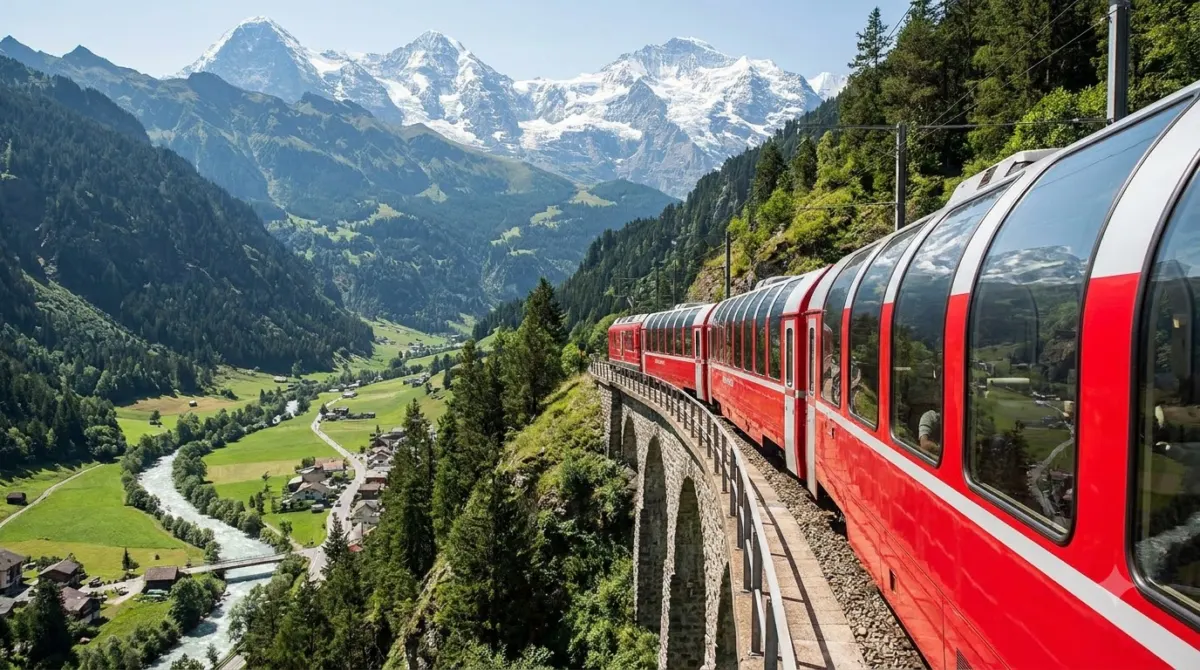
How many days in Switzerland? The day itinerary at a glance
| Length | Covers |
|---|---|
| 4 day | The Jungfrau region only, from Interlaken |
| 7 day | Lucerne, the Jungfrau region and Zermatt |
| 10 day | Adds Lake Geneva and a scenic train |
| 2 weeks | Adds Ticino, the Engadine or Appenzell |
Seven days in Switzerland is the sensible minimum for anyone visiting Switzerland for the first time. Four days works only if you stay in one region and do not try to move.
Where to sleep on this route
The 7 day Switzerland itinerary
Day 1: arrive in Zurich
Zurich Airport has its own train station, and you can be in the old town in ten minutes or in Lucerne in about an hour without leaving the railway.
- The Niederdorf old town on the east bank of the Limmat, a knot of lanes and small shops.
- A walk along the Limmat to Lake Zurich, and the promenade at Bürkliplatz.
- Lindenhof, the terrace above the river, for a panoramic view over the roofs.
Zurich is worth one day, not three. It is the country’s financial capital rather than its scenic one.
Day 2: Lucerne and Mount Pilatus
An hour from Zurich by train. Lucerne is the prettiest of the Swiss cities and the gateway to the central lakes.
- The Chapel Bridge, the Kapellbrücke — a covered wooden footbridge of 1333 with painted panels in the roof, and the water tower beside it.
- The old town, with frescoed facades on the squares behind it.
- Mount Pilatus by the golden round trip: boat across the lake, the world’s steepest cogwheel railway up, and a cable car and gondola down. Most of it is covered by the pass.
- A boat on Lake Lucerne if you would rather stay at water level, with panoramic views of lakes and cliffs from the deck.
Day 3: Interlaken and the Lauterbrunnen valley waterfalls
Take the train south to Interlaken and change for the Lauterbrunnen valley — a U-shaped trench with vertical walls and seventy-two waterfalls, including the Staubbach falls dropping 300 metres beside the village.
- Base here rather than in Interlaken. A day in Interlaken is enough — it is the transport hub between Lake Thun and Lake Brienz, and the Lauterbrunnen valley is where the scenery is.
- Trümmelbach Falls, a glacier river running through a cave inside the mountain, reached by a lift built into the rock. It is the most impressive waterfall in the valley and the only one you go inside.
- Stechelberg at the end of the valley is where the cable car up to Gimmelwald and Mürren starts.
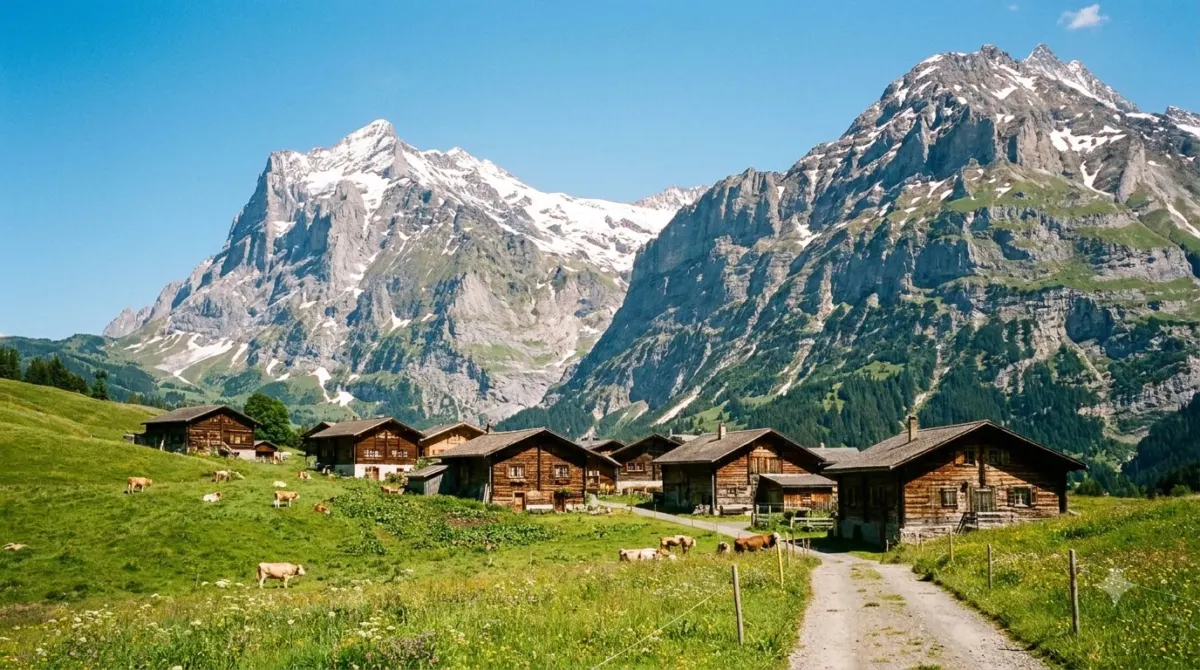
Day 4: Mürren, Gimmelwald and the Schilthorn
Day 4 is the one people remember. Take the cable car from Stechelberg up to Gimmelwald, a hamlet of barns and chalets with no road in, then on to Mürren on its terrace above the valley.
- Both villages are car-free and reachable only by cable car or the funicular from Lauterbrunnen.
- The Schilthorn above them has a revolving restaurant and stunning views across to the Eiger, Mönch and Jungfrau — the most picturesque skyline in the Swiss Alps.
- The North Face trail from Mürren is an easy walk with the whole wall in front of you.
Day 5: Grindelwald, the glacier and the Top of Europe
- Grindelwald, on the other side of the ridge, reached by train through Zweilütschinen.
- The Jungfraujoch, the Top of Europe — the highest railway station in Europe at 3,454 metres, with an ice palace and a glacier plateau. It is expensive and only partly covered by the pass, and it is worth it on a clear day and pointless in cloud. Check the summit webcam before buying.
- Männlichen and the Royal Walk as the cheaper alternative, with arguably the better view of the three peaks.
- First Cliff Walk above Grindelwald if you would rather have the adventure version.
Day 6: the train to Zermatt
Roughly three hours by train via Spiez and Visp, and the ride itself is part of the trip.
Zermatt is car-free. Vehicles stop at Täsch and everyone transfers to a shuttle train for the last five kilometres, which is why the village is quiet and full of electric carts.
Day 7: the Matterhorn from Gornergrat and the 5 lakes hike
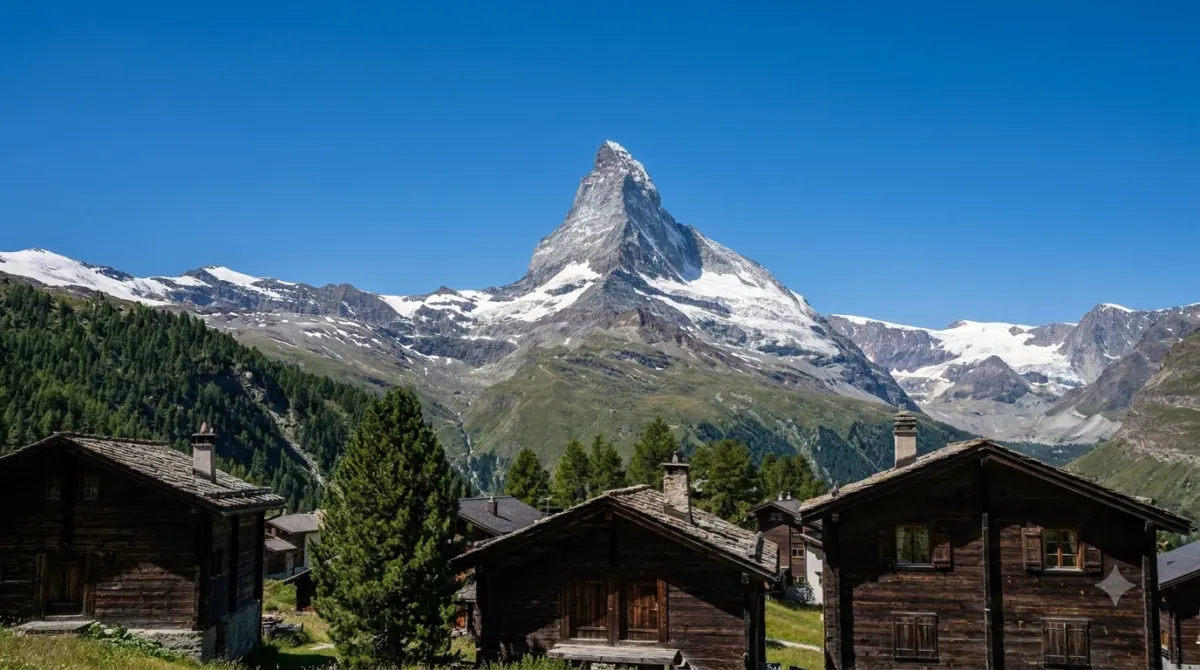
- Gornergrat by cogwheel railway for the classic view of the Matterhorn across the glacier, and views of the Alps in every direction from the summit terrace.
- The Matterhorn Glacier Paradise cable car, the highest in Europe, if the weather is clear.
- The Five Lakes Walk — the 5 lakes trail from Blauherd, where the peak reflects in several of them. Two and a half hours and mostly downhill.
The 10 day Switzerland itinerary
Three or four extra days, and they should go west and south rather than to more mountains.
Day 8: Montreux and Lake Geneva
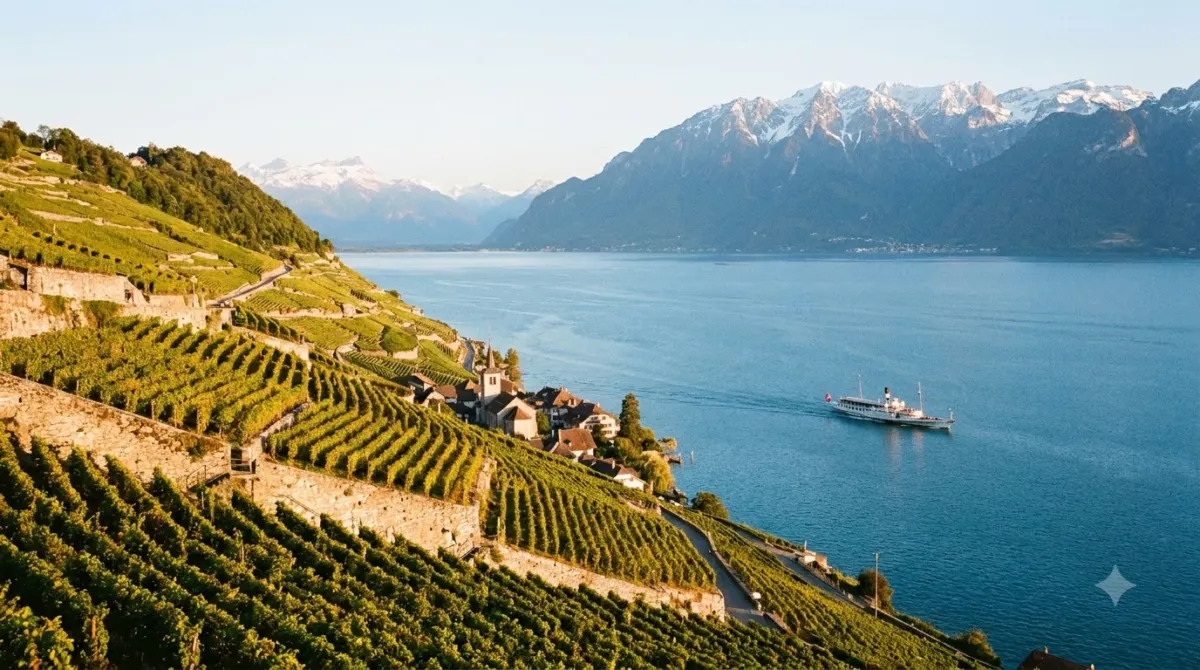
The Lavaux vineyard terraces above Lake Geneva are UNESCO listed, and the Chateau de Chillon sits on a rock in the water below them. This is the warmest corner of Switzerland and the views of lake and mountain together are the best in the country outside the Alps. Lausanne, twenty minutes away, has the Olympic Museum.
Day 9: a scenic train ride — Glacier Express, Bernina Express or GoldenPass
Pick one panoramic express train and give it the day.
- The GoldenPass or Golden Pass line from Montreux to Interlaken via Gstaad, three hours through meadow country.
- The Glacier Express from Zermatt to St Moritz, eight hours and the most famous scenic train in Switzerland.
- The Bernina Express from Chur over the pass into Italy, the highest rail crossing in the Alps.
- Reservations are required on all three even with a rail pass.
Day 10: Bern’s old town, or Thun Castle
Bern’s arcaded old town is a UNESCO site and almost nobody stops there. Thun has Thun Castle above a turquoise river at the end of Lake Thun, and it is the quietest good town in the country.
Day 11: Geneva, or back to Zurich
Fly out of Geneva if you finished on Lake Geneva, or take the train back across for a last night by Lake Zurich. Two hours either way, and both airports sit on the rail network.
On two weeks, add Ticino for the Italian-speaking south, the Engadine and the Bernina Express, or Appenzell for the rolling green version of the country.
The Swiss Travel Pass: does the rail pass pay?
This is the single biggest decision in planning a trip to Switzerland, and the answer depends on how much you move.
- What it covers: all SBB trains, buses and boats, city transport in around 90 towns, most museums, and a 50 percent discount on most mountain railways and cable cars.
- What it does not cover in full: the Jungfraujoch, the Schilthorn and several other summit rides — you get a discount, not free travel.
- It pays if you move most days, and it is sold in blocks of consecutive days rather than flexible ones. On the itinerary above it pays.
- It does not pay if you base in one valley and walk. A regional pass such as the Jungfrau Travel Pass is better then.
- Half Fare Card is the alternative — half price on almost everything for a fixed fee, and better for slower trips.
- Reservations are not needed on normal trains, only on the panoramic scenic trains.
Switzerland travel: public transportation, and why not to drive
- Trains run every 30 minutes on most lines, and connections are timed to work. A four-minute change is normal and reliable. Where there is no train you take the bus, and it meets the train.
- Luggage can be sent ahead between stations, which is worth knowing if you are moving hotels with heavy bags.
- Zermatt, Wengen, Mürren, Gimmelwald, Saas-Fee and Braunwald are car-free. A rental car cannot reach them.
- A car costs more than it saves once you add the motorway vignette, parking, and the car parks at Täsch or Lauterbrunnen.
- Rent one only for Appenzell, the Jura, or remote valleys off the rail network.
- English is widely spoken everywhere in tourism, alongside German, French and Italian depending on the region.
Day trip ideas and stunning views without a summit ticket
The expensive part of visiting Switzerland is the mountain excursions, and several of the best panoramic views of lakes and peaks cost very little.
- Harder Kulm above Interlaken — a funicular to a viewing platform with Lake Thun and Lake Brienz on either side and the Jungfrau in front. Harderkulm is the cheapest big view in the country.
- Männlichen from Wengen, then the Royal Walk to Kleine Scheidegg — views of the mountains from the same angle as the Jungfraujoch at a fraction of the price.
- The 5 lakes hike at Zermatt from Blauherd, with the Matterhorn reflected in several of them.
- The boat on Lake Lucerne or Lake Thun, both free with the pass, and among the best value hours in Switzerland.
- The Aletsch glacier from Bettmeralp by aerial lift, for the largest glacier in the Alps without the Jungfraujoch crowds.
- Golden hour photography anywhere in the Lauterbrunnen valley costs nothing at all, and the light on the walls at dusk is the reason people stay a second night.
Ice sculptures and ice palaces at the Jungfraujoch and the Matterhorn Glacier Paradise are the standard indoor consolation on a cloudy day, and they are not worth the ticket on their own.
Swiss food, and what a day actually costs
- Fondue and raclette are winter dishes eaten year-round in tourist towns. A traditional Swiss fondue is shared and filling and is the one restaurant meal worth the money.
- Rösti, the potato cake, is the everyday dish, and lake fish is the regional speciality on Geneva and Lucerne.
- Supermarket lunch from Coop or Migros is what most travellers do, and station branches open late.
- Half-board mountain hotels are usually cheaper than eating out twice.
- Tap water is excellent and public fountains everywhere are drinkable, which sounds trivial and saves a surprising amount.
When to go, and what it costs
- June to September for hiking, with the meadows at their best in June and the weather most settled in September.
- Late December to March for skiing, at the highest prices of the year. Switzerland borders Italy and France, so combining is easy in either direction.
- The cheapest months are November and early December, plus late April and May, when many mountain lifts close between seasons. Check before booking.
- Switzerland is expensive — the most expensive country in Europe for food and rooms. Supermarket picnics and half-board hotels are the standard defences.
- Weather changes the whole trip. Summit tickets are the biggest single cost and are wasted in cloud, so keep them flexible and watch the webcams.
Where to stay in Switzerland
Two maps for the bases this route uses most. They show live availability, so you can see what is free on your dates and where it actually sits.
Map shows live availability. We may earn a commission on bookings made through it, at no extra cost to you.
Map shows live availability. We may earn a commission on bookings made through it, at no extra cost to you.
See what is available in Zermatt →
See what is available in Zurich →
- Lauterbrunnen or Wengen for the Jungfrau region — Lauterbrunnen for access, Wengen for the terrace view and no cars.
- Interlaken only if you want hotel and Airbnb choice and some nightlife; the scenery is up the valley.
- Zermatt for the Matterhorn, and there is no alternative base.
- Lucerne for the central lakes, in the old town near the Chapel Bridge.
- Zurich for one night at either end of the trip, near the Hauptbahnhof.
- Book early for July and August, and note that many mountain hotels close entirely in the shoulder weeks.
Comparing Alpine trips? Our 10 day Italy itinerary and the south of France itinerary both border Switzerland, and both reach the opposite conclusion about renting a car.
Starting or finishing in the city? See where to stay in Zurich — the trams make location a question of price rather than convenience.
Basing yourself for the mountains? See where to stay in Lucerne — distance from the station decides more there than the neighbourhood does.
Not sure which bases to build the route around? See where to stay in Switzerland, sorted by what each base can actually reach by train.
Check hotels across Switzerland →
Frequently asked questions
How many days are enough to visit Switzerland?
Seven days covers Lucerne, the Jungfrau region and Zermatt with no rushed transfers. Ten adds Lake Geneva and a scenic train such as the GoldenPass or Glacier Express. Four days works only if you stay in one region, most sensibly the Lauterbrunnen valley, and do not try to move.
What are the best ways to get around Switzerland?
The train, without qualification. Swiss Federal Railways run every 30 minutes on most lines and connections are timed to work. A car is worse than useless for the main sights, because Zermatt, Wengen, Mürren and Gimmelwald are car-free by law and can only be reached by train or cable car.
Is the Swiss Travel Pass worth it?
It pays if you move most days, which the standard seven and ten day itineraries do. It covers all trains, buses and boats, city transport in about 90 towns and most museums, plus 50 percent off most cable cars. It does not fully cover the Jungfraujoch or the Schilthorn. If you are basing in one valley, a regional pass or the Half Fare Card is cheaper.
What is the best month to travel to Switzerland?
June to September for hiking and the mountain railways, with June best for alpine meadows and September for settled weather. Ski season runs late December to March at peak prices. Avoid the shoulder weeks in late April, May and November, when many cable cars and mountain hotels close between seasons.
What are the prettiest places to visit in Switzerland?
The Lauterbrunnen valley and the villages above it — Wengen, Mürren and Gimmelwald — are the scenic heart of the country. Zermatt for the Matterhorn, Lucerne for the old town and the Chapel Bridge, and the Lavaux vineyard terraces above Lake Geneva. Bern’s arcaded old town is the most underrated city.
How much does a trip to Switzerland cost?
Switzerland is the most expensive country in Europe for food and accommodation. The largest single variable after hotels is mountain excursions: the Jungfraujoch alone costs more than most day trips anywhere else. Supermarket lunches, half-board mountain hotels and choosing one summit ride rather than three are the standard ways to keep it manageable.
Do people speak English in Switzerland?
Yes, very widely, especially in tourism and on the railways. The national languages are German, French, Italian and Romansh depending on the region, and station announcements and signage are usually multilingual. You will not need to learn any of them for a standard trip.
Keep planning Switzerland
Written and checked by
Triplarks Editorial
An editorial desk, not an invented persona: research, drafting and fact-checking are done by the same small team. Every number here carries the date it was read.