Quick answer where to stay in Tuscany
Florence for the first half, in the historic centre or just across the river. Then an agriturismo in the countryside, or Montepulciano or Pienza for the Val d’Orcia. Siena if you want one base and are willing to drive out each day.
On this page
- The ultimate Tuscany itinerary: a 7 day road trip in Tuscany at a glance
- Days 1 to 3: Florence, without a car
- Day 4: rent a car and drive into the countryside
- Days 4 to 6: southern Tuscany, from Montepulciano and Pienza to Montalcino
- San Gimignano, Volterra and the western hill towns
- Chianti: the countryside you can reach quickly
- How many days in Tuscany: a week in Tuscany, or a 3 day itinerary in Tuscany
- Doing Tuscany without a car
- Where to stay in Tuscany across the region
- Florence and Tuscany inside a longer Italy trip itinerary, with Cinque Terre
- Tuscany travel guide: food, wine and the practical notes
- The beauty of Tuscany is in the drive, not the checklist
- Frequently asked questions
Tuscany is two holidays wearing the same name, and they do not travel the same way.
Some links below are affiliate links. We may earn a commission if you book through them, at no extra cost to you. We do not rank hotels, and any prices on the map come live from the booking sites.
The art is in the cities and the cities are on the railway. Florence, Siena, Pisa, Lucca and Arezzo connect by train, and you can do all of them without ever renting a car. The landscape is not on the railway. The cypress-lined road over gold hills that made you want to come is in the Val d’Orcia, roughly two hours south of Florence, and no train goes there.
The common mistake is booking a one week itinerary in Florence and assuming the countryside is a day trip. It is four hours of driving for three hours of hills. So a travel itinerary for Tuscany is really one decision: where does the car start.
Distances, train connections and town positions checked 9 September 2026. Opening hours and ticket rules change, so verify anything time-critical before you travel.
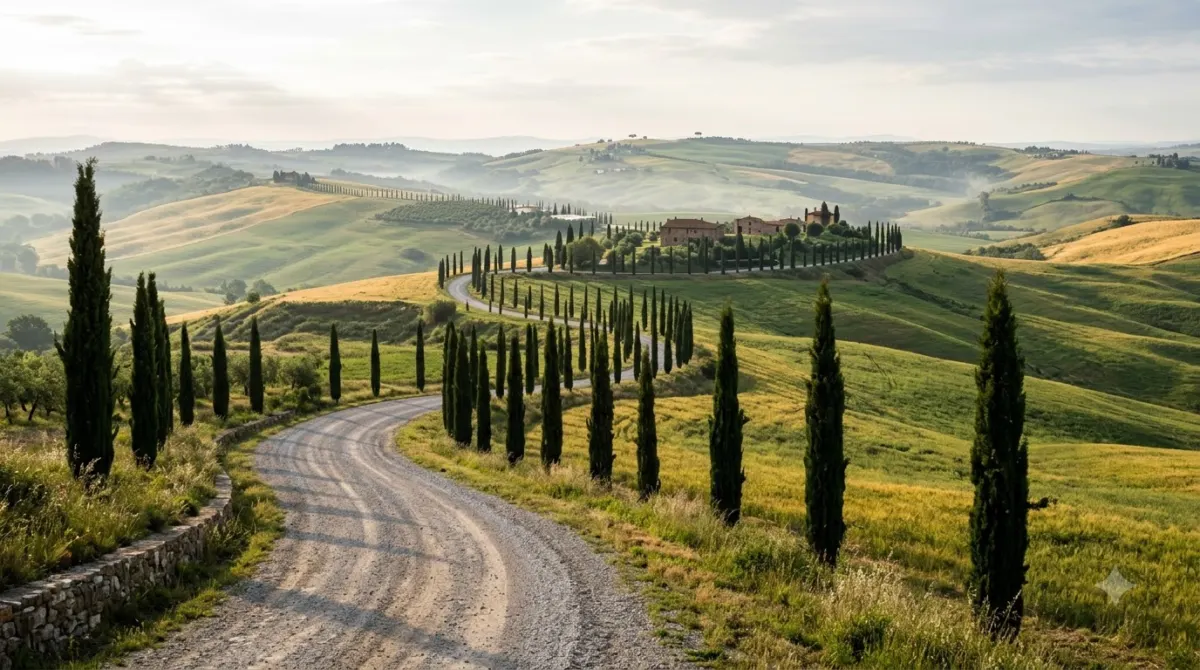
The ultimate Tuscany itinerary: a 7 day road trip in Tuscany at a glance
| Days | Base | Transport |
|---|---|---|
| Days 1–3 | Florence | On foot and by train |
| Day 3 | Siena as a day trip | Bus or train from Florence |
| Day 4 | Pick up the rental car, drive south | Car from here on |
| Days 4–6 | Val d’Orcia or Chianti | Car |
| Day 7 | Back to Florence, or on to Pisa | Car, then train |
Three days in Florence, then 3 nights in the countryside, with the car collected on the morning of day four. That is the shape that works, and it avoids paying for a car to sit in a Florence garage while you look at paintings. Everything up to day 7 assumes that split.
Where to sleep on this route
Days 1 to 3: Florence, without a car
Florence is small, walkable and closed to traffic in the historical centre. A car here is a liability, not an asset.
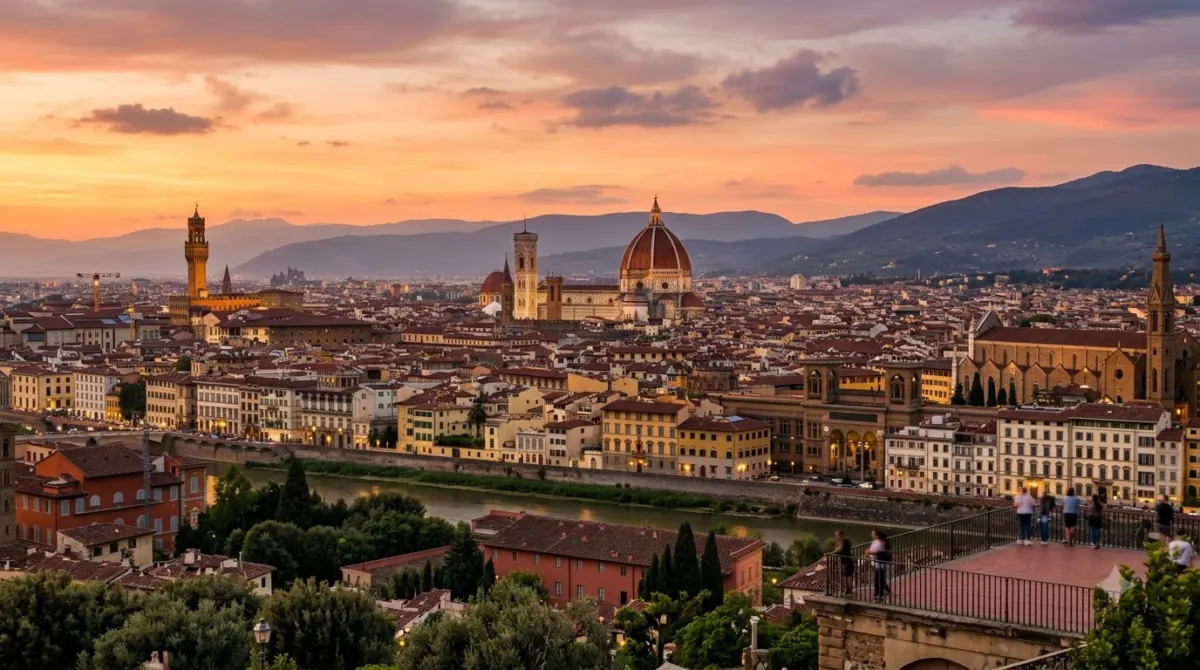
- The Duomo complex — Florence Cathedral, the dome, the baptistery and the campanile are one ticket, and the dome climb needs booking well ahead.
- The Uffizi for the Renaissance paintings, and the Accademia for one statue that is worth the queue.
- Piazza della Repubblica and Piazza della Signoria are the two squares the city organises itself around, and Santa Maria Novella is the church and the station at the western end.
- Piazzale Michelangelo at sunset, up the hill on the south bank, for the view over the rooftops. Walk up, get the bus down.
- Eat in a trattoria across the river in Oltrarno, where the prices stop being aimed at visitors, and skip any ristorante with a menu in six languages.
Give Florence three days. Two works if you book everything in advance; one is a museum queue with a city attached.
Day 3: Siena as a day trip from Florence
- The bus is better than the train for Florence to Siena, because Siena’s station sits below the town and the bus drops you near the middle.
- The Piazza del Campo is the reason to come: a shell-shaped brick square that slopes, where the Palio horse race runs twice each summer.
- Siena Cathedral has a striped marble front and an inlaid floor that is uncovered only part of the year.
- It is about an hour and a quarter each way, which makes it the one genuinely comfortable day trip from Florence.
- Or sleep here instead. Siena after the coaches leave is a quieter, older city than Florence ever gets.
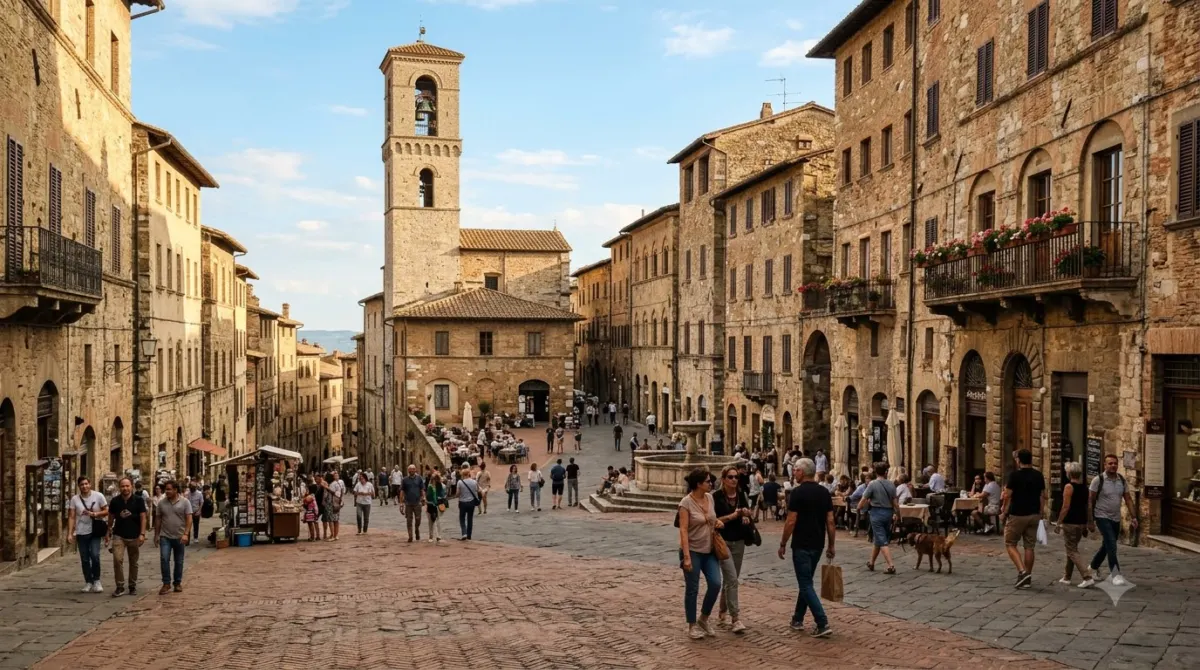
Day 4: rent a car and drive into the countryside
This is the hinge of the trip. Car rental in Florence is easiest from the airport or from an office just outside the restricted zone.
- Do not collect the car before you need it. Florence parking is expensive and the historic centre is a ZTL, monitored by camera, with fines arriving months later.
- Chianti is the short version — the hills between Florence and Siena, forty minutes out, vineyards and stone villages.
- The Val d’Orcia is the real thing — about two hours south, and the landscape that appears on every poster of the region.
- Monteriggioni, a tiny complete walled village on a hill, is the natural stop on the way south.
- Book an agriturismo with parking, and do not book anything inside a hill town’s walls if you are driving.
Days 4 to 6: southern Tuscany, from Montepulciano and Pienza to Montalcino
This is the part of Tuscany people picture, and it is the part that needs the car.
- Pienza is a small Renaissance town rebuilt by Pope Pius II as an experiment in ideal town planning, and it is where the pecorino comes from. Podere il Casale, a farm on the ridge outside it, is the landmark for the cheese.
- Montepulciano is a steep hilltop town of brick and stone with cellars cut into the rock beneath it, home of Vino Nobile di Montepulciano and of wine bars like La Vineria di Montepulciano built into the old vaults.
- Montalcino, half an hour west, produces Brunello, the most serious red wine in the region. A winery visit here is a proper wine tasting, not a gift shop.
- Bagno Vignoni has a thermal bath in the middle of its main square instead of a piazza, which is worth the detour on its own, and gives you a sense of the beauty of Tuscany that no gallery does.
- The roads between them are the point. Drive the SP146 between Pienza and Montepulciano in early morning light and you will understand the poster.
Map shows live availability and prices. We may earn a commission on bookings made through it, at no extra cost to you.
San Gimignano, Volterra and the western hill towns
- San Gimignano still has fourteen of its medieval towers, built by competing families, and it is the most striking silhouette in Tuscany.
- Go early or stay the night. It is small and receives a great many day trippers between ten and four.
- Volterra is bigger, quieter and older, an Etruscan town on a ridge with a Roman theatre below the walls, and it is still worked for alabaster and glass.
- Both sit west of the Florence to Siena road and fit into a day if you are driving.
- Monteriggioni and Certaldo are the smaller stops on the same loop.
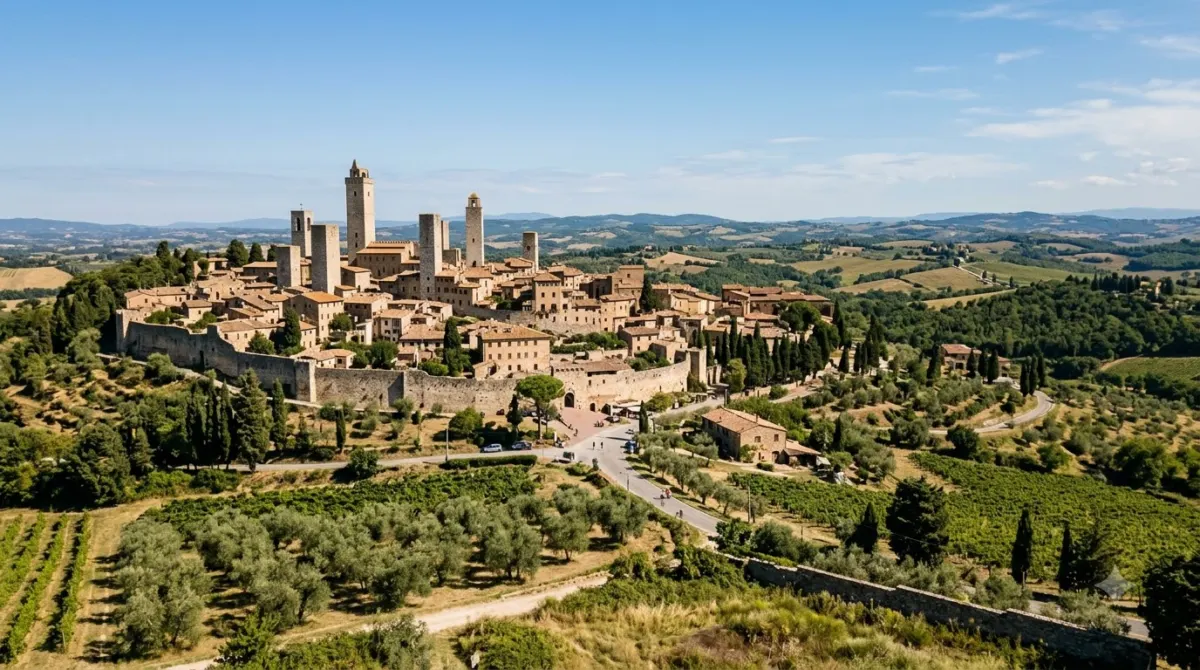
Chianti: the countryside you can reach quickly
- Forty minutes from Florence, which makes Chianti the compromise if you only have a few days in the countryside.
- Greve, Panzano and Radda are the towns, and the SR222 through Greve and Panzano is the road, with Radda a short drive off it.
- Wine here is Sangiovese, and most estates take visitors without much formality.
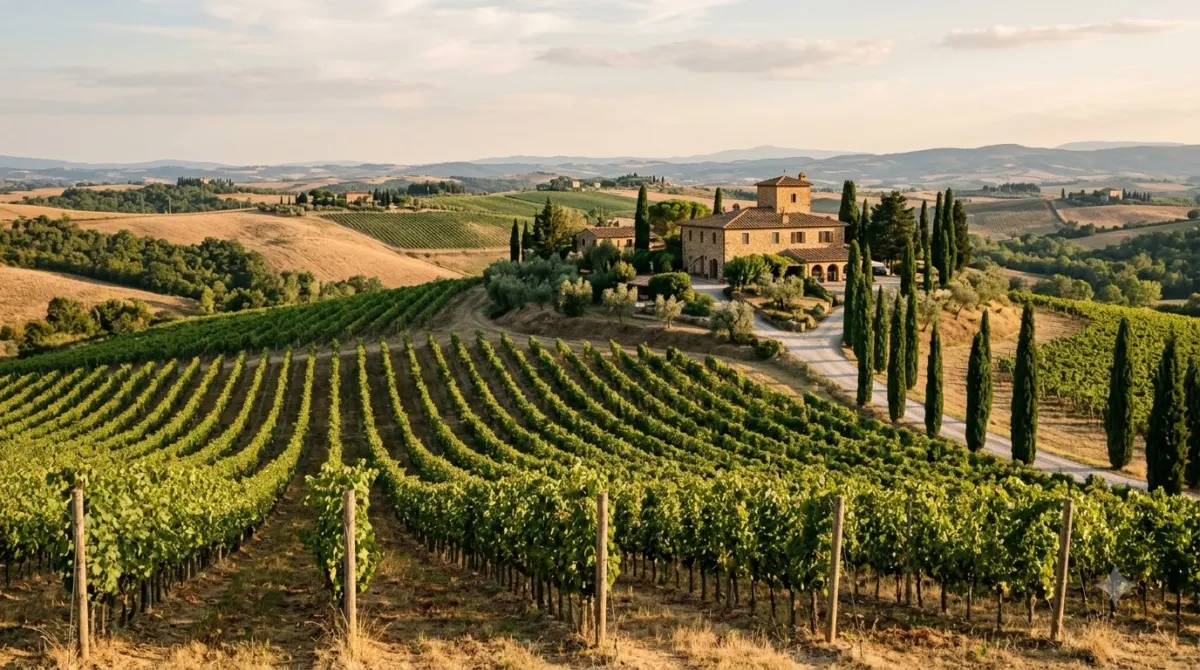
- It is greener and more wooded than the Val d’Orcia, which is open, bare and golden.
- Best for a short trip to Tuscany where you want hills, a pool and a vineyard without a long drive.
How many days in Tuscany: a week in Tuscany, or a 3 day itinerary in Tuscany
- 3 days — a Florence travel plan with Siena added, by train. Do not try the countryside on that much time in Tuscany.
- 5 days — 3 days in Florence, then two nights in Chianti with a car.
- One week in Tuscany — Florence, Siena, and three nights in the Val d’Orcia. The full itinerary above.
- 10 days — adds Lucca, Pisa, Arezzo and Cortona, or several days in the countryside doing nothing at all before heading back in to Florence.
- The first thing to cut is Pisa. The tower takes an hour including the photograph, and it is a fifty-minute train from Florence when you want it.
Do not move base more than twice. Tuscany rewards staying still, and the driving between hill towns is the pleasure rather than the cost.
Doing Tuscany without a car
It is a real option, and it changes the trip into a city trip rather than a countryside one.
- The train from Florence reaches Pisa in about fifty minutes, Lucca in eighty, and Arezzo in an hour.
- Siena is by bus, and it is the better of the two options.
- San Gimignano needs a bus change at Poggibonsi and is doable but slow.
- The Val d’Orcia is effectively unreachable without a car or an organised tour, and a tour is the honest answer if you will not drive.
- Wine bars in Florence pour everything the region makes, which is a fair substitute for a winery if the countryside is out.
Where to stay in Tuscany across the region
- Florence for the first half, inside the historical centre or just across the river.
- An agriturismo — a working farm with rooms — is the characteristic hotel of the Tuscan countryside, usually with a pool and a terrace. Borgo Pignano near Volterra is the large, restored end of the same idea.
- Siena if you want one base for the whole trip and are willing to drive out each day.
- Montepulciano or Pienza for the Val d’Orcia, both with incredible views and stunning views straight off the town walls.
- Check the parking before booking anywhere inside a hill town.
The full breakdown is in our guide on where to stay in Tuscany.
Florence and Tuscany inside a longer Italy trip itinerary, with Cinque Terre
- Rome is ninety minutes from Florence by fast train, which makes the pairing obvious.
- Venice is about two hours north, and Bologna sits between them.
- Cinque Terre is two and a half to three hours from Florence and is the most common add-on to a trip itinerary here, though it is a different kind of holiday.
- Pisa and Florence both have airports, and Pisa is often the cheaper arrival.
- On a first trip to Italy, Rome, Florence and Venice with three nights of Tuscan countryside is the route that works.
See our 10 day Italy itinerary, our Florence hotel guide and our Cinque Terre itinerary for the neighbouring pieces.
Tuscany travel guide: food, wine and the practical notes
A few things that change how you spend your time in Tuscany, none of which fit neatly into a day plan.
- Lunch is the better meal to spend money on. A long lunch at a rural ristorante with a view costs less than the same dinner and comes with the light.
- Buy the picnic instead. Pecorino from Pienza, bread, tomatoes and a bottle of Tuscan wine, eaten on a wall somewhere, is the most Tuscan thing you can do and it is nearly free.
- Winemaking here is small scale. Most estates are family run, tastings are informal, and the person pouring often made the wine.
- The thermal springs are real. Bagno Vignoni and Saturnia are natural thermae, used since the Etruscan civilization and the Romans, and several rural hotels have built a spa around them.
- Frescoes are the local art form. The best are not in the Uffizi but on the walls of churches and chapels in small towns, and they are usually free to look at.
- Every hilltop town closes in the afternoon. Shops shut, and a town that felt alive at noon is asleep at three.
- Day 7 is for slowing down. Leave the last morning empty rather than adding a stop on the way back in to Florence.
The beauty of Tuscany is in the drive, not the checklist
The heart of Tuscany is not a town. It is the twenty minutes between two towns, which is why the region rewards a car and punishes a coach tour.
- The stunning views are roadside. Nearly every famous photograph of the region of Tuscany was taken from a lay-by, not from inside a walled town.
- Drive at either end of the day. The gold light people associate with Tuscany lasts about an hour and does not happen at noon.
- Leave gaps in the plan. Three nights in one agriturismo beats six nights in six hotels, including Florence.
- Do not over-schedule the Val d’Orcia. Two towns a day is plenty and one is better.
Not sure which area to book? See where to stay in Verona.
Frequently asked questions
How many days do you need in Tuscany?
Seven days for both halves. Three days in Florence, one for Siena, and three nights in the countryside with a car. Five days works if you use Chianti instead of the Val d’Orcia, since it is only forty minutes from Florence. Three days is a city trip and you should not attempt the countryside.
Do you need a car in Tuscany?
For the countryside, yes. The cities — Florence, Siena, Pisa, Lucca, Arezzo — are connected by train and bus, and a car is a liability in all of them. The Val d’Orcia, the landscape most people picture, has no railway and is roughly two hours south of Florence, so it needs a car or an organised tour.
Can you visit the Val d’Orcia as a day trip from Florence?
You can, and it is a poor trade. It is about two hours each way, so a day trip buys you four hours of driving for three hours in the hills, in the middle of the day when the light is flat. Sleep there for two or three nights instead, or use Chianti, which is forty minutes out.
Should I base myself in Florence or the countryside?
Both, in that order. Florence first, on foot and by train, then collect a rental car on the morning you leave and drive south. Collecting the car earlier means paying for parking and risking a ZTL fine while it sits unused during the city half of the trip.
Is Siena better than Florence?
They do different jobs. Florence has the Renaissance art and the museums, and it is busy. Siena is a smaller, older, more intact medieval city built around the Piazza del Campo, and it empties in the evening when the coaches leave. Most people should see Florence and sleep in it, then treat Siena as a day trip or a single night.
What is the best time to visit Tuscany?
May, June, September and early October. The hills are green in late spring and gold in September, the driving is pleasant and the hill towns are not overwhelmed. July and August are hot and crowded. Winter is quiet and many rural places close.
Is Tuscany worth visiting without a car?
Yes, as a city trip. Florence, Siena, Pisa, Lucca and Arezzo are all reachable by train or bus and would fill a week on their own. What you will not see is the countryside, and if that is the reason you are going, either rent a car for part of the trip or book a tour into the Val d’Orcia.
Keep planning Italy
- Best Hotels in Taormina: The Town Is Up, the Sea Is Down
- Best Hotels on the Amalfi Coast: Pick the Town First
- Best Hotels in Positano: Count the Steps Before the Stars
- Best Hotels in Florence: The ZTL Matters More Than the Stars
- Where to Stay in Verona: Inside the River Loop, or Outside It
- Where to Stay in Tuscany: You Are Choosing a Driving Radius
- Where to Stay in Puglia: Pick the Building, Not the Town
- Where to Stay in Cinque Terre: Ask About the Stairs First
Written and checked by
Triplarks Editorial
An editorial desk, not an invented persona: research, drafting and fact-checking are done by the same small team. Every number here carries the date it was read.