Quick answer
Pick a district first and check its U-Bahn or S-Bahn station before you look at the room — Berlin has no single centre and the distances are real. Eastern Mitte for a first visit, Prenzlauer Berg for families, Kreuzberg for food and nightlife, Charlottenburg for quiet and value.
On this page
- Where to stay in Berlin: the short answer
- Mitte — the historic centre
- Prenzlauer Berg
- Kreuzberg and Friedrichshain
- Charlottenburg and the west
- Schöneberg
- Near the Hauptbahnhof
- Which landmarks and attractions sit where
- Getting around, and why it decides your district
- What the accommodation is like
- A note on Museum Island
- How many nights
- Where not to stay
- Neukölln and the southern districts
- Wedding and Moabit
- Berlin with children
- What a Berlin apartment gets you
- Safety and the practical stuff
- Berlin in winter
- Staying in Potsdam instead
- Dates that fill the city
- Splitting a stay between two districts
- BER and the airport hotels
- Choosing by what you came for
- The short version
- Frequently asked questions
Berlin is enormous and low-rise, and it has no single centre. That is the thing to understand before booking: unlike Munich or Vienna, there is no compact old town where everything sits. Berlin has several centres, they are kilometres apart, and the one you choose changes your trip more than the hotel does.
Some links below are affiliate links. We may earn a commission if you book through them, at no extra cost to you. We do not rank hotels, and any prices on the map come live from the booking sites.
Where to stay in Berlin: the short answer
| If you are | Stay in | Why |
|---|---|---|
| Here two or three nights, first visit | Mitte | The historic sights and Museum Island |
| Here with children, or for longer | Prenzlauer Berg | Residential, cafes, playgrounds |
| Here for nightlife | Friedrichshain or Kreuzberg | Bars and clubs on the doorstep |
| Wanting quiet, space and shops | Charlottenburg | West Berlin, older money, calmer |
| Here for food and markets | Kreuzberg or Neukölln | The most interesting eating in the city |
One answer with no caveats: eastern Mitte, between Hackescher Markt and Alexanderplatz. You are walking distance from Museum Island and the Brandenburg Gate, and on the U-Bahn and S-Bahn for everything else. For the rest of the country, see our Germany itinerary and where to stay in Munich.
Map shows live availability and prices. We may earn a commission on bookings made through it, at no extra cost to you.
Mitte — the historic centre
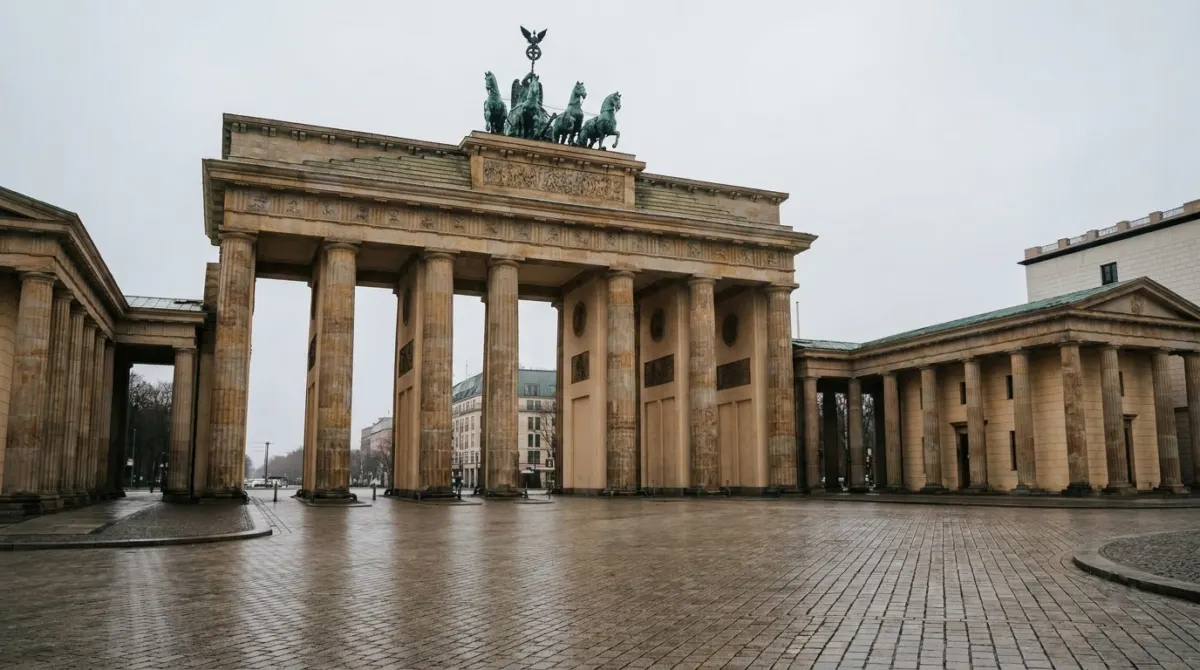
Mitte holds nearly everything a first visit comes for: the Brandenburg Gate, the Reichstag, the Holocaust Memorial, Unter den Linden, Museum Island and the television tower at Alexanderplatz.
Staying here puts those within walking distance of each other, which matters in a city this spread out. It is also the best-connected district for trains and the airport.
The trade is character. Parts of Mitte — particularly around Friedrichstraße and Potsdamer Platz — are corporate and empty in the evening. The eastern end, around Hackescher Markt and the Scheunenviertel, keeps more life after dark and is the part to aim for.
Hackescher Markt and the Spandauer Vorstadt
The old quarter north of the S-Bahn viaduct at Hackescher Markt is the most enjoyable part of Mitte to stay in. It is a grid of narrow streets with galleries, small shops and restaurants, threaded through with the Hackesche Höfe, a chain of restored Art Nouveau courtyards. The gilded dome of the New Synagogue on Oranienburger Straße marks the western edge.
Museum Island is a ten-minute walk, the S-Bahn station at Hackescher Markt connects to the main station and Alexanderplatz in a few stops, and the trams run north into Prenzlauer Berg. Rooms here cost more than elsewhere in Mitte, and they are worth it.
Alexanderplatz and the Nikolaiviertel
Alexanderplatz is the transport hub of the east: S-Bahn, three U-Bahn lines, regional trains and trams all meet under the television tower. The square itself is a windswept expanse of East German planning and department stores, and the hotels around it are large, modern and often good value for Mitte.
Just south, the Nikolaiviertel is a small old quarter around the city’s oldest church, rebuilt by East Germany in the 1980s. It is pleasant for an hour, quiet at night and close to the river.
Potsdamer Platz and Friedrichstraße
Both are convenient for the Brandenburg Gate, the Holocaust Memorial and the Kulturforum, and both suit a business trip better than a holiday. Potsdamer Platz was rebuilt from wasteland beside the Wall in the 1990s and is all glass towers and shopping arcades; Friedrichstraße is a long street of offices and showrooms. Stay here if your days are around the government quarter or the Philharmonie, not for the evenings.
Prenzlauer Berg
North-east of Mitte, Prenzlauer Berg is the district of restored nineteenth-century apartment blocks, tree-lined streets, cafes and playgrounds. It was the centre of alternative East Berlin and is now the most family-oriented inner district in the city.
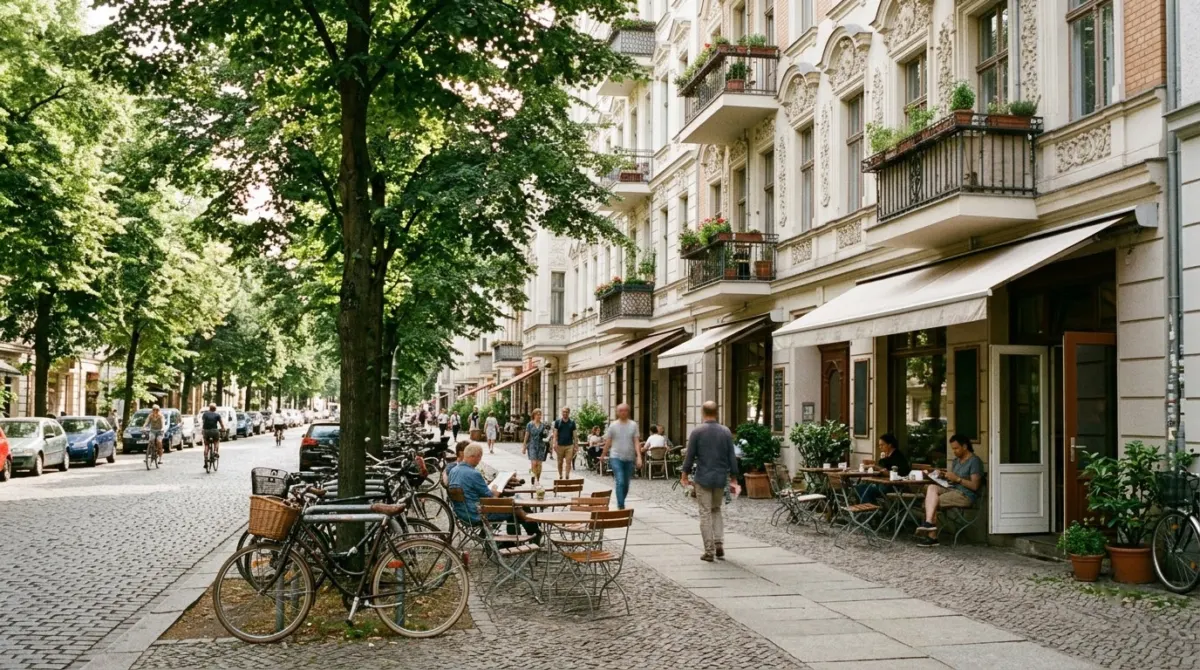
It is two or three U-Bahn stops from Mitte, or half an hour on foot. Accommodation leans towards apartments rather than hotels, which suits longer stays.
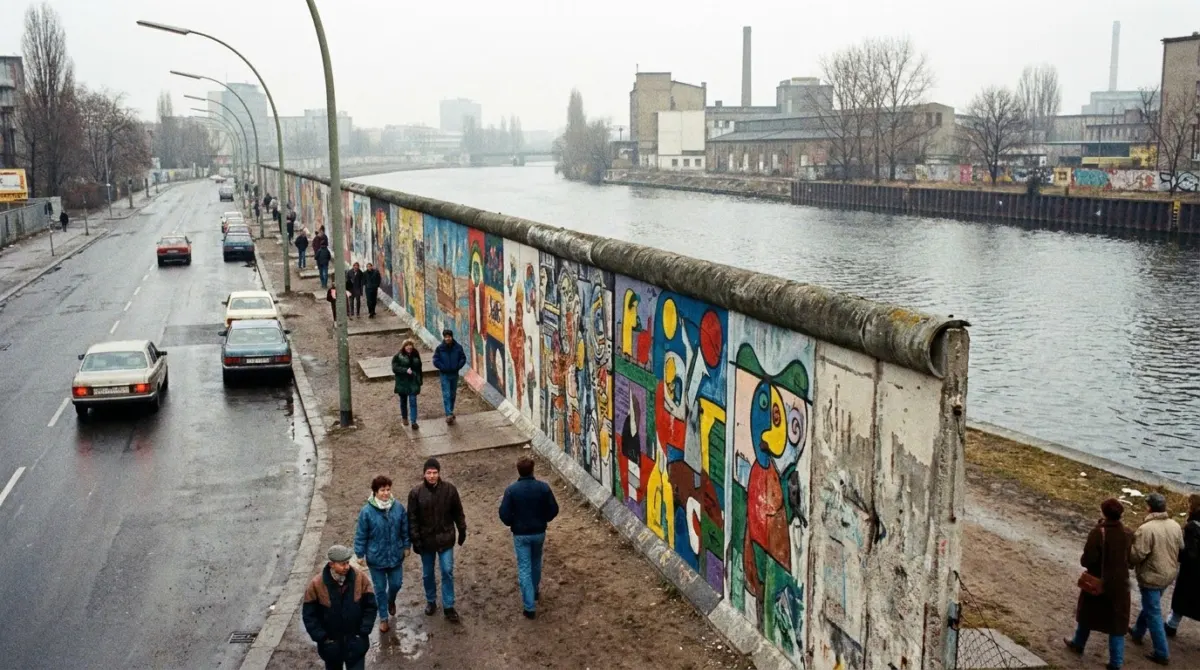
The Berlin Wall Memorial on Bernauer Straße sits on its western edge, and it is the best place in the city to understand what the Wall actually was — a preserved section with the death strip intact, rather than a souvenir fragment.
Kreuzberg and Friedrichshain
Kreuzberg is the district most people mean when they talk about Berlin’s character: Turkish markets, canal-side bars, street art, and a food scene that is the best in the city. The eastern half around Kottbusser Tor is louder and busier; the western half near Bergmannstraße is calmer.
Friedrichshain, across the river, is where the clubs are, along with the East Side Gallery — the longest surviving stretch of the Wall, painted by artists in 1990.
Both are good bases for people who want to be out late and do not mind a U-Bahn ride to the museums. Neither is a good base for an early start.
West Kreuzberg or east Kreuzberg
Kreuzberg is two districts in one. The west, around Bergmannstraße, the market hall at Marheinekeplatz and the Viktoriapark with the hill that gives the district its name, is leafy and residential, with cafes rather than clubs. It is the better choice for couples and for anyone who wants Kreuzberg’s food without the noise.
The east, around Kottbusser Tor, Görlitzer Park and the Landwehrkanal, is louder, younger and busier late into the night. It is also where the Markthalle Neun, the restored market hall that anchors the area’s food scene, stands. Light sleepers should look at a courtyard-facing room or move west.
Friedrichshain around Boxhagener Platz
Friedrichshain’s centre of gravity is Boxhagener Platz, a square surrounded by bars, cafes and restaurants, with markets at weekends. To the north runs Karl-Marx-Allee, the monumental East German boulevard of the 1950s. To the south, the old railway works of the RAW-Gelände have become clubs, climbing walls and beer gardens, and the Oberbaum Bridge crosses the Spree into Kreuzberg.
The S-Bahn and U-Bahn at Warschauer Straße are the district’s lifeline: the S-Bahn runs straight through to Alexanderplatz, Friedrichstraße and the main station. Pick a room within ten minutes of that station or of Ostkreuz and the district works well as a base.
Charlottenburg and the west
Before reunification, Charlottenburg was the centre of West Berlin, and it still feels like a different city: wide boulevards, department stores along the Ku’damm, older buildings and a quieter, wealthier air.
It is twenty minutes by U-Bahn from Mitte, which is the main objection. In exchange you get larger rooms, better value, and the Charlottenburg Palace and the Tiergarten on your doorstep.
For returning visitors, or anyone who finds Mitte too busy, this is the thinking person’s base.
Around Savignyplatz
Within Charlottenburg, aim for the streets around Savignyplatz, a leafy square just north of the Ku’damm with an S-Bahn station under the railway arches. The arches and the side streets hold restaurants, bars and bookshops, and the residential blocks around them are some of the most attractive in the west.
From the S-Bahn here, trains run directly to the Zoo station, the main station, Friedrichstraße and Alexanderplatz, which goes a long way towards solving Charlottenburg’s distance problem. It is a better choice than the busy stretch of the Ku’damm itself, which is shops by day and quiet at night.
Schöneberg
South of the Tiergarten, between Charlottenburg and Kreuzberg, Schöneberg is the district most visitors never consider and many Berliners would choose. It is residential and handsome, with nineteenth-century apartment buildings, local restaurants and squares that fill on market days.
Its centre is Winterfeldtplatz, where the weekly market on Wednesdays and Saturdays is the largest and best known in Berlin. Nearby Nollendorfplatz has been the heart of the city’s gay scene since the 1920s, and the large lesbian and gay street festival takes over the streets around it each July.
To the south-west, the Rathaus Schöneberg was West Berlin’s town hall, and the square in front of it is where John F. Kennedy gave his “Ich bin ein Berliner” speech in 1963. It now carries his name, and it holds a flea market at weekends.
Schöneberg is a few U-Bahn stops from both Kreuzberg and the Ku’damm, and about fifteen minutes from Potsdamer Platz. It suits a second visit, a longer stay in an apartment, or anyone who wants a calmer base between the east and the west.
Near the Hauptbahnhof
Berlin’s main station opened in 2006 on the north bank of the Spree, and the area around it is still being built. That shapes the case for staying here.
The advantages are transport. Long-distance trains to Hamburg, Munich, Dresden and the rest of Germany leave from here, the airport express to BER takes about twenty-three minutes, and the U5 runs from the station under the Brandenburg Gate and Museum Island to Alexanderplatz. The Reichstag and the government quarter are a short walk across the river.
The disadvantages are atmosphere. The blocks around the station are new offices and business hotels, and the streets empty in the evening. Moabit, to the north-west, is livelier but residential rather than interesting.
Stay here for one night at the start or end of a rail trip, for an early train or flight, or if you are moving on to Hamburg or Dresden the next morning. For a stay of three nights, eastern Mitte is a few stops away and much better.
Which landmarks and attractions sit where
Berlin’s sights are spread across a city nine times the area of Paris, so the district you pick decides which ones you see in the evening rather than on a planned trip.
Mitte holds the Brandenburg Gate, the Reichstag, Museum Island, Unter den Linden and the Holocaust Memorial. Friedrichstrasse runs through it as the main north-south axis, with its own S-Bahn and regional station, and is a useful anchor if you want everything historic within walking distance.
Kreuzberg and Friedrichshain hold the East Side Gallery, the Jewish Museum and most of the nightlife.
Charlottenburg, the area Berliners still call City West, has Charlottenburg Palace, the Zoo, the KaDeWe department store and the Memorial Church. It is the quieter half of the city and the one older visitors usually prefer.
Prenzlauer Berg has no major landmark at all, which is rather the point of it — it is residential, and you travel in.
A practical note: Berlin’s attractions do not cluster the way Paris or Vienna do. Whichever district you choose, expect to use the U-Bahn daily, and treat the walkable sights as the bonus rather than the plan.
Getting around, and why it decides your district
Berlin’s public transport is excellent and you will use it constantly, because the distances are real: Charlottenburg to Friedrichshain is about twelve kilometres.
The U-Bahn, S-Bahn, trams and buses share one ticket system, with zones A and B covering the city and zone C reaching the airport and Potsdam. A day ticket or a multi-day pass is almost always worth it.
BER airport is south-east of the city. The airport express reaches the main station in about twenty-three minutes, and the S-Bahn takes longer. Check whether your ticket includes zone C.
The practical consequence: choose a district with good U-Bahn or S-Bahn links rather than one that looks central on a map. In Berlin, a station matters more than a postcode.
What the accommodation is like
Berlin has more rooms per visitor than most European capitals, which keeps prices lower than Munich, Paris or Amsterdam for comparable quality.
Apartments are widespread and well-established, and they suit families and longer stays. Hostels here are unusually good, often with private rooms.
Hotels are mostly modern, with lifts and standard rooms, because so much of the city was rebuilt. The exceptions are the restored buildings in Prenzlauer Berg and Charlottenburg, where lifts are less certain.
Air conditioning is far from universal and July and August can be hot, so check if that matters to you.
A note on Museum Island
Museum Island holds five museums in the middle of the Spree, and it is the main reason many people stay in Mitte.
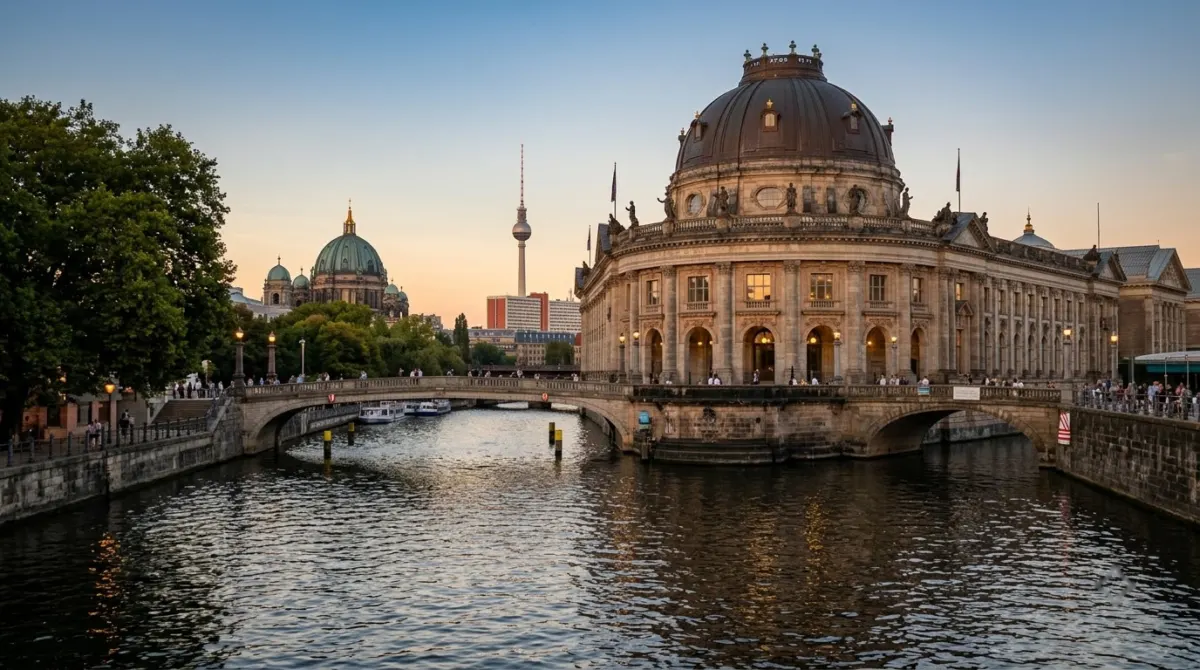
Be aware that the complex is in the middle of a long-running renovation programme, and individual museums — including major ones — close for extended periods. Check which are actually open on your dates before you build a day around them, rather than relying on a general guide.
How many nights
Three nights is the realistic minimum for a first visit, and four is better. Berlin’s sights are spread out, the history needs time, and the city rewards an unhurried pace more than it rewards a checklist.
Two nights covers Mitte and nothing else. Our guide to how many days in Berlin goes through what each length gets you.
Where not to stay
Potsdamer Platz and the immediate corporate blocks, which are convenient and lifeless after six in the evening.
The outer suburbs, which in a city this large mean a genuinely long commute rather than a short hop.
Anywhere chosen only on price without checking the nearest U-Bahn or S-Bahn station. In Berlin that single detail decides how your days feel.
Neukölln and the southern districts
South of Kreuzberg, Neukölln is the district that has changed fastest in the last decade: cheap rents, a large Turkish and Arab population, and a dense run of bars and restaurants along Weserstraße and around Hermannplatz.
It is further out and less convenient for the sights, which is reflected in the price. For a second visit, or for anyone whose Berlin is about eating and going out rather than museums, it is the best value in the inner city.
The northern edge, around the canal and Tempelhofer Feld — the former airport, now an enormous public park — is the part to aim for.
Wedding and Moabit
North and north-west of Mitte, Wedding and Moabit are the inner districts that gentrification has reached last. They are working-class, multicultural and noticeably cheaper than their neighbours, and they have the feel that Prenzlauer Berg and Kreuzberg had before they became famous.
Wedding’s attractions are low-key: the Humboldthain park with its wartime flak tower, the underground tours from Gesundbrunnen station, and canal-side and river-side walks. Moabit, wedged between the Spree and the canals beside the main station, has a restored nineteenth-century market hall and quiet residential streets.
Gesundbrunnen station, on the S-Bahn ring and served by some long-distance trains, puts Wedding within easy reach of the rest of the city, and the U-Bahn runs straight into Mitte.
Neither is a first-visit district, because there is little to walk to and the evenings are local rather than lively. For a long stay on a budget, or for a returning visitor who wants to see the city that is not on the postcards, both are worth a look — check the specific street, as in any large city, before you book.
Berlin with children
Berlin is easier with children than its reputation suggests, mostly because of the space.
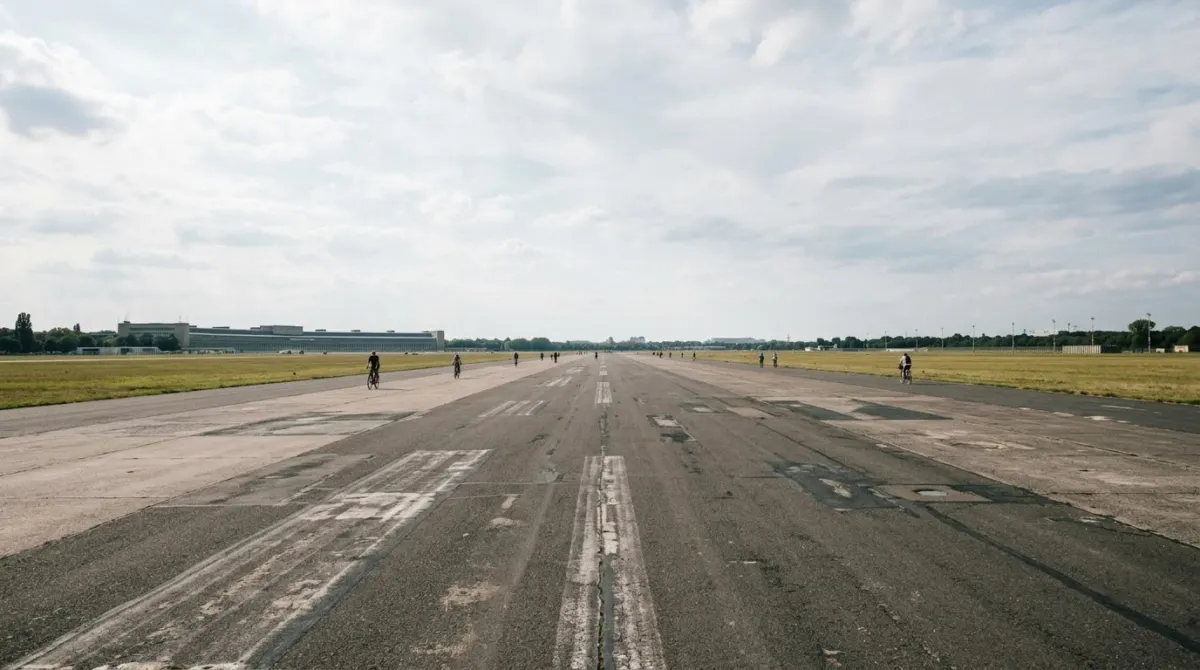
Tempelhofer Feld is a disused airport turned park where children can cycle on the runways. The Tiergarten is central and enormous, with the zoo at its western end. The lakes at Wannsee are a genuine beach day in summer, forty minutes out on the S-Bahn.
Prenzlauer Berg is the district to stay in: playgrounds, cafes that expect children, and apartments rather than hotel rooms.
What tires children here is the distance between things, so plan fewer sights per day than you would in a compact city.
What a Berlin apartment gets you
Berlin has one of the strongest apartment markets in Europe, and for stays of three nights or more it is usually the better choice.
The typical inner-city apartment is a restored nineteenth-century flat with high ceilings, large windows and a kitchen, in a building with a courtyard. Many have no lift, which matters if you are on the fourth floor.
The practical advantages are space, a washing machine and the ability to eat breakfast at home in a city where restaurant breakfasts are slow and busy. The disadvantage is the lack of a reception when something goes wrong.
Safety and the practical stuff
Berlin is an ordinary large European city: busy stations attract pickpockets, some areas are livelier at night than others, and normal city sense covers it.
Two more useful points. Cash is still common in Berlin, more than in most western European capitals, and small bars, bakeries and some restaurants may not take cards at all. And Sunday closing is real — shops and supermarkets are shut, with exceptions at the main stations, so buy food on Saturday.
Berlin in winter
From late November it is dark by four, which removes the outdoor half of Berlin: the East Side Gallery, the long district walks and the lakes. What remains is a museum city with Christmas markets, and the markets here are spread across the districts rather than concentrated in one square.
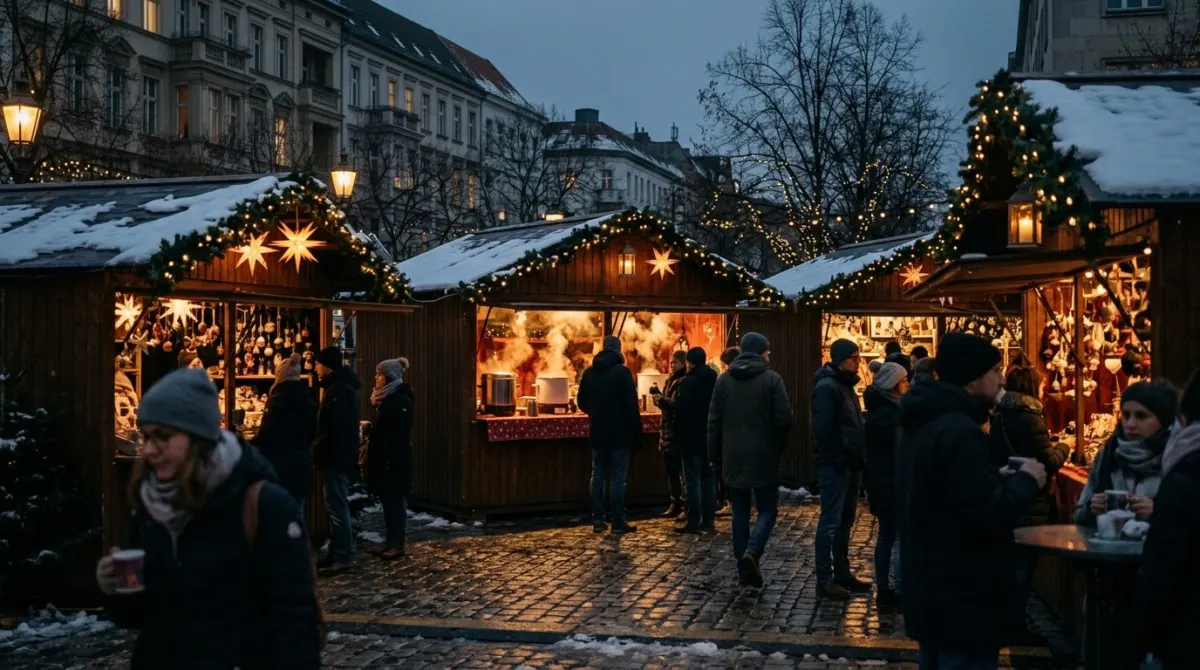
Accommodation is at its cheapest in January and February, which is the compensation. If you are coming then, favour a central district over a distant one, because a twenty-minute walk in a Berlin January is a different proposition from the same walk in June.
Staying in Potsdam instead
Potsdam is a separate city just beyond Berlin’s south-western boundary, and it is inside the Berlin transport network: it sits in zone C, the S-Bahn runs from central Berlin to Potsdam Hauptbahnhof, and regional trains make the trip faster.
Staying there is a real option if the palaces matter more to you than the nightlife. You wake up next to Sanssouci and its park, which are at their best early in the day before the visitors arrive from Berlin, and you have the Dutch Quarter and the old town for the evening.
The costs are time and energy. Every day in central Berlin starts and ends with a train ride of half an hour or more, and Potsdam is quiet in the evening. It also has direct regional trains and an express bus to BER, which helps at the end of a trip.
The sensible version is one or two nights in Potsdam at the end of a Berlin stay, rather than using it as a base for the whole trip. Our guide to how many days in Berlin covers where the Potsdam day fits.
Dates that fill the city
Berlin has a lot of hotel rooms, which is why it is usually good value, but a handful of events fill them and change the price everywhere.
The Berlinale, the international film festival, takes over Potsdamer Platz and the cinemas of the city for about ten days in February. In 2026 it ran from 12 to 22 February.
The Berlin Marathon is held on a Sunday in late September, and the weekend around it is one of the busiest of the year for hotels. The course starts and finishes near the Brandenburg Gate.
The Festival of Lights projects light installations onto the Brandenburg Gate, the cathedral and other landmarks every evening for about ten days in October. It is free and draws large crowds to Mitte.
The large trade fairs at the Messe Berlin, out in the west near Charlottenburg, push up prices in that part of the city in particular.
New Year’s Eve brings a huge party to the Brandenburg Gate, and central rooms around it go early.
Outside these dates, Berlin rarely sells out. If yours overlap with one, book early and consider a district a few stops away from the event.
Splitting a stay between two districts
On a stay of five nights or more, two bases can be better than one, because Berlin’s districts are so different from one another.
The combination that works best is eastern Mitte first, then Kreuzberg or Prenzlauer Berg. Spend the first two or three nights within walking distance of the monuments and Museum Island, while you are doing the sightseeing, then move to a residential district for the rest of the stay, when the days become slower and the evenings matter more.
The reverse also works for a returning visitor: Charlottenburg or Schöneberg first, for the west and its museums, then Friedrichshain for the east.
Moving costs half a morning and a taxi or a few stops on the U-Bahn, which is a small price for seeing two versions of the city. It is not worth it on a stay of three or four nights.
BER and the airport hotels
Berlin Brandenburg Airport has a station directly under Terminal 1, and three kinds of train link it to the city.
The airport express runs every fifteen minutes to Südkreuz, Potsdamer Platz and the main station, taking about fourteen, nineteen and twenty-three minutes respectively. Regional trains run to Ostkreuz and Potsdam, and two S-Bahn lines run every twenty minutes, slower but with many more stops. All need an ABC ticket, because the airport is in zone C, and paper tickets must be validated before you board.
That speed changes the old advice. With the express, an early flight is manageable from Mitte, Kreuzberg or the main station, and there is little reason to sleep at the airport unless your flight leaves before the first trains or you arrive in the middle of the night.
When one of those applies, there are hotels within walking distance of the terminals. For anything else, stay in the city.
Choosing by what you came for
History and museums: eastern Mitte. Everything from the Brandenburg Gate to Museum Island is walkable, and the Wall sites are a short ride.
Eating and going out: Kreuzberg or Neukölln, where the food is and where the evening starts late.
Children or a long stay: Prenzlauer Berg, for apartments, playgrounds and quiet streets.
Quiet and space: Charlottenburg, twenty minutes west, for larger rooms and a calmer city.
The short version
Berlin has no single centre, so pick a district and check its U-Bahn or S-Bahn station before you look at the room. Eastern Mitte for a first visit, Prenzlauer Berg for families, Kreuzberg or Friedrichshain for nightlife, Charlottenburg for value and quiet. Three nights minimum, four if you can.
Frequently asked questions
What is the best area to stay in Berlin?
Eastern Mitte, between Hackescher Markt and Alexanderplatz, for a first visit: Museum Island and the Brandenburg Gate are walkable and the transport links are the best in the city. Prenzlauer Berg for families, Kreuzberg or Friedrichshain for nightlife, Charlottenburg for quiet and value.
Is Mitte a good place to stay in Berlin?
Yes for a short first visit, because the historic sights cluster there. Aim for the eastern end around Hackescher Markt rather than Friedrichstraße or Potsdamer Platz, which are corporate and empty in the evening.
Is Berlin walkable?
Within districts, yes. Across the city, no — Charlottenburg to Friedrichshain is about twelve kilometres. Berlin is a public transport city, so pick accommodation by its nearest U-Bahn or S-Bahn station rather than by how central it looks.
Where should I stay in Berlin with family?
Prenzlauer Berg. It is residential, full of cafes and playgrounds, two or three stops from Mitte, and the accommodation leans towards apartments, which suits longer stays with children.
How many nights do you need in Berlin?
Three at minimum and four if you can. The sights are spread across a large city and the twentieth-century history takes time to see properly. Two nights covers Mitte and little else.
Is Berlin cheaper than Munich?
Generally yes, for accommodation. Berlin has more rooms per visitor than most European capitals, which keeps rates lower for comparable quality, and apartments and hostels are both strong here.
Is it worth staying near Berlin Hauptbahnhof?
For one night at the start or end of a rail trip, yes: long-distance trains leave from there, the airport express takes about twenty-three minutes, and the Reichstag is a short walk away. For a longer stay, eastern Mitte is a few stops away and has far more life in the evening.
Keep planning Germany
- Where to Stay in Cologne: One Street Back From the Cathedral
- Where to Stay for Oktoberfest: Buy the Walk Home
- Where to Stay in Frankfurt: The City, the Station or the Airport
- Best Hotels in Munich: What the Money Actually Buys
- Where to Stay in Munich: Inside the Ring, or One Stop Out
- How Many Days in Berlin? Four, and Why It Needs More Than Munich
- How Many Days in Munich? Three, and Four If You Use It as a Base
- 10 Day Germany Itinerary: Five Bases, Four Trains
Written and checked by
Triplarks Editorial
An editorial desk, not an invented persona: research, drafting and fact-checking are done by the same small team. Every number here carries the date it was read.