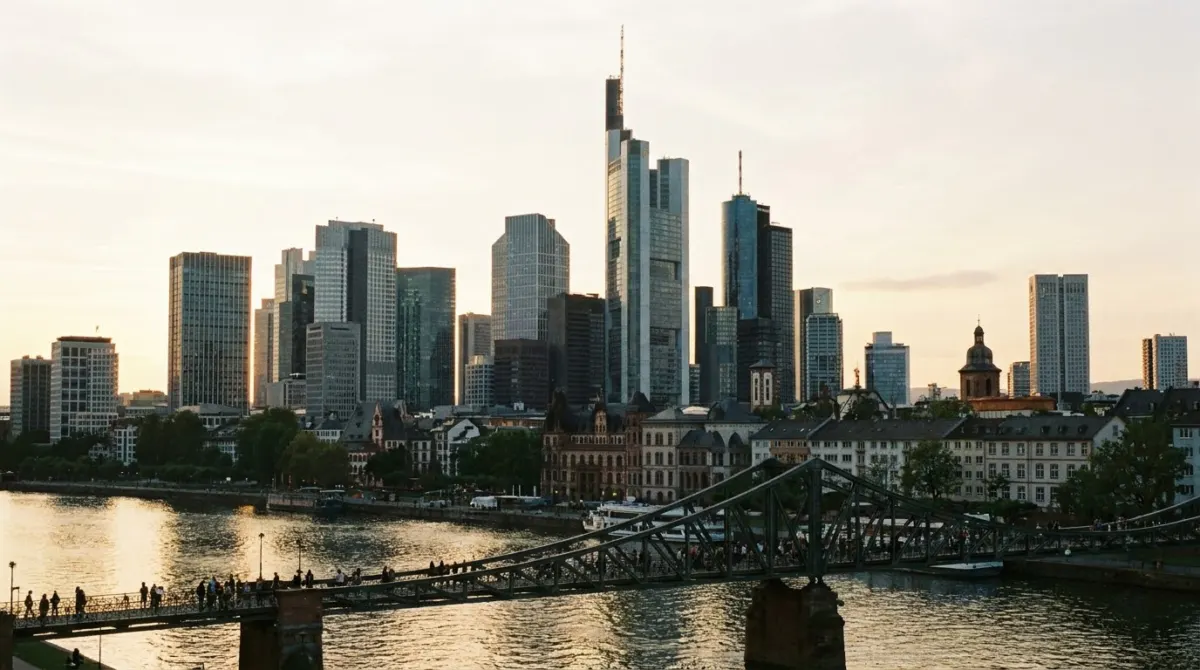
Quick answer
Stay in the Innenstadt between the Hauptwache and the river for a short visit, or Sachsenhausen across the water for the cider taverns and the museum embankment. Check whether your dates fall on a major trade fair before booking — that changes the price more than the district does.
On this page
- Where to stay in Frankfurt: the short answer
- Altstadt and Innenstadt
- Sachsenhausen, across the river
- Nordend and Bornheim
- Ostend and the eastern riverbank
- Around the Hauptbahnhof
- Westend and the fair
- Bockenheim and the Europaviertel
- The airport, and when it makes sense
- Höchst, Offenbach and the S-Bahn towns
- What the accommodation is like
- Weekends are cheaper here
- Where not to stay
- What there is to do in Frankfurt
- Eating and drinking by district
- Frankfurt with children
- Frankfurt as a base
- Getting around
- What the trade fairs do
- Seasons and events that move prices
- How many nights, realistically
- The short version
- Frequently asked questions
Frankfurt is the one German city most visitors pass through without stopping, because it has the busiest airport in the country and a reputation for being all banks. The reputation is half earned: the skyline is genuinely unusual for Germany, and the old town beneath it was rebuilt from nothing after 1944.
Some links below are affiliate links. We may earn a commission if you book through them, at no extra cost to you. We do not rank hotels, and any prices on the map come live from the booking sites.
Where you stay here is a more practical question than in most cities, because the answer usually depends on whether you are here for a trade fair, a flight or the city itself. For the rest of the country, see our Germany itinerary, where to stay in Munich and where to stay in Berlin.
Where to stay in Frankfurt: the short answer
| If you are | Stay in | Why |
|---|---|---|
| Here one or two nights to see the city | Altstadt or Innenstadt | The old town, the museums, the river |
| Catching an early flight | Near the Hauptbahnhof, or the airport | Ten minutes by train to the terminals |
| Here for a trade fair | Westend or Bockenheim | Walking distance to the Messe |
| Wanting bars and restaurants | Sachsenhausen, across the river | The cider taverns and the museum embankment |
| On a budget | Bahnhofsviertel, with care | Cheapest beds, roughest streets |
One answer with no caveats: the Innenstadt between the Hauptwache and the river. You walk to the old town, the museums and the station, and the airport train takes about fifteen minutes.
Map shows live availability and prices. We may earn a commission on bookings made through it, at no extra cost to you.
Altstadt and Innenstadt
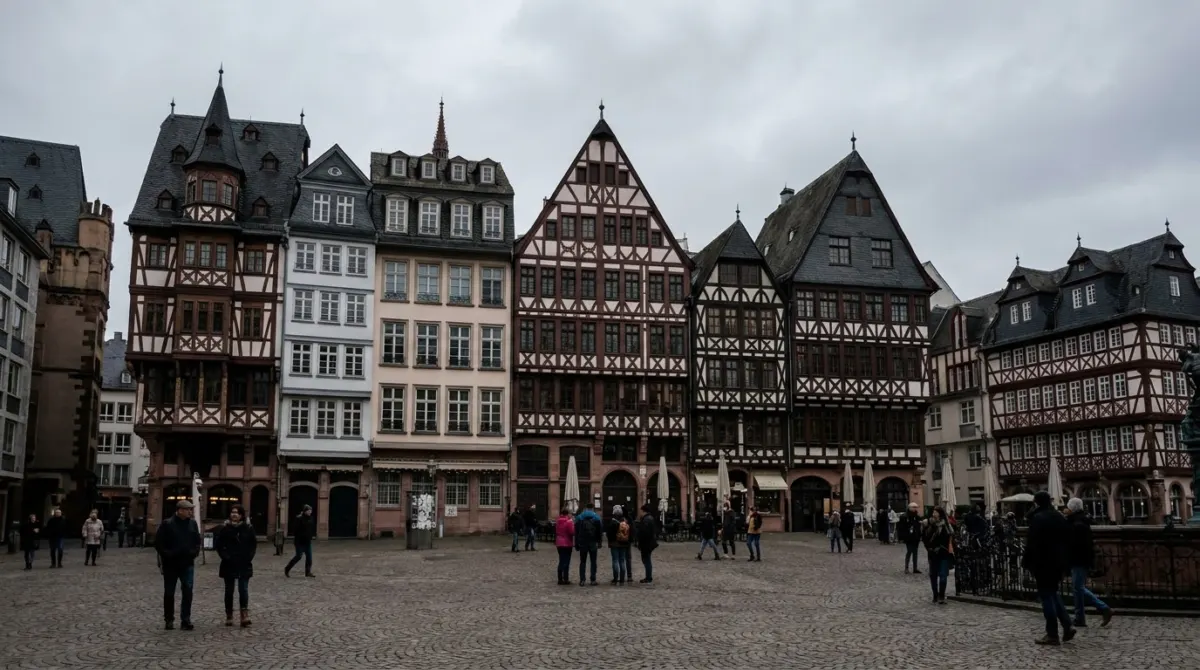
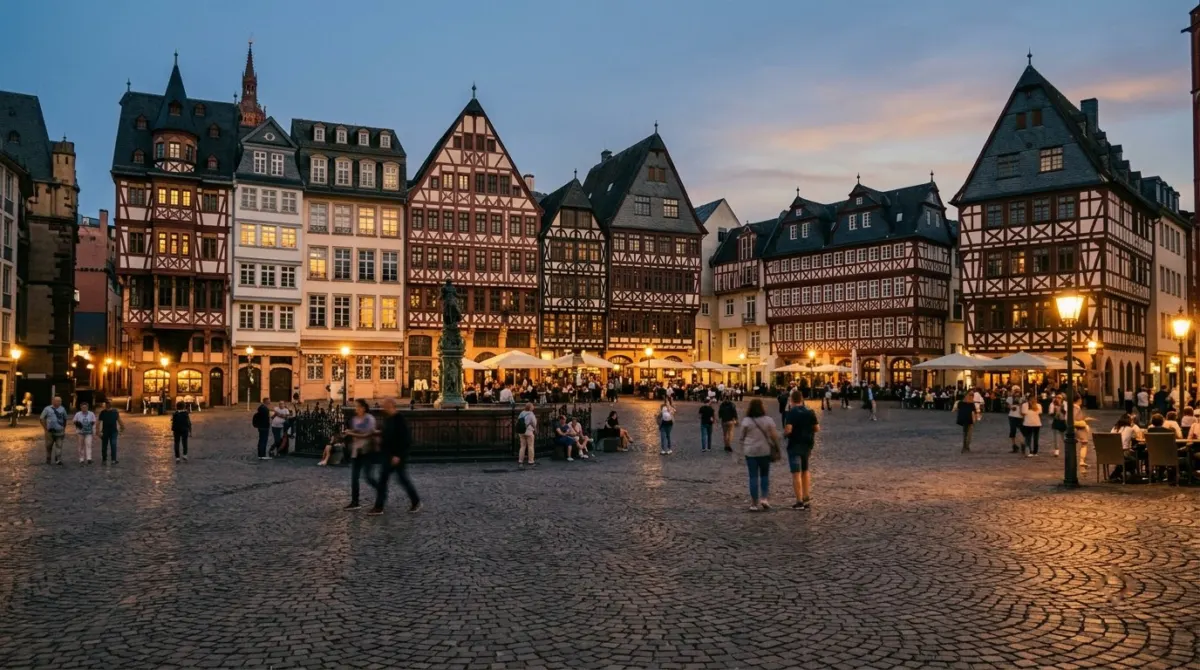
The Römerberg is the old town square, with its stepped-gable houses — reconstructed, like almost everything around it, because the medieval centre was destroyed in a single night of bombing in March 1944. The newest reconstruction, the Neue Altstadt between the Römer and the cathedral, opened only in 2018.
Staying in this area puts you within ten minutes of the old town, the shopping streets around the Hauptwache, and the river. It is the most expensive part of the city and the most convenient.
The trade is that the Innenstadt empties in the evening. Frankfurt is a working city and the centre is quiet after the offices close, so you will cross the river for dinner.
Sachsenhausen, across the river
South of the Main, Sachsenhausen is where Frankfurt goes out. The old quarter is a run of narrow streets with Apfelwein taverns — the local cider, served in a ribbed glass and poured from a stoneware jug — and it is the most enjoyable part of the city in the evening.
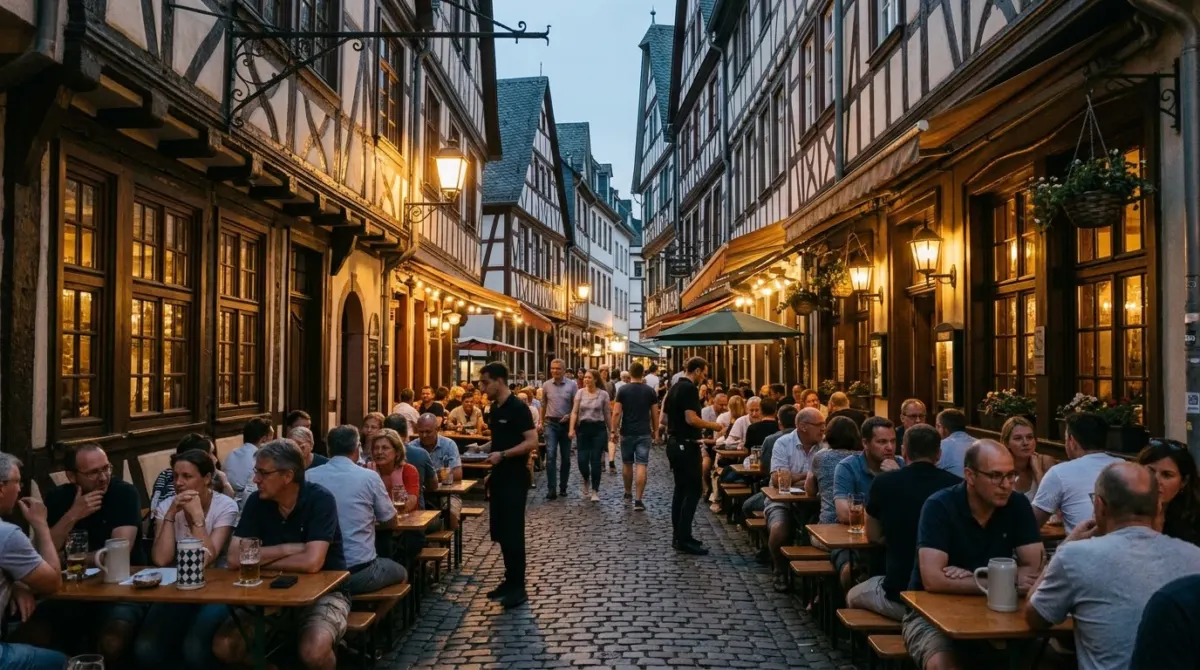
Along the river runs the Museumsufer, the museum embankment, with a dozen museums in a row including the Städel art collection and the German Film Museum.
It is fifteen minutes’ walk from the old town across a footbridge. For a stay of two nights or more, this is the better side of the river.
Nordend and Bornheim
North-east of the old town, beyond the green belt of the old city walls, Nordend and Bornheim are where Frankfurt actually lives. Both districts are made up of residential streets of older apartment buildings, small squares and neighbourhood bakeries, and neither has any sight you would cross the city for. That is the appeal.
The spine of both is Berger Straße, a long shopping and eating street that runs out from the edge of the centre through Nordend and into Bornheim. The Bornheim end is the more interesting one: the district was a separate village until it was absorbed into the city, and it was long known in Frankfurt as the “merry village” for its taverns. Several of the city’s most traditional apple wine houses still sit on Berger Straße, which makes it the best alternative to Sachsenhausen for an evening of cider and green sauce with far fewer tour groups.
The U4 runs underneath Berger Straße and reaches the Konstablerwache, the Römer and the main station without a change, so the old town and the trains are never far away.
The catch is supply. There are few hotels out here, and most of what you will find is apartments. For a stay of four nights or more, or for a second visit when you want to see the ordinary city rather than the skyline, that suits well. For one night before a flight it does not.
Ostend and the eastern riverbank
East of the centre, Ostend is the district that has changed most in the last fifteen years. Its landmark is the European Central Bank, whose twin glass towers stand on the riverbank and incorporate the city’s former wholesale market hall. Around it, the old docks of the Osthafen have been steadily converted to offices, design studios and newer hotels.
For visitors the useful part is the strip along Hanauer Landstraße and around the Ostbahnhof, where many of the newer, more reasonably priced hotels have opened. Trams run along Hanauer Landstraße into the centre, and the S-Bahn stops at the Ostbahnhof.
The zoo also sits in Ostend, close to the Bornheim border, which makes the district a practical choice for families.
What Ostend lacks is atmosphere after dark. Outside a handful of bars and restaurants along the converted harbour, it is quiet in the evening, and you will take the tram into the centre or walk across the river to Sachsenhausen for dinner. Treat it as a good-value base with good transport rather than a destination.
Around the Hauptbahnhof
The main station sits west of the centre, and the streets immediately around it — the Bahnhofsviertel — hold the cheapest rooms in Frankfurt and the city’s red light district, along with a visible drug scene.
Said plainly: it is not dangerous for visitors in the way people imagine, but it is unpleasant at night and it surprises people who booked on price alone.
What it does offer is unbeatable transport. The S-Bahn to the airport takes about ten minutes, long-distance trains leave from here, and the centre is a ten-minute walk. For an early flight or a single night, that can be worth it — preferably on the northern streets rather than the southern ones.
Westend and the fair
North-west of the centre, Westend is the leafy residential district of nineteenth-century villas and the university, and it sits beside the Messe, Frankfurt’s enormous trade fair complex.
During a major fair — and Frankfurt hosts several of the largest in the world — hotel rates across the whole city rise sharply and availability disappears. If your dates coincide with one, either book months ahead or stay in a neighbouring town on the S-Bahn.
Outside fair weeks, Westend is quiet, pleasant and good value, about twenty minutes’ walk from the old town.
Bockenheim and the Europaviertel
The two districts on either side of the Messe suit different travellers.
Bockenheim, west of Westend, is the old university quarter. The university has largely moved to newer campuses, but the district has kept its student character: cheaper restaurants, bookshops and bars along Leipziger Straße, its main shopping street. The U-Bahn station at Bockenheimer Warte puts you a few minutes from the Hauptwache, and the Messe is walkable. Outside fair weeks it is one of the better-value places to stay in the inner city, and it has a life of its own in the evening, which Westend does not.
The Europaviertel is the opposite: a new district built on the former freight railway land between the main station and the Messe, with modern apartment blocks, a shopping centre and a cluster of large business hotels. It exists for the trade fair, and during a fair that is exactly what you want from it.
For a leisure trip, Bockenheim is the one to choose. The Europaviertel has little to offer once the halls close, and the old town is a tram or U-Bahn ride away rather than a walk.
The airport, and when it makes sense
Frankfurt Airport has its own long-distance railway station and hotels attached to the terminals, which makes it unusually viable as a place to sleep.
It earns its place in two situations: a flight before about seven in the morning, and a long connection where you want a bed rather than a lounge. For anything else, the city is ten to fifteen minutes away by train and far more interesting.
Höchst, Offenbach and the S-Bahn towns
Frankfurt’s rail network makes it realistic to sleep outside the city limits and still be in the centre in under half an hour, which matters most during fair weeks.
Höchst is technically part of Frankfurt, but it was an independent town until 1928 and still feels like one. It lies about ten kilometres west of the centre on the north bank of the Main, and its old town has around four hundred half-timbered houses under heritage protection, a castle and a riverside promenade. The S1 and S2 S-Bahn lines run from Höchst into the centre, so it is a genuinely attractive alternative to the business hotels.
Offenbach, directly east across the Main, is a separate city with a long industrial history and the German Leather Museum. It has its own hotels, a short S-Bahn ride from the Hauptwache and the Konstablerwache.
Eschborn, north-west of the city, is an office suburb with modern hotels on the S-Bahn. It has no charm at all, but it is often the place that still has rooms when the city is full.
For a trip that is about the Rhine or Heidelberg rather than Frankfurt itself, Mainz and Wiesbaden are still the better choice: they are destinations in their own right, not just overflow.
What the accommodation is like
Frankfurt’s stock is overwhelmingly modern and business-oriented, which has consequences in both directions.
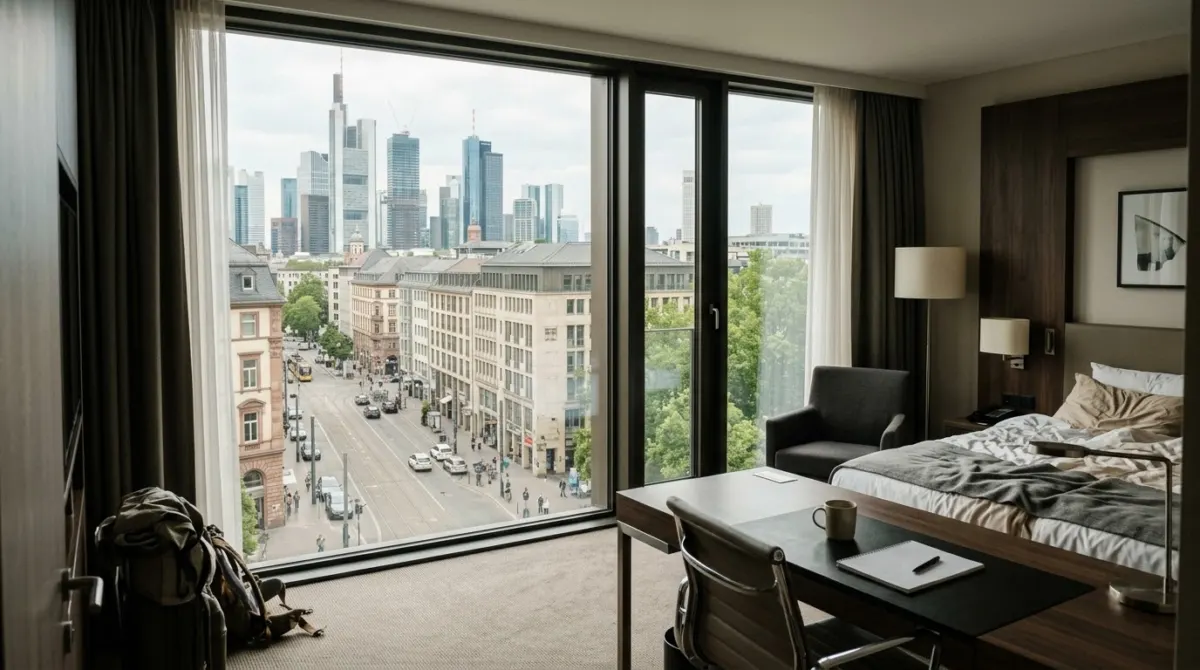
The good: lifts, air conditioning, reliable rooms, good accessibility, and strong weekend pricing, because the business travellers leave on Friday.
The less good: very little character, and rooms that are smaller than their price suggests during fair weeks.
Apartments are plentiful and are the better choice for stays over three nights. The German Pension format barely exists in central Frankfurt, unlike Munich.
Weekends are cheaper here
This is the one piece of Frankfurt-specific booking advice that saves real money.
Because the city runs on business travel, hotel rates are often highest from Monday to Thursday and lowest at weekends — the opposite of almost every other European tourist city. A Friday and Saturday night in Frankfurt frequently costs less than a Tuesday.
The exception, as always, is a trade fair, which overrides everything.
Where not to stay
The southern Bahnhofsviertel streets, unless price is the only consideration and you know what you are booking.
The outer office districts, which are convenient for nothing in the evening.
Anywhere at all during a major fair without checking the rate first — the same room can cost several times its normal price.
What there is to do in Frankfurt
More than its reputation allows, and most of it within walking distance of the river.
The Museumsufer is the main case for the city: a dozen museums along the south bank, including the Städel for European art from the middle ages onwards, the German Architecture Museum and the Film Museum. Two or three of them fill a day.
The Römerberg and the Neue Altstadt are a reconstruction of the medieval centre, the newest part finished in 2018. It is small — an hour covers it — and it is genuinely well done.
The Main Tower has a public viewing platform near the top, which is the only way to see the skyline from inside it.
Sachsenhausen in the evening for Apfelwein, which is an acquired taste served in a ribbed glass and poured from a blue stoneware jug.
Eating and drinking by district
Frankfurt’s food is regional and specific, and where you eat it says a lot about which district you should stay in.
The apple wine taverns are concentrated in two places: the old quarter of Sachsenhausen, which is the better known and the busier, and Berger Straße in Bornheim, which is more local. The tavern menu is the same in both: Grüne Soße, the cold green sauce made from seven herbs and served with boiled eggs and potatoes, and Handkäs mit Musik, a small sour-milk cheese marinated in oil with onions and caraway.
The Kleinmarkthalle, the covered market hall a few minutes from the Hauptwache, is the best lunch in the city centre. The tourist board’s own advice is Saturday lunch there, when it is at its busiest and liveliest.
The Fressgass, the pedestrian street between the Alte Oper and the Hauptwache, is the centre’s main run of restaurants and cafes, convenient rather than exceptional.
The Bahnhofsviertel, for all its reputation, has some of the most varied and international food in Frankfurt, and its bar scene draws locals rather than tourists. Eat there early and leave the southern streets after dark.
If eating well is part of the point of your trip, Sachsenhausen and Bornheim are the two bases that put the most of it on your doorstep.
Frankfurt with children
Frankfurt is a straightforward city with children, mainly because the centre is compact and the best family sights are all close to public transport.
The Senckenberg Natural History Museum, on the edge of Westend and Bockenheim, is one of the largest natural history museums in Germany and has the dinosaur skeletons that children come for. The Palmengarten, the botanical garden nearby, has glasshouses that work in any weather and gardens for running around in. The zoo is in Ostend, a short ride from the centre.
In December, the Christmas market includes a separate children’s market on the Mainkai by the river.
For a family stay, Westend puts the museum and the Palmengarten within walking distance and is quiet at night. Sachsenhausen works too, with the riverside paths and the Museumsufer close at hand, but the old quarter itself gets loud late in the evening, so look at the streets away from the taverns.
Frankfurt as a base
This is the strongest argument for more than one night, and it is underused.
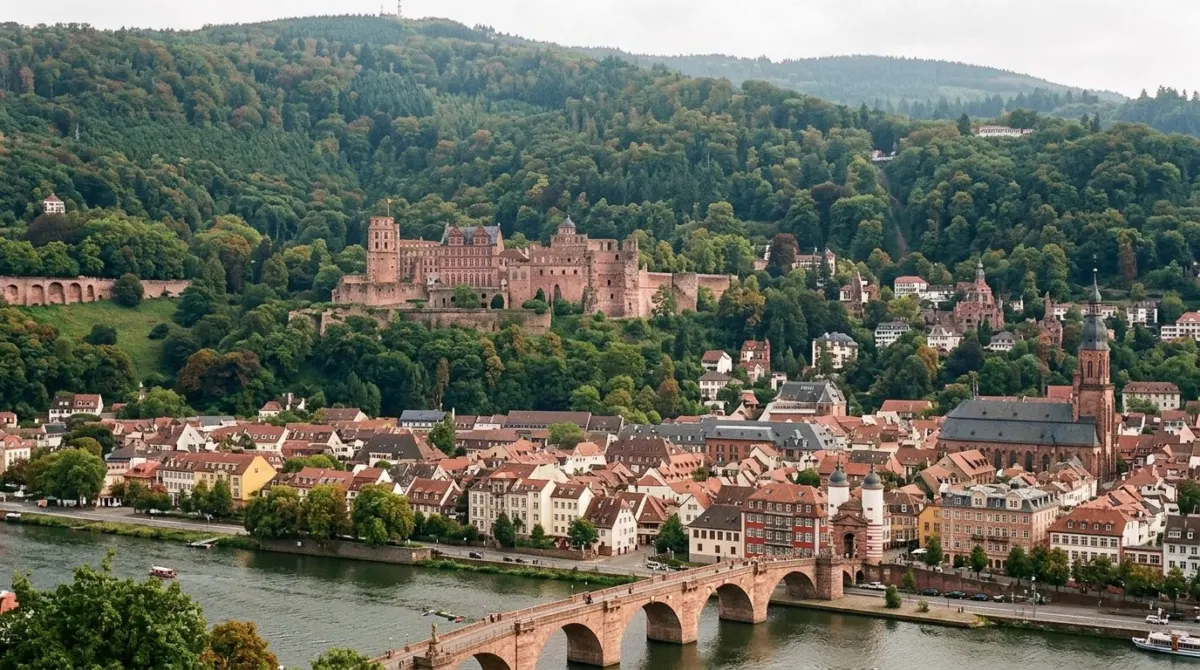
Heidelberg is about an hour by train: a castle above a river, a long pedestrian old town and the oldest university in Germany.
Mainz is forty minutes, with a Romanesque cathedral and the Gutenberg Museum.
The Rhine Gorge begins about an hour away, and the boats between the river towns run from Bingen and Rüdesheim.
Würzburg, ninety minutes away, is the northern end of the Romantic Road.
Few cities in Europe put that many day trips inside ninety minutes, which is what the central position and the rail hub buy you.
Getting around
The centre is walkable end to end in half an hour, and the U-Bahn, S-Bahn and trams cover everything else on one ticket.
The airport is about ten to fifteen minutes by S-Bahn from the Hauptbahnhof, and it has its own long-distance station, so you can arrive by plane and leave by fast train without entering the city.
That connection is the reason Frankfurt works as a first or last night of a German trip even if you have no interest in the city itself.
From the airport to your district
Frankfurt Airport has two stations. The regional station is under Terminal 1, and the S-Bahn lines S8 and S9 run from there to the Hauptbahnhof and on through the centre under the Hauptwache and the Konstablerwache. The long-distance station is a separate building linked to Terminal 1, with fast trains to Cologne, Munich, Berlin and the rest of the country.
If you land at Terminal 2, take the free SkyLine shuttle train to Terminal 1 for the stations.
For Sachsenhausen, change at the Hauptbahnhof to the S-Bahn lines that stop at the Lokalbahnhof and the Südbahnhof; for Westend and the Messe, change there too.
Is the Frankfurt Card worth it?
The standard Frankfurt Card covers public transport in the city, including trips to and from the airport, and gives discounts of up to fifty percent at more than fifty partners, including dozens of museums. It is sold for one or two days, and those days are calendar days rather than twenty-four-hour periods, so buy it in the morning rather than the evening. A cheaper basic version gives the discounts without the transport.
It pays off on a day with an airport trip and two or three museums on the Museumsufer. On a day spent walking the old town and Sachsenhausen, it does not.
What the trade fairs do
Frankfurt hosts some of the largest trade fairs in the world, and during them the accommodation market behaves like Munich’s during Oktoberfest.
Rates across the whole city rise several times over, minimum stays appear, and rooms are sold on non-refundable terms. This is true even in districts far from the Messe, because demand overwhelms supply everywhere.
The Messe publishes its full calendar of fairs well in advance, and it is the first thing to check before choosing dates. Not every event there moves the market; the large international fairs do, and they are the ones that fill the halls across several days.
Before booking flights, it is worth checking whether your dates fall on a major fair. If they do and you cannot move, look at Mainz, Wiesbaden or Darmstadt, all of which are a short train ride away and unaffected.
Seasons and events that move prices
Trade fairs are the main thing that moves Frankfurt’s hotel prices, but not the only one.
The Christmas market runs through Advent across a chain of squares in the centre: the Römerberg, the Paulsplatz, the Hauptwache, the Roßmarkt and the Friedrich-Stoltze-Platz, with the children’s market on the Mainkai. In 2026 it runs from 23 November to 22 December. It is one of the larger markets in Germany, and central rooms on December weekends go early.
The Museumsuferfest, on the last weekend of August, fills both banks of the Main with stages, stalls and late museum openings, and ends with fireworks on the Sunday. In 2026 it ran from 28 to 30 August. Sachsenhausen is at the centre of it, which is wonderful if you came for it and noisy if you did not.
The Dippemess, a traditional fair held in spring and autumn on the fairground on the Bornheim side of the city, is busy with locals but has little effect on hotel prices.
Summer is the slow season for business travel, so July and early August can be good value in the centre, while spring and autumn are when the largest fairs tend to cluster. Check the Messe calendar for your exact dates before anything else.
How many nights, realistically
Most people give Frankfurt one night because a flight forces it, and that night is better spent in the city than at the airport. One night covers the Römerberg, the river and an evening in Sachsenhausen without rushing.
Two nights is the point at which the Museumsufer becomes worth it, and three turns the city into a base for Heidelberg, Mainz and the Rhine. Beyond that the returns fall away quickly, because Frankfurt is small and the day trips are better than the city.
The short version
Stay in the Innenstadt between the Hauptwache and the river for a short visit, or Sachsenhausen across the water for the cider taverns and the museum embankment. The station district is cheapest, roughest and ten minutes from the airport. Check whether your dates fall on a trade fair before you book anything, and remember that weekends here are often cheaper than midweek.
Check Frankfurt availability →
Frequently asked questions
What is the best area to stay in Frankfurt?
The Innenstadt between the Hauptwache and the river for a short visit, or Sachsenhausen across the water if you want the cider taverns and the museum embankment on your doorstep. The station district is cheapest and roughest.
Is the area around Frankfurt Hauptbahnhof safe?
It is the city's red light district with a visible drug scene, and it is unpleasant rather than dangerous for visitors. The transport is excellent — ten minutes to the airport — so for a single night before an early flight it can be worth it, preferably on the northern streets.
Should I stay at Frankfurt airport?
Only for a flight before about seven in the morning, or a long connection where you want a bed. The city centre is ten to fifteen minutes away by train and far more interesting.
Is Frankfurt cheaper at weekends?
Usually yes, which is unusual. The city runs on business travel, so rates are often highest midweek and lowest on Friday and Saturday. Trade fairs override this completely.
How many days do you need in Frankfurt?
One night covers the old town and an evening in Sachsenhausen. Two if you want the Museumsufer. Three or more if you are using it as a base for Heidelberg, Mainz or the Rhine, all under ninety minutes by train.
Is Frankfurt worth visiting?
For a night or two, yes — the reconstructed old town, the skyline and the museum embankment are a genuine city break, and the cider taverns in Sachsenhausen are unlike anything elsewhere in Germany. As a base for the Rhine and Heidelberg it is better still.
Where are the best apple wine taverns in Frankfurt?
In two places: the old quarter of Sachsenhausen, south of the river, which is the best known and the busiest, and Berger Straße in Bornheim, which is more local and less touristy. Both serve the same tavern food, including green sauce and Handkäs mit Musik.
Keep planning Germany
- Where to Stay in Cologne: One Street Back From the Cathedral
- Where to Stay for Oktoberfest: Buy the Walk Home
- Best Hotels in Munich: What the Money Actually Buys
- Where to Stay in Berlin: Pick a District, Not a Hotel
- Where to Stay in Munich: Inside the Ring, or One Stop Out
- How Many Days in Berlin? Four, and Why It Needs More Than Munich
- How Many Days in Munich? Three, and Four If You Use It as a Base
- 10 Day Germany Itinerary: Five Bases, Four Trains
Written and checked by
Triplarks Editorial
An editorial desk, not an invented persona: research, drafting and fact-checking are done by the same small team. Every number here carries the date it was read.