
Driving in Costa Rica is not dangerous. It is slow, and it costs more than the rental quote says. Those are the two things that catch people out, and neither shows up in the brochure.
Some links below are affiliate links. We may earn a commission if you book through them, at no extra cost to you. We do not rank hotels, and any prices on the map come live from the booking sites.
Quick answer: where to stay if you are driving. Pick bases so that you never drive after dark. Most first trips use La Fortuna and Manuel Antonio, both within about three hours of San José airport.
Check hotels in La Fortuna →Check hotels in Manuel Antonio →See them on a map ↓
The short answer: rent a car. A Costa Rica road trip is one of the best in the Americas, and a car turns a series of transfers into an actual trip. But go in knowing the real price and the real drive times, because both are roughly double what the internet first tells you.
This guide covers what it’s like to drive here, what a car really costs, and whether it is the best way to get around Costa Rica for your trip.
Prices, rules and road conditions checked 18 August 2026.
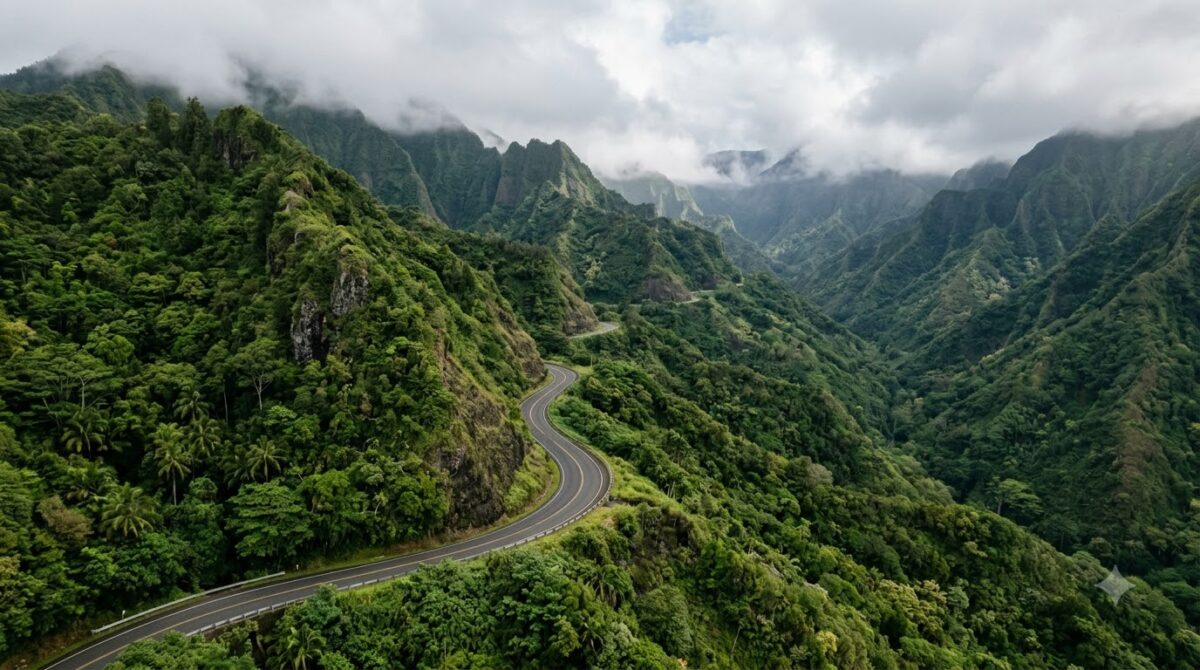
What is it like driving in Costa Rica?
Most roads in Costa Rica are better than US travelers expect and slower than anyone expects, which is why we recommend driving for almost every itinerary but never on a tight schedule.
Imagine a country the size of Denmark with a mountain range down the middle, almost no motorway, and 150 kilometres that takes four hours. That is Costa Rican driving.
- Roads are mostly paved and mostly fine. The horror stories are about the last 10 kilometres to a lodge, not the highway.
- Everything is slower than it looks. Two-lane roads, trucks on hills, roadworks, and no way past.
- Drivers are not aggressive, but they are casual. Overtaking on blind curves is normal. Motorcycles filter constantly.
- Rain changes everything. Afternoon downpours in the green season cut visibility to nothing in minutes.
The single most useful adjustment: add 30 to 50 per cent to whatever your phone says once you leave the main highways. On Ruta 1, Ruta 27 and Ruta 34 the estimates hold. Everywhere else they do not, because the app does not know about the trucks, the potholes or the one-lane bridges.
Should you rent a car in Costa Rica, or take a shuttle?
Rent a car if you are visiting more than two places, travelling with children, or staying anywhere outside a town centre. Take shuttles if you are visiting two bases and would rather not drive.
| Rental car | Shared shuttle | Private driver | |
|---|---|---|---|
| Cost | US$45–75/day all in | US$55–70 per person per leg | US$150–250 per leg |
| Best for | 2+ people, multiple stops | Solo, two bases | Families of four |
| Flexibility | Total | Fixed daily departures | Total |
| Downside | You do the driving | No stops between stops | Price |
Worth being honest about the maths: for two people doing four legs, shuttles run around US$500 total and a car for ten days runs around US$550. The car is not the cheap option — it is the flexible one. Solo travellers genuinely save money on shuttles.
Taking a shuttle is not a downgrade — it is simply a different way to get around Costa Rica, and for some trips the better one. Public buses cover the same routes for a tenth of the price and roughly double the time, usually with a change in San José. Uber works in the capital and patchily in bigger beach towns; it is not a way to move between regions.
Can you drive in Costa Rica with a US driver’s license?
Yes. A valid driver’s license from your home country — the United States, Canada, the UK, the EU and most others — is accepted for as long as your tourist entry stamp is valid, up to 90 days. You do not need an International Driving Permit, though carrying one does no harm if your licence is not in the Latin alphabet.
What you must carry in the car at all times:
- Your drivers license — the physical card, not a photo of it
- Your license and passport together — or a passport copy showing the entry stamp
- The rental agreement and insurance papers, which the agency puts in the glovebox. Rental license plates are not marked differently from local ones, so you are not signposted as a tourist.
Minimum age is usually 21, and most agencies add a young-driver surcharge under 25. Some will not rent to under-23s at all.
Costa Rica car rental: the rental car insurance nobody quotes
This is the single biggest complaint about Costa Rica travel, and it is entirely avoidable if you know about it before you book.
Costa Rican law requires every rental car to carry third-party liability insurance. It is not optional, it cannot be waived, and your credit card’s rental cover does not replace it. Comparison sites almost never include it in the headline rate.
| What you see | What you pay |
|---|---|
| Advertised rate | US$8–15 per day |
| + mandatory liability insurance | US$15–25 per day |
| + optional collision waiver | US$15–30 per day |
| + taxes and fees | varies |
| Real all-in cost | US$45–75 per day |
Three things that will save you an argument at the counter:
- Book direct with an agency that quotes the all-in price. You will not enjoy the number more, but you will not be ambushed by it.
- Expect a hold on your credit card of roughly US$1,000 to US$3,000 if you decline the optional collision waiver. It is a hold, not a charge, but it ties up your limit for the trip.
- Photograph the car before you leave. Every panel, both bumpers, the roof, the windscreen, the wheels, and the fuel gauge. Do the same on return. Damage disputes here are common and photographs end them.
Do you need a 4×4 in Costa Rica?
Usually no. Rental agencies push the upgrade hard because the margin is good.
A standard car is fine for: San José, La Fortuna in San Carlos, Manuel Antonio, Jacó, Costa Rica, Tamarindo, Costa Rica and the rest of Guanacaste Province, Uvita, and the paved road up to Monteverde — outside the wet season. Jaco in particular is an easy hour from the airport on good road.
You want a genuine four-wheel drive — a high-clearance SUV, not a raised hatchback — for:
- The Osa Peninsula and anything near Drake Bay, where river crossings are part of the road
- The dirt coast road down the Nicoya Peninsula — the stretch linking Nosara, Sámara and Santa Teresa fords streams and washes out
- Monteverde in heavy rain
- Anywhere at all in September and October, the wettest months
- Any lodge whose own website mentions 4×4 — they are not upselling, they know their road
If your itinerary is the standard northern loop plus a beach, you do not need one. Our 10 day Costa Rica itinerary runs entirely on paved road.
Costa Rica road conditions: highways, rural roads and potholes
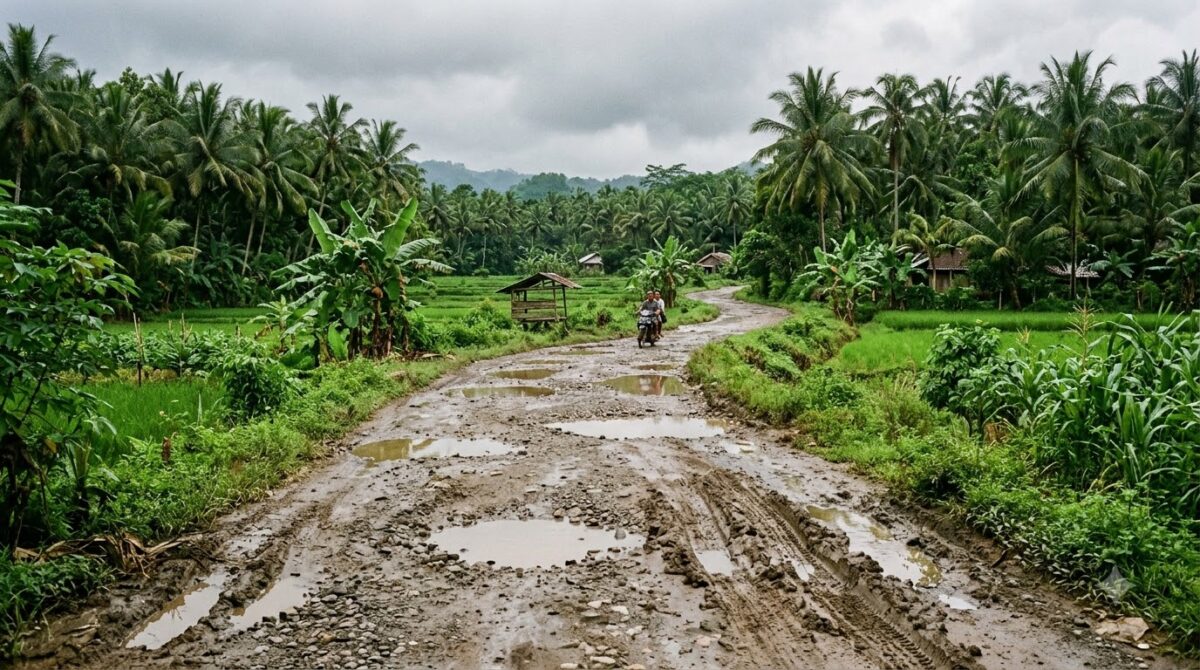
Three tiers, and knowing which one you are on is most of the skill.
- The major routes around Costa Rica — Ruta 1 (the Interamericana Highway 1), Ruta 27 (San José to the Pacific), Ruta 34 (the coastal road). Paved, two lanes mostly, reasonable surface. Ruta 27 is the only stretch that feels like a motorway.
- Secondary paved roads — the majority of your driving. Narrow, no shoulder, no lighting, and potholes that appear overnight after rain. Perfectly drivable at 40–60 km/h.
- Rural roads — gravel, dirt, river rock. This is the last 5 to 20 kilometres to many lodges and beaches. Slow to walking pace in places.
The mountain stretch of the Interamericana south of Cartago towards San Isidro de El General — the Cerro de la Muerte — is the one piece of road worth respecting: 3,300 metres, thick fog most afternoons, and the most demanding driving experience in the country.
About potholes: they are not evenly distributed. A road can be perfect for 20 kilometres then have a crater deep enough to break a rim. Watch the car in front — if it swerves, follow it. That swerve is information, not bad driving.
Costa Rican driving customs and what local drivers do
The written rules of the road are unremarkable. The unwritten ones are what you actually need.
- Motorcycles own the gaps. A motorcycle will filter between lanes, overtake on the right, and appear alongside you in stopped traffic. Check your mirror before every lane change, and never open a door without looking.
- Overtaking on blind curves is normal. Local drivers do it constantly on mountain roads. Expect oncoming vehicles in your lane and leave yourself room to move right.
- Trucks set the pace. A loaded semi-trailer truck climbing a grade on the Interamericana Highway 1 will slow a whole queue to 25 km/h for kilometres. There is nothing to do about it. Budget for it instead.
- Hazard lights mean “I am about to do something”. Slowing suddenly, stopping, reversing, or warning of trouble ahead. Not just a breakdown.
- Roundabouts are chaotic. The San Jose ones in particular. Traffic already on the roundabout has priority in theory; in practice, the more committed vehicle wins.
Motorcycles, trucks and the local driving culture
Two vehicle types dictate the rhythm of Costa Rican roads. A motorcycle will be beside you before you see it, and a truck ahead of you for longer than you would like. Neither is hostile; both are simply part of the driving culture here.
Driving in cities versus rural areas
Cities mean rush hour, one-way grids and aggressive lane discipline. Rush hour in the city of San Jose runs roughly 6.30–9am and 4–7pm and is genuinely bad. Avoid crossing the city at those hours; take the ring road if you can.
Rural areas mean the opposite problem: empty roads, no lighting, dirt roads, livestock, cycling without lights, and no phone signal to call anyone. Different skill, same answer — slow down.
If something goes wrong, call 911 — it is the emergency number throughout Costa Rica and operators generally speak some English. Save your car rental company number in your phone as well — they arrange roadside assistance and are usually faster than anyone else.
Costa Rica road signs and the rules that differ
Road signs are in Spanish and mostly pictorial, so the rules of the road read easily even without the language. The ones worth learning:
| Sign | Means |
|---|---|
| ALTO | Stop |
| CEDA EL PASO | Give way — and on a one-lane bridge, the side with this sign yields |
| PUENTE ANGOSTO | Narrow bridge ahead |
| DESPACIO | Slow down |
| NO ADELANTAR | No overtaking |
| ZONA ESCOLAR | School zone, heavily enforced |
Rules that differ from North America:
- Costa Rica drives on the right side of the road, as in North America and mainland Europe.
- No right turn on red unless a sign explicitly allows it.
- Seat belts are compulsory for everyone, front and back, and enforced.
- Phone in hand while driving is a serious fine. Mount it or leave it.
- Drink-driving limits are low and penalties are severe. Treat it as zero.
- Oncoming drivers flashing headlights are warning you about police, an accident or an animal ahead. It is a courtesy, not an insult.
Map shows live availability and prices. We may earn a commission on bookings made through it, at no extra cost to you.
One-lane bridges and river crossings
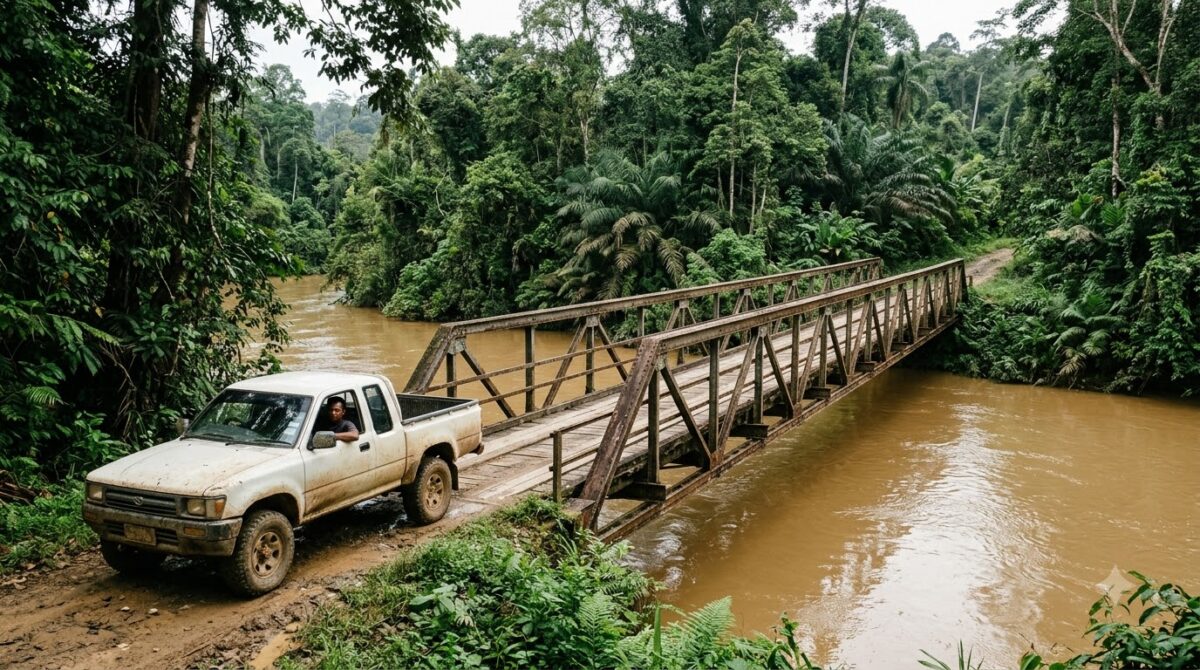
One-lane bridges are everywhere, including on main roads. The rule is simple: whichever direction faces the CEDA EL PASO sign gives way. If you cannot see a sign, the car already on the bridge has right of way, and the polite convention is that the first one clearly committed goes.
Do not stop on the bridge to take a photograph. It happens constantly and it is how tempers flare.
River crossings are a real thing on the Osa Peninsula, parts of Nicoya and some lodge access roads. Three rules:
- Never cross water you have not seen someone else cross. Wait. Someone local will come along.
- Depth is not the only issue. A fast current in 40cm of water will move a vehicle.
- Rental insurance does not cover water damage. Drowning the engine is on you, and it is expensive.
If it has rained hard upstream, a crossing that was ankle-deep in the morning can be impassable by afternoon. This is the main reason lodges tell you to arrive before dark.
Driving in the rainy season
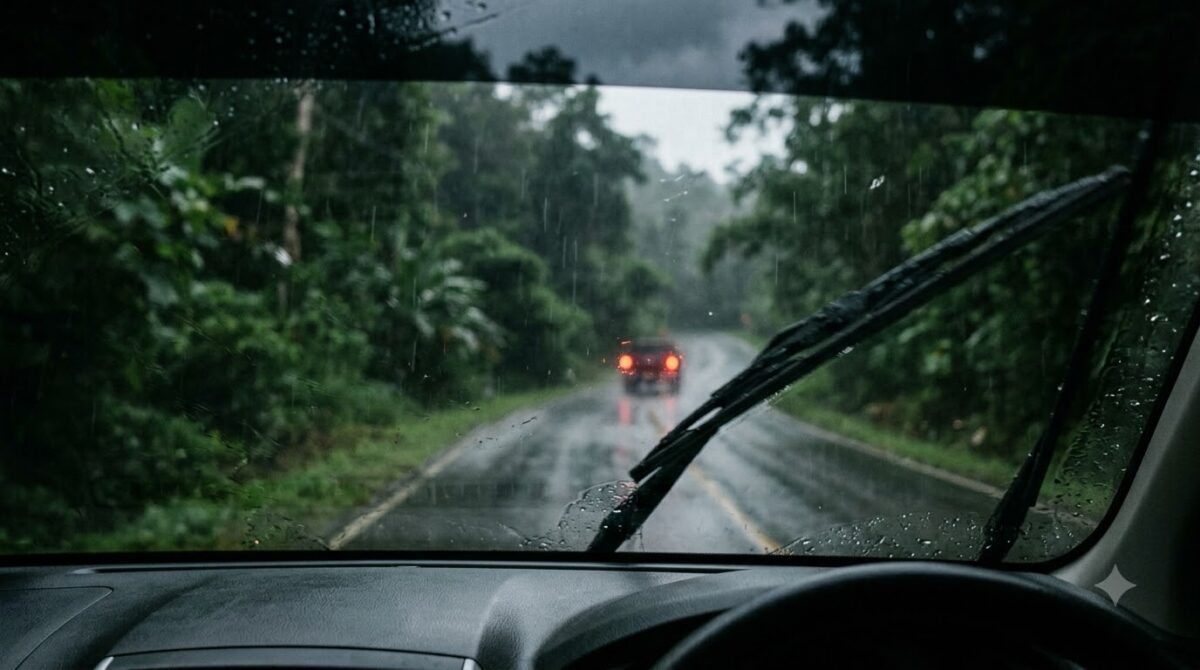
The green season runs May to November on the Pacific side, with September and October the wettest. Rain usually arrives mid-afternoon and falls hard for one to three hours.
- Drive in the morning. This is the whole strategy. Leave early, arrive before the rain.
- Pull over if you cannot see. Hazard lights on, well off the road. Everyone does it.
- Standing water hides potholes. A puddle can be 3cm or 30cm and looks identical.
- Landslides close roads in the wettest weeks, particularly on mountain routes. Ask your hotel before setting out.
See our guide to the best time to visit Costa Rica for how the seasons differ by region.
Why you should avoid driving at night in Costa Rica
Every guide tells you to avoid driving at night in Costa Rica and most do not say why. Here is why.
- No street lighting outside towns. None at all.
- No shoulder and no markings on many secondary roads, so the edge of the road is guesswork.
- Pedestrians and cyclists in dark clothing walk on the road, because there is no pavement.
- Motorcycles without working lights are common outside the cities.
- Potholes are invisible until you are in them.
- Animals — dogs, cattle, and occasionally something more interesting.
It is not about crime. It is that the road gives you no information after dark. Plan every drive to finish by 5.30pm — Costa Rica is close to the equator, so sunset is around 5.30 to 6pm all year with almost no twilight.
Gas stations, tolls and paying for things
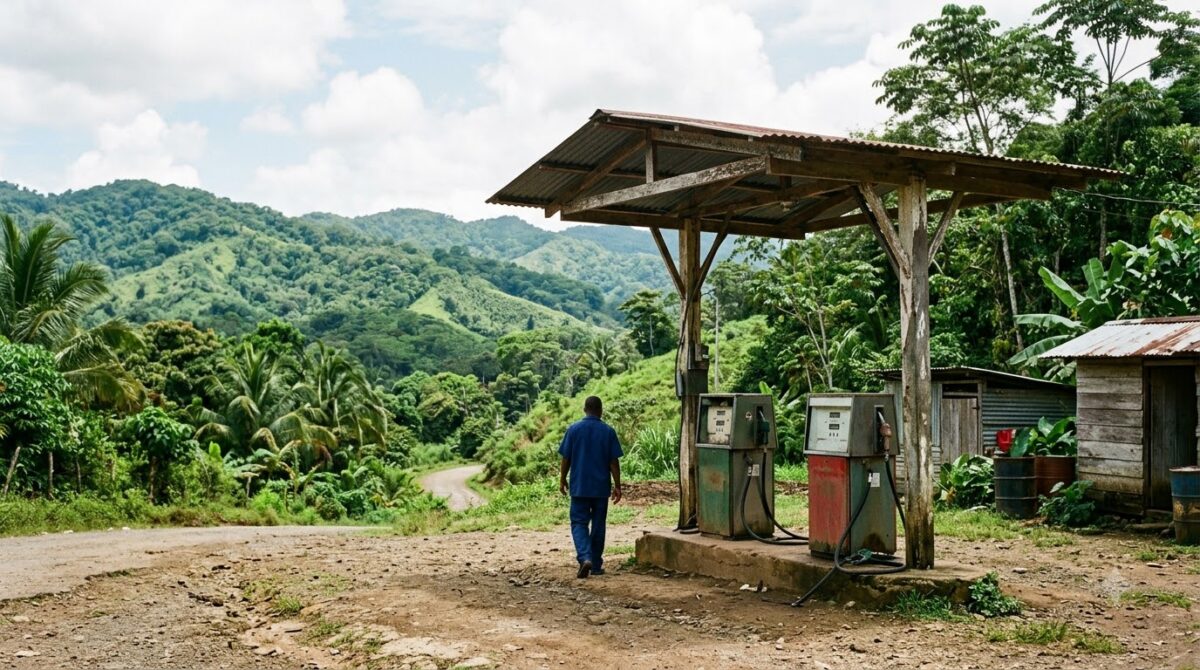
Fuel. Every station is full-service — there is no self-service in Costa Rica. Pull up, say lleno, por favor for a full tank, and pay the attendant. Prices are regulated nationally, so fuel costs the same in San José as in a village, and there is nothing to be gained by shopping around. Cards are accepted almost everywhere. A small tip is not expected.
Stations are sparse outside towns. Fill up when you pass one if you are below half a tank and heading somewhere rural. The Osa Peninsula and the Nicoya coast road are the two places people run dry.
Tolls. Ruta 27 between San José and the Pacific has several toll booths. They are cheap — a few hundred to a couple of thousand colones each — but keep small colones in the car, because not every lane takes cards and none of them love a US$20 note.
Parking. In towns you will meet informal attendants in orange or yellow vests who watch your car for a small tip, usually 500 to 1,000 colones. Paying is normal and worth it. In San José use a guarded lot rather than the street.
If the police stop you
Traffic police — tránsito — run checkpoints, and rental cars get waved down for document checks fairly often. It is routine and almost always nothing.
- Pull over, stay in the car, be polite. Hand over licence and passport copy when asked.
- Fines are never paid at the roadside. A legitimate ticket is written up and either paid at a bank or charged to your rental company later. Anyone asking for cash on the spot is not following procedure.
- You are entitled to a written ticket. Asking for one politely resolves most awkward situations.
Traffic fines in Costa Rica are high by regional standards, and speed cameras exist on the main highways. Rental companies charge tickets to your card afterwards, sometimes months later.
Is it safe to drive in Costa Rica? Car crime and what actually happens
Carjacking is rare and is not the thing to worry about. The real and very common crime is theft from parked cars.
It happens at exactly the places you will stop: trailheads, waterfall car parks, beach access points, viewpoints. Thieves watch for tourists putting a bag in the boot and then walking away.
- Leave nothing visible. Ever. Not a jacket, not a charging cable, not an empty bag.
- Do not put valuables in the boot at the car park. Pack them out of sight before you arrive.
- Never leave passports in the car at all.
- Use guarded parking where it exists. The 1,000 colón fee is the cheapest insurance available.
- Be wary of a stranger pointing at your tyre. The distraction while an accomplice opens the other door is an old routine that still works.
Beyond that, driving here is safe in the ordinary sense. The genuine risk on Costa Rican roads is a night-time collision on an unlit curve, not crime.
Finding your way when there are no addresses
San José, Costa Rica and the rest of the country largely do not use street numbers. Addresses are given by landmark and distance: 200 metres east of the church, 50 metres north of the old fig tree. One cuadra — a block — is counted as 100 metres, and directions are given in cardinal points rather than left and right.
The landmark is sometimes gone. A famously used reference in San José is a fig tree that was removed decades ago and is still in addresses.
- Download offline maps before you go. Mobile coverage disappears in valleys and on the Osa.
- Use Waze rather than Google Maps in Costa Rica for live conditions — locals use it heavily and report closures fast.
- Save your hotel’s exact pin, not its name. Names duplicate; pins do not.
- Ask for the Waze pin when you book a rural lodge. Most send one, and it saves an hour.
Tips for driving in Costa Rica: safe driving the first time
- Add 30 to 50 per cent to every drive time your phone gives you off the main highways.
- Budget US$45–75 per day all in, not the advertised rate.
- Photograph the car at pickup and return. Every panel.
- Arrive everywhere before dark. Plan drives to end by 5.30pm.
- Fill up at half a tank when heading rural.
- Keep small colones for tolls and parking attendants.
- Leave nothing in the car at any trailhead or beach.
- Do not cross a river you have not watched someone else cross.
- Follow the swerve of the car ahead — it is avoiding something.
- Slow down. Almost every problem on this list is solved by driving 15 km/h slower.
Ready to plan the route itself? Our Costa Rica itinerary lays out a 10 day loop with real drive times for every leg, and the 7 day version covers the same ground faster.
Check hotels across Costa Rica →
Frequently asked questions
Is it a good idea to drive in Costa Rica?
Yes, for most trips. The roads are mostly paved and the driving is not dangerous, just slow. A car is what lets you reach the beaches, waterfalls and lodges that shuttles do not serve. The two things to plan for are the real all-in rental cost of US$45 to US$75 a day, and drive times 30 to 50 per cent longer than your phone estimates.
Is renting a car in Costa Rica a good idea?
For two or more people visiting several places, yes. For a solo traveller visiting two bases, shared shuttles at US$55 to US$70 per leg are cheaper. A car for ten days costs roughly the same as four shuttle legs for two people, so the car buys flexibility rather than savings.
Can I drive in Costa Rica with my U.S. driver’s license?
Yes. A valid licence from the US, Canada, the UK, the EU and most other countries is accepted for the length of your tourist entry stamp, up to 90 days. No International Driving Permit is required. Carry your licence and your passport or a copy of the entry stamp in the car.
Are carjackings or car crime common in Costa Rica?
Carjacking is rare. Theft from parked cars is very common, especially at trailheads, waterfall car parks and beach access points. Leave nothing visible in the car, never leave passports in it, do not transfer valuables to the boot in the car park, and use guarded parking where it exists.
Do I need a 4×4 vehicle for driving in Costa Rica?
Not for the main tourist route. A standard car handles San Jose, La Fortuna, Monteverde, Manuel Antonio and the Pacific beach towns in the dry season. You need a genuine high-clearance 4×4 for the Osa Peninsula, the dirt coast road on the Nicoya Peninsula, and for travel in September and October.
What should I know about car rental insurance in Costa Rica?
Costa Rican law requires mandatory third-party liability insurance on every rental. It cannot be waived and your credit card cover does not replace it. It adds US$15 to US$25 a day and is usually missing from advertised prices, which is why a car quoted at US$12 a day actually costs US$45 to US$75.
What are the road conditions like in Costa Rica?
Main highways are paved and in reasonable condition. Secondary roads are narrow with no shoulder, no lighting and potholes that appear after rain. The last few kilometres to many lodges and beaches are gravel or dirt. Almost nothing is motorway, so average speeds are low.
Is it safe to drive at night in Costa Rica?
It is best avoided. There is no street lighting outside towns, no road markings on many secondary roads, pedestrians and cyclists walk on the road in dark clothing, and potholes are invisible. Sunset is around 5.30 to 6pm year round with little twilight, so plan every drive to finish by 5.30pm.
What happens if the police stop me?
Document checks at traffic police checkpoints are routine. Pull over, stay in the car and hand over your licence and passport copy. Fines are never paid at the roadside in Costa Rica: a legitimate ticket is written up and paid at a bank or charged to your rental company. You are entitled to a written ticket.
Rental costs, insurance rules and road conditions read 18 August 2026. Insurance requirements and fine levels change — confirm the all-in price with your rental agency in writing before you travel.