
Two full days in Florence covers the essentials and three is the comfortable answer. A fourth day is only worth it if you are using Florence as a base for Tuscany.
Some links below are affiliate links. We may earn a commission if you book through them, at no extra cost to you. We do not rank hotels, and any prices on the map come live from the booking sites.
Quick answer: where to stay. Book three nights for two full days. Santa Maria Novella station is ten minutes on foot from the Duomo, so a hotel in the centre costs you almost nothing in transfer time.
Check hotels in Florence →Check Santa Croce →See them on a map ↓
Florence is unusual among Italian cities in that the sights are concentrated rather than spread out. The historic center is about a kilometer across, so extra days buy you museums and day trips rather than travel time. That makes the arithmetic clearer here than in Rome.
This is what each day covers, laid out as a Florence itinerary you can follow. Booking rules and opening patterns checked 7 September 2026.
The short answer
| Days in Florence | What you get | Who it suits |
|---|---|---|
| 1 day | Duomo complex, Piazza della Signoria, Ponte Vecchio, one gallery | A stop between Rome and Venice |
| 2 days | The above plus the Uffizi and the Accademia, properly | Most first-time visitors |
| 3 days | The above plus the Oltrarno, Pitti Palace and city views | The comfortable version |
| 4–5 days | Add a Tuscany day trip: Siena, San Gimignano or Lucca | Florence as a base |
Less than three days and something goes: usually the Oltrarno, which is the half of Florence where people actually live. Two days sees the art. Three days sees the city.
Book these before you fly
Planning your trip to Florence starts with three timed tickets, and they shape the days around them.
- The Duomo complex ticket covers the cathedral, Brunelleschi’s dome, the bell tower, the baptistery and the Museo dell’Opera del Duomo. The dome climb requires a reserved time slot and cannot be bought at the door.
- The Uffizi Gallery — timed entry, sells out days ahead in summer.
- The Galleria dell’Accademia — where Michelangelo’s David is. Also timed, also sells out.
Everything else in Florence can be decided on the morning.
Day 1: the Duomo complex and the center
Morning: the cathedral and the dome
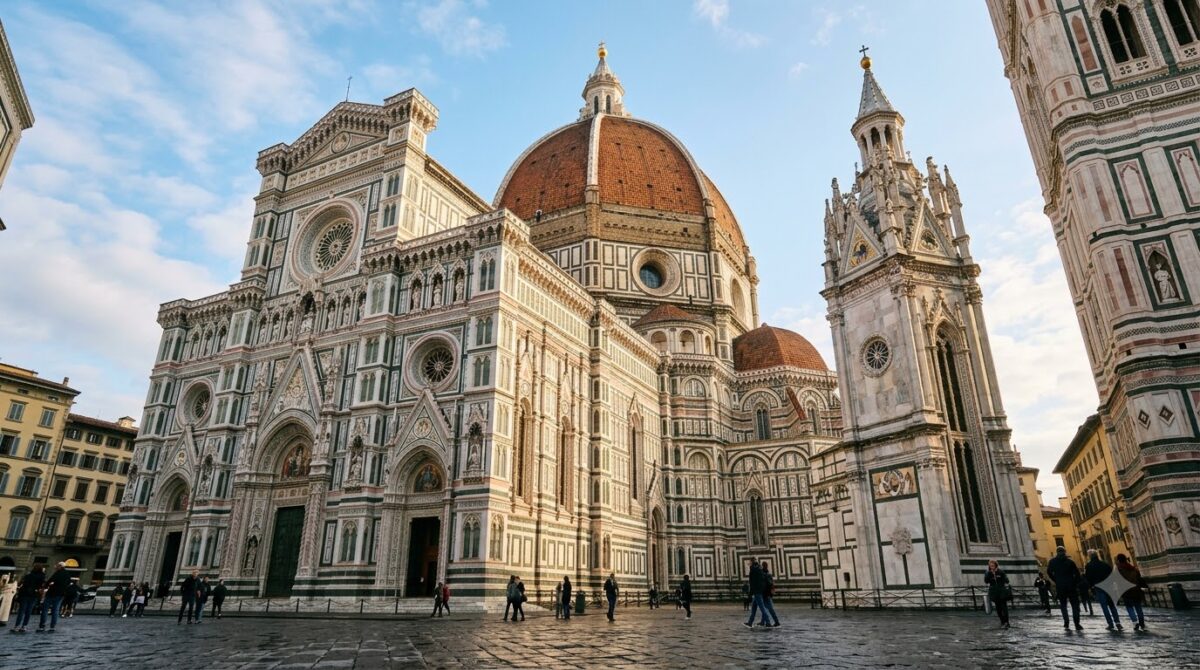
The Duomo complex is the whole morning and it is more than one building.
- The cathedral itself is free to enter and has a queue. The interior is plainer than the facade suggests.
- Brunelleschi’s dome is 463 steps and the reserved slot. The climb goes between the inner and outer shells, which is claustrophobic in places and remarkable throughout.
- Giotto’s bell tower is 414 steps, no reservation needed, and gives you the view with the dome in it. If you only climb one, climb this.
- The baptistery has the gilded doors and a gold mosaic ceiling most people miss.
- Museo dell’Opera del Duomo holds the originals of what is outside. Quiet, air conditioned, and the best of the five for anyone who likes context.
Afternoon: Piazza della Signoria and the Ponte Vecchio
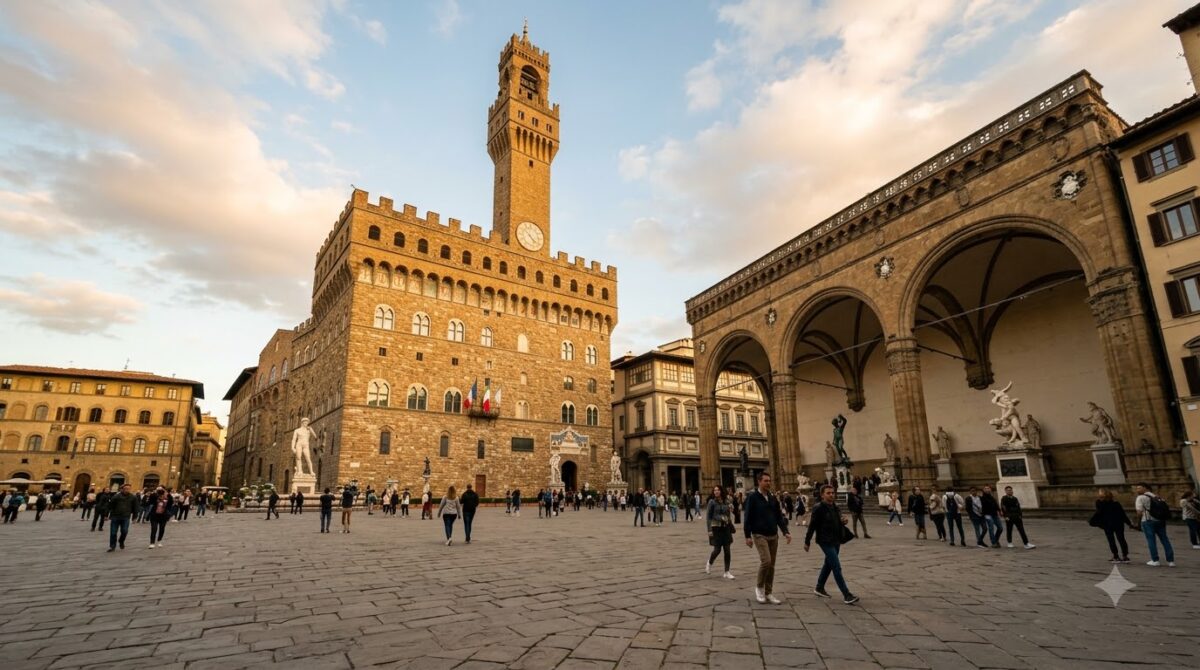
Piazza della Signoria is an open-air sculpture gallery in front of Palazzo Vecchio, and it costs nothing. The Loggia dei Lanzi holds original Renaissance statues you can stand under.
From there it is five minutes to the Ponte Vecchio, the bridge lined with goldsmiths. Walk across, then along the far bank for the view back at it.
Evening: Mercato Centrale or Santa Croce
The upstairs food hall at Mercato Centrale is open late and is the easiest good meal in Florence. Santa Croce, ten minutes east, has the better trattorias.
Map shows live availability and prices. We may earn a commission on bookings made through it, at no extra cost to you.
Day 2: the Uffizi, the Accademia and the Renaissance
Morning: the Uffizi Gallery
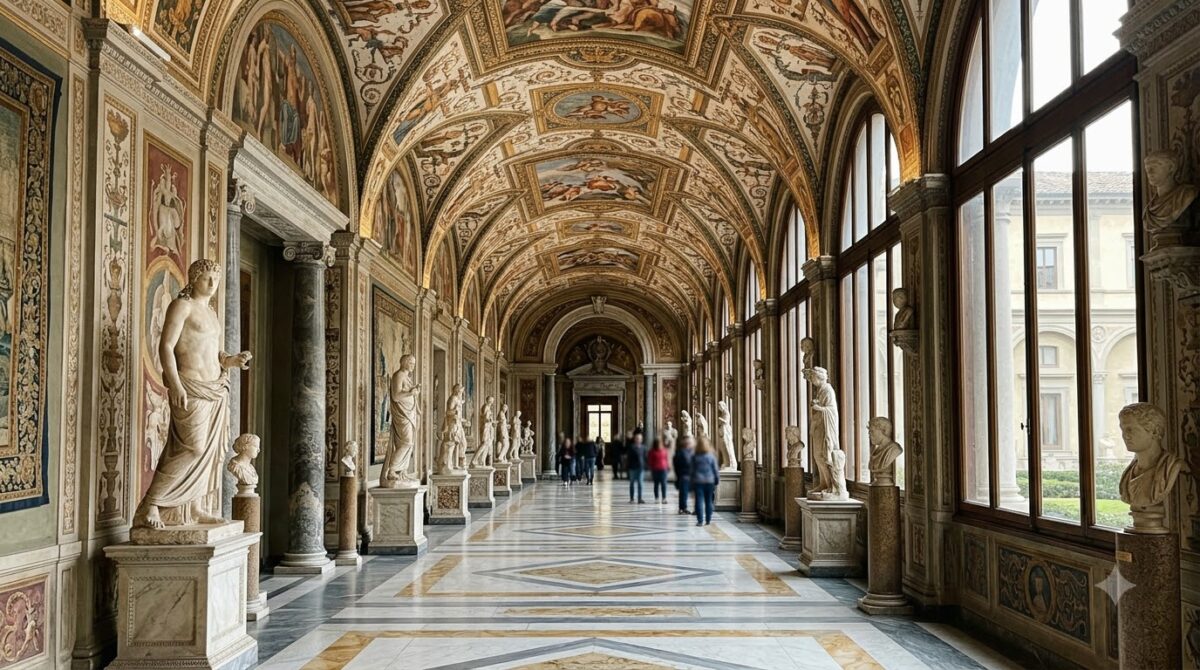
Botticelli, Leonardo, Caravaggio, and a corridor of ancient sculpture. Allow two hours if you are selective and four if you are not, and go at your timed slot rather than drifting in.
The trick most people miss: the Uffizi is a U-shaped building and the second corridor is much quieter than the first. If it is packed, walk on and come back.
Afternoon: the Accademia and San Lorenzo
The Galleria dell’Accademia is small and holds one overwhelming thing: Michelangelo’s David. An hour is enough. It sits north of the Duomo, near San Lorenzo.
While you are there: the Basilica of San Lorenzo and the Medici Chapels, which hold Michelangelo’s tombs for the House of Medici and are far quieter than anything else on this list.
Evening: sunset over the city
The best views of Florence are from outside it. Piazzale Michelangelo is the famous one, about twenty minutes uphill on foot or a short bus ride, and it is free.
Go ten minutes further up to San Miniato al Monte. It is a Romanesque church with a mosaic facade, the same view with a fraction of the crowd, and if you time it right the monks sing vespers.
Day 3: the Oltrarno and the other Florence
This is the day that turns a museum trip into a visit to a city, and it is the first thing cut when people only have two days in Florence.
- The Pitti Palace — the Medici residence across the river, with several museums inside. Pick one rather than trying all.
- The Boboli Gardens behind it — formal Renaissance gardens on a hill, and the only real green space in the center.
- Santo Spirito — a Brunelleschi church with a plain unfinished facade, on a square that fills with locals in the evening.
- The artisan workshops along Via Maggio and the surrounding streets: gilders, framers, leather workers, still doing it.
- The Brancacci Chapel — Masaccio frescoes that changed Western painting, and almost nobody goes.
Where you sleep affects how naturally this day happens. Our guide to where to stay in Florence compares the Oltrarno against the centro storico.
Day 4 and 5: Tuscany day trips
Florence is the best base in Tuscany because the train station is central and the region is small.
| Day trip | Travel | Worth it for |
|---|---|---|
| Siena | 1 hr 30 by bus | The best medieval square in Italy |
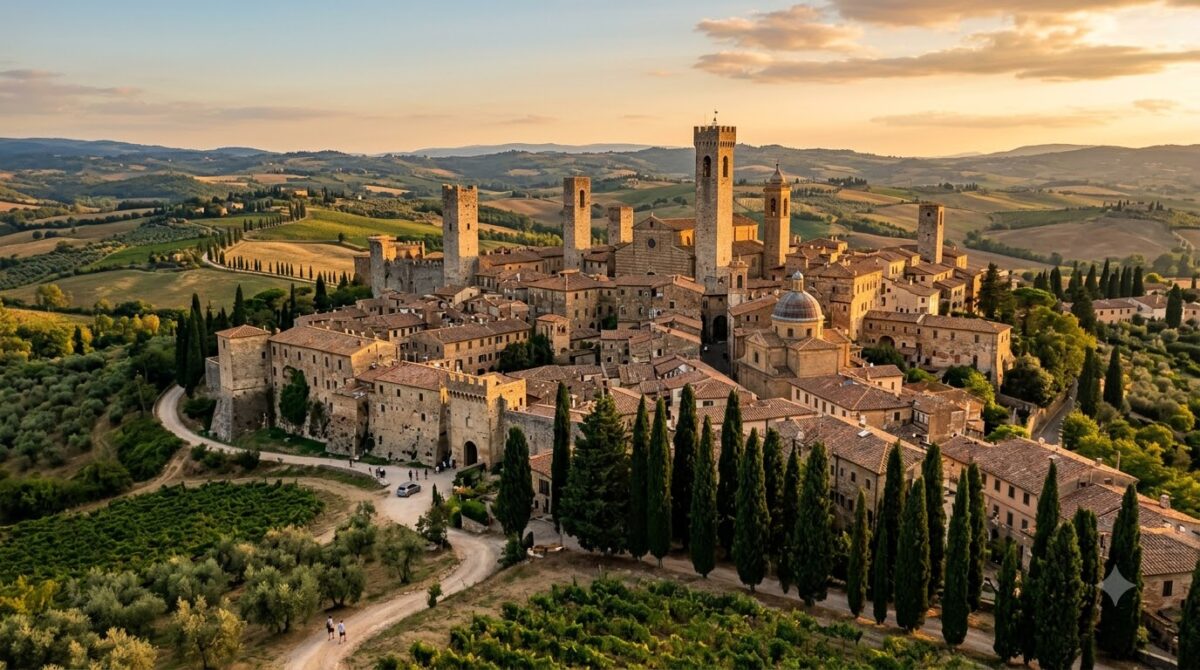
| San Gimignano | 1 hr 30 via Poggibonsi | Medieval towers, hill town views |
| Lucca | 1 hr 20 by train | Cycling the intact city walls |
| Pisa | 1 hr by train | Half a day, not a full one |
| Bologna | 35 min by fast train | The best food city in Italy |
| Chianti and Val d’Orcia | Car or tour | The countryside itself |
Bologna is the underrated one. Thirty-five minutes each way on the fast train, and a better eating day than anywhere in Tuscany.
Is 1 day in Florence enough?
It works as a stop rather than a visit, and plenty of people do it between Rome and Venice.
The realistic single day: Duomo complex in the morning, Piazza della Signoria and Ponte Vecchio at lunchtime, and one gallery in the afternoon. Choose the Accademia over the Uffizi if you want the single most famous object; choose the Uffizi if you want the better museum.
What one day misses: the Oltrarno entirely, the city views, and any sense of Florence outside its three most crowded streets. It is enough to say you have seen the David and not enough to know the city.
What changes the number of days
- Summer heat. Florence sits in a river basin and holds heat badly. In July and August the middle of the day is unusable outdoors, which effectively removes a third of each day.
- Museum closing days. Several major sites close on Mondays, and the Duomo complex has its own pattern. A two day visit landing badly can lose a major site.
- Whether you are doing Tuscany. If San Gimignano and Siena are on the list, you need four or five days, not three.
- Art fatigue is real. Two big galleries in one day is where people stop enjoying it. Space them.
Count nights, not days
The most common way to lose a day in Florence is arithmetic. A train arriving at four in the afternoon and another leaving at ten the next morning is described as two days and is really one evening.
Three nights gives you two full days. Build the timed tickets around the full days, not the arrival or departure ones.
Travel times to know: Rome to Florence is about 1 hour 30 on the fast train, Venice about 2 hours, and Bologna 35 minutes. Santa Maria Novella station is ten minutes on foot from the Duomo, so arriving by train costs you almost nothing in transfer time.
How Florence fits into a trip to Italy
Almost nobody visits Florence alone, and its position on the map does most of the planning for you: it sits between Rome and Venice on the main fast line.
- On a 7 day Italy trip — two nights in Florence, and skip the Tuscany day trips.
- On 10 days — three nights, which is what our 10 day Italy itinerary allows.
- On two weeks — four or five nights, using Florence as the Tuscany base.
If Rome comes first, how many days in Rome answers the same question for the previous stop, where the arithmetic is different because the sights are further apart.
A 3 days in Florence itinerary, condensed
The three day version above, written as a 3-day Florence itinerary you can follow straight through.
| Day | Morning | Afternoon | Evening |
|---|---|---|---|
| 1 | Duomo complex: climb the Duomo or the bell tower, then the Opera del Duomo Museum | Piazza della Signoria, Ponte Vecchio | Mercato Centrale |
| 2 | Guided tour of the Uffizi, or self-guided if you prefer | Accademia, San Lorenzo, Medici Chapels | Piazzale Michelangelo and San Miniato for the best views in Florence |
| 3 | Oltrarno: Pitti Palace or the Brancacci Chapel | Boboli Gardens, artisan workshops | Dinner in Florence on the far side of the Arno |
If you only spend 3 days in Florence, that is the shape. Everything else — day trips from Florence, a week in Tuscany, the Vasari Corridor — belongs to a longer trip.
Things to do in Florence beyond the big three
The Duomo, the Uffizi and the Accademia are the reason most people come. These are what fills the gaps, and several are what make a visit to Florence memorable rather than efficient.
- Basilica di Santa Croce — the burial place of Michelangelo, Galileo and Machiavelli, with Giotto frescoes. The most rewarding of the churches in Florence after the cathedral.
- The Vasari Corridor — the elevated private passage the Medici built from Palazzo Vecchio across the Ponte Vecchio to the Pitti Palace. Access is limited and worth checking.
- Stroll along the Arno at either end of the day. The light on the river at dusk is the thing photographers come back for.
- Palazzo Vecchio — climb the tower for a view of the Duomo from directly across the rooftops.
- The first Sunday of the month is free entry at state museums including the Uffizi and the Accademia. It is also the busiest day of the month, so it is a trade rather than a bargain.
- A small group tour of the Uffizi is worth it if Renaissance art is new to you. Without context the gallery is a long corridor of religious paintings; with it, it is the story of how painting changed.
The historic center of Florence is a UNESCO World Heritage Site in its entirety, which is a useful way to think about the city: the streets between the sights are part of the site, not the gaps between it.
Day trips from Florence, in order of worth
If you have four or five days, these are the best day trips from Florence, and they are the reason to extend rather than to add another museum.
- A day trip to Siena — the Campo is the finest medieval square in Italy, and the cathedral is more beautiful than Florence’s. Ninety minutes by bus, which is faster than the train.
- San Gimignano — the towered hill town, best combined with Siena on a single tour or a long self-drive day.
- Bologna — 35 minutes each way, and the best eating day available from Florence.
- A day trip to Chianti — vineyards and small towns in Tuscany between Florence and Siena. Needs a car or a tour, since public transport does not serve it.
- Lucca — cycle the intact Renaissance walls, an hour and twenty by train.
- A Cinque Terre day trip — possible at roughly two and a half hours each way, and honestly too far for a day. Give it an overnight or skip it.
Either stay in Florence and day trip out, or give Tuscany its own base. Doing both badly — two nights in Florence, two in the country — means two packing days out of four.
The best views in Florence
Worth its own section because the view of the Duomo is what people remember, and there are five ways to get it.
- Giotto’s bell tower — the only climb that puts the dome itself in the picture. 414 steps.
- Climb the Duomo — higher, more remarkable, and you cannot see the dome from on top of it. Reserved slot required.
- Palazzo Vecchio tower — lower, quieter, and a fine view across the rooftops.
- Piazzale Michelangelo — the classic postcard, free, twenty minutes uphill.
- San Miniato al Monte — ten minutes above Piazzale Michelangelo, same view, far fewer people, and a Romanesque church worth the walk on its own.
Go morning or late afternoon. Midday flattens the light and the hill viewpoints face north-west, so late afternoon is when the city glows.
Booking, and the one mistake that costs a day
Tickets sell out days in advance for the Uffizi, the Accademia and the dome climb, and in high season it can be a week. Book tickets well in advance rather than assuming you can queue.
The mistake that costs people a day is arriving without those three booked, discovering the next available slot is in four days, and spending the visit to Florence looking at the outside of buildings. There is a lot to see in Florence without a ticket, but not the three things you came for.
Florence is one of the few cities where this genuinely matters, because the supply is fixed and small. Venice and Rome have more capacity; Florence does not.
Adding the countryside? See our Tuscany itinerary for how the car half of the trip works.
Frequently asked questions
How many days do you need in Florence?
Two full days covers the Duomo complex, the Uffizi, the Accademia and the historic center. Three is the comfortable answer because it adds the Oltrarno and the city views. Four or five only makes sense if you are using Florence as a base for Tuscany day trips.
Is 2 days in Florence enough?
Yes for the art and the center. Day one covers the Duomo complex and Piazza della Signoria, day two the Uffizi and the Accademia. What two days cuts is the Oltrarno, the Pitti Palace and the views from Piazzale Michelangelo, which is the half of Florence where people actually live.
Is 3 days in Florence too many?
No, three is the comfortable number. The third day adds the Oltrarno, the Boboli Gardens, the Brancacci Chapel and sunset from San Miniato al Monte, none of which fit into two days. It also spaces the two big galleries out, which matters more than people expect.
What should I book in advance for Florence?
Three things: the Duomo complex ticket, because the dome climb needs a reserved time slot and cannot be bought at the door; the Uffizi Gallery; and the Galleria dell Accademia. All three use timed entry and all three sell out days ahead in summer. Everything else can be decided on the morning.
Can you see Florence in one day?
You can see the center. The Duomo complex in the morning, Piazza della Signoria and Ponte Vecchio at lunchtime, and one gallery in the afternoon is a realistic single day between Rome and Venice. It misses the Oltrarno and the city views entirely.
What is the best day trip from Florence?
Siena for the medieval square, San Gimignano for the towers, or Bologna for the food. Bologna is the underrated choice at 35 minutes each way on the fast train. Pisa is an hour away and is genuinely half a day rather than a full one.
Should I climb the dome or the bell tower in Florence?
The bell tower, if you climb only one. Giotto bell tower is 414 steps against 463 for the dome, needs no reservation, and gives you the view with Brunelleschi dome in it rather than from it. The dome climb is the more remarkable experience, going between the inner and outer shells, but it must be booked ahead.
How many nights should I book in Florence?
Three nights for two full days, four for three. Arrival and departure days are not sightseeing days: a train in at four and out at ten the next morning is one evening. Build the timed museum tickets around the full days rather than the travel ones.