Quick answer
Two nights in Oslo, two on the Sognefjord and two in Bergen, joined by the Bergen railway and the Flam line. Book the fjord accommodation first — Flam and Aurland have very few rooms — then the train tickets for the saver fares.
On this page
- 7 day Norway itinerary at a glance
- Day 1 — arrive in Oslo
- Day 2 — Oslo’s museums
- Day 3 — the railway day
- Day 4 — the fjord
- Day 5 — west to Bergen
- Day 6 — Bergen
- Day 7 — a last fjord, or the city
- A plan for the wet days
- What to book in advance
- What this week leaves out
- Doing the week in the other direction
- The Norway in a Nutshell question
- What a week costs, roughly
- When to take this week
- Where to stay on this week
- The variations worth knowing
- Adding an eighth day
- Finse and the Rallarvegen
- Common mistakes on the classic week
- The short version
- Frequently asked questions
Seven days is the natural length for a first trip to Norway, because the classic route has exactly that shape: two cities, one railway, one fjord, and no internal flights.
Some links below are affiliate links. We may earn a commission if you book through them, at no extra cost to you. We do not rank hotels, and any prices on the map come live from the booking sites.
This is that week day by day. For the reasoning behind it, see our Norway itinerary; for other lengths, how many days in Norway.
7 day Norway itinerary at a glance
| Day | Where | Doing |
|---|---|---|
| 1 | Oslo | Arrive, the waterfront, the opera house |
| 2 | Oslo | Bygdøy museums, the Vigeland park |
| 3 | Oslo to Flåm | The Bergen railway and the Flåm line |
| 4 | The Sognefjord | The Nærøyfjord by boat |
| 5 | Flåm to Bergen | Boat or train west |
| 6 | Bergen | Bryggen, the funicular, a museum |
| 7 | Bergen | A fjord trip or the city, then fly |
Where to sleep on this route
Day 1 — arrive in Oslo
The airport train takes about twenty minutes to the central station. Two trains leave from the same platform: the express and the cheaper regional service.
Use the afternoon on the waterfront: the opera house, whose sloping roof is a public space you walk up, the fortress above the harbour, and dinner in the centre or in Grünerløkka.
Day 2 — Oslo’s museums
The ferry from the city hall pier to Bygdøy takes about ten minutes in summer and lands beside the museums: the Viking ships, the Fram polar vessel, the Kon-Tiki raft and the open-air folk museum.
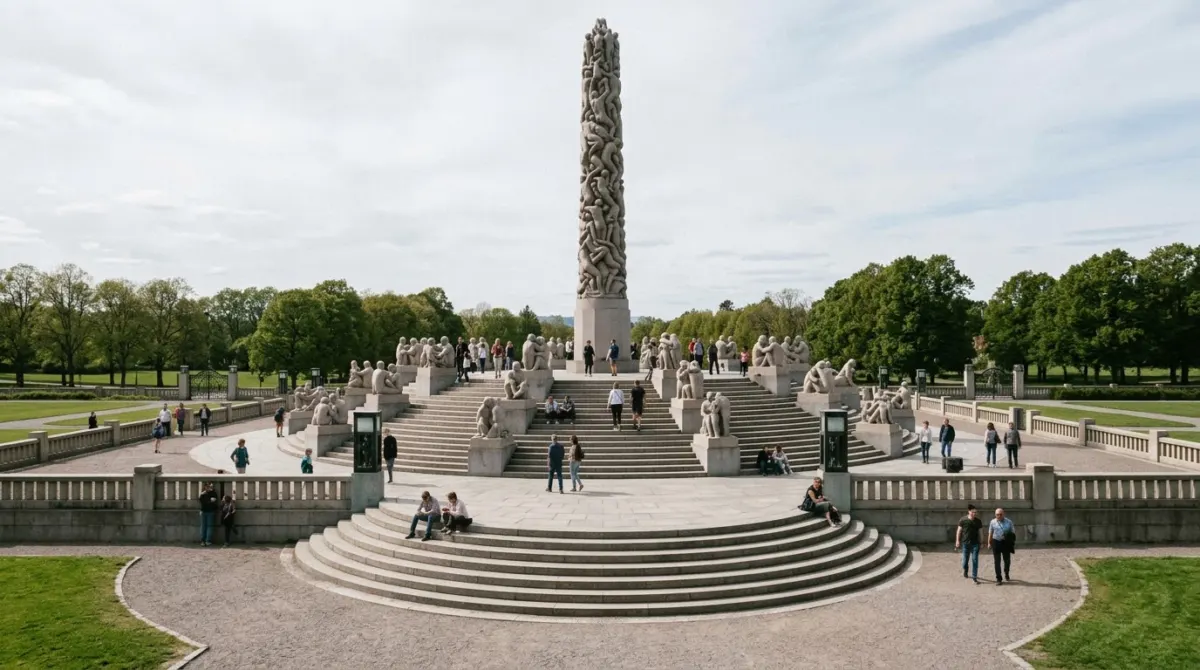
In the afternoon, the Vigeland sculpture park, which is free and open at all hours, or the National Museum in the centre.
Pack tonight: tomorrow is an early start.
Day 3 — the railway day
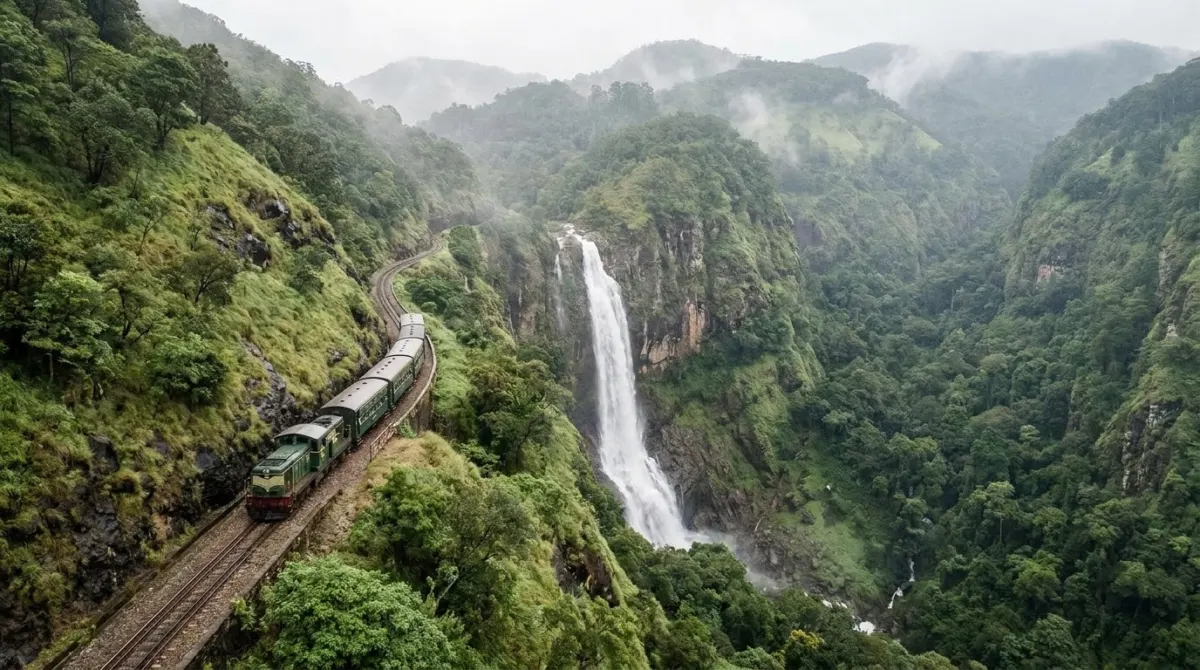
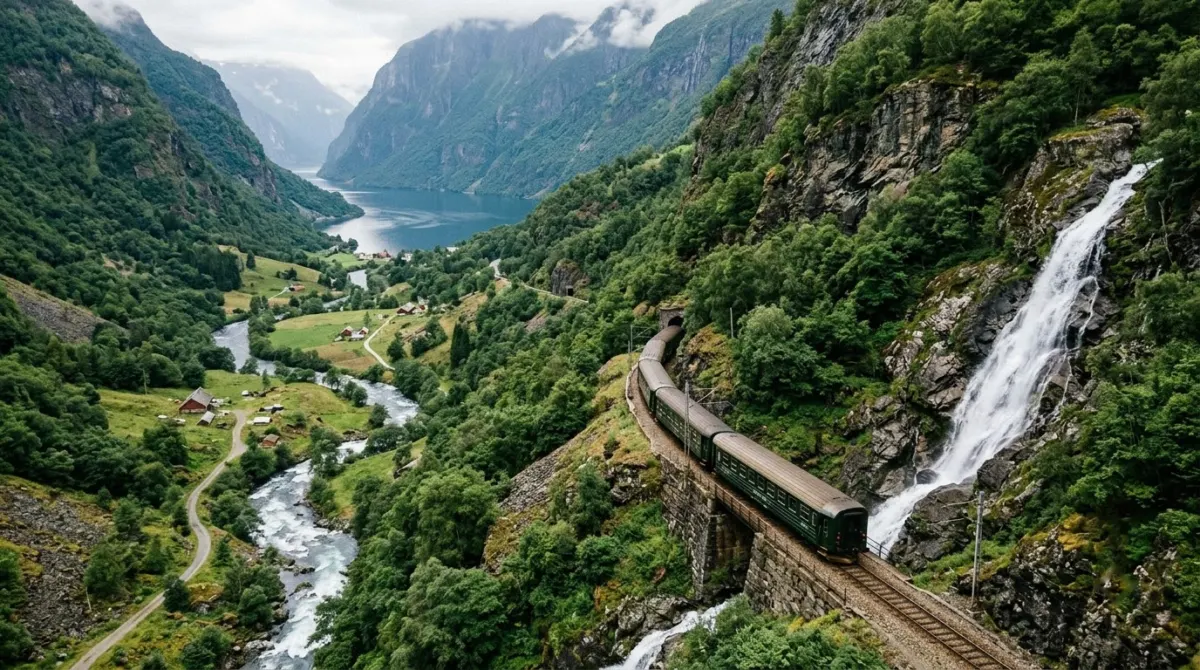
The Bergen railway climbs from Oslo over a high plateau above the tree line, and it is one of the great train journeys in Europe rather than a transfer.
At Myrdal, change for the Flåm railway, which drops twenty kilometres down a valley to the fjord — one of the steepest standard-gauge lines in the world, with a waterfall stop on the way.
Sleep at Flåm or, better, at Aurland five minutes away, which is quieter.
Map shows live availability and prices. We may earn a commission on bookings made through it, at no extra cost to you.
Day 4 — the fjord
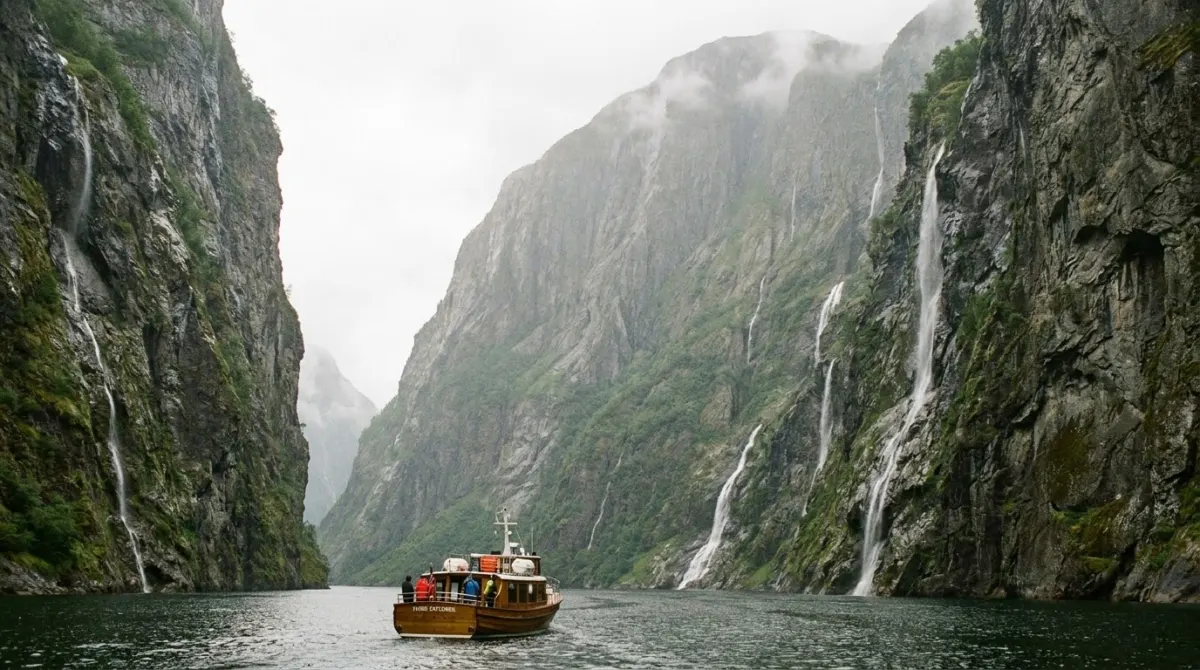
The boat from Flåm through the Nærøyfjord to Gudvangen takes about two hours. It is the narrowest navigable fjord in the world, a UNESCO site, and the reason most people come to Norway.
Return by bus over the mountain road, or stay out and walk. In the afternoon, the Stegastein viewpoint above Aurland, a platform that projects out over the fjord six hundred metres below.
This is the day the whole week is built around, which is why you have two nights here.
Day 5 — west to Bergen
Two ways to do it, and both are good.
By express boat down the Sognefjord, which takes about five hours and is a sightseeing day in itself.
By train, back up the Flåm line to Myrdal and onwards to Bergen, which takes about three hours and completes the railway.
Arrive in Bergen with the evening free. Our guide to where to stay in Bergen explains why to stay near the harbour.
Day 6 — Bergen
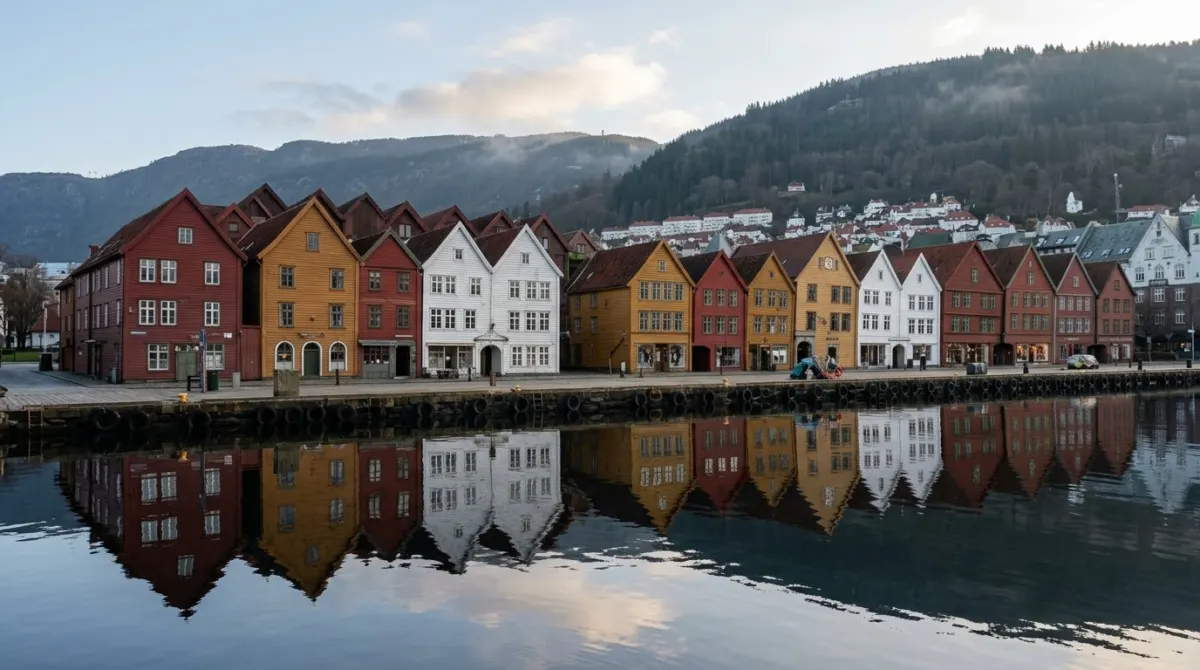
Bryggen, the wooden Hanseatic wharf, early before the cruise passengers arrive, and the narrow passages behind it. The fish market opposite for lunch.
In the afternoon the Fløibanen funicular up Fløyen, with trails and a view over the islands at the top, or KODE, the four art museums around the city lake.
Day 7 — a last fjord, or the city
If your flight is late, take a fjord boat from the harbour — the Mostraumen trip takes about three hours and is the easiest fjord excursion in Norway.
If it is early, walk the city and fly out. Bergen airport is about twenty minutes from the centre by road; the Bybanen light rail takes about three-quarters of an hour but runs from the terminal to the centre with no change.
A plan for the wet days
Bergen earns its reputation for rain, and on a seven-day trip at least one day will probably be grey. The answer is an indoor list for each base rather than a lost day.
In Bergen: KODE, the art museums around the city lake, with one of the strongest Munch collections outside Oslo; Bryggens Museum, built over the excavated remains of the medieval town behind the wharf; and the aquarium out at Nordnes. The Fløibanen funicular runs in the rain too, though the view at the top depends on the cloud.
In Oslo: the National Museum and MUNCH on the waterfront, each big enough for a whole morning, and the Fram and Kon-Tiki museums on Bygdøy, which are indoors once you are off the ferry.
On the fjord: the Flåm Railway Museum beside the station, and the Nærøyfjord boat itself, which is atmospheric in low cloud in a way a viewpoint is not. Move the Stegastein visit to whichever afternoon is clearest, since a platform above a fjord full of cloud shows you nothing.
What to book in advance
- The Bergen railway and the Flåm line, where the cheap fares go early in summer.
- Accommodation at Flåm or Aurland, which has very few rooms.
- The Nærøyfjord boat in July and August.
Everything else can be left open, and the Bergen days should be, because the weather decides what is worth doing.
What this week leaves out
Lofoten and Tromsø, which need a flight and three days of their own.
Geiranger and the northern fjords, which need a car.
Stavanger and Preikestolen, south of Bergen.
Each is a reason for a ten-day or fourteen-day trip rather than a gap in this one.
Doing the week in the other direction
Bergen to Oslo works identically and has one practical advantage: the long rail day comes at the end, when you have already seen the fjord, rather than in the middle.
It also suits flights better for many visitors, since Bergen has direct services from a number of European cities, and it means you finish in a capital rather than at the fjord, which some people prefer.
The only real argument for starting in Oslo is that the Flåm line is more dramatic descending than climbing, and in the Oslo-first direction you come down it.
The Norway in a Nutshell question
The packaged version of this route sells the Bergen railway, the Flåm line, the Nærøyfjord boat and the Gudvangen bus as a single ticket, often done in one very long day.
The route is excellent. The one-day version is the problem: you see the fjord through a window for two hours and arrive somewhere in the dark.
The components can all be booked separately for the same journeys spread over two or three days, which is what this itinerary does. That is the same trip with the fjord actually in it.
What a week costs, roughly
Norway is expensive, and the costs fall in a predictable order: food first, then transport, then accommodation.
Three things make a real difference. Hotel breakfasts, which are substantial and usually included. Supermarket lunches, which is normal Norwegian behaviour rather than a budget tactic. And booking train tickets early, where the saver fares are a fraction of the walk-up price.
What is free is the landscape, and the right to roam means walking almost anywhere on uncultivated land.
When to take this week
June to August for the longest days, all boats running and the best chance of clear weather, with the most visitors.
May and September for fewer people with everything still operating, and in late May the waterfalls at full volume from the snowmelt.
October to April is a different trip: the Flåm line runs year-round but fjord boats reduce, daylight shortens sharply, and the week stops working as written.
Where to stay on this week
Oslo: Sentrum, near the central station, because day three starts with an early train.
The fjord: Aurland rather than Flåm if you can, since it is quieter and the Stegastein viewpoint is above it. Both have very few rooms.
Bergen: near the harbour, where the ferries, the market and the funicular all are.
Our guides to Oslo and Bergen cover the districts in detail, and the fjord village accommodation is the booking to make first.
The variations worth knowing
Add a night at Voss if you want activities — rafting, paragliding and the gondola — between the fjord and Bergen.
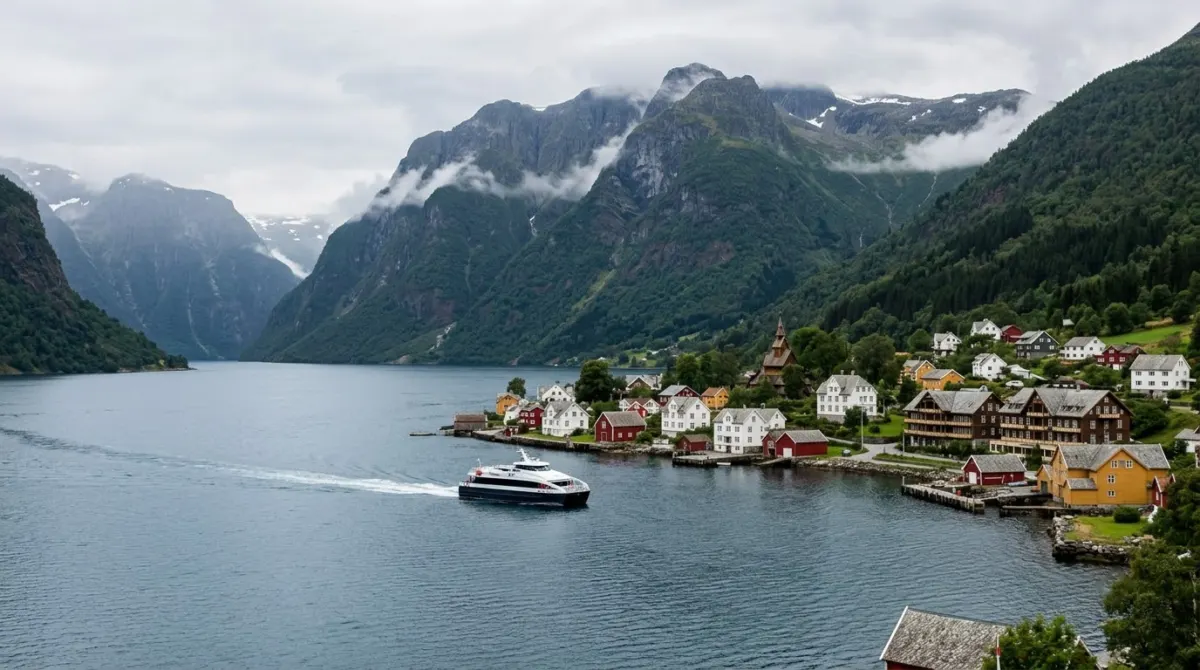
Swap Flåm for Balestrand, further along the Sognefjord, which is quieter and reached by express boat.
Add Stavanger and Preikestolen south of Bergen, which turns the week into nine days.
All three keep the shape of the itinerary and change its texture.
Adding an eighth day
If the week stretches by one day, the most valuable addition is a third night on the fjord rather than a new place.
That gives you a walking day — the trail from Aurland over the mountain, or the valley paths above Flåm — and a spare morning if the first fjord day was cloudy.
The alternative, if you would rather move, is a night at Voss between the fjord and Bergen, which puts rafting, paragliding and a cable car into the week.
Finse and the Rallarvegen
The Bergen railway’s highest point is also its most interesting stop. Finse, at 1,222 metres, is Norway’s highest railway station: a hotel, a few cabins and a lake on the open plateau below the Hardangerjøkulen glacier, with no road in.
In summer it sits on the Rallarvegen, the navvies’ road built to construct the railway, which runs from Haugastøl through Finse and Myrdal down to Flåm. It is protected as a cultural monument and is one of the best-known cycle routes in Norway. Most riders go westwards, because the plateau is high and Flåm is at sea level, and bikes can be hired at Haugastøl, Finse and Flåm.
For this week, the active version of day three is to leave the train at Finse, cycle the stretch down to Myrdal and Flåm, and arrive at the fjord by bike rather than on the Flåm line. The season is short — roughly July to late September, depending on snow — and early on parts of the plateau are still white, when Visit Norway suggests taking the train over the highest section.
Outside that window, watch for Finse from the train. It is the point where the line is most obviously above the tree line, and the reason the journey counts as a sight rather than a transfer.
Common mistakes on the classic week
Collecting a rental car in Oslo. This route runs on trains and boats, and the car would sit in a car park for two days.
One night on the fjord. The weather needs a second chance, and the fjord is the reason for the trip.
Doing the Nutshell loop in a day. The same journeys spread over two or three days cost little more and give you the fjord rather than a window.
Leaving the train tickets to the last minute. Saver fares on the Bergen line are a fraction of the walk-up price.
The short version
Two nights in Oslo, the Bergen railway and the Flåm line on day three, two nights on the fjord at Flåm or Aurland, two in Bergen, and fly home from there. Book the fjord accommodation first and the train tickets second, keep the Bergen days flexible for the weather, and do not compress the whole route into a single Nutshell day.
Frequently asked questions
What is the best 7 day Norway itinerary?
Two nights in Oslo, the Bergen railway and the Flåm line as a travel day, two nights on the Sognefjord and two in Bergen. It needs no internal flights and runs entirely on trains and boats.
Is 7 days enough for Norway?
For the southern fjords, yes — it is the natural length for the classic route. It is not enough to add Lofoten or Tromsø, which need a flight and three days of their own.
Should I stay in Flåm or Aurland?
Aurland if you can. It is five minutes from Flåm, considerably quieter, and the Stegastein viewpoint above it is one of the best things on the route.
Is the Flåm railway worth it?
Yes. It drops twenty kilometres down a valley from the main Bergen line and is one of the steepest standard-gauge railways in the world, with a waterfall stop on the way.
Should I take the boat or the train from Flåm to Bergen?
The express boat down the Sognefjord takes about five hours and is a sightseeing day; the train takes about three and completes the railway. Both are good, and the boat is the better one in clear weather.
What should I book in advance for a week in Norway?
The Bergen railway and Flåm line tickets for the cheap fares, accommodation at Flåm or Aurland because there are very few rooms, and the Nærøyfjord boat in July and August.
Keep planning Norway
- Where to Stay in Tromso: Central, Because the Tours Leave From There
- Where to Stay in Bergen: Close to the Harbour, Because of the Rain
- Where to Stay in Oslo: Sentrum First, Then the Districts
- Best Hotels in Oslo: The Pricing Runs Backwards Here
- How Many Days in Norway? Seven for the Fjords, Ten for the Arctic
- How Many Days in Oslo? Two, and Three If You Like Museums
- How Many Days in Bergen? Two, and the Rain Is the Reason
- 5 Day Norway Itinerary: One City and One Fjord
Written and checked by
Triplarks Editorial
An editorial desk, not an invented persona: research, drafting and fact-checking are done by the same small team. Every number here carries the date it was read.