Food
German Dishes by Region: Traditional German Food and Where to Eat It
By Nora Castell Checked
Hotel links open Stay22 (Booking.com and Agoda) and tour links open GetYourGuide. We may earn a commission at no extra cost to you.
Where to stay to eat well in Germany
Pick the city by the food. Munich for beer halls and pork knuckle, Berlin for currywurst and street food, Stuttgart for Maultaschen and spätzle.
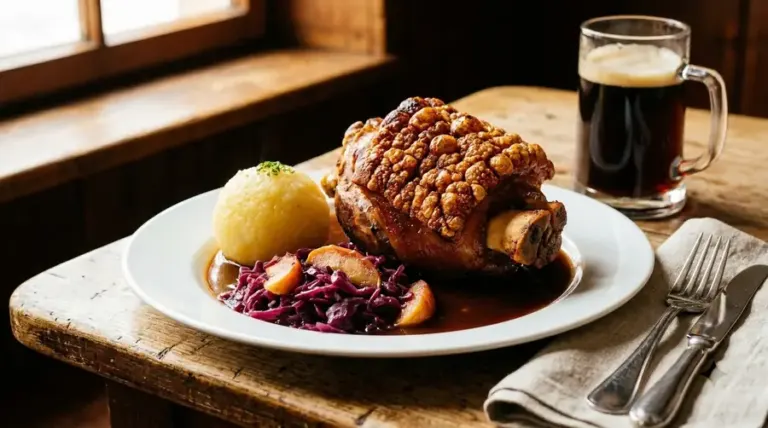
Illustration Check hotels in Munichor compare on AgodaFirst trip
Munich
Classic Bavarian food, beer gardens and the Viktualienmarkt in one walkable centre.
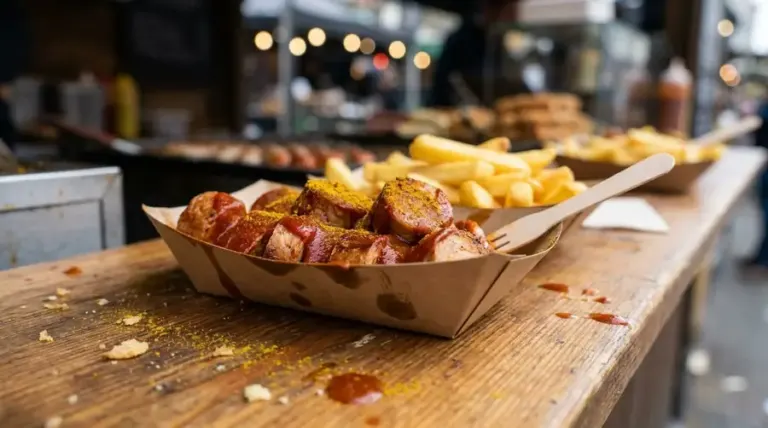
Illustration Check hotels in Berlinor compare on AgodaBest for street food
Berlin
Currywurst, döner kebab and old Berlin cooking, plus food from everywhere.
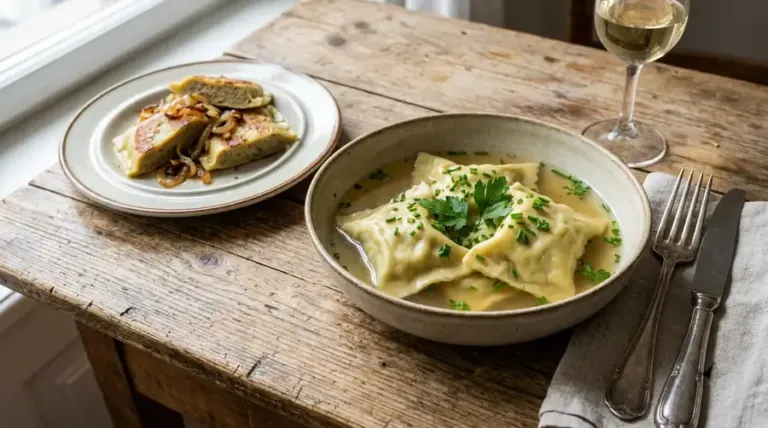
Illustration Check hotels in Stuttgartor compare on AgodaBest for home cooking
Stuttgart
Swabian pasta, lentils with spätzle and wine taverns inside the city.
On this page
- Traditional German food by region: the menu
- Where to eat traditional German dishes, region by region
- Berlin: currywurst, döner kebab, Eisbein and a street food tour
- Munich and Bavaria: traditional Bavarian food, Weißwurst, pork knuckle and pretzel
- Nuremberg and Franconia: Rostbratwurst, Schäufele and Lebkuchen
- Cologne and the Rhineland: Kölsch, sauerbraten, Halve Hahn and potato pancakes
- Frankfurt and Hesse: green sauce with sour cream, Handkäs mit Musik and apple wine
- Hamburg and northern Germany: Fischbrötchen, Labskaus and Franzbrötchen
- The Black Forest and Baden: Black Forest cake, Black Forest ham and Flammkuchen
- Stuttgart and Swabia: Maultaschen, spätzle and lentils with sausages
- The best German dishes: the top 10 to try first
- How German cuisine works: the German restaurant, the beer hall and the side dish
- German sausage: bratwurst, Weißwurst and currywurst
- German potato dishes: boiled potatoes, potato dumplings and German potato pancakes
- German soup: comfort food in a bowl
- German sauerkraut and red cabbage
- German meat dishes and gravy: sauerbraten, Rouladen and the braise
- German bread, pretzels and the Abendbrot
- Delicious German cakes and German desserts
- Oktoberfest food and German Christmas food
- Dresden, Leipzig and Thuringia: the east
- When to eat what: German food by season
- Ordering words
- When Germans eat
- Hotels near the food in Munich, with live prices
- Famous German food: FAQ
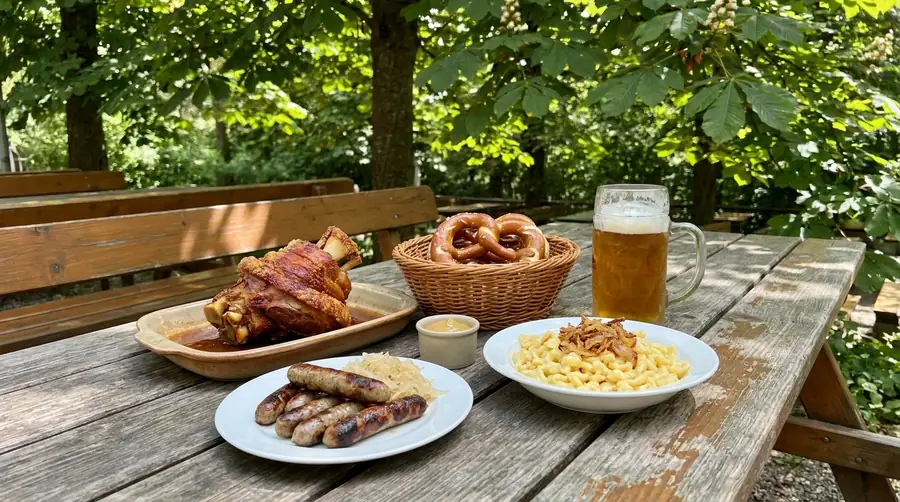
German food is more regional than its reputation. Outside Germany, German cuisine is often reduced to sausages, sauerkraut and beer, and those are all here, but traditional German food changes a great deal from one region to the next. The south eats dumplings, roast pork and pretzels; Swabia eats spätzle and Maultaschen; the Rhineland eats sweet and sour sauerbraten; Frankfurt eats green sauce and drinks apple wine; and the north eats herring, kale and Labskaus. Even the sausage changes: tiny in Nuremberg, white in Munich, curried in Berlin. German cooking is built on pork, beef and veal, potatoes, cabbage, dairy and very good bread, and it is comfort food at heart: braised meat, rich gravy, potato dumplings and a side dish of red cabbage or potato salad. This guide is for travellers, not cooks. It is not a cookbook of authentic German recipes, recipes from Germany or easy German recipes to make at home, but a guide to the best German dishes and where to eat them. First comes the menu, with every popular German dish and the place it belongs to. Then we go region by region, from Berlin to Munich and Bavaria, Nuremberg, Cologne, Frankfurt, Hamburg and the north, the Black Forest and Stuttgart, with what to order there and where to stay so dinner is a short walk home. If you are still planning the route, our Germany itinerary connects most of these cities by train.
Some links below are affiliate links. We may earn a commission if you book through them, at no extra cost to you. Where we name hotels, we shortlist them by location and recent guest reviews, and we have not stayed in them. Any prices on the map come live from the booking sites.
Short answer
- Eat each dish where it belongs: currywurst in Berlin, Weißwurst in Munich, bratwurst in Nuremberg, green sauce in Frankfurt, Maultaschen in Stuttgart.
- Lunch is often the main hot meal; many traditional kitchens close by about 10 pm.
- Several regional names, such as Nürnberger Rostbratwurst and Black Forest ham, are protected by EU law.
Triplarks · Germany
Traditional German food by region: the menu
Each famous German dish and the city or region where it is best.
German sausages, roasts and meat dishes the main course
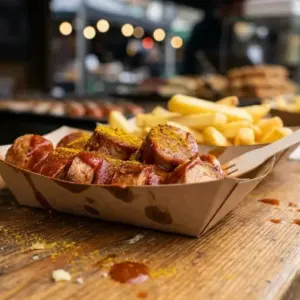
CurrywurstBerlin
Sliced pork sausage under curry ketchup and curry powder, with chips (French fries) or a bread roll.
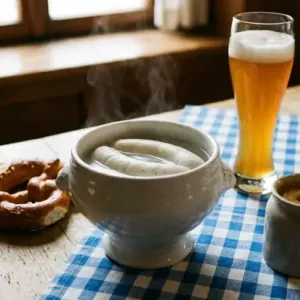
WeißwurstMunich
A white sausage of veal and pork bacon flavoured with parsley and lemon, eaten in the morning with sweet mustard and a pretzel.
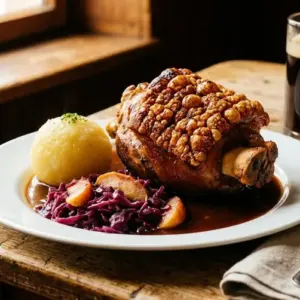
SchweinshaxeMunich, Bavaria
Roast pork knuckle (ham hock) with crispy crackling, served with a potato dumpling and dark beer gravy.
SchweinsbratenBavaria
Roast pork shoulder with crackling, gravy, a potato dumpling and cabbage, the Bavarian Sunday roast.
LeberkäseBavaria
A smooth meatloaf of finely ground pork and beef baked in a tin, sliced thick into a roll with mustard. Despite the name, it has no cheese and the Munich version little or no liver.
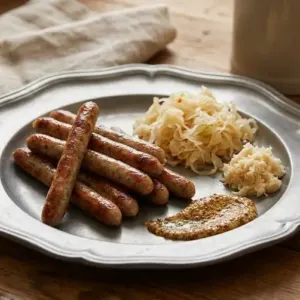
Nürnberger RostbratwurstNuremberg
Finger-sized pork sausages grilled over beech wood, served six to twelve at a time with sauerkraut or potato salad.
Thüringer RostbratwurstThuringia, Erfurt
A long, thin grilled sausage seasoned with marjoram and caraway, eaten in a roll with mustard.
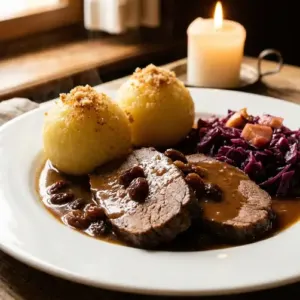
Rheinischer SauerbratenCologne, Rhineland
Beef marinated for days in vinegar and spices, braised, then served with a sweet and sour raisin gravy.
SchnitzelEverywhere
A thin breaded cutlet. Wiener schnitzel must be veal; Schnitzel Wiener Art is pork. Jägerschnitzel comes with mushroom gravy.
EisbeinBerlin
Boiled cured pork knuckle with sauerkraut and pease pudding, the Berlin take on the ham hock.
Königsberger KlopseBerlin, the east
Veal or pork meatballs poached in a creamy white sauce with capers, served with boiled potatoes.
FrikadelleEverywhere
A fried patty of ground meat, onion and bread, called Bulette in Berlin and Fleischpflanzerl in Munich.
RinderrouladenEverywhere
Slices of beef rolled around bacon, onion, mustard and pickled cucumber, then braised in gravy.
Döner kebabBerlin
Spit-roasted meat in flatbread with salad and sauce. Berlin is widely credited with the sandwich form, in the early 1970s.
German potatoes, dumplings and German pasta the side dish and more
German potato saladEverywhere
In the south, with vinegar, broth and onion; in the north, with mayonnaise. Served with sausages and schnitzel.
Potato dumplingsBavaria, Franconia, Thuringia
Kartoffelknödel or Klöße, made from raw potatoes, cooked potatoes or both, to soak up gravy.
SemmelknödelBavaria
Bread dumplings made from day-old rolls, milk, egg and parsley; Leberknödel are liver dumplings served in clear soup.
German potato pancakesCologne, the Rhineland
Grated raw potato fried crisp: Reibekuchen in Cologne, Kartoffelpuffer elsewhere, with apple sauce.
BratkartoffelnEverywhere
Sliced boiled potatoes fried with onion and bacon, the German version of home fries.
SpätzleSwabia, Stuttgart
Soft egg noodles, the classic German pasta, scraped off a board into boiling water.
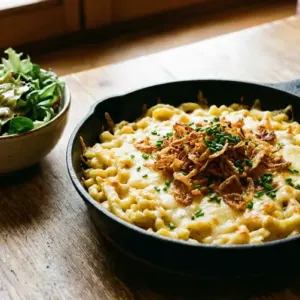
KäsespätzleSwabia, Allgäu
Spätzle layered with melted mountain cheese and topped with crispy fried onions.
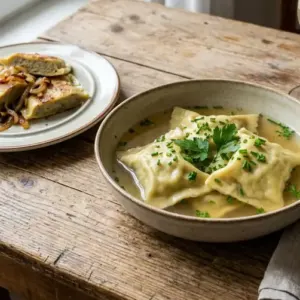
MaultaschenSwabia, Stuttgart
Large pasta pockets filled with meat, spinach and bread, served in broth or fried with onion.
SchupfnudelnSwabia, Baden
Finger-shaped potato noodles fried in butter, often tossed with sauerkraut and bacon.
SauerkrautEverywhere
Fermented white cabbage, braised with caraway, juniper or wine; homemade sauerkraut is still common in the country.
Red cabbageEverywhere
Rotkohl or Blaukraut, braised with apple, vinegar and spices, served with roasts and game.
German cucumber saladEverywhere
Thin-sliced cucumber in a dressing of vinegar or sour cream and dill.
German bread, fish and snacks the bakery, the harbour and the beer garden
PretzelBavaria, Swabia
The Brezn or Brezel: a lye-dipped bread knot with a crisp brown crust and coarse salt.
ObatzdaBavaria
A beer garden spread of soft ripe cheese mashed with butter, onion, paprika and caraway.
Halve HahnCologne
Not half a chicken at all: a rye roll with a thick slice of mature Gouda, mustard and raw onion.
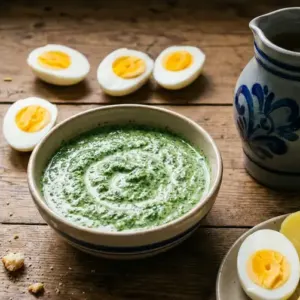
Frankfurter Grüne SoßeFrankfurt, Hesse
A cold sauce of seven fresh herbs with sour cream or quark, served with boiled potatoes and eggs; an EU-protected name since 2016.
Handkäs mit MusikFrankfurt, Hesse
A small, tangy sour milk cheese marinated in vinegar, oil and onions.
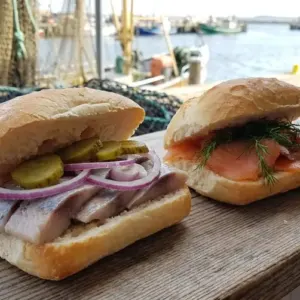
FischbrötchenHamburg, the north coast
A bread roll filled with pickled herring, Bismarck herring, smoked mackerel or shrimps.
LabskausHamburg, Bremen
A sailor’s hash of corned beef, potato and beetroot, topped with a fried egg, gherkin and rollmops.
Grünkohl mit PinkelBremen, Lower Saxony
Kale stewed for hours with smoked sausage and pork, the winter dish of the north.
German potato soupEverywhere
Kartoffelsuppe, a thick potato soup with leek, carrot and sliced sausage.
German breadEverywhere
Dark rye and sourdough loaves, seeded rolls and pumpernickel; bread is the base of breakfast and supper.
Black Forest hamBlack Forest
Schwarzwälder Schinken, a raw ham cured with spices and cold-smoked over fir wood.
German cakes, Christmas sweets and German drinks Kaffee und Kuchen and the beer hall
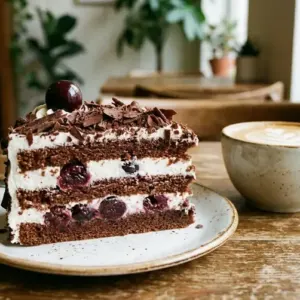
Black Forest cakeBlack Forest
Schwarzwälder Kirschtorte: chocolate sponge, cream and cherries, with Kirschwasser cherry spirit.
ApfelstrudelBavaria, the south
Paper-thin dough rolled around apples, raisins and cinnamon, shared with Austria.
KaiserschmarrnBavaria
A fluffy torn pancake with raisins, dusted with sugar and served with plum compote.
BerlinerBerlin, everywhere
A jam doughnut, called Pfannkuchen in Berlin and eaten above all on New Year’s Eve.
FranzbrötchenHamburg
A flattened cinnamon pastry, Hamburg’s answer to the croissant.
Rote GrützeHamburg, the north
Red berries and cherries cooked into a thick compote, served with vanilla sauce or cream.
Frankfurter KranzFrankfurt
A ring cake layered with buttercream and jam, covered in caramelised nut brittle.
StollenDresden, Saxony
A heavy Christmas bread with dried fruit, marzipan and a thick coat of icing sugar.
LebkuchenNuremberg
Spiced Christmas gingerbread on a thin wafer, sometimes glazed with chocolate.
German beerMunich, Cologne, Bamberg
Helles and wheat beer in Bavaria, Kölsch in Cologne, Altbier in Düsseldorf, smoked Rauchbier in Bamberg.
ApfelweinFrankfurt
Tart apple wine, poured from a grey stoneware jug called a Bembel.
Riesling and German wineRhine, Mosel, Baden, Württemberg
White Riesling and Silvaner, Pinot Noir from Baden and red Trollinger from around Stuttgart.
Seasonal dishes come and go, so check what is on the day.Dish photos are illustrations.
Where to eat it
Where to eat traditional German dishes, region by region
- 1Berlin
Street food · Eisbein · Königsberger Klopse
Where to eat ↓Hotels in Berlin → - 2Munich
Beer halls · Weißwurst · roast pork
Where to eat ↓Hotels in Munich → - 3Nuremberg
Small sausages · smoked beer · gingerbread
Where to eat ↓Hotels in Nuremberg → - 4Cologne
Brewhouses · sauerbraten · Reibekuchen
Where to eat ↓Hotels in Cologne → - 5Frankfurt
Apple wine taverns · green sauce · sausages
Where to eat ↓Hotels in Frankfurt → - 6Hamburg
Harbour food · fish rolls · kale in winter
Where to eat ↓Hotels in Hamburg → - 7Freiburg
Black Forest · cherry cake · smoked ham
Where to eat ↓Hotels in Freiburg → - 8Stuttgart
Spätzle · Maultaschen · wine taverns
Where to eat ↓Hotels in Stuttgart →
Region 1 of 8
Berlin: currywurst, döner kebab, Eisbein and a street food tour
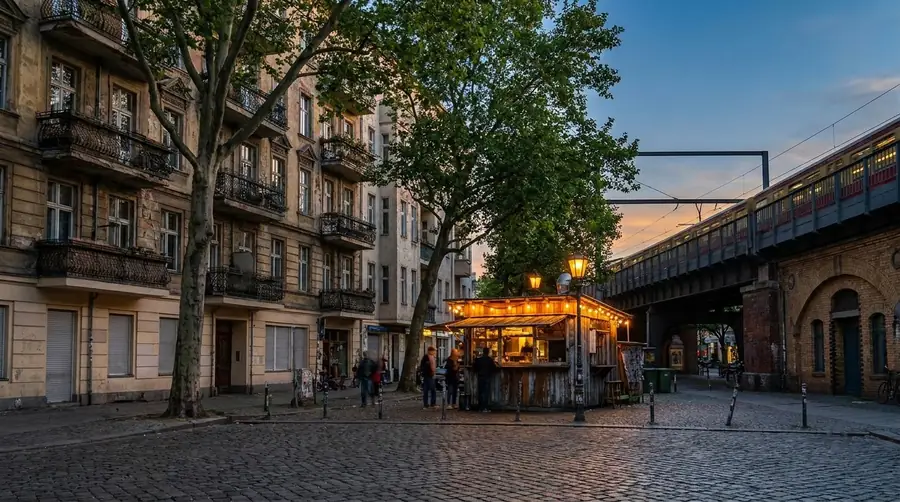
Berlin eats on the street more than any other German city, and its most famous dish is a snack. Currywurst, sliced pork sausage under a warm sauce of ketchup and curry powder, is usually traced to Herta Heuwer, who is said to have first sold it from a stand in Charlottenburg in September 1949; the story goes that she mixed it from ketchup and curry powder obtained from British soldiers. Hamburg and the Ruhr have their own claims. German foodies argue endlessly about the best stand. Order it with or without the skin (mit oder ohne Darm), with chips or a bread roll. The döner kebab sandwich, meat sliced from a vertical spit into flatbread with salad and garlic or chilli sauce, is widely credited to Turkish immigrants in West Berlin in the early 1970s, though other cities dispute it, and it is now as Berlin as the currywurst. For older Berlin home cooking, look for Eisbein, a boiled cured pork knuckle served with sauerkraut and pease pudding; Königsberger Klopse, meatballs in a creamy caper sauce; Buletten, Berlin’s fried meat patties; and a thick potato soup with sausage. The jam doughnut that the rest of Germany calls a Berliner is a Pfannkuchen here, and Berliners eat stacks of them on New Year’s Eve. A food tour of Kreuzberg or Neukölln is a good way to try Turkish, Vietnamese and Middle Eastern food alongside the German classics. Work out how many days in Berlin you need first, then use our Berlin itinerary to fit the meals in.
Order hereCurrywurstDöner kebabEisbeinKönigsberger KlopsePfannkuchen
Region 2 of 8
Munich and Bavaria: traditional Bavarian food, Weißwurst, pork knuckle and pretzel
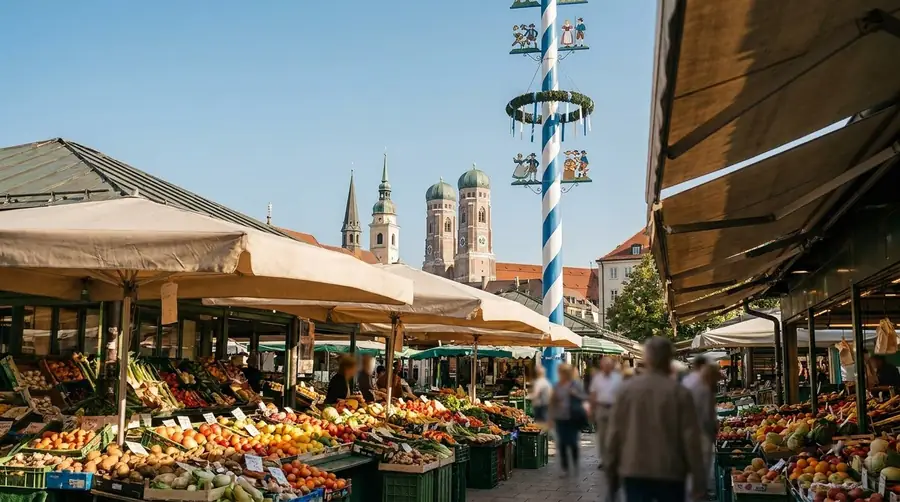
Bavarian food is what most people picture when they think of German food, and Munich is the place to eat it. The morning starts with Weißwurst, a pale sausage of veal and pork flavoured with parsley and lemon, warmed in hot water, peeled rather than eaten in its skin, and served with sweet mustard, a soft pretzel and a wheat beer. Tradition says it should be eaten before the noon church bells, a custom from the days before refrigeration. At lunch, beer halls and taverns serve Schweinshaxe, a whole roast pork knuckle with crispy crackling, and Schweinsbraten, roast pork shoulder in dark beer gravy, both with a potato dumpling or bread dumpling and cabbage. Leberkäse, a smooth baked meatloaf, is sliced thick into a roll at butcher’s counters. In a beer garden you may bring your own food in many places, or buy roast chicken, grilled fish on a stick (Steckerlfisch), radish and Obatzda, a cheese spread with paprika and onion. The Viktualienmarkt, Munich’s open-air food market since the early 1800s, is the place for a stand-up lunch. Dessert is Kaiserschmarrn or apple strudel. At Oktoberfest, from late September, the tents add roast chicken and ox to the menu. Our how many days in Munich guide and 3-day Munich itinerary plan the visit, and where to stay for Oktoberfest covers the festival.
Order hereWeißwurstSchweinshaxeBreznObatzdaLeberkäseKaiserschmarrn
Region 3 of 8
Nuremberg and Franconia: Rostbratwurst, Schäufele and Lebkuchen
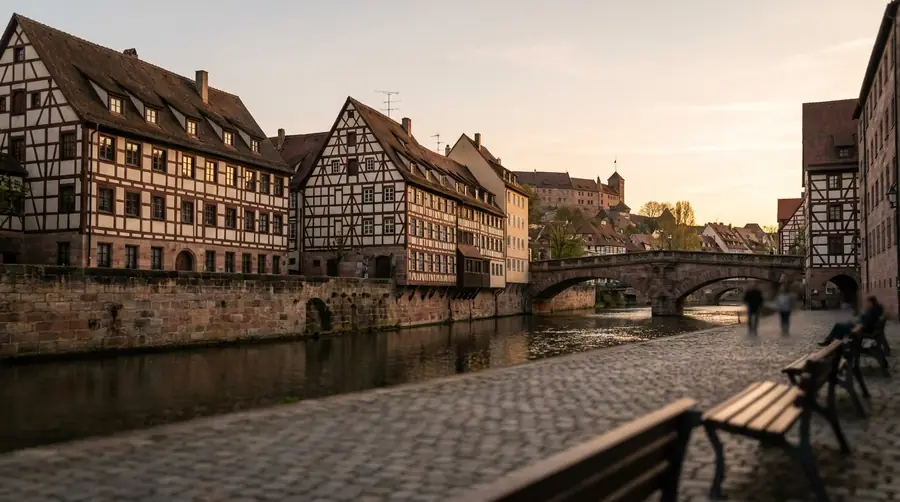
Nuremberg is in Franconia, the northern part of Bavaria, and the Franconians will tell you their food is not Bavarian. The city’s pride is the Nürnberger Rostbratwurst, a pork sausage only a few centimetres long, seasoned with marjoram and grilled over beech wood. It is a protected name in the EU, so the real thing has to be made in the city. Order six, eight or twelve on a pewter plate with sauerkraut, horseradish and German potato salad, or “Drei im Weggla”: three in a bread roll from a street stand. Saure Zipfel are the same sausages simmered in a vinegar and onion broth. Sunday lunch in Franconia is Schäufele, roast pork shoulder with crackling, dark gravy and a potato dumpling. Nuremberg is also the city of Lebkuchen, spiced gingerbread baked on a thin wafer; Nürnberger Lebkuchen is another protected name, sold all year and above all at the Christkindlesmarkt, one of Germany’s best-known Christmas markets. Franconia has more small breweries than anywhere else in the country, and nearby Bamberg is famous for Rauchbier, a smoked beer that tastes a little like ham. Our Germany itinerary shows how Nuremberg fits between Munich and Berlin by train.
Order hereNürnberger RostbratwurstPotato saladPotato dumplingsLebkuchenFranconian beer
Region 4 of 8
Cologne and the Rhineland: Kölsch, sauerbraten, Halve Hahn and potato pancakes
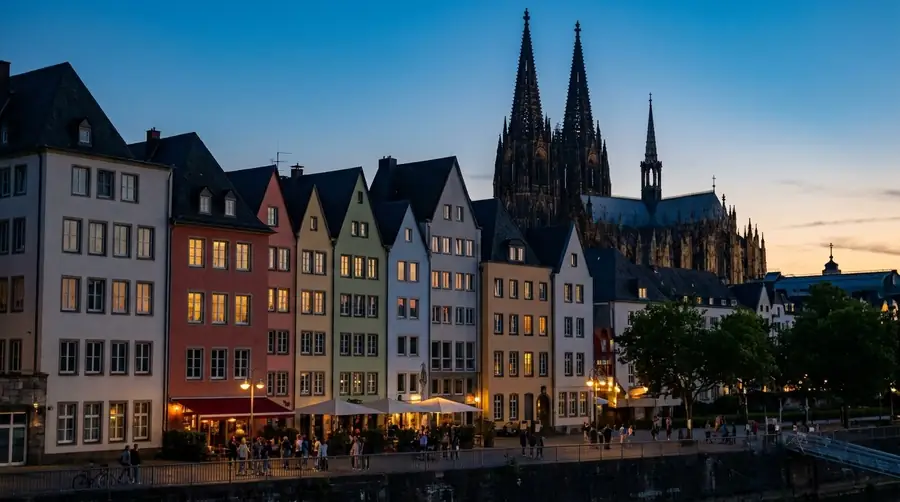
Cologne eats in its brewhouses, the old taverns that brew and pour Kölsch, a light, crisp beer served in small straight 0.2-litre glasses called Stangen. The waiter, the Köbes, replaces your empty glass until you put a beer mat on top. The food is hearty and a little sweet. Rheinischer Sauerbraten is beef marinated for several days in vinegar, wine and spices, then braised and served with a gravy thickened with raisins and Printen gingerbread, red cabbage and potato dumplings; it was once made with horse meat, and a few places still offer that version. The dish everyone orders once is Halve Hahn, which sounds like half a chicken but is a rye roll with a thick slice of Gouda, mustard and raw onion. Himmel un Ääd, “heaven and earth”, is mashed potato and apple sauce with fried blood sausage and onions. Reibekuchen, crisp German potato pancakes eaten with apple sauce or on dark bread, are sold at Christmas markets and some brewhouses on Fridays. Downriver, Düsseldorf drinks its own dark Altbier, and Aachen, to the west, bakes Aachener Printen, a hard spiced gingerbread. Our 10-day Germany itinerary links Cologne with the Rhine and Frankfurt.
Order hereRheinischer SauerbratenHalve HahnReibekuchenRed cabbageKölsch
Region 5 of 8
Frankfurt and Hesse: green sauce with sour cream, Handkäs mit Musik and apple wine
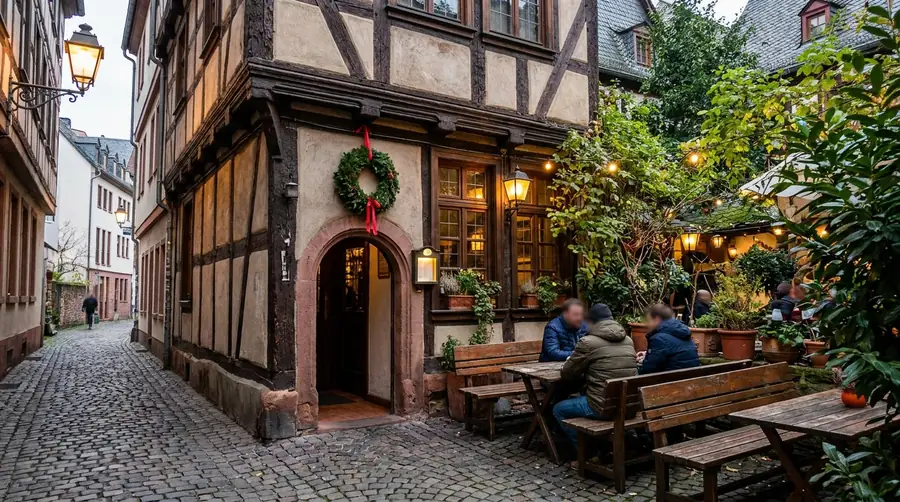
Frankfurt is a banking city with a homely kitchen, and the best place to taste it is an apple wine tavern in Sachsenhausen, across the river from the centre. Apfelwein, called Ebbelwoi locally, is a tart, dry cider poured from a grey and blue stoneware jug, the Bembel, into a ribbed glass; a green fir wreath over the door shows that a tavern serves its own. The signature dish is Frankfurter Grüne Soße, a cold green sauce of seven fresh herbs, such as borage, chervil, cress, parsley, burnet, sorrel and chives, blended with sour cream or quark and served with boiled potatoes and hard-boiled eggs; it is best in spring. Handkäs mit Musik is a small, pungent sour milk cheese marinated with vinegar, oil and onions; the “music” is a joke about the onions. Other classics are Rippchen mit Kraut, cured pork chop with sauerkraut, and Frankfurter Würstchen, the thin smoked pork sausages that gave the frankfurter its name. For cake, try Frankfurter Kranz, a buttercream ring cake covered in nut brittle. The Kleinmarkthalle, the covered market in the centre, is good for a quick lunch. Plan your stay with our where to stay in Frankfurt guide.
Order hereGrüne SoßeApfelweinHandkäs mit MusikFrankfurter KranzBoiled potatoes
Region 6 of 8
Hamburg and northern Germany: Fischbrötchen, Labskaus and Franzbrötchen
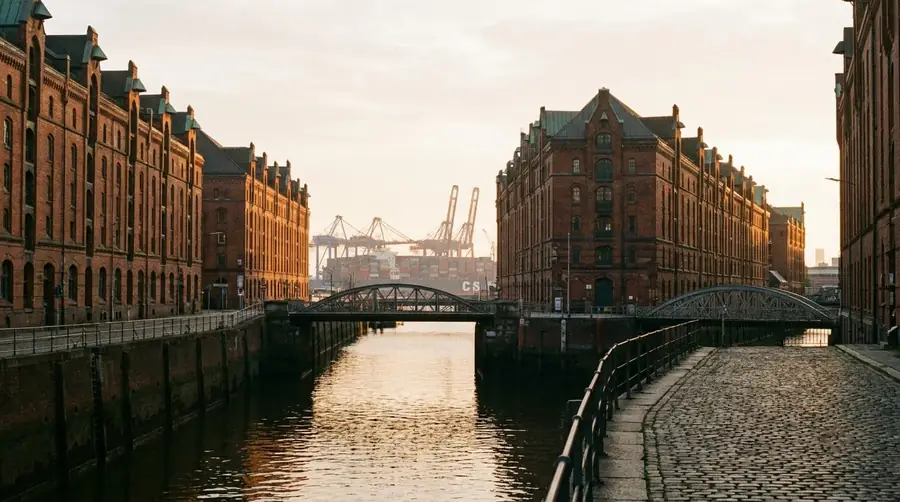
Northern German food is shaped by the North Sea, the Baltic and long, cold winters. In Hamburg, the quick lunch is a Fischbrötchen, a crusty roll filled with pickled herring, smoked mackerel, fried fish or North Sea shrimps, sold at kiosks along the harbour and at the Sunday morning Fischmarkt. Labskaus, an old sailors’ dish, is a pink hash of corned beef, potato and beetroot topped with a fried egg, a gherkin and a rolled pickled herring; it looks odd and tastes far better. In late summer, look for Birnen, Bohnen und Speck, a stew of pears, green beans and bacon, and in winter for Grünkohl, kale cooked for hours with smoked Pinkel sausage, which is a winter ritual in Bremen and Lower Saxony. Bakeries sell Franzbrötchen, a flattened cinnamon pastry that Hamburg claims as its own, and dessert is Rote Grütze, a red berry compote with vanilla sauce. An hour north-east, Lübeck is famous for its marzipan, which is made to a strict recipe and protected under its city name. The name hamburger probably comes from Hamburg steak, but the burger is an American dish, not a Hamburg one.
Order hereFischbrötchenLabskausGrünkohlFranzbrötchenRote Grütze
Region 7 of 8
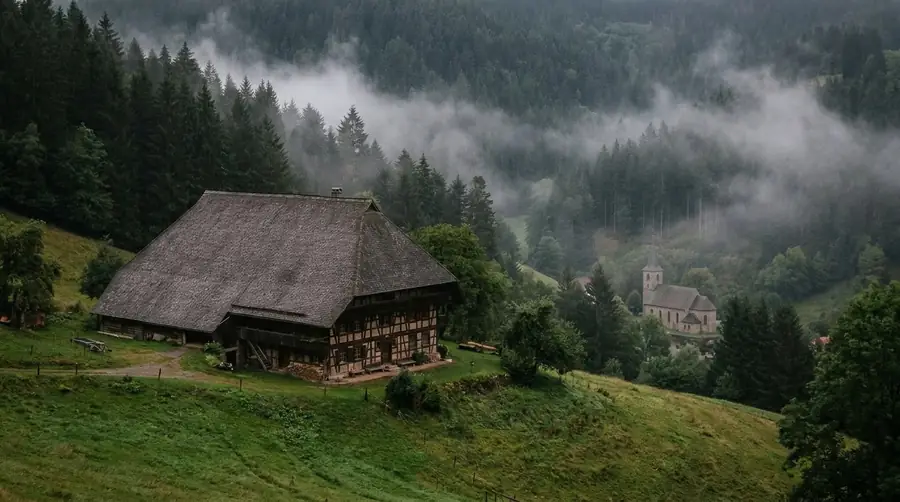
The Black Forest and Baden: Black Forest cake, Black Forest ham and Flammkuchen
The Black Forest, in the south-west corner of Germany, gave its name to two of the most famous German foods. Black Forest cake, Schwarzwälder Kirschtorte, is layers of chocolate sponge, whipped cream and sour cherries, soaked in Kirschwasser, the clear cherry spirit distilled in the region, and topped with chocolate shavings. Its exact origin is disputed; the most cited story credits a confectioner called Josef Keller in the 1910s, though not in the Black Forest itself. Eat it in a village café in the afternoon, the German habit of Kaffee und Kuchen. Black Forest ham, Schwarzwälder Schinken, is a raw ham cured with salt, garlic and juniper, then cold-smoked over fir wood; it carries EU protection and must be produced in the region. Baden, the wine country between the forest and the Rhine, shares a border with Alsace, so Flammkuchen, a thin crisp tart of sour cream, onions and bacon, is on most menus with a glass of local Pinot Noir. Freiburg, the biggest city in the area, has a market around its cathedral every day except Sunday, where stands sell the Lange Rote, a long red sausage in a roll. In spring, the Rhine valley around Schwetzingen is famous for white asparagus (Spargel) with ham, boiled potatoes and hollandaise.
Order hereBlack Forest cakeBlack Forest hamSchupfnudelnBaden wine
Region 8 of 8
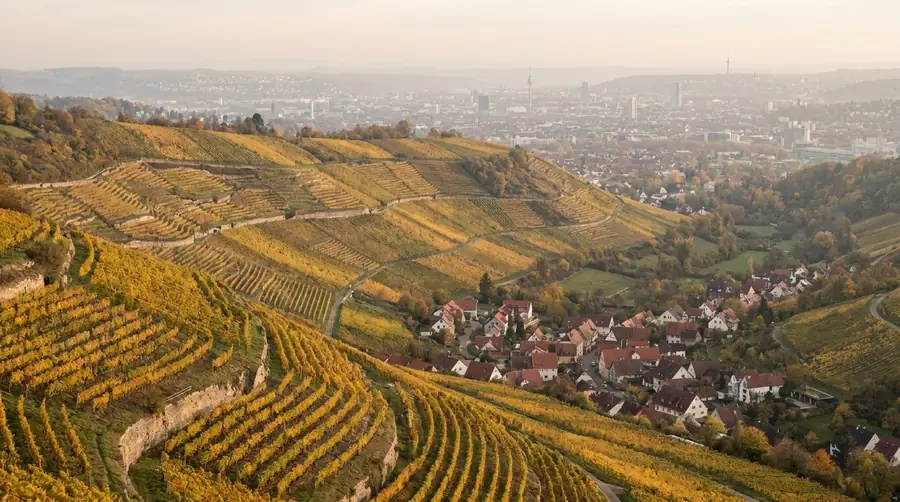
Stuttgart and Swabia: Maultaschen, spätzle and lentils with sausages
Swabia, the region around Stuttgart, is the home of German pasta, and Swabians are serious about it. Spätzle are soft egg noodles scraped from a board into boiling water and served with roasts and gravy, and Käsespätzle layer them with melted cheese and crispy fried onions, a comfort food that the Allgäu, further south, also claims. Maultaschen are large pasta pockets filled with minced meat, spinach, bread and onion; eat them in a clear broth, or sliced and fried with egg and onion the next day. Swabian Maultaschen and Swabian spätzle are both protected names in the EU. A local nickname for Maultaschen, Herrgottsbscheißerle, “little cheats on the Lord God”, comes from the story that monks hid meat in the pasta to eat it during Lent; it is a legend rather than history. The everyday Swabian dish is Linsen mit Spätzle und Saitenwürstle, lentils with spätzle and a pair of thin sausages, and the Sunday one is Zwiebelrostbraten, roast beef with crispy onions. Stuttgart grows wine inside the city limits, mostly red Trollinger, and in season small farmhouse wine taverns called Besenwirtschaften open with simple food and their own wine.
Order hereMaultaschenKäsespätzleLinsen mit SpätzleSchupfnudelnTrollinger
The best German dishes: the top 10 to try first
If you only have a few days, these are the most famous and popular German dishes, the authentic German food Germans themselves would put on a list of must-try food. Each is at its best in the region named.
- Bratwurst, grilled pork sausage, best in Nuremberg and Thuringia.
- Schnitzel, a breaded veal or pork cutlet, found everywhere.
- Sauerbraten, marinated braised beef, best in Cologne and the Rhineland.
- Schweinshaxe, roast pork knuckle, best in Munich.
- Currywurst, sausage with curry ketchup, best in Berlin.
- Spätzle and Käsespätzle, egg noodles, best in Stuttgart and Swabia.
- Maultaschen, Swabian pasta pockets, best in Stuttgart.
- Pretzel, the Brezn, best in a Bavarian beer garden.
- Kartoffelsalat, German potato salad, everywhere.
- Black Forest cake, best in a Black Forest café.
Germany’s most popular dish is hard to name. Rankings change from year to year, schnitzel and currywurst are regular names near the top, and the döner kebab sells in huge numbers. For a visitor, schnitzel, bratwurst and sauerbraten are the safest answer.
How German cuisine works: the German restaurant, the beer hall and the side dish
Traditional German food is served in a few kinds of place. A Gasthaus or Gaststätte is a traditional German restaurant or inn with a set menu of regional dishes; a Brauhaus or beer hall brews its own beer and serves hearty food; a Biergarten is an outdoor beer garden; and an Imbiss is a street food stand. A main course usually comes with one or two side dishes chosen from potatoes, dumplings, spätzle, sauerkraut, red cabbage or salad. A few words help you read the menu.
- Hauptgericht
- Main course. Vorspeise is a starter and Nachspeise or Nachtisch is dessert.
- Beilage
- Side dish: Salzkartoffeln (boiled potatoes), Pommes (chips), Klöße or Knödel (dumplings).
- Tagesgericht
- Dish of the day, often the best value at lunchtime.
- Mittagstisch
- A lunch menu, served at midday on weekdays.
- Kaffee und Kuchen
- Afternoon coffee and cake, around 3 to 4 pm.
German sausage: bratwurst, Weißwurst and currywurst
Germany has well over a thousand kinds of sausage, and most regions have their own. Grilled bratwurst is the classic: Nürnberger is small and herby, Thüringer long and thin, and both are protected names. Weißwurst is the Munich breakfast sausage. Bockwurst and Frankfurter Würstchen are boiled or warmed, and Leberwurst and Teewurst are spreads for bread. Sausages are usually served with mustard, a bread roll, sauerkraut or potato salad, so “sauerkraut or potato salad?” is the usual question at the counter.
German potato dishes: boiled potatoes, potato dumplings and German potato pancakes
Potatoes became a staple in the 1700s, pushed by rulers such as Frederick the Great of Prussia, and are now on almost every German plate, as boiled potatoes, mashed, fried or made into dumplings.
Hot German potato salad, north and south
German potato salad is a hot topic. In southern Germany, cooked potatoes are sliced while warm and dressed with beef broth, vinegar, oil and onion, sometimes with bacon, and it is often served warm, which is why Americans call it hot German potato salad; in the north, the dressing is mayonnaise, often with gherkins. Both are served with sausages, schnitzel and Leberkäse.
German potato dumplings
Kartoffelknödel in Bavaria and Klöße further north are German potato dumplings made from raw potatoes, cooked potatoes or a mix of both, sometimes with a crouton in the middle. The Thuringian version, made mostly from grated raw potatoes, is famous. They are there to soak up gravy, so they come with roast pork, sauerbraten and Rouladen.
German potato pancakes
Kartoffelpuffer, or Reibekuchen in the Rhineland, are made from grated raw potatoes, onion and egg, fried until crispy and served with apple sauce, or with sugar beet syrup on dark bread in Cologne.
German soup: comfort food in a bowl
Soup is a big part of comforting German home cooking, and many traditional restaurants list three or four. Kartoffelsuppe, German potato soup, is thick with leek, carrot and celeriac and often comes with sliced sausage. Linsensuppe (lentil soup) and Erbsensuppe (pea soup) are cooked with smoked pork and are classic lunch dishes, ladled out at markets and street stalls in winter. In Bavaria, a clear beef soup made with beef stock carries Leberknödel, liver dumplings, or Flädle, thin strips of pancake, the Swabian favourite. Gulaschsuppe, a paprika beef soup from Hungary by way of Austria, is on almost every menu in the south and at ski huts.
German sauerkraut and red cabbage
Sauerkraut is white cabbage fermented with salt for weeks. German sauerkraut is usually cooked again before serving, with caraway, juniper, bay, onion, apple or a splash of wine, so it is softer and milder than many people expect. Red cabbage is braised with apple, vinegar and a little sugar until sweet and sour, and is the standard side dish for roasts, game and sauerbraten. Both are on most German restaurant menus all year.
German meat dishes and gravy: sauerbraten, Rouladen and the braise
Many German meat dishes are slow cooked: a braise of pork or beef in a rich gravy, served with dumplings and red cabbage. It is meat and potatoes cooking, and very good after a cold day of sightseeing.
Sauerbraten
Sauerbraten is a traditional dish made with beef marinated for several days in vinegar or wine with onions and spices, then braised slowly. Every region has its own version; the Rhineland one is sweetened with raisins, the Swabian and Franconian ones are not.
Rinderrouladen
Thin slices of beef are spread with mustard, rolled around bacon, onion and pickled cucumber, browned and braised for hours. Rouladen with red cabbage and potato dumplings is a classic family Sunday dinner.
Schnitzel: Germany and Austria
Schnitzel is shared by German and Austrian kitchens. Wiener Schnitzel, made from thin veal cutlets in breadcrumbs, is the Austrian original and must be made with veal to use that name; Schnitzel Wiener Art is made with pork. In Germany you will also find Jägerschnitzel with mushroom gravy and Zigeunerschnitzel, now often renamed Paprikaschnitzel, with a pepper sauce.
German bread, pretzels and the Abendbrot
Germany has a huge range of bread, from dark rye and sourdough to seeded rolls, and the German bread culture is listed on the national inventory of intangible cultural heritage. The evening meal at home is often Abendbrot, literally “evening bread”: bread with cheese, ham, sausage and pickles. The pretzel, soft inside with a shiny brown crust, is at its best in Bavaria and Swabia, where it is eaten at breakfast, as a snack and in the beer garden.
Delicious German cakes and German desserts
Germans take afternoon cake seriously. Alongside Black Forest cake, look for Bienenstich, a yeast cake with honey and almond crust and custard filling; Käsekuchen, German cheesecake made with quark, a fresh soft cheese; Streuselkuchen with crumble; and Apfelkuchen, apple cake with cream. Plum cake (Zwetschgenkuchen) appears in late summer. Rote Grütze is the northern dessert, Kaiserschmarrn and Apfelstrudel the Bavarian ones.
Oktoberfest food and German Christmas food
Two seasons bring out special dishes.
Oktoberfest food
Oktoberfest in Munich has its roots in the royal wedding of 1810 and now runs for about two weeks from late September. The tents serve roast chicken (Hendl), pork knuckle, roast ox, grilled fish, giant pretzels, Obatzda and radish, with litre mugs of beer brewed by Munich’s own breweries. Many other German cities hold their own autumn beer festivals.
German Christmas food
From late November, Christmas markets sell mulled wine (Glühwein), grilled bratwurst, potato pancakes, roasted almonds, Lebkuchen and Stollen. Christmas dinner is often roast goose or duck with red cabbage and potato dumplings, while Christmas Eve is simpler, often sausages with German potato salad. Dresden is famous for its Stollen, Nuremberg for Lebkuchen, Aachen for Printen and Lübeck for marzipan.
Dresden, Leipzig and Thuringia: the east
If your trip continues east, Saxony and Thuringia have their own dishes. Thuringia is the home of the Thüringer Rostbratwurst, grilled over charcoal and eaten with mustard in a roll, and of large Thuringian potato dumplings. Dresden is known for Christmas Stollen and Eierschecke, a layered cake of yeast dough, quark and custard. Leipziger Allerlei is a dish of spring vegetables, crayfish and morels, and the Spreewald near Berlin is famous for its pickled gherkins.
When to eat what: German food by season
German cooking follows the seasons closely, and many restaurants change the menu for a few weeks at a time.
- Spring (March to May): green sauce in Frankfurt, wild garlic, and white asparagus season from about April to 24 June.
- Summer (June to August): beer gardens, strawberries, chanterelle mushrooms, and pears, beans and bacon in the north.
- Autumn (September to November): Oktoberfest, new wine with onion tart (Zwiebelkuchen), game, pumpkin and roast goose on St Martin’s Day in November.
- Winter (December to February): Christmas markets, Stollen and Lebkuchen, kale with sausage in the north, and doughnuts at New Year’s Eve and carnival.
Ordering words
- Ein Helles
- A pale lager, the standard beer in Munich.
- Weißbier or Weizen
- Wheat beer, cloudy and served in a tall glass.
- Eine Schorle
- Wine or apple juice mixed with sparkling water.
- Mit Senf
- With mustard. Süßer Senf is the sweet Bavarian kind.
- Zum Mitnehmen
- To take away.
- Die Rechnung, bitte
- The bill, please. Say “zusammen” to pay together or “getrennt” to pay separately.
- Guten Appetit
- Enjoy your meal. Prost is cheers.
When Germans eat
Lunch has traditionally been the main hot meal, and the evening meal at home is often bread with cold cuts. Restaurants serve hot dinners, but traditional kitchens in smaller towns may close by about 9 or 10 pm, and many close one day a week (Ruhetag).
A typical day
- BreakfastAbout 7–10 amBread rolls, cheese, ham and coffee; Weißwurst in Munich.
- LunchAbout 12–2 pmThe main hot meal, often a dish of the day.
- Kaffee und KuchenAbout 3–4 pmCoffee and cake.
- DinnerAbout 6–8.30 pmRestaurants; at home, Abendbrot.
Typical times, not opening hours. Check each place.
Live prices
Hotels near the food in Munich, with live prices
Prices appear on the pins once dates are set. We pre-fill a week about a month ahead; change the dates on the map to see yours.
Famous German food: FAQ
What is the most famous German food?
Bratwurst, schnitzel, sauerkraut, pretzels, sauerbraten and Black Forest cake are the best-known German foods. Each is at its best in a different region, such as bratwurst in Nuremberg and Black Forest cake in the Black Forest.
What is the national dish of Germany?
Germany has no official national dish. Sauerbraten is often named, along with bratwurst with sauerkraut and, in popularity surveys, currywurst.
What is traditional German food?
Traditional German food is hearty home cooking built on pork, beef and veal, potatoes, cabbage, dumplings, bread and dairy: roasts with gravy, sausages, potato salad, spätzle and sauerkraut, with cake in the afternoon.
What do Germans eat for breakfast?
Usually fresh bread rolls with butter, jam, cheese, ham or sausage, a boiled egg and coffee. In Munich, a late breakfast of Weißwurst, sweet mustard, pretzel and wheat beer is a tradition.
What foods do Germans eat at Christmas?
Roast goose or duck with red cabbage and potato dumplings, sausages with potato salad on Christmas Eve, and Stollen, Lebkuchen and marzipan, with mulled wine at the Christmas markets.
Is German food spicy?
No. German food is seasoned with mustard, horseradish, caraway, marjoram, juniper and herbs rather than chilli. Currywurst is the mildly spicy exception.
Which German city has the best food?
Munich for classic Bavarian food and beer gardens, Berlin for street food and the widest choice, and Stuttgart or Frankfurt for regional home cooking. Nuremberg is the best small city for sausages.
Where should I stay in Germany for food?
Munich for a first trip, Berlin for street food, and Cologne for brewhouses and pub food. Stay central in each, near the old town, so restaurants are a short walk away.
Keep planning Germany
- Where to Stay in Cologne: One Street Back From the Cathedral
- Where to Stay for Oktoberfest: Buy the Walk Home
- Where to Stay in Frankfurt: The City, the Station or the Airport
- Best Hotels in Munich: What the Money Actually Buys
- Where to Stay in Berlin: Pick a District, Not a Hotel
- Where to Stay in Munich: Inside the Ring, or One Stop Out
- How Many Days in Berlin? Four, and Why It Needs More Than Munich
- How Many Days in Munich? Three, and Four If You Use It as a Base

Written and checked by
Nora Castell is the pen name of the Triplarks editorial desk and the editor of its Costa Rica and Central America guides. Each guide is built from national park, transport and tourism sources, operator rate cards and recent traveller reports, then fact-checked, with every figure dated to the day it was read. Triplarks uses AI tools to help draft; nothing goes live until it has been edited and checked. Where we have not been somewhere, we do not write as though we have.