Quick answer
Three bases for the week: Dublin for two nights, Galway for three, Killarney for one or two. Book the Galway and Killarney nights first, because both towns are small and both fill in summer.
On this page
- 7 day Ireland itinerary: the week at a glance
- Days 1 and 2 — Dublin, without a car
- Day 3 — west, with a stop in the middle
- Day 4 — the Cliffs of Moher and the Burren
- Day 5 — Connemara
- Day 6 — south to Kerry
- Day 7 — Dingle, then out
- Connemara National Park, the stop most loops rush past
- The booking decision that makes this work
- What this week leaves out
- Where this week meets the Wild Atlantic Way
- The week without a car
- The version if you land at Shannon
- What each transfer day costs
- Driving notes
- When to go
- Rainy-day swaps in the west
- Packing for an Irish week
- What to book before you fly
- Where to sleep on this route
- If you have eight or ten days instead
- Driving in Ireland on a 7-day road trip
- Three stops this week is often short of
- Frequently asked questions
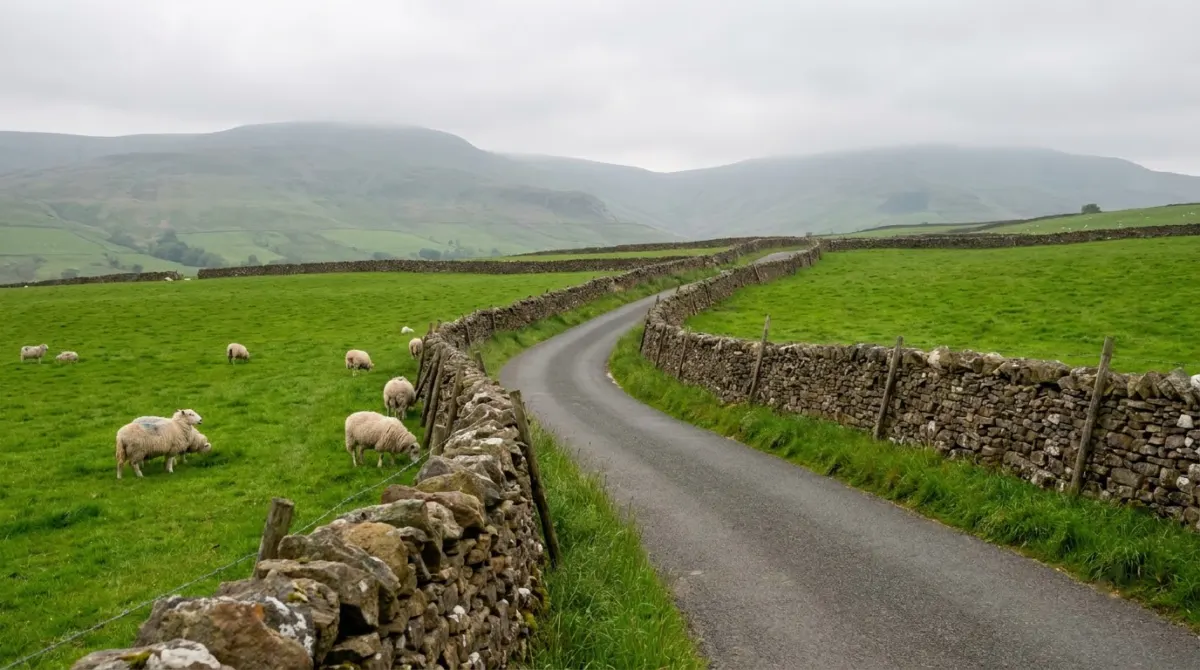
Seven days is the most common length for a first trip to Ireland, and the most commonly over-planned. The country is small on a map and slow on the road: outside the motorways you are on national and regional routes through towns, and every extra base costs you a morning.
Some links below are affiliate links. We may earn a commission if you book through them, at no extra cost to you. We do not rank hotels, and any prices on the map come live from the booking sites.
This is a seven-day route built on three bases — Dublin, Galway, Killarney — with a stop worth making on every transfer. If you want the reasoning behind which bases to pick, our Ireland itinerary covers the map; this one covers the days.
7 day Ireland itinerary: the week at a glance
| Day | Base | Doing |
|---|---|---|
| 1 | Dublin | Arrive, Trinity, the old city on foot |
| 2 | Dublin | Kilmainham Gaol, Guinness Storehouse, music |
| 3 | Galway | Collect car, Clonmacnoise on the way, evening in Galway |
| 4 | Galway | Cliffs of Moher and the Burren |
| 5 | Galway | Connemara and Kylemore |
| 6 | Killarney | Drive south, Adare, afternoon in the national park |
| 7 | — | Dingle Peninsula, then out of Shannon or Cork |
Where to sleep on this route
Days 1 and 2 — Dublin, without a car
Do not collect the rental car when you land. Dublin does not need it, central parking is expensive, and you will not use it for two days.
Day 1 covers Trinity College and the Book of Kells, the Georgian squares, the National Museum of Ireland and the two cathedrals, all within twenty minutes’ walk of each other. Day 2 is Kilmainham Gaol in the morning — book it before you fly, it sells out — and the Guinness Storehouse after it.
Our Dublin itinerary has the full version of these two days.
Map shows live availability and prices. We may earn a commission on bookings made through it, at no extra cost to you.
Day 3 — west, with a stop in the middle
Collect the car mid-morning, after the commuter traffic has cleared, and drive west. The direct run to Galway is about two and a half hours on motorway, which makes it the easiest transfer of the week — and the one with room for a stop.
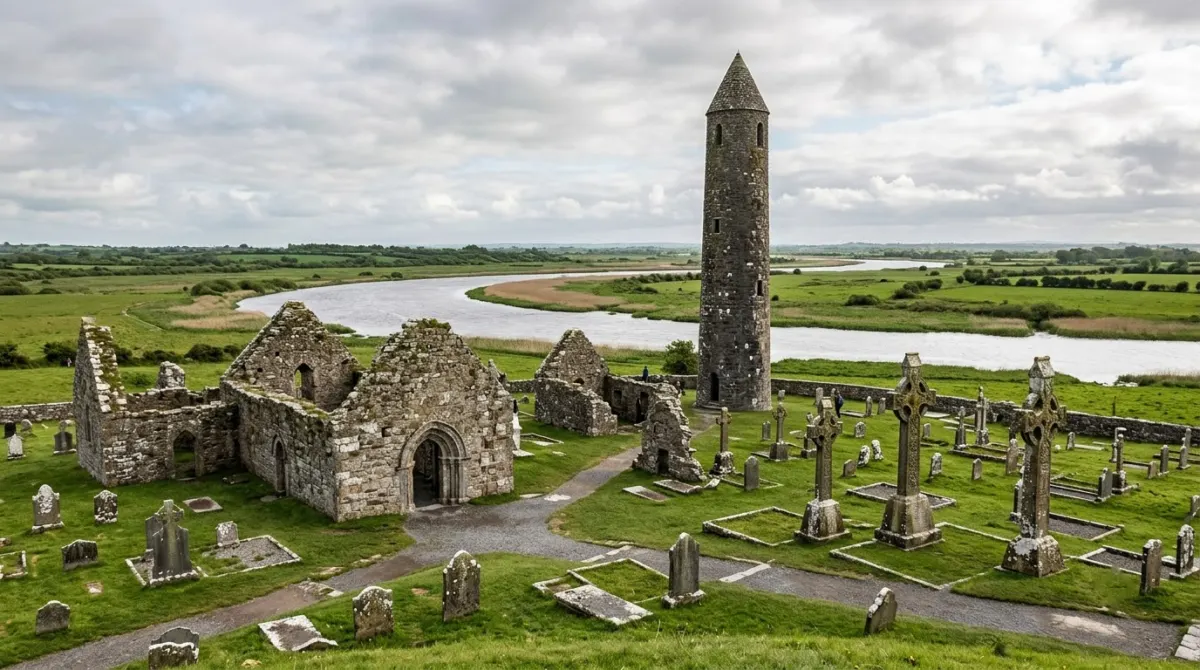
Clonmacnoise is the stop: a sixth-century monastic city on a bend of the Shannon, with round towers, high crosses and a graveyard that was the burial place of kings. It adds about forty minutes of driving and an hour on site.
Arrive in Galway with the evening in front of you. The Latin Quarter has live music most nights.
Day 4 — the Cliffs of Moher and the Burren
South from Galway into County Clare. The Cliffs of Moher rise to about 214 metres at their highest and run for roughly 14 kilometres; the visitor centre sits in the middle and the walking paths run both ways from it.
Go early or late. The middle of the day is when every coach from Galway, Limerick and Dublin arrives at once.
The Burren, on the way there or back, is the opposite landscape: a limestone plateau of bare grey pavement with wildflowers in the cracks, and the Poulnabrone dolmen, a portal tomb roughly 5,800 years old, standing in the middle of it. Doolin is the village to stop in for lunch and music.
Day 5 — Connemara
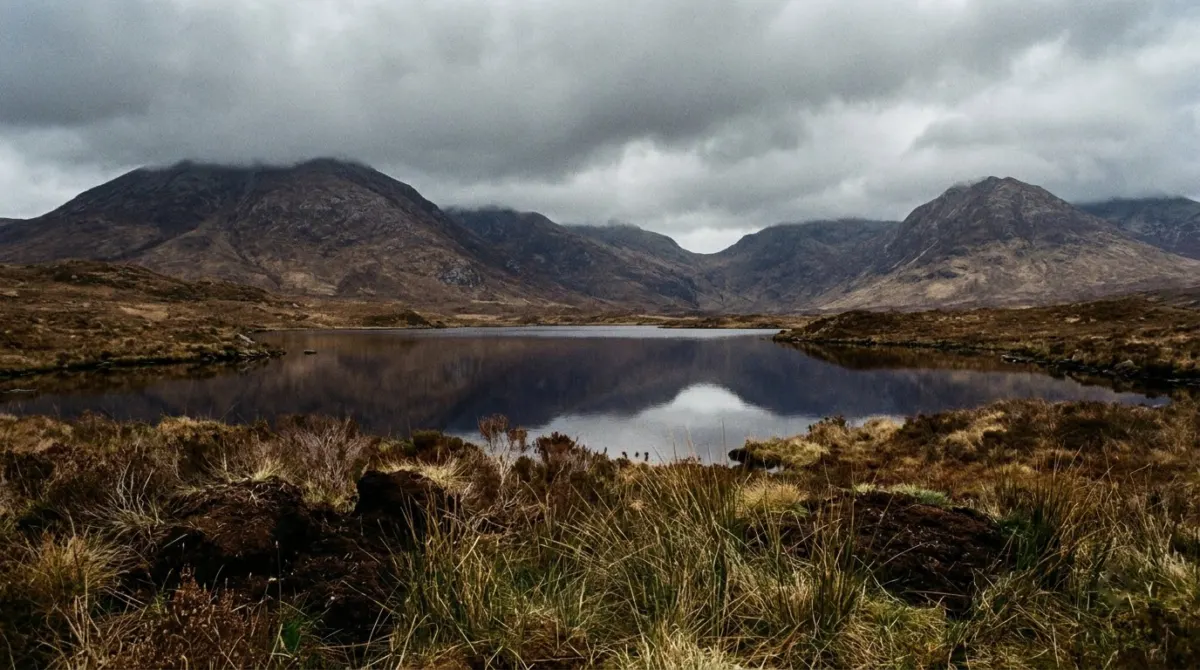
North-west from Galway, and the best full day of the week. Connemara is mountains, bog, lakes and inlets, with the Twelve Bens at its centre.
The usual loop takes in Kylemore Abbey — a Victorian house on a lake below a mountain, with a walled garden — the fjord at Killary Harbour, and the coast road through Clifden. Allow the whole day and do not try to combine it with anything else.
Day 6 — south to Kerry
Galway to Killarney is around three hours. Break it at Adare, a village of thatched cottages in County Limerick that is directly on the route, or at the Cliffs of Moher if you skipped them on day 4.
Arrive in Killarney with the afternoon left and spend it inside Killarney National Park: Muckross House and gardens, Torc Waterfall, and the lakes. Do not start the Ring of Kerry today.
Day 7 — Dingle, then out
The last day forces a choice. The Ring of Kerry is a full day of 179 kilometres and leaves no time for anything else. The Dingle Peninsula and the Slea Head Drive are shorter, narrower and, for most people with one day, the better of the two.
Drive Slea Head in the morning, have lunch in Dingle town, and go to your flight from there.
Connemara National Park, the stop most loops rush past
Day five usually treats Connemara as a drive, with Kylemore and Killary Harbour seen from the car. The best walk on the route is one turn off it.
Connemara National Park is beside the village of Letterfrack on the N59, close to Kylemore. Entry to the park and the visitor centre is free, and so is the parking. From the visitor centre, the trails climb towards Diamond Hill. The summit looks over Tully Mountain, Kylemore Abbey and the Twelve Bens, whose highest peak, Benbaun, is the highest point in County Galway at 725 metres.
Check the visitor centre’s days before you plan around it. It opens from Wednesday to Sunday and closes on Mondays and Tuesdays, but the park itself stays open.
Give it two to three hours in the middle of the day, between Kylemore in the morning and Clifden in the afternoon. It turns a day of viewpoints into a day with a proper walk in it.
The booking decision that makes this work
Fly into Dublin and out of Shannon or Cork. Killarney to Dublin Airport is around four hours; Shannon is about an hour and a half and Cork about an hour and a half. An open-jaw ticket usually costs little more than a return and removes the worst drive of the week from the last morning.
If you must return to Dublin, add the drive to day 7 and cut Dingle to a half day.
What this week leaves out
Northern Ireland and the Causeway Coast — a fortnight’s trip if you want both coasts.
The south: Cork, Kinsale and Waterford — covered in our southern Ireland itinerary.
Donegal and the north-west — wilder than Kerry, much less visited, and too far from this loop.
The Aran Islands — possible as a long day trip from Galway, better with an overnight. Ferries to Inis Mór sail all year from Rossaveal, about forty minutes across, with a shuttle bus from Galway city. The fort at Dún Aonghasa is about seven kilometres from the harbour, at the top of a sheer 87-metre cliff with no barrier at the edge. Doing it properly takes the whole of a day you do not have on this route.
Where this week meets the Wild Atlantic Way
The Wild Atlantic Way is Ireland’s signposted coastal touring route. It runs about 2,500 kilometres from the Inishowen Peninsula in Donegal to Kinsale in County Cork. Many first-time visitors assume a week means driving it. It does not, and this itinerary does not try.
What the week does is dip into three of its best stretches and skip the rest. The Cliffs of Moher and the Burren on day four are the Clare section. Connemara on day five is the Galway section, and Slea Head on day seven is the Kerry section. Between them you see the coast at its most dramatic without spending the week on the road between highlights.
Driving the whole route is a trip of several weeks, not one. If you want more of it than this, the honest addition is the north-west: Mayo, Sligo and Donegal are the quietest part of the route and the furthest from any of this week’s bases. They suit a second trip better than an eighth and ninth day bolted onto this one.
The week without a car
If you do not want to drive on the left, the week still works with trains and day tours. It changes shape a little.
Days 1 and 2 stay as they are, because Dublin never needed the car.
Day 3 becomes the train from Dublin Heuston to Galway, about two and a half hours. Clonmacnoise drops out, because it is hard to reach without a car.
Days 4 and 5 become day tours from Galway, to the Cliffs of Moher and the Burren on one day and Connemara on the other. Most leave from near Eyre Square. The trade-off is timing: tours reach the cliffs in the middle of the day, which is when they are busiest.
Day 6 is the hardest transfer by public transport. Galway to Killarney takes longer than the three-hour drive, and Adare drops out. Killarney has a railway station in the town, but many trains from the east need a change at Mallow, so check the connection before you rely on it.
Day 7 becomes a Dingle or Ring of Kerry coach tour from Killarney, then the train or bus towards your flight.
What you lose is two stops and some freedom over timing. What you gain is a week without a rental desk, insurance decisions or regional roads.
The version if you land at Shannon
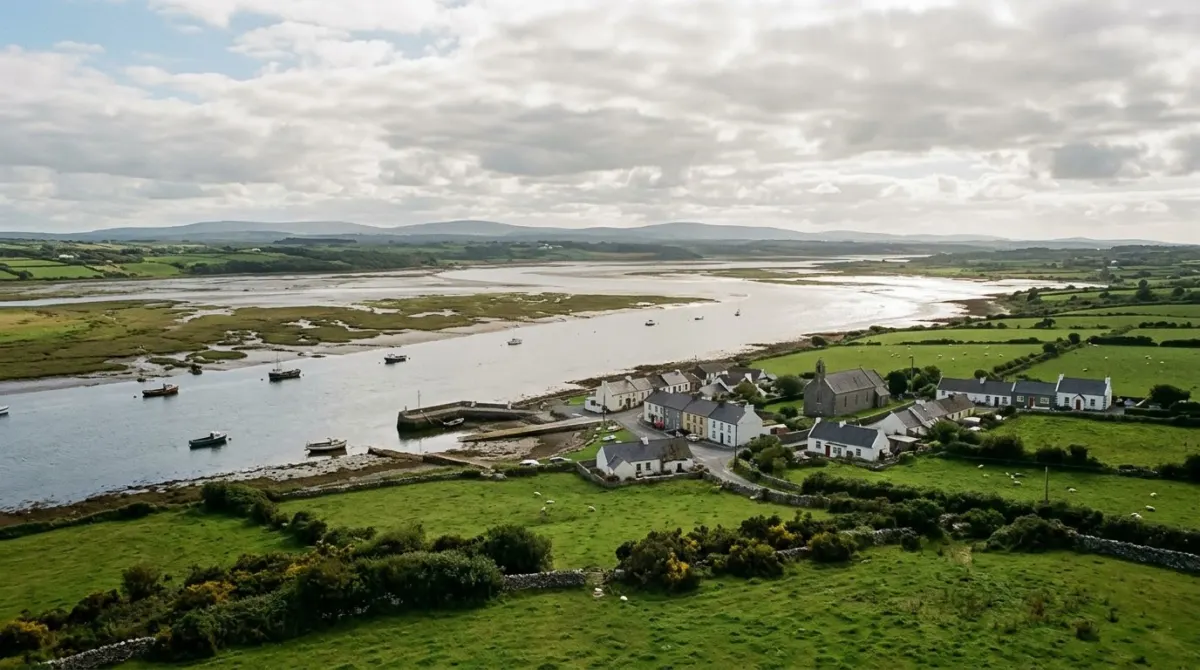
Shannon sits between Galway and Kerry, and landing there changes the week for the better: it removes the long transfer at both ends.
- Day 1: land, drive to Galway in about an hour and a half, evening in the city.
- Day 2: Cliffs of Moher and the Burren.
- Day 3: Connemara and Kylemore.
- Day 4: south to Killarney, afternoon in the national park.
- Day 5: the Ring of Kerry.
- Day 6: Dingle and Slea Head.
- Day 7: east to Dublin, or out of Shannon or Cork.
This version fits both Kerry peninsulas into the week, which the Dublin-first route cannot.
What each transfer day costs
Checkout is usually eleven and check-in three. A two-hour drive between them leaves four hours in the middle that are either wasted or used.
That is why every transfer day on this itinerary has a stop built into it: Clonmacnoise between Dublin and Galway, Adare between Galway and Killarney. A transfer day with a stop is a good day. Without one it is a wasted morning, and the week only has seven.
Driving notes
Ireland drives on the left, and most visitors adapt within a day. The roads take longer.
Motorways connect Dublin to Galway, Limerick and Cork and are straightforward. Everything else is national and regional roads through towns.
Regional roads are narrow, with hedges or stone walls at the edge of the tarmac and no verge. On the peninsulas, two cars meeting means one reverses.
Speed limits are a legal maximum, not a target. Since February 2025 the default limit on rural local roads is 60 km/h, and on a single-track lane even that is a ceiling, not a target.
Signs in Gaeltacht areas, including parts of Connemara and west Kerry, may give place names in Irish only.
Allow about two-thirds of the speed your navigation app predicts once you are off the motorway.
When to go
May, June and September are the best weeks of the year for this route: long days, open attractions, and fewer coaches than midsummer. July and August bring the longest evenings and the heaviest traffic, and the west-coast rooms sell out months ahead. October to March shortens the driving day enough to cut a stop from most days, and some rural places close.
Rainy-day swaps in the west
This week has a wet day in it more often than not, and the trick is to have each base’s indoor fallback ready.
In Galway: the Galway City Museum, beside the Spanish Arch, is free and open from Tuesday to Saturday. Swap the Cliffs of Moher and Connemara between days four and five according to the forecast. You have three nights in Galway precisely so that you can.
In Kerry: Muckross House, inside the national park, is the indoor anchor. Ross Castle’s guided tours run from early March to early November, with a maximum of fifteen people each, first come, first served.
On the road: Clonmacnoise and the Rock of Cashel are both good in grey weather, because the ruins and the visitor exhibitions carry the visit. The Cliffs of Moher in fog do not; if they are clouded in, there is nothing to see from the edge, so move them to another day rather than standing in a car park waiting.
Packing for an Irish week
Three things make the difference on this route, and none of them are exotic.
A waterproof jacket rather than an umbrella, because the rain usually arrives sideways. Shoes that handle wet grass, because the viewpoints on the Cliffs, in Connemara and in Kerry all involve a short walk off tarmac. And layers, since a single day on the west coast can move between sun, wind and rain within an hour.
What to book before you fly
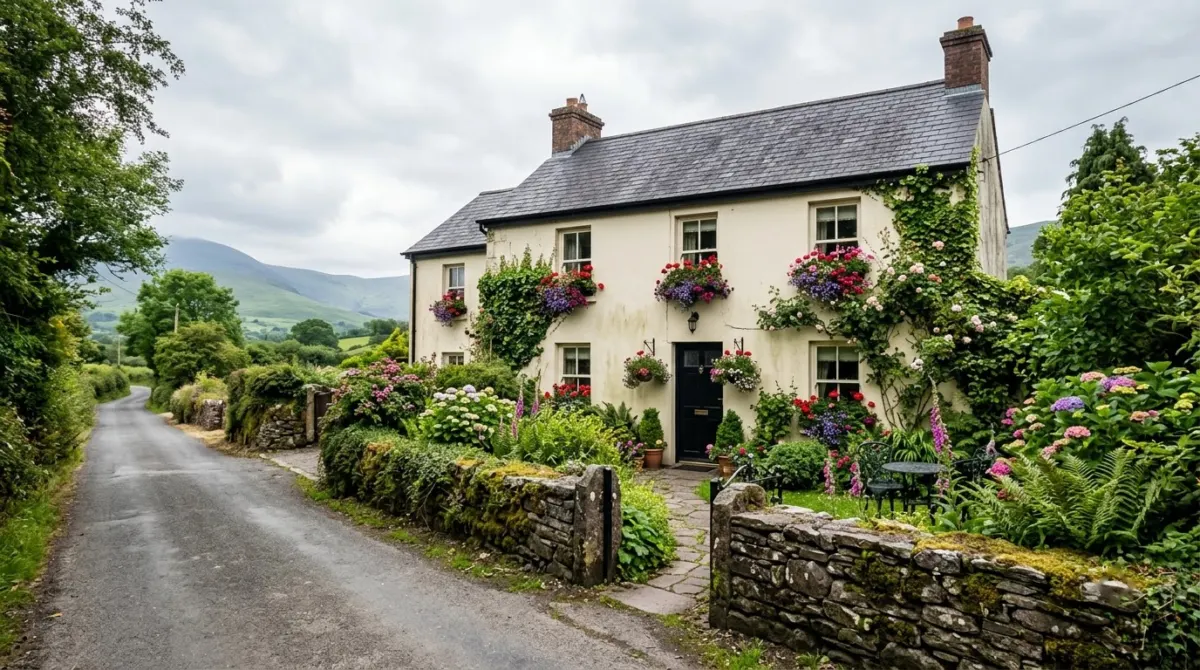
- Kilmainham Gaol — the only sight in Ireland that reliably sells out weeks ahead.
- The Book of Kells — timed entry at Trinity College.
- Galway and Killarney nights — both towns are small and both fill in summer and on festival weekends.
- An automatic car, if you need one — manual is the default in Ireland, and automatics are a smaller and more expensive part of every fleet.
Nothing else on this week needs reserving in advance, and leaving the day trips flexible lets you move Connemara or the Cliffs to whichever day looks clearer.
Where to sleep on this route
Three bases, three decisions.
Dublin: central and on foot, with the airport coach stops in mind — see where to stay in Dublin.
Galway: a street back from the Latin Quarter, close to Eyre Square where the day tours leave — see where to stay in Galway.
Killarney: in the town if you want to walk to dinner and take organised trips, outside it if you have the car and want the lakes. Our where to stay in Ireland guide sets the three in context.
If you have eight or ten days instead
The honest upgrade is not more places, it is more nights in the same ones.
Eight days: add a night in Kerry so that both the Ring of Kerry and Dingle fit without a race.
Ten days: add the south — Kinsale, Cork and Cobh — on the way back east, which turns a loop into a circuit and removes the long final drive.
Driving in Ireland on a 7-day road trip
One week in Ireland is a road trip, and the driving is the part that catches people out.
You drive on the left, in a right-hand-drive car, on roads that narrow without warning. Renting a car here is straightforward but the insurance is not: Ireland is excluded from most credit-card collision cover, so you will be buying it at the desk.
Regional roads are slower than the map suggests. An hour on an Irish regional road covers far less ground than an hour on the motorway, and the scenic coastal stretches are the slowest of all — which is the point of them, but it has to be budgeted.
Automatic cars sell out months ahead in summer. Book early if you cannot drive a manual.
Three stops this week is often short of
A 7-day Ireland itinerary fills up fast, and these are the ones people most often wish they had added.
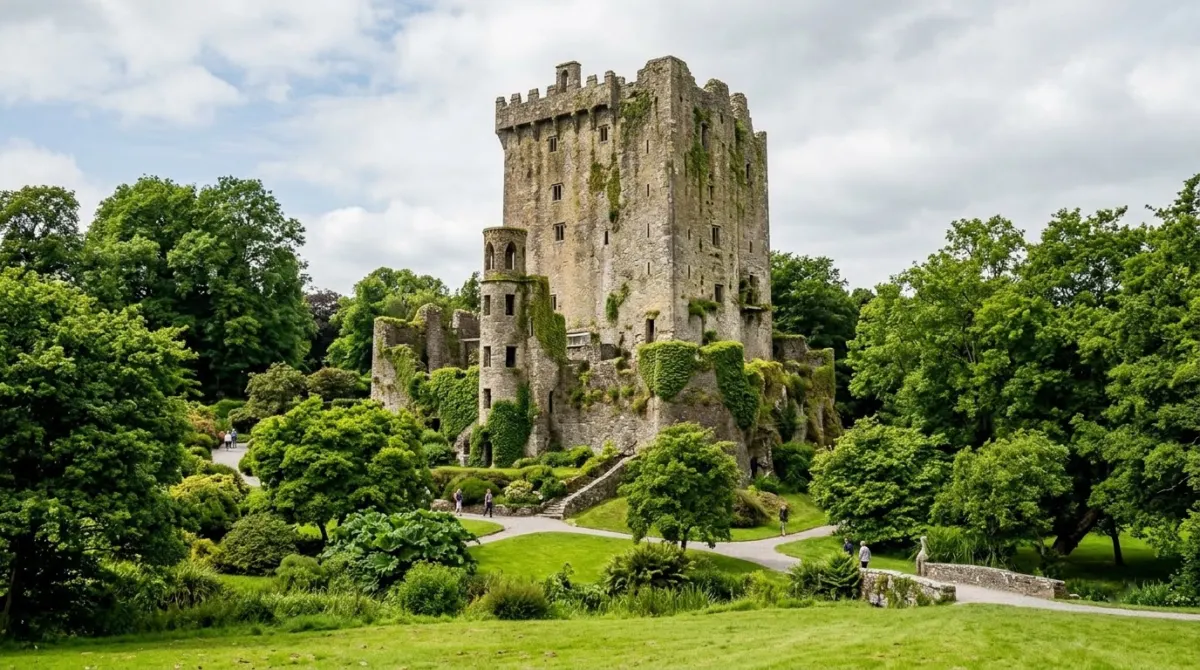
Blarney Castle, near Cork, for the stone and the gardens, which are better than the stone.
The Rock of Cashel in Tipperary — a medieval cathedral and round tower on a limestone outcrop, almost exactly halfway between Dublin and Cork, which makes it the natural lunch stop on that leg rather than a detour.
An evening in a pub with live music, which is not a sight and does not go on a map. Dublin’s Temple Bar is the version visitors find first and the one locals avoid; the same music is better and cheaper two streets away, and better still in Galway, Doolin or Dingle.
Frequently asked questions
Is 7 days enough for Ireland?
Enough for Dublin and the west coast properly: two nights in Dublin, three in Galway, one in Kerry. It is not enough to add Northern Ireland or the south as well without the week becoming a drive.
How many places should I stay in a week in Ireland?
Three. Checkout at eleven and check-in at three means every move costs the middle of a day, so a fourth base takes a morning from somewhere better spent.
Should I rent a car for a 7 day Ireland itinerary?
Yes, but collect it on the morning you leave Dublin rather than at the airport when you land. The city does not need a car and central parking is expensive.
Ring of Kerry or Dingle on a 7 day trip?
Dingle, if you only have the one day. Slea Head is shorter and more concentrated, and it leaves time to reach a flight afterwards. The Ring of Kerry is a full day on its own.
Should I fly out of Dublin or somewhere else?
Somewhere else, if you can. Killarney to Dublin Airport is about four hours, while Shannon and Cork are both around an hour and a half. An open-jaw booking usually costs little more than a return.
What is the best stop between Dublin and Galway?
Clonmacnoise, a sixth-century monastic site on the Shannon with round towers and high crosses. It adds roughly forty minutes of driving and turns a transfer into a day.
Do I need to book the Cliffs of Moher in advance?
It is not compulsory, but it is worth doing. The visitor experience is priced lower when booked ahead, and a booked time helps you arrive early or late rather than with the midday coaches.
Keep planning Ireland
- Where to Stay in Kilkenny: On the Mile, or Beside the Station
- Where to Stay in Doolin: Book a Room You Can Walk Home To
- Where to Stay in Belfast: Four Quarters, Four Different Trips
- Where to Stay in Killarney: The Town, or the Lakes
- Where to Stay in Dingle: In Town, or Out Where the View Is
- Where to Stay in Ireland: Pick Three Bases, Not Seven
- Where to Stay in Galway: The Noise Decides It, Not the Distance
- Best Hotels in Dublin: What Each Kind of Building Gives You
Written and checked by
Triplarks Editorial
An editorial desk, not an invented persona: research, drafting and fact-checking are done by the same small team. Every number here carries the date it was read.