Quick answer
The Jordaan or the western canal belt for a first visit, Oud-Zuid if you want a lift and the museums on the doorstep, De Pijp for food, Noord or Oost for value. Check the staircase before you check anything else — canal houses are steep and most have no lift.
On this page
- Where to stay in Amsterdam: the short answer
- The canal belt and the Jordaan
- What to know about the centre
- Museum Quarter and Oud-Zuid
- De Pijp
- Oost and Noord
- The Plantage
- Oud-West
- Westerpark and the Spaarndammerbuurt
- Leidseplein and Rembrandtplein
- Zuidas, Sloterdijk and the business hotels
- The Red Light District, and what staying near it means
- Hostels and budget beds in the city centre
- Stairs, lifts and luggage
- Getting around
- How many nights
- What the accommodation is actually like
- Why Amsterdam is expensive, and what to do about it
- Tourist tax, VAT and the final bill
- Apartments and holiday rentals: the rules
- Zaandam and Utrecht as cheaper bases
- When the city fills up
- Getting in from the airport
- Cycling, and whether to
- The short version
- Frequently asked questions
Amsterdam’s centre is small, built on concentric canals, and almost entirely walkable — which makes the usual question of distance much less important than two other things: how noisy the street is, and whether the building has a lift.
Some links below are affiliate links. We may earn a commission if you book through them, at no extra cost to you. We do not rank hotels, and any prices on the map come live from the booking sites.
Both of those are more serious here than in most European cities, and both are the real content of this decision. If you are continuing by train into Germany, see where to stay in Cologne and where to stay in Berlin.
Where to stay in Amsterdam: the short answer
| If you are | Stay in | Why |
|---|---|---|
| Here two or three nights, first visit | Jordaan or the canal belt | Central, quiet, the city you pictured |
| Here for the museums | Museum Quarter / Oud-Zuid | Rijksmuseum and Van Gogh on the doorstep |
| Wanting bars and restaurants | De Pijp | The market, the food, local rather than touristic |
| Arriving by train | Centrum, east of the station | Walk with luggage |
| Wanting space and value | Oost or Noord | Ten minutes by tram or free ferry |
| Travelling with family | Oud-Zuid or Oost | Larger rooms, lifts, parks |
One answer with no caveats: the Jordaan or the western canal belt. You are ten minutes’ walk from the station and the museums, on quiet streets, in the Amsterdam people come to see.
Map shows live availability and prices. We may earn a commission on bookings made through it, at no extra cost to you.
The canal belt and the Jordaan
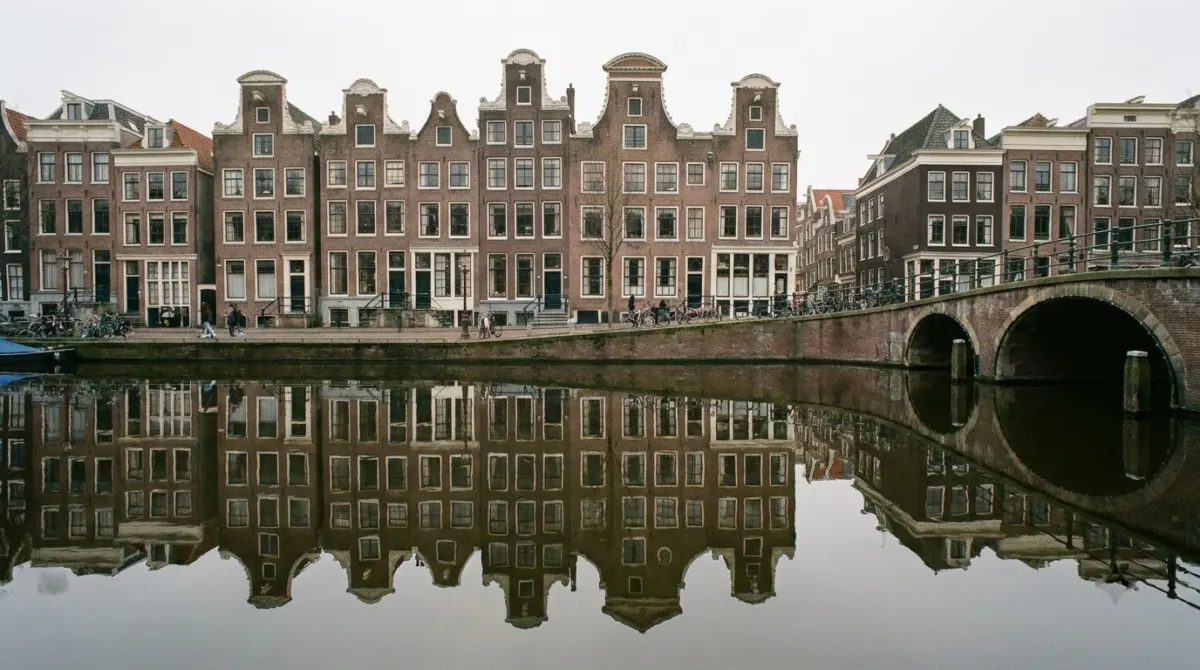
The Grachtengordel — the seventeenth-century ring of canals — is the centre of the city and a UNESCO site. The Jordaan, just west of it, was a working-class district and is now the most sought-after part of Amsterdam: narrow streets, small shops, courtyards and canal houses.
Staying here gives you the postcard version of the city and quiet nights, which is not true of everywhere central.
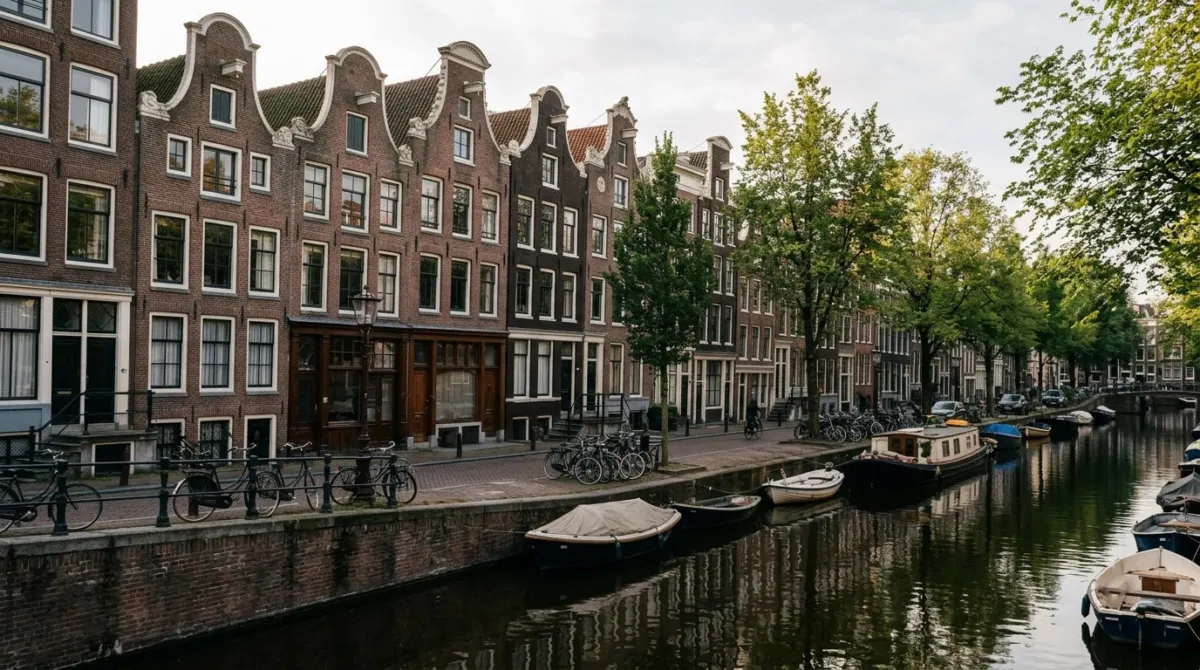
Two warnings. Canal houses are tall, narrow and old, which means staircases that are closer to ladders and frequently no lift. And rooms are small, because the buildings were taxed on frontage and built accordingly.
What to know about the centre
The area immediately east and south of Centraal Station — the medieval core around the Dam, the Damrak and De Wallen — is the busiest part of the city and the one to be careful about booking.
It is loud until very late, it has a high concentration of stag groups and visitors, and the streets are crowded at all hours. None of that makes it dangerous; it makes it a poor place to sleep.
If convenience to the station matters, the streets east towards the Nieuwmarkt are five minutes away and far calmer.
Museum Quarter and Oud-Zuid
South-west of the centre, around Museumplein, this is where the Rijksmuseum, the Van Gogh Museum and the Stedelijk sit together, with the Vondelpark beside them.
Oud-Zuid is the grand residential district: wide streets, larger buildings, lifts, and more hotels built as hotels rather than converted from houses. It is fifteen to twenty minutes’ walk or a short tram ride from the centre.
This is the practical choice for families, for anyone who needs step-free access, and for anyone whose Amsterdam is mainly the art.
De Pijp
South of the canal belt, De Pijp is a dense nineteenth-century district built around the Albert Cuyp street market, and it has the best concentration of restaurants, cafes and bars in the city.
It is twenty minutes’ walk from the centre and a few minutes by tram or metro. Accommodation leans towards apartments and small hotels.
Stay here if eating and drinking matter more than being inside the canal ring, or if you are staying more than three nights.
Oost and Noord
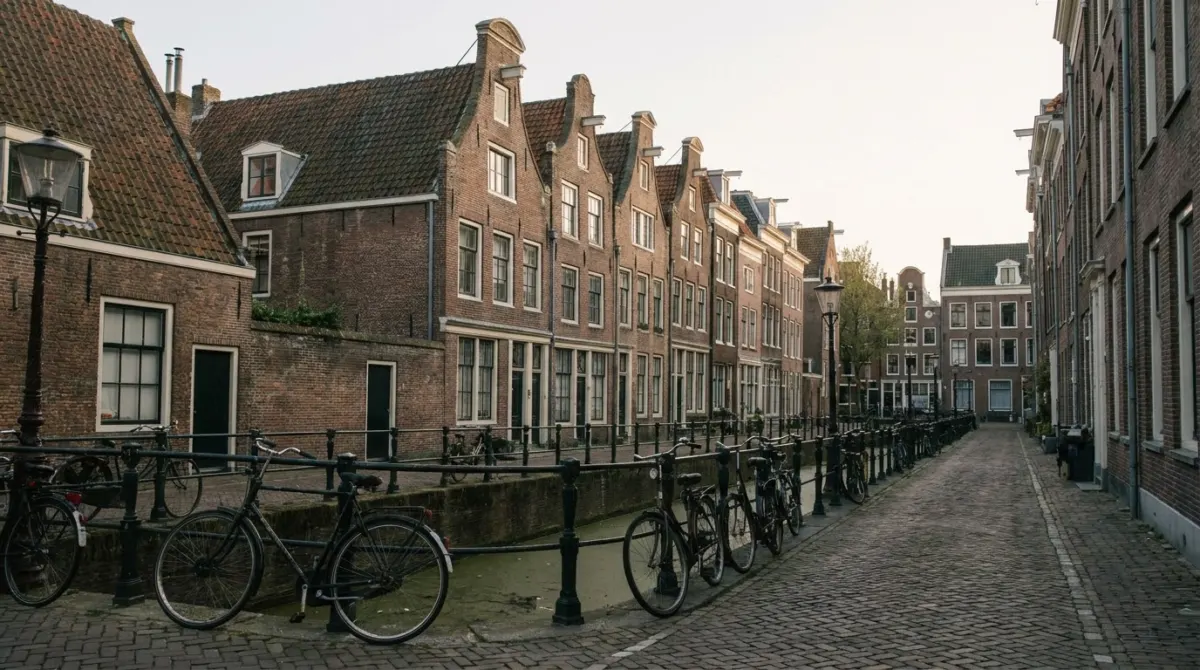
Oost, east of the centre, is residential and increasingly interesting, with the Oosterpark, the Wereldmuseum (the former Tropenmuseum, renamed in 2023) and a growing food scene. It is ten minutes by tram.
Noord, across the IJ, is reached by free ferries from behind Centraal Station, running every few minutes, day and night. It holds the former shipyard at NDSM, the EYE film museum and the A’DAM tower.
Both are cheaper than the centre by a noticeable margin. Noord in particular offers newer buildings with lifts and larger rooms, and the ferry is genuinely quick.
The Plantage
Between the old centre and Oost, the Plantage is the quietest central district in Amsterdam and the one most visitors have never heard of.
It is still the greenest part of the old city. Artis, the zoo, has been here since 1838; the Hortus Botanicus, founded in 1638 as a medicinal herb garden, is one of the oldest botanical gardens in the world; and the Wertheimpark runs along the water and holds the Auschwitz monument. The Dutch Resistance Museum, the Jewish Museum and the Portuguese Synagogue are all within a few minutes’ walk.
Who it suits. Families, first-time visitors who want to sleep well, and anyone staying long enough to want a park outside the door. The Rembrandtplein, the Waterlooplein and the Nieuwmarkt are each ten to fifteen minutes on foot, and the trams along the Plantage Middenlaan run into the centre.
The trade-off. It has few bars and is quiet after dinner, which is either the point or the problem.
Oud-West
West of the Vondelpark and south of the Jordaan, Oud-West is a nineteenth-century residential district that has become one of the most enjoyable places to stay without paying canal belt rates.
Its anchor is De Hallen, a converted tram depot that now holds a food hall, an arthouse cinema, a branch of the public library and a hotel. Around it, the Kinkerstraat and the Overtoom are long local shopping streets, and the Ten Katemarkt is a street market where you can try Dutch snacks such as kibbeling and broodje haring. The Vondelpark runs along the district’s eastern edge, and the canals here are quiet enough for hired kayaks and paddleboards.
Getting in. The Leidseplein and Museumplein are about fifteen minutes on foot, and several tram lines run straight to the centre.
Stay here if you want De Pijp’s local feel with more space, or if you are on a third or fourth visit and want to live in the city for a few days rather than look at it. Accommodation is mainly small hotels and apartments, with the same canal-house stair warnings as the centre.
Westerpark and the Spaarndammerbuurt
North-west of the Jordaan, Westerpark is a park built around a former gasworks, and the district around it is one of the most livable in the city.
The Westergas buildings now hold restaurants, a brewery, a cinema and event halls, with a market on the first Sunday of every month and major events such as the Unseen photography fair in September. Just beyond the park, the Spaarndammerbuurt is lined with brick social housing from the 1910s and 1920s in the Amsterdam School style, and Het Schip, the most famous block, is a museum of that movement. There is a city farm in the park and a nature playground, which makes it a good choice with children.
Getting in. The Jordaan begins at the park’s edge, and Centraal is a short bus or bike ride.
The trade-off. Hotel choice is thin, and the stock is mostly apartments and a few newer hotels. On a big event weekend at the Westergas, the park is busy until late.
Leidseplein and Rembrandtplein
These are the city’s two main nightlife squares, both inside the canal belt, and both full of hotels that look perfectly placed on a map.
Leidseplein, at the south-west corner of the canal ring, is surrounded by theatres, bars and clubs, and is a few minutes’ walk from Museumplein. Rembrandtplein, to the east near the Amstel, is ringed by large cafes and has clubs on and around the square. Both are busy late into the night every weekend.
Who they suit. Anyone who wants to be in the middle of the evening and does not mind the sound of it. Rooms on the squares themselves are loud; rooms two or three canals away keep the convenience without the noise.
Who should avoid them. Families, light sleepers, and anyone on a museum-heavy trip with early starts. For those, the Museum Quarter or the Plantage gives the same central location with quieter nights.
Before you reserve, find the hotel on a map and check whether the windows face the square.
Zuidas, Sloterdijk and the business hotels
Two districts outside the ring hold a large share of the city’s modern hotels, mostly built for business travellers, and they can be good value at weekends.
Zuidas is the business district around Amsterdam Zuid station, with high-rise offices, the VU university and the RAI convention centre nearby. Its advantage is transport: trains run directly from Zuid to Schiphol, and the north-south metro line runs from Zuid through De Pijp to Centraal.
Sloterdijk, to the west, is a major rail interchange on the line from Schiphol to Centraal, and is changing from an office district into a mixed neighbourhood with housing and creative spaces.
What you get. Lifts, larger rooms, air conditioning and reliable accessibility — everything canal houses lack.
What you lose. Any sense of Amsterdam outside the window. The evenings are quiet and the streets are built for offices, so every meal out is a ride away.
Choose them for a convention, a very early flight, or a short trip where the room matters more than the street.
The Red Light District, and what staying near it means
De Wallen, the Red Light District, sits inside the oldest part of the canal district, a few minutes from Amsterdam Centraal. It is not a separate quarter you can avoid by accident — several of the cheapest central hotels are on its edge, and the listing will not say so.
What it is actually like. Narrow lanes, medieval buildings, and from about nine in the evening a slow-moving crowd that is mostly there to look. The city has cut back on group tours and introduced quiet hours, but the noise on the main lanes runs past midnight at weekends.
Who it suits. Nobody travelling with children, and nobody who needs to sleep before one. Everyone else should simply check the street name against a map before booking, because the area is small and the street two blocks north is quiet.
The Oude Zijde around Nieuwmarkt, five minutes east, gets you the same central location without the crowd.
Hostels and budget beds in the city centre
Amsterdam has one of the better hostel networks in Europe, and for a first trip they are worth considering beyond the dorm bed.
Where they are. A cluster around Vondelpark and the museum district, a second around the centre near Centraal Station, and a growing number in Oost and Noord where the buildings are newer and the private rooms larger.
Private rooms in hostels are the part most visitors miss. They cost well under a central hotel, come with the common room and the bike hire, and in the newer Noord and Oost properties are better rooms than the budget hotels they compete with.
What to check: whether the hostel has a bar attached, because that decides whether you sleep, and whether breakfast is included, which in Amsterdam is unusual.
Stairs, lifts and luggage
This deserves its own section because Amsterdam is unusual.
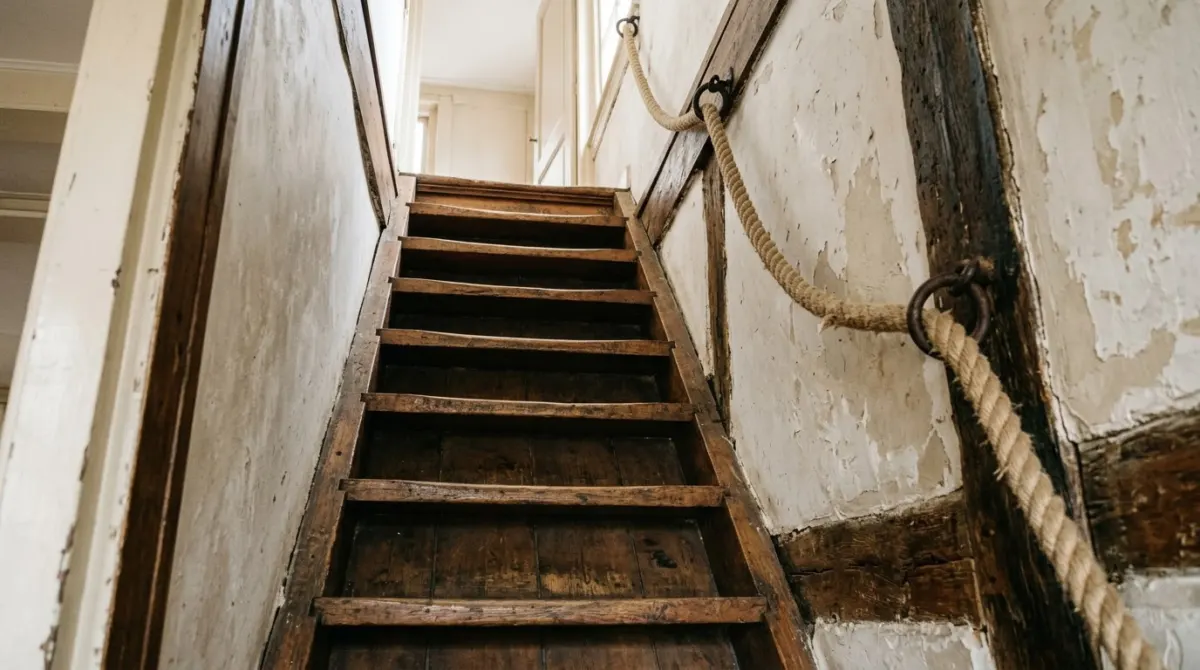
Canal houses were built tall and narrow with extremely steep staircases, often with shallow treads and a rope instead of a bannister. Many have no lift at all, and a room on the third floor means three flights of that.
If you have heavy luggage, mobility issues or small children, this is the single most important thing to check before booking — more important than the district. Modern hotels in Oud-Zuid, Oost and Noord are where lifts are reliable.
Getting around
The centre is walkable end to end in about half an hour, and that is how most visitors get around.
Trams cover the rest and are frequent; the metro is useful for Noord and the south. The free ferries behind Centraal Station cross to Noord in a few minutes.
Schiphol Airport is fifteen to twenty minutes by direct train to Centraal Station, which is one of the best airport links in Europe.
Cycling is how the city moves, and it is not a gentle introduction for inexperienced riders: the lanes are fast, busy and used by people commuting.
How many nights
Two nights covers the main museums and the canals. Three is the right number for a first visit, adding a district and a day without a queue.
Four or more makes Amsterdam a base for Haarlem, Utrecht, the Zaanse Schans windmills and the coast, all within an hour by train.
Our guide to how many days in Amsterdam works through each length.
What the accommodation is actually like
Amsterdam’s building stock shapes the rooms more than the price does.
Canal house conversions are tall, narrow and old. Rooms are small, floors are uneven, staircases are extremely steep and lifts are the exception. In exchange you are sleeping in a seventeenth-century merchant’s house on a canal.
Purpose-built hotels cluster in Oud-Zuid, around the station, in Oost and in Noord. These are where lifts, larger rooms, air conditioning and accessible bathrooms are reliable.
Apartments are common and well regulated, and they suit stays over three nights, although many are in the same canal houses with the same stairs.
Houseboats exist as accommodation and are charming for a night; they are small, they move slightly, and they are not for everyone.
Why Amsterdam is expensive, and what to do about it
The city caps new hotel development and attracts a steady flow of visitors year-round, which keeps supply tight and prices high relative to the rest of the Netherlands.
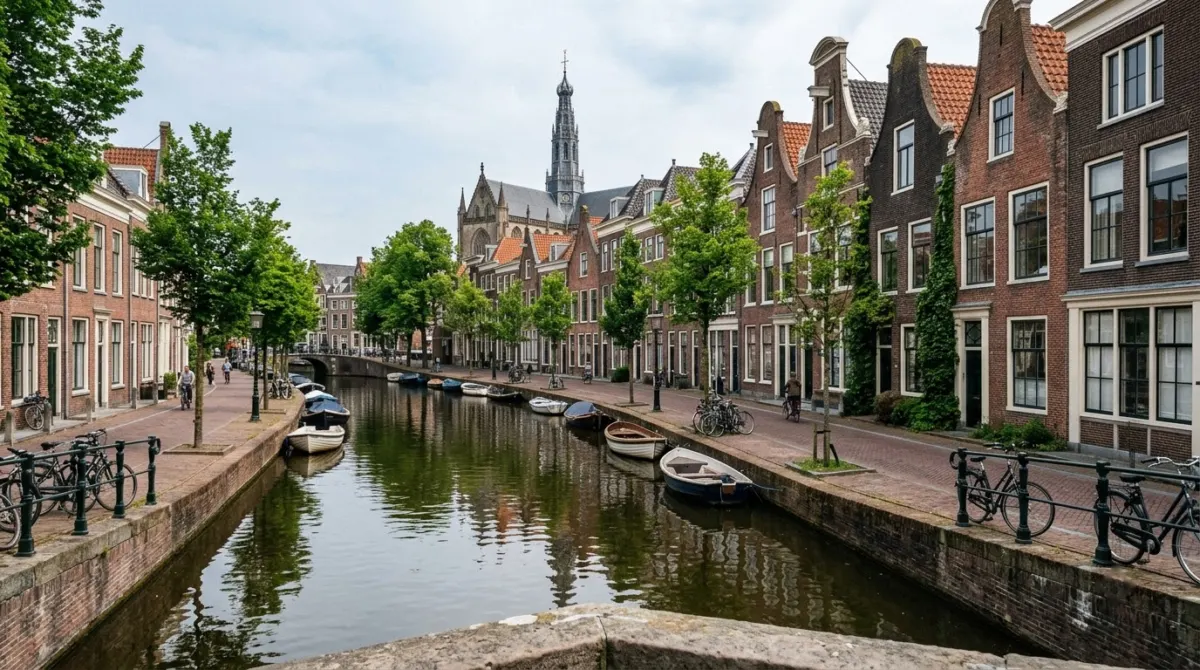
Three ways to work with that. Stay in Noord or Oost, where rooms are newer and cheaper and the centre is ten minutes away. Stay in Haarlem, fifteen minutes by train, which is a genuinely pleasant small city and much cheaper. Or come midweek, since weekends carry a significant premium.
What does not work is booking late. Amsterdam does not have a slack season in the way most cities do.
Tourist tax, VAT and the final bill
Amsterdam’s room rates often look lower on the search page than on the final bill, and the difference is tax.
The tourist tax is 12.5% of the room price, calculated before VAT. It applies to hotels, hostels, bed and breakfasts, apartments, short-stay rentals and campsites alike.
VAT on overnight stays rose from 9% to 21% on 1 January 2026, and the city puts the combined tax on a hotel stay at 33.5%.
Two practical consequences. First, compare rates with taxes included; some listings show the tourist tax as a separate charge paid at the hotel. Second, because the tax is a percentage, it grows with the room price, which strengthens the case for staying in Haarlem or Zaandam, which set their own, separate tourist taxes, if the budget is tight.
The city has said it may raise the tourist tax further if visitor numbers do not fall, so check the rate if you are reserving well ahead.
Apartments and holiday rentals: the rules
Amsterdam regulates short-term rentals more tightly than almost any city in Europe, and the rules affect what you can find.
Every legal rental has a registration number, which must appear in the listing on every rental site. A listing without one is a warning sign.
Private homes can be rented to tourists for a limited number of nights a year — 30 in most of the city, and 15 in several busy neighbourhoods in the centre and De Pijp. The host must live at the address, and no more than four guests may stay at once.
What that means for you. Whole-home rentals are fewer than the demand, are someone’s actual home, and are often unavailable at peak dates. Groups larger than four need two rentals or a hotel. For families, an aparthotel or a hotel with family rooms is more reliable than an apartment.
Bed and breakfasts are licensed separately and are a good middle ground: a local host, a breakfast, and usually a canal house with the stairs that come with it.
Zaandam and Utrecht as cheaper bases
Haarlem is the usual answer to Amsterdam’s prices, but two other bases are worth knowing.
Zaandam is just over ten minutes by direct train to Centraal and about five to Sloterdijk, closer in practice than many addresses inside Amsterdam. The Zaanse Schans windmills are a short trip further up the line, so the windmills are on your doorstep.
Utrecht, about half an hour away, is a real city of its own, with the wharf-level canals, the Dom tower and a university-town evening life. It suits a longer trip where you want two cities from one hotel, and it is the better base if your plans include Rotterdam or the east of the country.
The rule for either: choose a hotel within walking distance of the station, because the commute is quick only from the platform. And check the last train back: NS runs a night network on some main routes, but not on every line.
When the city fills up
Spring, from late March through May, is the busiest period: tulip season brings a surge, and the weather is at its most pleasant.
King’s Day, the national holiday in late April, turns the whole city into a street party and fills every room weeks ahead.
Summer is busy throughout, and December fills for the festive weeks.
The quietest and cheapest weeks are January, February and early November, when the city is cold, dark and considerably more pleasant to walk around.
Getting in from the airport
Schiphol has a railway station beneath the terminal with direct trains to Centraal Station every few minutes, taking fifteen to twenty minutes. It is one of the best airport connections in Europe.
That has a practical consequence for where you stay: anywhere near a tram line from Centraal, or on the metro, is effectively twenty-five minutes from the plane. Staying at the airport makes sense only for very early departures.
Cycling, and whether to
Amsterdam has more bicycles than people and the infrastructure is built around them, which is why visitors are tempted.
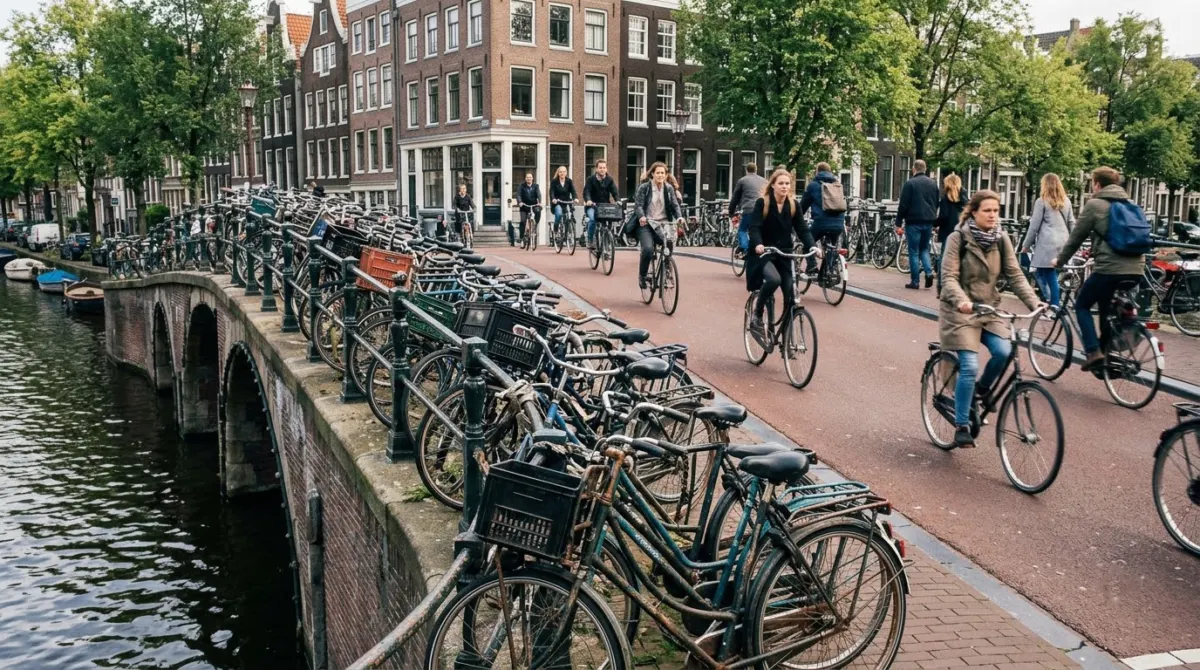
Two honest points. The bike lanes are fast and used for commuting, not for sightseeing, and hesitating in them is genuinely dangerous. And the rules — priority, signalling, where to stop — are followed closely by locals and almost never by visitors.
If you are a confident urban cyclist, it is the best way to see the city. If you are not, the centre is half an hour across on foot and the trams go everywhere else.
The short version
Jordaan or the western canal belt for a first visit, Oud-Zuid for museums and lifts, De Pijp for food, Noord or Oost for value. Avoid the streets immediately around Centraal and De Wallen for sleeping. Check the staircase and whether there is a lift before you check anything else, book early because the city has no slack season, and take the train from Schiphol rather than a taxi.
Check Amsterdam availability →
Frequently asked questions
What is the best area to stay in Amsterdam?
The Jordaan or the western canal belt for a first visit: central, quiet, and the version of the city most people picture. The Museum Quarter suits anyone here for the art, and De Pijp has the best food.
Should I stay near Centraal Station?
Close to it, not in the streets immediately around it. The medieval core and De Wallen are loud until very late and crowded at all hours. The Nieuwmarkt side is five minutes away and much calmer.
Are Amsterdam canal houses difficult?
The staircases are the steepest in Europe and many buildings have no lift, so a third-floor room means three flights of near-ladder stairs. If you have heavy luggage or mobility issues, book a modern hotel in Oud-Zuid, Oost or Noord instead.
Is Amsterdam Noord worth staying in?
Yes, for value and space. Free ferries run from behind Centraal Station every few minutes, day and night, and the crossing takes a few minutes. The buildings are newer, which usually means lifts and larger rooms.
How many nights do you need in Amsterdam?
Two covers the main museums and the canals. Three is better and adds a district. Four or more if you want day trips to Haarlem, Utrecht or the windmills, all under an hour by train.
What is the tourist tax in Amsterdam?
12.5% of the room price before VAT, charged on hotels, hostels, B&Bs, apartments and campsites. Since 1 January 2026 VAT on overnight stays is 21%, so the city puts the total tax on a hotel stay at 33.5%. Check whether the rate you see includes both.
Do I need to book Amsterdam accommodation early?
Yes for spring, particularly the tulip season, and for any weekend. The city has a cap on new hotels and a steady flow of visitors, which keeps supply tight and prices high relative to the rest of the Netherlands.
Keep planning Netherlands
- How Many Days in Amsterdam? Three, and Five as a Base
- 5 Day Amsterdam Itinerary: One Hotel, Three Cities
- Amsterdam in 1 Day: Pick One Thing, Then Walk
- Netherlands Itinerary: Three Bases, or One and a Rail Pass
- 4 Day Amsterdam Itinerary: Three Days In, One Day Out
- 3 Day Amsterdam Itinerary: Two Days In, One Day Out
- Two Day Amsterdam Itinerary: Built Around One Ticket
Written and checked by
Triplarks Editorial
An editorial desk, not an invented persona: research, drafting and fact-checking are done by the same small team. Every number here carries the date it was read.